
Currently Empty: £0.00


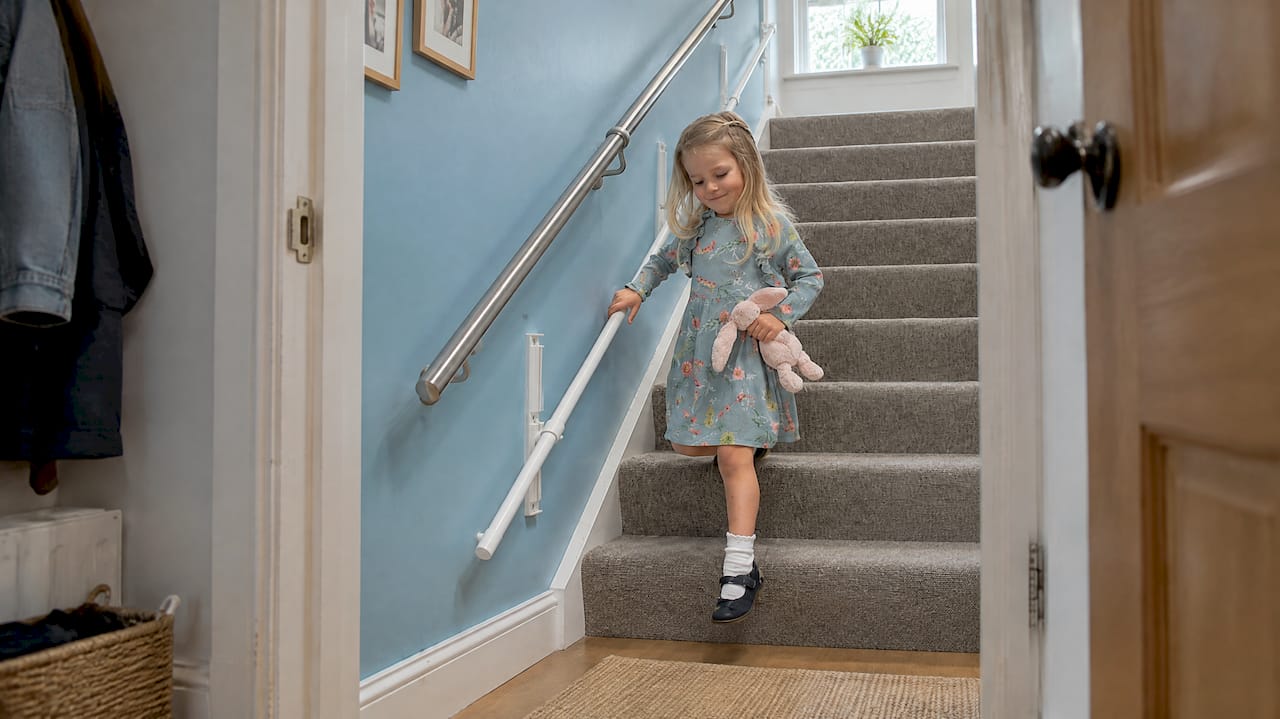
A child handrail costs far less than replacing or adding a full banister. The KiddieRail Extension Pack is £24.99 to £36.99, depending on length. A full-height handrail job in the US typically runs to hundreds of dollars once labour is added. Cheap wooden “loft grab bar” kits can look like the budget option. They are not made for a toddler’s reach, though. The honest comparison is between a rail built for small hands and a rail built for adults that you then try to adapt.
This guide sets out what drives the price, what a sensible budget looks like for a normal UK staircase, and how to read a weight limit. It also covers the checks to make before you buy.
TL;DR
- A child-height rail is a bolt-on product, not a building job. You fit it below your existing handrail, so there is no joiner’s bill.
- Our Extension Pack costs £24.99 to £36.99 and adds length if your staircase is longer than the standard rail.
- Adult handrail projects are priced by material, length and labour. US estimates run from a few hundred to over a thousand dollars, which is why a purpose-made child rail is the cheaper route.
- A stated weight limit only means something if you know what it applies to: the rail, the brackets, the screws and the wall behind them.
- Measure your staircase, check your wall type and add any extension length before you order.
Table of Contents
- What a child handrail costs, and what the price should include
- Why the extension pack matters to your budget
- Child handrail versus a new banister: the real cost comparison
- What the cost doesn’t buy: gates and adult rails
- Weight limits: what the number really tells you
- UK rules to check before you buy
- Before you order: a short checklist
- Our view on what is worth paying for
- Get the right KiddieRail for your stairs
- FAQ
- Sources
What a child handrail costs, and what the price should include
The price you see depends on what type of product it is. Three kinds turn up in searches, and they are not equivalent.
Purpose-made child rails. These fit below the standard handrail and sit at a height a toddler can grip. KiddieRail is this kind of product. The extension packs that lengthen it cost £24.99 to £36.99 each, as published on our extension pack page. The main rail’s price is shown on our shop page, where you can see the current figure for the UK.
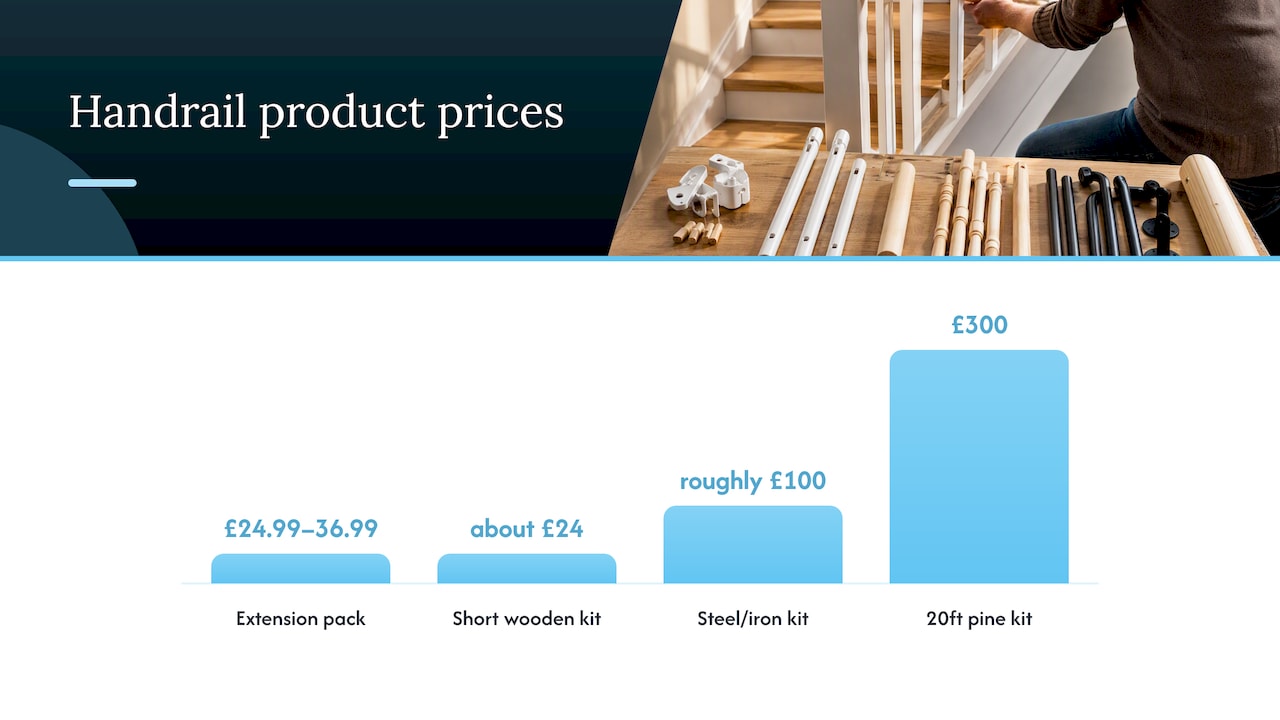
Generic wooden or metal handrail kits. Search results for this topic show full kits for adults and the elderly from about £24 for short wooden lengths. Prices run to roughly £100 for steel or iron-pipe kits and £300 for a 20ft pine kit. These are built for adult grip height. Mounted low for a child, they leave you to work out brackets, spacing and wall fixings yourself.
Professionally installed banisters. This is a different job altogether. You are replacing or adding a structural rail with the cost of labour on top.
What to check is in the price
Two products at the same price can be very different once you open the box. Before you compare, check:
- Fixings. Are the screws and wall plugs included, and are they suited to your wall (plasterboard, brick, or stud)?
- Length covered. Count your wall run in centimetres and compare it to what the rail covers. If it falls short, add the cost of an extension.
- Age range. A rail for children up to about 5 is a different product from a general-purpose grab bar.
- Delivery and returns. Postage can change a £25 product into a £30 one.
- Warranty. Check the term on the product page you are buying from, not on a snippet in search results.
Why the extension pack matters to your budget
Most staircases fit the standard rail. Longer straight runs, wide landings and stairs that turn are where extra length comes in. We sell two extension sizes: an additional 85cm length and an additional 170cm length. Together they sit in the £24.99 to £36.99 range.
A quick way to budget: measure the wall alongside the stairs and any landing in centimetres, subtract what the standard rail covers, and divide the remainder by 85. That tells you whether one pack or two will do the job. Round up rather than down, as a rail that stops one step short of the top leaves a gap exactly where a child is most likely to lose balance.
If your staircase has a landing, our page on fixing stair landing safety gaps explains how the lower rail continues around it.
Child handrail versus a new banister: the real cost comparison
Parents often ask whether they should simply have a joiner fit a lower second rail. It is possible, but the price changes sharply once labour and materials come in.
Because UK price data for this job is thin, we looked at US sources for the pattern, not the numbers. HomeAdvisor reports US stair-railing installation at $500 to $1,300, with an average of $900. Its material prices alone run from $80 to $800 for an 8-foot length and $120 to $1,200 for 12 feet. Bob Vila gives a much wider span of $200 to $10,000 for replacements and says many homeowners spend about $900 for roughly 25 feet. In both cases, material, length and local labour rates drive the total.
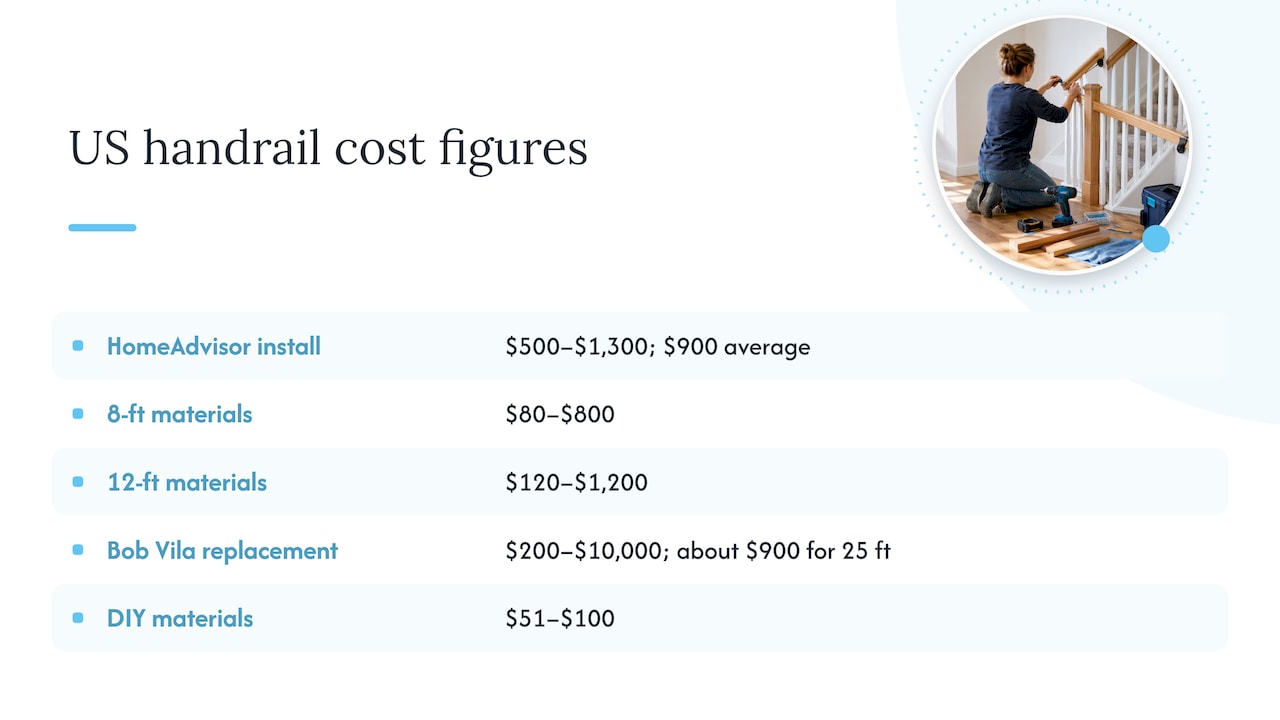
Even the do-it-yourself route is not trivial. Family Handyman’s guide puts a DIY handrail install at $51 to $100 in materials. It lists the rail, brackets, epoxy and a length of 2×4, plus sandpaper, nails, tape and glue. That is a carpentry project, and the end result is still an adult-height rail.
These are American figures in dollars, so treat them as a guide to how the cost behaves, not as a UK quote. The pattern holds in Britain: a bespoke handrail job is priced by length, materials and labour, and it gets more expensive as the staircase gets more complicated. A child rail is a fixed, known-price product that you fit yourself.
If you want to understand how stair length and materials change an installation quote, this guide on stair length and materials walks through the factors, even though it covers decks.
What the cost doesn’t buy: gates and adult rails
A stair gate is cheaper in some cases, but it does a different job. It blocks the stairs, whereas a rail helps a child who is already climbing or descending. Once a child can walk and wants to practise, they need something at the right height to hold. We designed KiddieRail to support children on the stairs, rather than only keep them off.
An adult rail is typically around 900mm to 1000mm above the pitch line of the stairs, which is far above a toddler’s shoulder. The child rail sits below it. Our page on handrail placement for kids explains the 665 to 750mm placement range, and our page on wall mounted child handrails covers adjustment between 600 and 750mm.
Weight limits: what the number really tells you
Searchers often ask about a child handrail’s weight limit. The question is reasonable, but the number on a listing is easy to misread.
A rail is only as strong as its weakest part
A stated limit can refer to the rail alone, one bracket, or the finished installation. For example, one listing in search results says each bracket supports 200kg, and another says a kit can withstand 330 pounds. Neither tells you what happens if the screws are in plasterboard with nothing behind it. That is why the wall matters as much as the rail.
The things that decide real-world strength:
- The rail and bracket material. Metal and solid timber behave differently from plastic or hollow sections.
- The fixings. Screws and plugs must suit the wall.
- The wall itself. Brick or block holds fixings well. Stud walls need the screws to bite into timber, and plasterboard alone is weak.
- Spacing of brackets. More brackets means the load is shared.
- How the load comes. A child falling sideways pulls differently from one leaning on the rail.
What standards say, and what they don’t
For a sense of scale, some building codes set a load figure for adult handrails. For example, Wisconsin’s code requires handrails and guards to withstand a 200-pound load applied in any direction. That is a US state rule for adult rails, not a UK requirement or a standard for child rails. We mention it only to show that a quoted figure should say what direction and what part it refers to.
A child rail is meant for children, not adults. It is a helping hand for small walkers, not a replacement for your main handrail, and nobody should lean their full weight on it. Check the product page for what the maker says about the age range and the tested load, and ask the seller if it doesn’t say.
How to judge whether a stated limit is reliable
- Does it say what the number applies to (rail, bracket or full installation)?
- Does it say how the product was tested, or is it a bare claim?
- Is the number consistent across the seller’s own pages?
- Does the maker say what wall types it suits?
If the answer to most of these is no, the number is marketing, not evidence. For a rail that goes on your staircase, ask for the test detail before you buy. We describe KiddieRail as tested for durability and safety, and our team can answer questions about fitting it to your wall type.
UK rules to check before you buy
The child rail sits under your existing handrail, so the building rules for the main rail and guarding still apply to your stairs. According to HomeBuilding’s guide to Approved Document K:
- Staircases with more than two risers need a handrail on at least one side, and on both sides if the stairs are wider than one metre.
- Guarding for stairs must be at least 900mm high, and at least 1100mm for landings or balconies.
- Gaps in stair guarding must be small enough to stop a 100mm sphere passing through.
Those rules protect against falls from the stair, whereas a child rail helps a child keep balance on it. Check your gaps and guard heights first, then add the rail. If you rent, our advice on rental stairs childproofing covers what a tenant can do.
Before you order: a short checklist
- Measure the wall length beside the stairs and any landing, in centimetres.
- Identify the wall: brick, stud or plasterboard. Our guide to a handrail backing board explains how to add solid fixing behind thin walls, with 85cm and 170cm options.
- Decide whether you need an extension pack.
- Check which side your adult handrail is on and where the child rail will sit below it.
- Check delivery cost, returns and warranty on the page where you buy.
Childminders and nurseries have their own points to consider. See our pages for childminder stair safety and daycare stair handrails.
Our view on what is worth paying for
We build one product, so here is how we think about value.
The cheapest rail is rarely the cheapest outcome. A wooden bar fitted at the wrong height does not help a toddler, and the money is wasted. A professional job is the right call if you are replacing the main banister anyway, but it is a lot to spend to give a three-year-old something to hold.
The product we make is adjustable, so the same rail serves from the first steps until about age five. You change the height as your child grows instead of buying again. It fits below a standard handrail and suits any home staircase layout, with extension packs for longer runs. You can fit it yourself without hiring a tradesperson.
We would also say this: the rail does not replace supervision. Stairs remain a place where small children need an adult nearby, whatever you fit. Our advice on child safety on stairs covers the habits that matter alongside the hardware.
— Paul
Get the right KiddieRail for your stairs
If you have measured up and want to go ahead, start with the KiddieRail Adjustable Child Stair Handrail. It fits below your existing handrail at a height suited to young children.
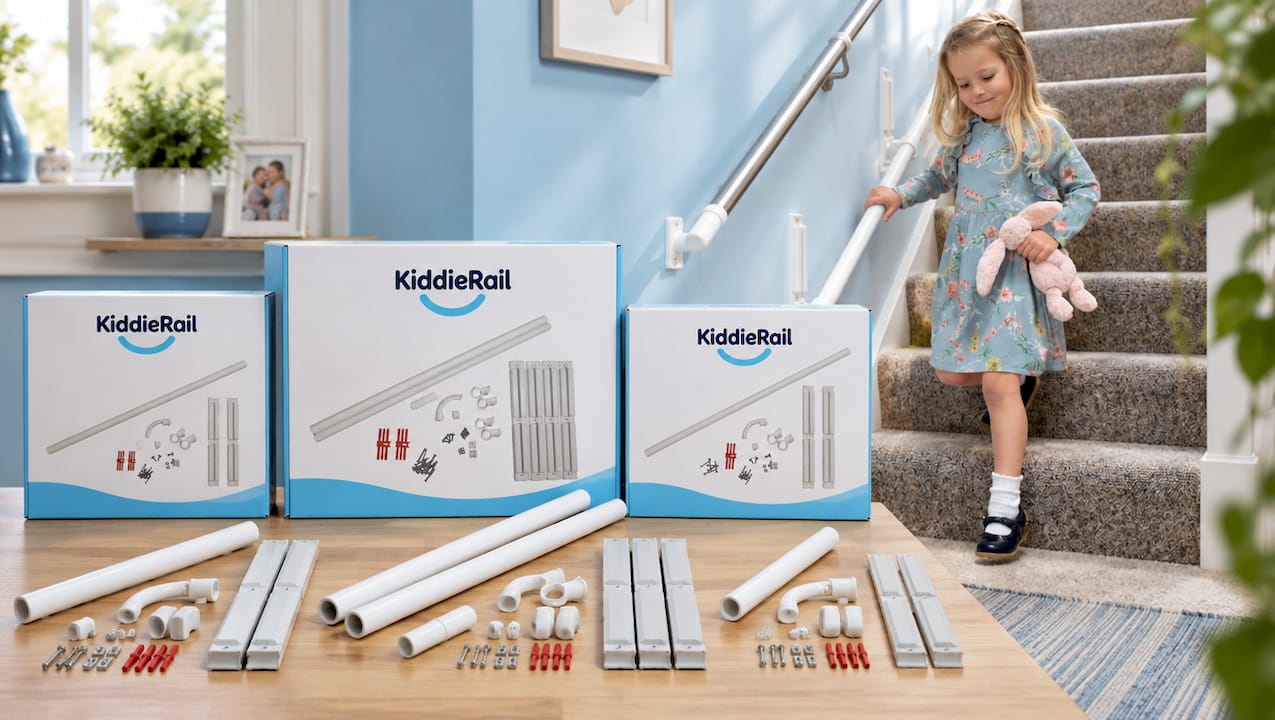
If your staircase is long or turns a corner, add an extension pack, priced from £24.99 to £36.99 depending on length.
FAQ
How much does a child stair handrail cost?
It depends on the type. Our extension packs cost £24.99 to £36.99, and the main rail’s price is on our shop page. Generic adult handrail kits range from around £24 to £300 depending on length and material, and a professionally fitted banister costs more once labour is added.
What is the standard handrail height for stairs in the UK?
The main handrail is commonly set at 900mm to 1000mm above the pitch line, and stair guarding must be at least 900mm high under Approved Document K. A child rail is a second, lower rail beneath it. It does not replace the main one.
What weight limit should a child handrail have?
There is no single correct number, because the limit depends on the rail, the brackets, the fixings and the wall. Look for a figure that says what it applies to and how it was tested. A rail for small children is not designed for adults to lean on.
Do I need a professional to fit a child handrail?
Not for KiddieRail, which is designed for straightforward self-installation. If your wall is thin plasterboard, add a backing board first so the screws have something solid to bite into.
Sources
- HomeAdvisor: What do stair railings cost to install?
- Bob Vila: How much does it cost to replace stair railings?
- Family Handyman: Install a new stair handrail
- Wisconsin Legislature: SPS 321.04(3)©1.a.
- HomeBuilding: What is Approved Document K?


