
Currently Empty: £0.00


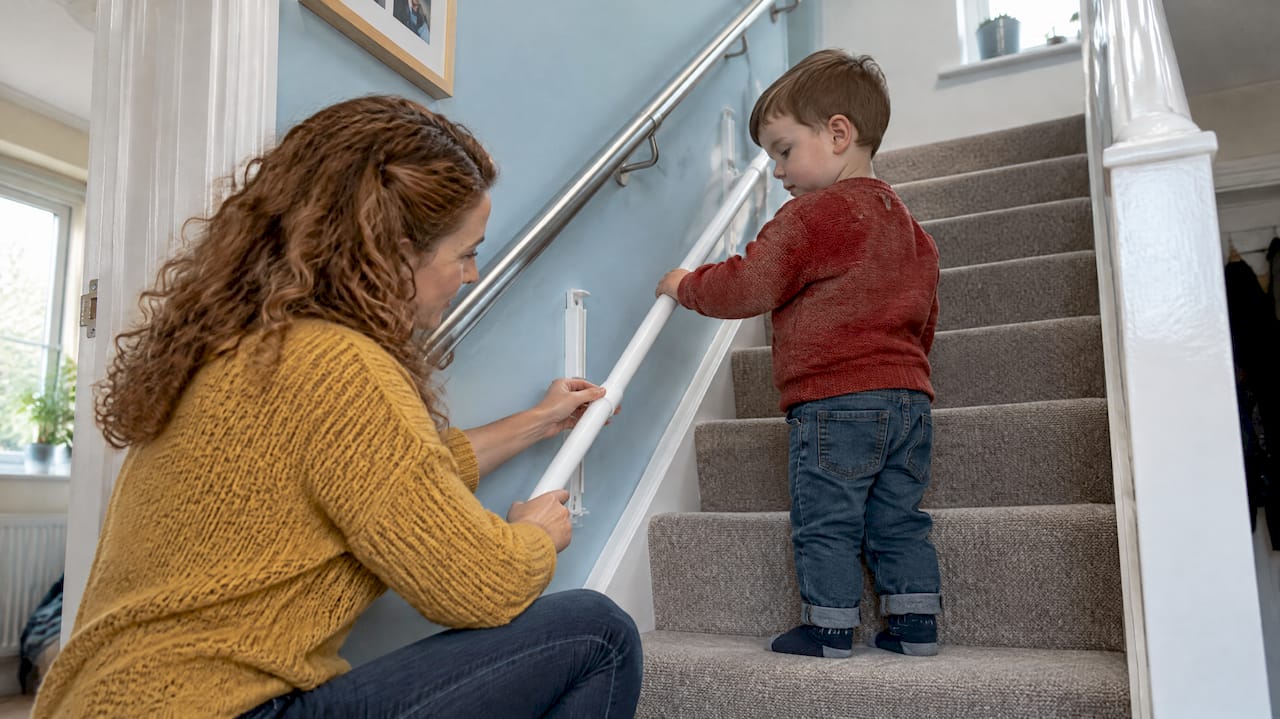
The simplest way to help a toddler on the stairs is a second, lower handrail they can actually reach, fixed below your standard rail. UK guidance for children’s settings points to extra rails at roughly 500–600 mm above the stair nosing, and the main choices are a purpose-made adjustable rail, a wall-mounted rail or a home-built one. This guide covers the heights, the options, the grip and gap details, and how to fit one without risking a wobbly rail that fails when a child leans on it.
TL;DR
- A standard adult handrail is out of reach for a toddler, so add a second rail lower down rather than relying on gates alone.
- UK guidance for childcare settings suggests child rails at about 500–600 mm above the nosing; other countries quote 600–750 mm, so pick a rail you can adjust as your child grows.
- Choose a rounded profile of about 40–45 mm that a small hand can wrap around, and leave a 60–75 mm gap to the wall.
- Fix into solid wall or a backing board, never into plaster alone, and keep gates at the top and bottom for babies and young toddlers.
- An adjustable, tool-simple system such as KiddieRail saves you building and re-building as your child grows.
Table of Contents
- Why a toddler needs their own handrail
- What height should a toddler handrail be?
- Toddler handrail ideas that work at home
- Grip, gap and finish: what to check on any rail
- Fitting a lower rail securely
- Perspective
- Other stair-safety measures to use alongside a rail
- Childminders and shared homes
- Add a KiddieRail to your stairs
- FAQ
- Sources
Why a toddler needs their own handrail
A standard handrail sits at adult shoulder-to-hip height. For a child who has just learnt to climb, it is above their head or at best at arm’s stretch, so they grab the spindles, the wall or your hand instead. A rail at their own height gives them something to hold that matches how they move: low, close and frequent.
The official UK guide to creating accessible childcare settings recommends additional lower handrails for young children. It adds that in existing settings, rails at appropriate heights for both adults and children are good practice, provided they do not restrict access. The same thinking applies at home: you are not replacing the adult rail, you are adding to it.
A lower rail also supports the habit you want to build. Children who learn to hold on every time they use the stairs carry that habit when they are bigger and faster.
What height should a toddler handrail be?
There is no single number, because children vary and different bodies publish different figures. Here is what the checked sources say.
| Source | Recommended child rail height | Context |
|---|---|---|
| UK guide to accessible childcare settings (2011) | About 500–600 mm, with adult rails at 900–1000 mm above the nosing | Childcare settings, United Kingdom |
| UN accessibility design manual | 0.60 m for a third rail for children and short people | International guidance |
| US Access Board (2016) | No higher than 28 in (710 mm) above stair nosings | Facilities primarily serving children, United States |
| Australian National Construction Code | Between 665 mm and 750 mm | Second handrail in primary schools, Australia |
| CBM guidance (2015) | 70 cm, with the main rail at 90 cm | Second rail for children and people of short stature |
Read together, the figures cluster between roughly 500 and 750 mm measured from the stair nosing, the front edge of each tread. A one-and-a-half-year-old will sit at the bottom of that range, while a four- or five-year-old will want the top. That spread is the main argument for a rail whose height you can change, rather than one fixed to suit a single birthday.
A practical way to find the right height for your own child: have them stand on a stair, let their arm hang relaxed, then bend the elbow slightly. The rail should sit around the height of their hand in that position. Mark it with masking tape, watch them climb, and adjust.
For more detail on how these heights play out on British staircases, see our guide to handrail height for kids on UK stairs.
Toddler handrail ideas that work at home
An adjustable child handrail system
This is the option designed for the job. KiddieRail is an adjustable stair handrail made for young children, fitting below a standard handrail and suited to any home staircase layout. Because the height can be changed, the same rail serves a new walker and a confident pre-schooler. Extension packs add length for longer flights or corners. You can see the range in our shop.
A wall-mounted child rail
If your staircase has a solid wall on one side, a wall-mounted rail is the neatest way to go. It keeps the rail close to the wall and leaves the stair width clear. Our page on wall-mounted child handrails explains how adjustable 600–750 mm positions suit UK stairs.
A second rail beside the existing banister
Where you have a banister and spindles, a child-height rail can sit below the existing handrail. A long-standing piece of DIY advice is to place the second rail about halfway between the adult rail and the stair. This is a rule of thumb rather than a standard, so check the result against the heights above and against your child.
A home-built wooden or pipe rail
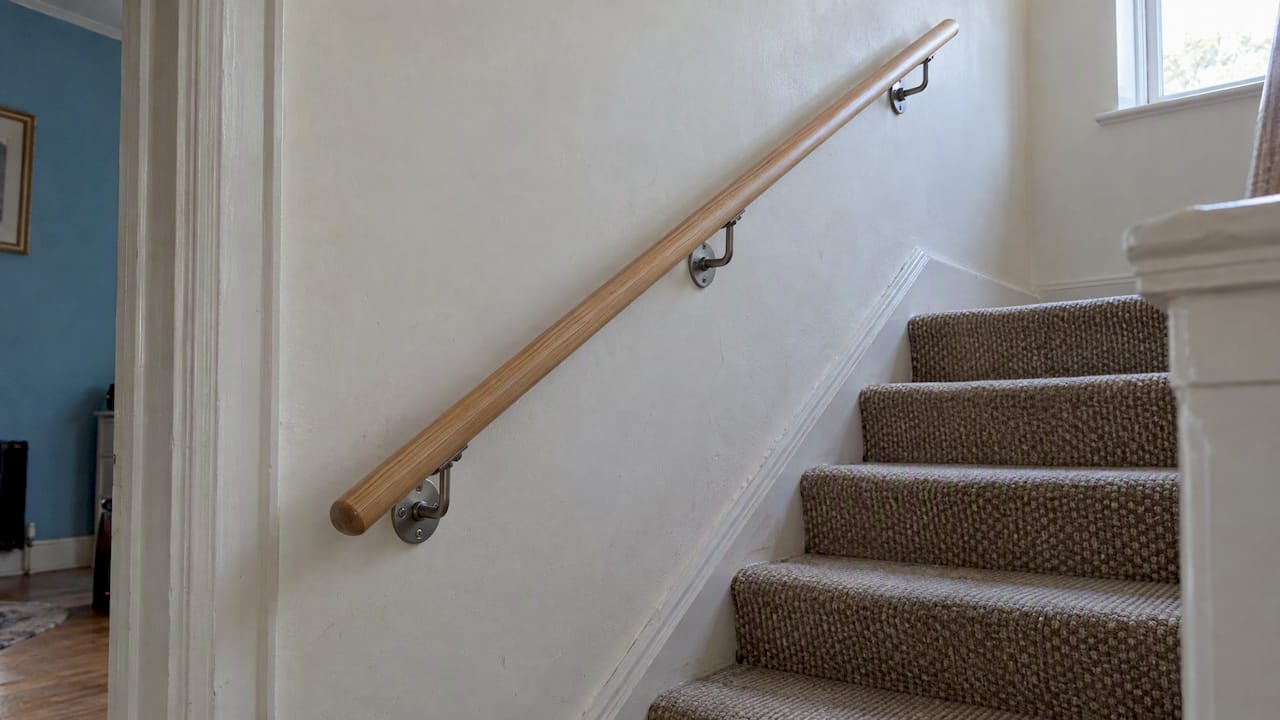
Many parents make their own from a length of dowel, timber or pipe on wall brackets. It is cheap and can look good, but you carry the responsibility for the grip size, the bracket strength and the fixings. If you go this way, use the grip and gap measurements below, and read our notes on handrail materials for kids.
Leave it in place afterwards
A tidy, unobtrusive second rail does not have to come down when children grow up. It still helps small visitors, grandparents who prefer a second hold and, for a future sale, it is a small plus rather than a problem.
Grip, gap and finish: what to check on any rail
A toddler’s hand is small and their grip is still developing, so the profile matters as much as the height.
- Diameter. The UK childcare guide recommends handrail profiles of 40–45 mm for a good grip. CBM suggests a cylindrical shape of 40–50 mm to help grasping. Very thin rails are harder for a small hand to hold securely.
- Gap to the wall. The same UK guide recommends 60–75 mm between a wall-mounted rail and the wall. That leaves room for fingers to wrap around without trapping them or scraping knuckles.
- Surfaces. Avoid hard-edged corners and rough textures on rails, fixtures and flooring. Run your palm along the whole length before you let a child use it.
- Continuity. A rail that runs the full flight without breaks lets a child keep hold from bottom to top. Where a flight turns, an extension pack or a corner-friendly fixing avoids a gap in the middle of the climb.
- Entrapment. If your child rail sits below an adult rail, the space between them should not form a trap. The US Access Board advises a 9-inch (230 mm) minimum vertical clearance between upper and lower rails to prevent entrapment. Treat that as a sensible benchmark for homes too.
Fitting a lower rail securely
A child will hang their full weight on a rail without a thought, so the fixing is where a DIY job succeeds or fails.
- Find what is behind the wall. Use a stud and pipe detector. Plasterboard alone will not hold a child’s weight, and you do not want to drill into cables or pipes.
- Plan the fixings. Mark bracket positions into studs, masonry or a timber backing board. Our guide to a handrail backing board shows how to pick lengths such as 85 cm or 170 cm and fix it first, so the rail sits on solid timber.
- Set the height. Measure up from the nosing line, not from the floor, because stairs rise at an angle. Use a long spirit level or a straight batten laid along the nosings as a guide.
- Fix and test. Tighten all brackets, then pull down and sideways on the rail with your full weight before your child touches it.
- Re-check regularly. Rails loosen. Test them every few weeks, particularly after the height is changed.
If your home is a listed building, rented, or has an unusual staircase, check with your landlord or an experienced joiner before drilling. If you are building, refurbishing or adapting a childcare setting, the UK guide recommends using professionals who know Approved Document M.
Perspective
We designed KiddieRail around one simple observation: families buy a gate for the stairs, then discover the child still has nothing to hold once the gate is open. A gate stops a child going up or down at the wrong moment. A rail at the right height helps them go up and down well.
That is why we made ours adjustable. A rail screwed in at one height is right for a few months and wrong after that, and parents end up drilling new holes. A rail you can raise as your child grows is a one-off job, and the extension packs mean it fits long flights and corners, not only a tidy straight run.
We also think a handrail changes how children behave. Once they have a rail that fits their hand, they reach for it naturally, and that habit is worth far more than any amount of reminding from you on the stairs.
Paul
Other stair-safety measures to use alongside a rail
A toddler handrail supports a child who is already walking. It does not replace the other layers of protection, especially for babies and the youngest toddlers.
- Gates. NI Direct advises that for children up to 24 months you fit compliant safety gates at both ends of the stairs, with a screw-fixed gate at the top and a pressure-mounted gate only at the bottom. Our guide on pairing gates and teaching walks you through the routine.
- Light and clutter. The same source advises keeping stairs well lit and free of clutter, and discouraging children from playing or running on them. Our page on stair clutter and toddler safety covers what to clear first.
- Guarding gaps. Building guidance for buildings likely to be used by children under 5 says that openings in guarding should not let a 100 mm sphere pass through, and that horizontal rails, which a child can climb, should be avoided. That is Welsh guidance for buildings, but it is a useful yardstick for your own landing and banisters.
- Soft surfaces nearby. Loose rugs at the foot of the stairs are a slip risk of their own. These quick nursery rug safety checks are worth running over the hall and landing.
- Starting early. If your baby is not yet moving, our guide to babyproofing stairs before crawling starts helps you get ahead.
- Flats and rentals. For flats and short-term lets, see our tips for apartment stairs and for a permanent lower rail on rental stairs.
Childminders and shared homes
If you mind other people’s children, the stairs are used by several ages at once, and the rail must work for adults carrying a child as well as for the child. The UK childcare guide supports rails at appropriate heights for adults and children in existing settings, provided access is not restricted, and quotes adult rails at 900–1000 mm with additional child rails at about 500–600 mm.
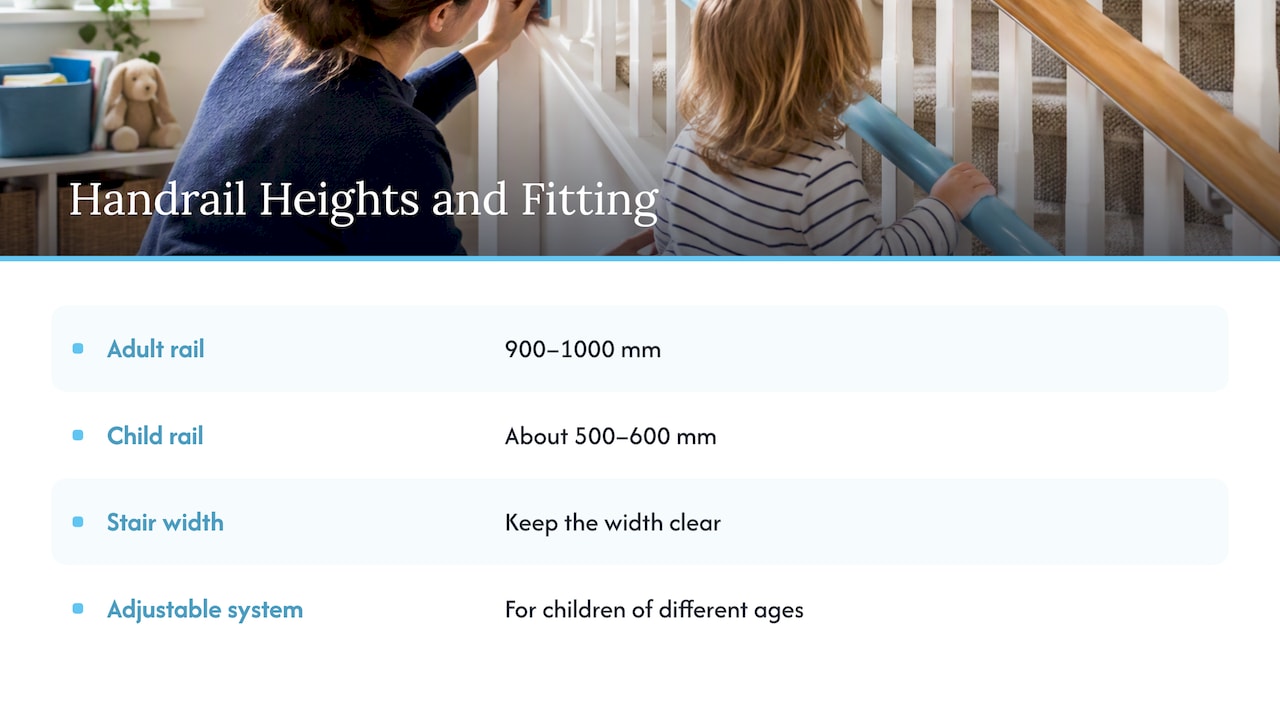
So keep the existing adult rail, add the child rail below, and keep the stair width clear. An adjustable system helps because children of different ages use the same flight. For more, read our guide to stair handrails for childminders and daycare settings. Check your own inspection body’s requirements too.
Add a KiddieRail to your stairs
If you would rather not design, cut and test your own rail, KiddieRail is made for this job. It is an adjustable child stair handrail that fits below your standard handrail, is designed to grow with your child, has been tested for durability and suits any home staircase. Installation is designed to be straightforward for a confident DIYer.
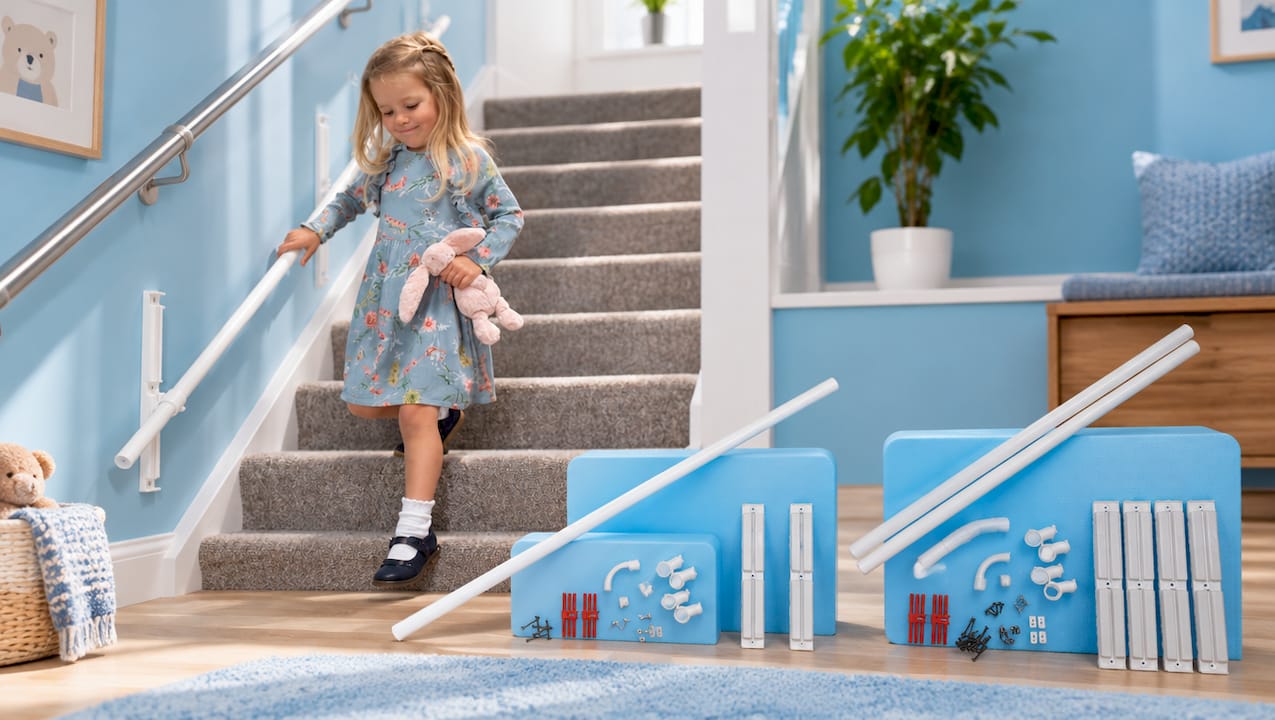
Start with the KiddieRail Adjustable Child Stair Handrail. For longer flights or corners, the extension packs cost £24.99–£36.99 as a one-off, depending on whether you choose the additional 85 cm or 170 cm length. You can also browse the whole range from our home page.
FAQ
What height should a toddler handrail be?
UK guidance for childcare settings suggests additional child rails at about 500–600 mm above the stair nosing. Other bodies quote figures up to 710–750 mm for older children. Because your child will grow, an adjustable rail lets you start low and raise it over time.
Can I fit a toddler handrail to a banister with spindles?
Yes, in many homes a second rail can be fitted below the existing banister, provided it is fixed to something solid and does not create a gap a child could get trapped in. Keep a clearance of around 230 mm between rails as a benchmark. If you are unsure about the structure, ask a joiner to check it.
Do I still need stair gates if I have a child handrail?
For babies and toddlers up to 24 months, yes. NI Direct advises gates at both ends of the stairs, screw-fixed at the top and pressure-mounted only at the bottom. A rail helps a walking child on the stairs, while a gate stops unsupervised access.
What size should the rail be for small hands?
Aim for a rounded profile of 40–45 mm, as recommended in the UK childcare guide, with a 60–75 mm gap to the wall. Avoid sharp edges and rough finishes.
Sources
- H – Creating accessible childcare settings (UK guide, 2011)
- Accessibility Design Manual, United Nations
- Stairways, US Access Board
- D3D22 Handrails, Australian Building Codes Board
- Handrail, CBM
- Guarding children against trips and falls, nidirect
- Building regulations guidance Part K, Welsh Government
- How do I install a handrail for stairs?, DIY Stack Exchange
- Nursery rug safety tests


