
Currently Empty: £0.00


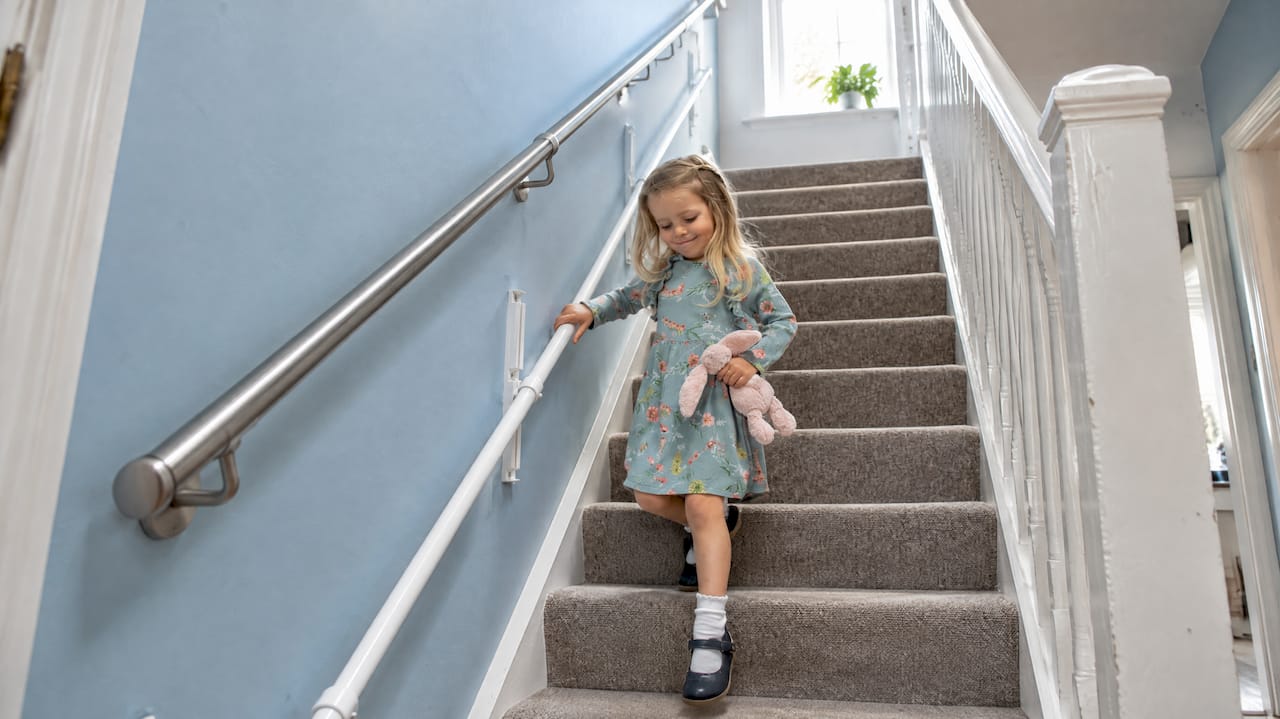
A child-height, adjustable wall mounted handrail is the single most practical addition we recommend for stair safety while toddlers are learning to walk. We recommend a child-height adjustable handrail that fits within the 600 to 750mm range suitable for most young children, and this guide covers materials, lengths, measuring and fitting so you can choose with confidence — including advice on UK staircase regulations, dimensions and checklist.
TL;DR:
- Mount child rails 610–710 mm above stair tread noses, leave at least 230 mm of vertical clearance below adult rails, and use rounded, returned ends.
- Choose a narrow, rounded, lightly textured profile that a child can fully grip; wipeable coatings clean easily, while wood needs periodic resealing or oiling.
- Measure the full rail run along the stair line before ordering; extension sections cover longer flights, but winding or spiral stairs are unsuitable.
- A straight flight typically takes under an hour to fit, but plasterboard brackets must anchor into studs or a backing board, never the board alone.
- Keep stair gates at the top and bottom and supervise toddlers; a rail at a child’s height adds support but does not replace either safeguard.
Table of Contents
- Why a child-height handrail actually helps
- Materials and grip: choosing the right finish and profile for small hands
- Lengths, modularity and extension options for your stair layout
- Measuring and mounting: practical checks before you buy
- Basic installation overview: tools, time and mounting methods
- Safety features and standards to check
- Maintenance, durability and extension pack considerations
- Why KiddieRail fits the brief
- Pairing a handrail with a gate and supervision
- KiddieRail product options and how to order
- FAQ
- Sources
Why a child-height handrail actually helps
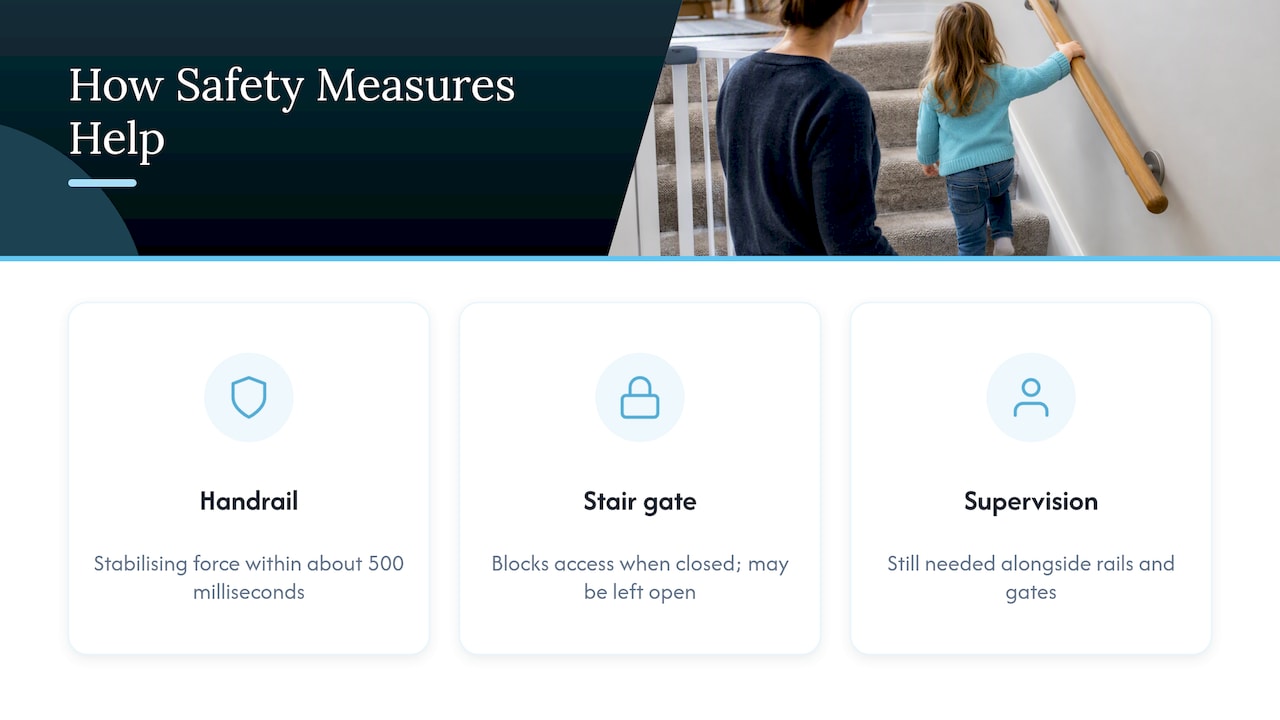
When a toddler loses their footing on stairs, the window to recover balance is short. Evidence submitted to the UK government’s review of stair safety guidance discusses how well-placed, graspable handrails let a person generate stabilising force within about 500 milliseconds of first contact, which matters when a standard adult rail sits well above a small child’s natural reach.
A lower rail gives a child something to grip the moment they feel unsteady, rather than forcing them to reach upward and overbalance further. International evidence reviews on childhood falls recommend barriers and railings as part of effective strategies to reduce home injuries, placing handrails alongside gates and guards rather than as a replacement for either.
That distinction is worth sitting with. A stair gate blocks access when closed, but gates get left open, especially once children start asking to use the stairs themselves. A handrail positioned at the right height is there every time, whether the gate is open, broken, or simply forgotten. It does not replace active supervision or a gate at the top and bottom of a flight. It fills the gap that exists whenever a child is on the stairs with an adult, learning to climb and descend under their own steam, which is exactly when a graspable, correctly placed rail earns its place.
Materials and grip: choosing the right finish and profile for small hands
Small hands grip differently from adult hands. A rail that feels secure to a parent can still be too wide, too cold or too slippery for a toddler’s fingers to close around properly, so the material and profile matter as much as the height.
- Solid wood feels warm to the touch and ages well, but needs periodic resealing or oiling to stop the grain roughening.
- Coated metal resists wear and stays rigid over long runs, though an uncoated or poorly finished metal rail can feel cold in winter.
- Plastic or coated grip profiles balance warmth and low maintenance, and are easy to wipe clean, which matters for a surface small hands touch daily.
Look for a rounded profile with a diameter small hands can close around fully, generally narrower than a standard adult handrail, with a non-slip or lightly textured finish rather than a glossy one. A rail that is too wide forces a child to splay their fingers rather than grip, which defeats the purpose during a stumble.
Pro Tip: Run your own hand around the rail profile with your fingers curled as a child’s would be; if you can’t close your grip comfortably, it’s too wide for most toddlers.
Cleaning is a minor but real consideration in busy households. A wipeable coated finish handles sticky fingers and daily contact better than raw wood, which can hold marks and needs a gentler cleaning routine to avoid damaging the sealant.
Lengths, modularity and extension options for your stair layout
Most stairs are not a single uniform flight, so measuring before you buy saves a return. Start by measuring the total run you want covered, from the top step to the bottom, along the line the rail will follow rather than a straight horizontal measurement.
- A base unit suits a single straight flight and is the right starting point for most standard UK staircases.
- Extension packs make sense once your run exceeds the base length, whether that’s a longer flight or a staircase with a half landing.
- Intermediate landings and short returns need a plan for how sections meet, since a rail that stops short of a landing edge leaves a gap exactly where a child might reach for support.
For longer runs, modular systems that join extension sections to a base rail avoid the cost and waste of ordering an oversized single piece. This also means a growing child’s needs, or a change of staircase in a new home, can be met by adding a section rather than replacing the whole rail.
Measuring and mounting: practical checks before you buy
Getting the height right is the single most important measurement, and it’s one you can check before ordering anything. Guidance from the US Access Board on child-specific handrails recommends a mounting height of 610 to 710mm, with at least 230mm of vertical clearance between an adult rail and a child rail to prevent small heads or limbs becoming trapped between the two.
- Measure from the nose of each stair tread (the front edge) up to your target height, checking at several points along the flight since treads and rail lines are rarely perfectly uniform.
- Check the sightline: stand your child, or a child of similar height, next to the stairs and confirm the rail sits roughly level with their hip or lower ribcage rather than their shoulder.
- Measure the gap between where the child rail would sit and the underside of any existing adult handrail, confirming at least 230mm of clearance.
- Note any obstructions along the planned run, including skirting boards, radiators, or balustrade posts that interrupt a straight fixing line.
Pro Tip: If your staircase has unusually deep skirting or a radiator partway down the flight, measure the clearance around that obstacle first, since it often dictates where brackets can actually sit rather than the overall rail length.
Unusual balustrade posts or newel posts can also break up a straight run. In these cases, a modular rail that can be cut or joined around a post, rather than a single rigid length, is easier to fit without compromising the mounting height along the whole flight.
Basic installation overview: tools, time and mounting methods
A straight flight typically takes under an hour to fit once you have the right tools and a confirmed height. You’ll generally need a drill, a spirit level, a pencil, a tape measure and the fixings supplied with the rail, plus a stud finder if you’re mounting on plasterboard.
- Solid walls take a direct fix with wall plugs and screws rated for the bracket spacing specified by the product.
- Plasterboard walls usually need a backing board or fixing into the underlying studs, since plasterboard alone won’t hold the load of a rail under repeated grip and pull.
- Every bracket should be checked with a level before final tightening, since even a slight slope along the run changes the usable grip height at either end.
Before fixing anything, confirm you’re drilling into a solid structure rather than a cavity, and check for pipes or cables if you’re working near a stud wall. If your stairs involve more than one flight, a winding section, or you’re unsure what’s behind the wall, it’s worth calling a tradesperson rather than guessing, since a poorly anchored rail under a child’s full body weight during a fall is worse than no rail at all.
Safety features and standards to check
A handrail that looks right is not automatically safe. A few specifications are worth confirming before you buy.
- Mounting height of 610 to 710mm, per the Access Board’s child handrail guidance.
- At least 230mm vertical clearance between the child rail and any adult rail above it, from the same guidance.
- Rounded, returned ends that curve back towards the wall rather than projecting outward, reducing the risk of snagging clothing or catching a child during a fall.
- Secure, closely spaced brackets rated for repeated pulling and leaning force, not just static weight.
A multicentre case-control study published in Archives of Disease in Childhood found that not having handrails on all stairs, and leaving stair gates open, were both associated with higher odds of a child falling, and the authors estimated that keeping gates in use and stairs in good repair could prevent a meaningful share of these injuries. That finding lines up with the Access Board’s clearance rule: the point of the 230mm gap is specifically to stop a child’s head or arm becoming wedged between two rails at different heights.
Before fitting, check that the rail profile itself isn’t climbable, meaning no horizontal ledges or wide gaps a determined toddler could use as a foothold, since a rail intended to support walking shouldn’t double as a climbing frame.
Maintenance, durability and extension pack considerations
A handrail needs occasional attention to stay as safe as the day it was fitted. Check fixings every few months, since repeated gripping and leaning can work screws loose over time, particularly on stud-wall installations.
- Inspect the finish for cracking, splintering or peeling coating, especially on wood, which can roughen with repeated contact.
- Check brackets for corrosion if your stairwell is near an entrance exposed to damp or changing temperatures.
- When joining extension sections, confirm the join sits flush and doesn’t create a lip or gap a small hand could catch on.
A rail that wobbles under light pressure, shows visible cracking at a joint, or has a bracket pulling away from the wall needs attention immediately rather than at the next convenient moment, since these are the failure points most likely to matter during an actual stumble.
Why KiddieRail fits the brief
We developed an adjustable lower handrail that fits below a standard adult rail, giving children their own rail at a height they can actually use rather than one sized for adults. Our tested placement guidance sits within the 600 to 750mm range that matches the clearance and height principles set out by the Access Board, and we publish dedicated measuring and fitting guidance for parents and childminders working out exact positioning on their own stairs.
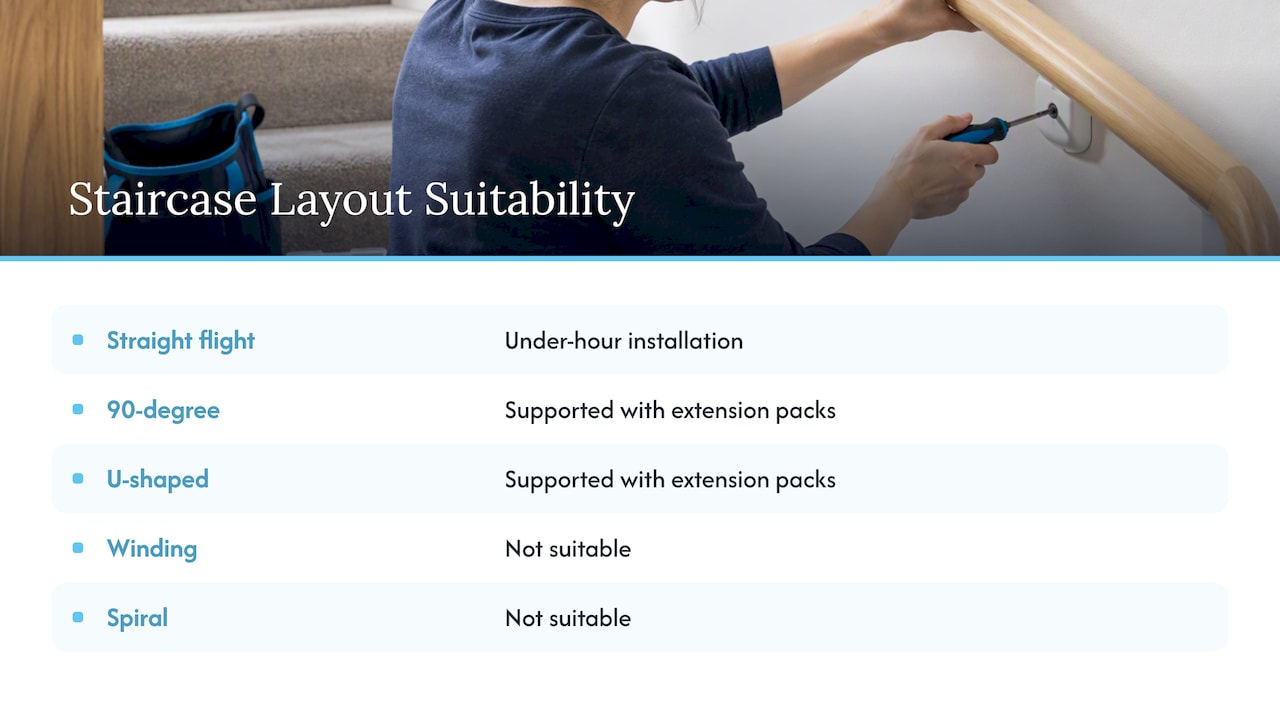
The pack is designed to install in under an hour on a straight flight, and supports extension packs so the rail can grow to cover longer runs or multi-section staircases, including standard, 90-degree and U-shaped layouts. It is not suitable for winding or spiral staircases, where the changing tread angle makes a straight modular rail impractical to fit safely.
Pairing a handrail with a gate and supervision
In our view, a child handrail works best as a permanent layer of support rather than a one-off purchase you tick off a safety list. Gates get propped open, forgotten, or outgrown faster than most parents expect, and a rail positioned at the right height is one of the few safety measures that keeps working regardless of whether anyone remembers to close anything.
Our practical advice is to measure your stairs properly before buying anything, fit a rail at child height, keep a gate at the top and bottom while your child is small, and never treat either as a substitute for watching a toddler on stairs.
— Paul
KiddieRail product options and how to order
Choosing the right setup comes down to measuring your stairs and matching the length to your flight, rather than guessing at a standard size.
- The KiddieRail Adjustable Child Stair Handrail is the base unit, suited to a single straight flight and the starting point for most homes.
- The KiddieRail Extension Pack (85cm/33.4 inch) adds length for a slightly longer run or a short landing section, priced at £24.99 to £36.99 one-off depending on the option selected.
- The KiddieRail Extension Pack (170cm/66.9 inch) suits longer flights or multi-section stairs needing a larger combined length, also priced at £24.99 to £36.99 one-off.

Before ordering, measure your total run, confirm your target height sits between 600 and 750mm, decide on a finish that suits your household, and check whether your wall is solid or plasterboard so you order the right fixings. Browse the full range of adjustable handrails and extension packs to find the combination that matches your staircase, or head straight to the accessories category if you already own a base unit and need an extension.
FAQ
What height should a child’s handrail be mounted at?
Child handrails should generally sit between 610 and 710mm from the stair tread nose, measured at a height a young child can comfortably reach and grip. Always leave at least 230mm of vertical clearance below any existing adult handrail to avoid a trapping gap.
How long does it take to install a wall mounted child handrail?
A straight flight typically takes under an hour to fit with basic tools, a confirmed mounting height, and the correct fixings for your wall type. Multi-flight staircases or plasterboard walls needing a backing board may take longer, and uncertain wall substrates are best handled by a tradesperson.
Can a child handrail be extended for longer staircases?
Yes, modular systems allow a base rail to be lengthened with extension packs rather than replacing the entire unit, which suits longer flights or stairs with a landing. Measure your full run first so you know whether one extension pack or two will cover the distance.
Does a child handrail work on plasterboard walls?
Child handrails can be fitted to plasterboard, but the brackets generally need to anchor into the wall studs or use a backing board rather than relying on plasterboard alone. A stud finder helps confirm fixing points before drilling.
Is a handrail enough on its own, or do I still need a stair gate?
A handrail is a helpful constant support but doesn’t replace a stair gate or active supervision, particularly for very young children. Evidence from a case-control study on childhood stair falls links the absence of handrails and open or missing stair gates with higher odds of injury, which supports using both together.
Sources
- Evidence to support potential changes to Approved Document K guidance on domestic stairs
- Risk and protective factors for falls on stairs in young children: multicentre case–control study (Arch Dis Child)
- World report on child injury prevention – falls (NCBI Bookshelf)


