
Currently Empty: £0.00


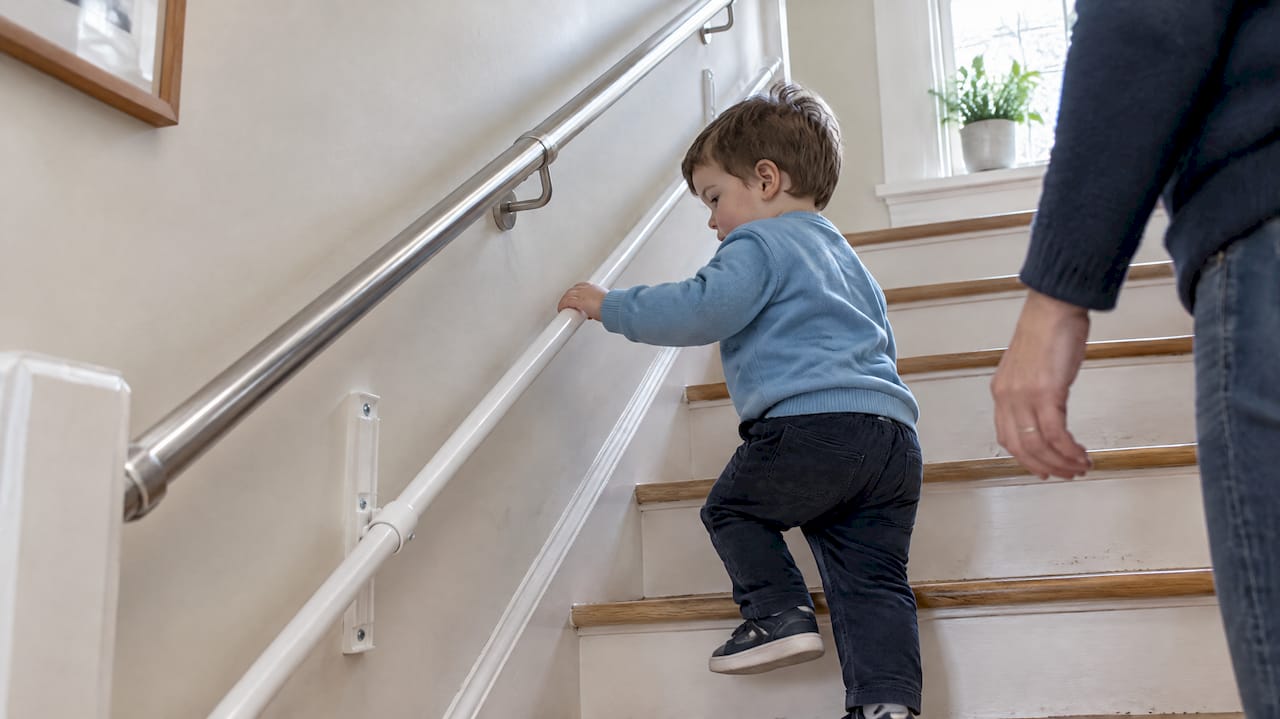
The right solution for stair safety in a family home is a permanent, adjustable child-height handrail fitted beneath the standard adult rail, not a temporary gate or a rented fix. Peer-reviewed research and official design guidance both point to lower, child-sized rails as a lasting way to cut stair-fall injuries. Consider choosing an adjustable rail built for this purpose: measure your child’s reach, check your stair layout, and select a rail that grows with them.
TL;DR:
- Most family homes should install an adjustable child-height handrail beneath the existing adult rail, set between 600 and 750 mm above the stair pitch line.
- The secondary rail must have enough vertical clearance from the adult rail to prevent climbable gaps and be mounted on solid fixing points.
- This system remains effective as a long-term solution because it adjusts in height as the child grows, unlike temporary gates or fixed rails.
- Proper installation involves extending the handrail beyond stair ends, returning ends into the wall, and maintaining clear vertical spacing to prevent footholds.
- Regular checks and possible extension packs are necessary to ensure the handrail stays secure and adapts to the child’s growth over time.
Table of Contents
- What is an adjustable child-height stair handrail?
- Safety evidence: key statistics and advisory guidance
- How to measure and choose the right handrail for your stairs
- Installing and maintaining your child stair handrail
- Why KiddieRail fits the brief on testing and longevity
- A practical note on priorities when choosing a rail
- Where to buy an adjustable handrail and extension pack
- FAQ
- Sources
What is an adjustable child-height stair handrail?
An adjustable child-height stair handrail is a second rail fitted below your existing adult handrail, set at a height your child can actually reach and grip. Unlike a stair gate, which blocks access, this rail supports a child while they climb and descend, building confidence and coordination rather than just keeping them off the stairs altogether.
The key difference from temporary or rental-focused fixes is permanence and growth. A gate gets removed once a child is a confident climber; an adjustable rail stays, moving upward in stages as your child gets taller. That makes it suited to a long-term family home rather than a short stay.
- Fits beneath a standard handrail without replacing it
- Adjusts in height as your child grows, unlike a fixed-position rail
- Works on straight runs and most domestic staircase layouts, subject to mounting points
Safety evidence: key statistics and advisory guidance
Stair falls remain one of the more common causes of childhood home injuries, and the evidence behind prevention is specific about what helps. A multicentre case-control study found that using stair gates and keeping them closed could be linked to a substantial reduction in stair-fall injuries in homes, underlining that consistent use of a physical barrier or support on stairs makes a measurable difference.
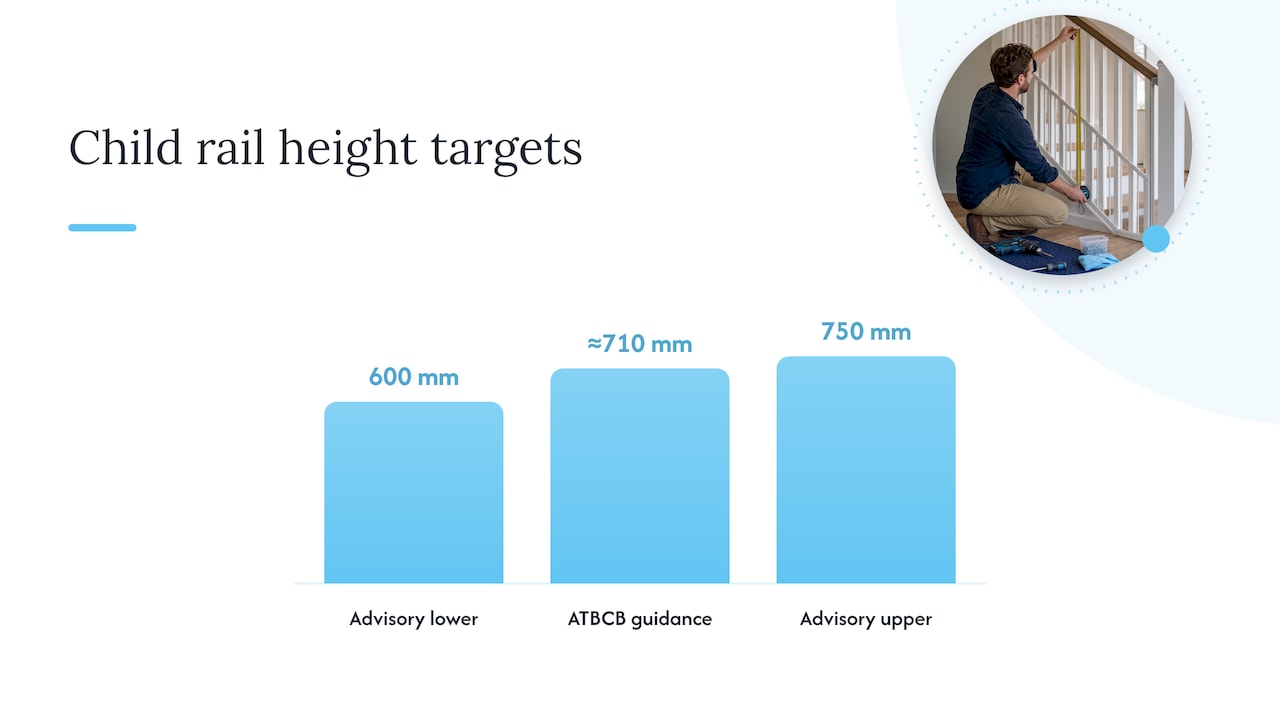
Advisory guidance goes further on rail positioning. The Architectural and Transportation Barriers Compliance Board recommends a secondary lower handrail for children at a maximum height of about 28 inches (710 mm), with enough vertical clearance between the two rails to avoid what’s known as the ladder effect, where horizontal gaps between rails become climbable rungs. Separate universal design guidance for early learning settings narrows this further, recommending a lower rail fixed roughly 600 to 750 mm above the pitch line.
For a home installation, these figures translate into practical checks:
- Set the child rail height within the 600 to 750 mm advisory range above the stair pitch line
- Leave sufficient vertical clearance between adult and child rails to prevent climbable gaps
- Keep gates at the top and bottom of stairs during the early years, as recommended by public health guidance from the HSE, alongside the rail
How to measure and choose the right handrail for your stairs
Getting the fit right starts with a few measurements rather than guesswork. Take these steps before comparing products.
- Measure your child’s standing reach to the hand at rest, not stretched overhead, to find a workable starting height.
- Note the height and projection of your existing adult handrail so the new rail sits clear of it.
- Check the stair nosing points along the full run, since pitch can vary slightly on older staircases.
- Confirm the wall or baluster run has solid fixing points at child-rail height, not just at adult height.
- Decide whether you’ll need an extension pack later as your child grows, and check it’s available for the system you’re buying.
Grip diameter matters as much as height. A profile that’s too thick is hard for small hands to close around securely, while one that’s too thin can feel unstable. Narrower, rounded profiles are generally easier for a child’s grip than standard adult handrail sections.
Before buying, check adjustability range, material and finish, and how the manufacturer describes durability testing. A rail that only adjusts across a narrow range will need replacing within a year or two, undoing the long-term value of a permanent fit.
Pro Tip: Measure at the top, middle and bottom of the staircase, not just one point, since many home staircases aren’t perfectly uniform along their length.
Installing and maintaining your child stair handrail
Mounting below the adult rail is straightforward, but a few details separate a safe install from a hazardous one. Design guidance for steps and handrails recommends extending handrails around 300 mm beyond the top and bottom of the stair run, with ends turned or returned into the wall rather than left exposed, which reduces snagging on clothing or bags.
Keep these points in mind during fitting:
- Maintain a continuous run along the full staircase rather than fitting isolated sections
- Return or turn rail ends into the wall at the top and bottom
- Preserve clear vertical spacing between the adult and child rails so no horizontal gap becomes a foothold
- Check fixing points are solid wood or masonry, not just plasterboard
Most adjustable rails are designed for straightforward self-installation with basic tools, and our own guide to childproofing your stairs properly walks through a typical fit. A tradesperson is worth calling in for unusual stair shapes, solid stone walls, or where existing balusters need modification to take new fixings.
Once fitted, a rail needs occasional attention rather than constant upkeep. Check fixings for movement every few months, particularly in a busy household, and inspect the rail surface for wear where small hands grip most often. As your child grows, an extension pack lets you raise the rail without replacing the whole system, which is worth checking for compatibility before you buy.
Pro Tip: Readers managing a carpeted staircase alongside a new rail should also check that any stair runner is fitted securely, since a loose runner edge creates its own trip hazard regardless of handrail height.
Why KiddieRail fits the brief on testing and longevity
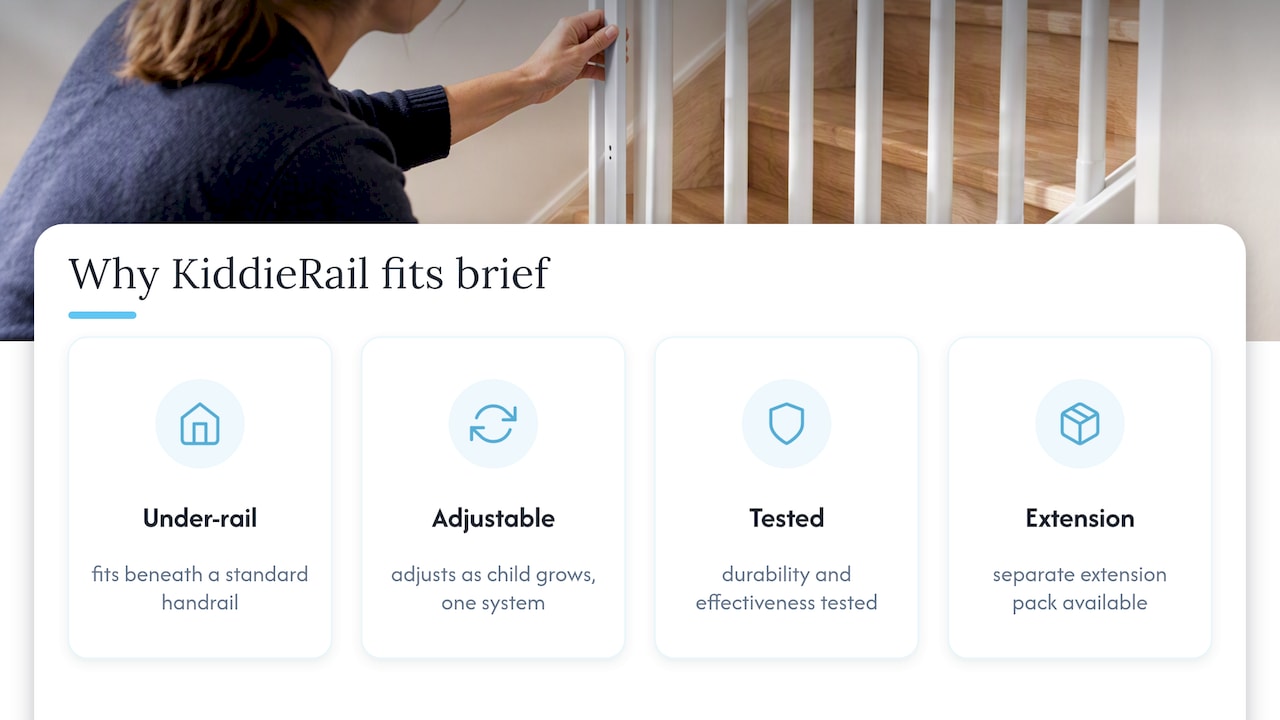
This adjustable stair handrail is designed specifically for young children and fits beneath a standard handrail rather than replacing it. The rail is built to grow with a child, so a family buys one system rather than a sequence of fixes as their child gets taller.
The handrail has undergone testing for durability and effectiveness, providing a checkable basis for user confidence rather than a marketing claim alone. An extension pack is available separately, allowing the same rail to be adjusted further as a child grows rather than needing full replacement. That combination, a tested product plus a clear upgrade path, is what we designed the system around.
A practical note on priorities when choosing a rail
Fit and simplicity matter more than any single feature on a spec sheet. A rail that’s awkward to adjust will quietly stop being adjusted, and a rail that’s fiddly to install will quietly stop being installed properly.
Two things worth checking before you buy: confirm the adjustability range actually covers toddler through to school age, and put a reminder in your calendar to check fixings twice a year. Both are small steps that keep a good product working as intended.
— Paul
Where to buy an adjustable handrail and extension pack
The adjustable child stair handrail is intended for family homes that need a lasting fit rather than a temporary one, designed to adjust as a child grows.

- Browse the full range in our shop to compare fitting options for your stair layout.
- Already own a rail and need more height? Check our extension packs, priced between £24.99 and £36.99 one-off.
- Start with a quick measure of your child’s reach and your stair nosing points, then match that against the adjustable range listed on the product page before ordering.
FAQ
What height should a child’s stair handrail be?
Advisory guidance recommends a secondary lower handrail for children at a maximum of about 28 inches (710 mm), with some design guidance suggesting 600 to 750 mm above the pitch line as a workable range. The right point within that range depends on your child’s height and the pitch of your particular staircase.
Do stair gates still help once we have a child rail fitted?
Yes, gates and a child rail serve different purposes and work well together in the early years. Public health guidance recommends gates at the top and bottom of stairs for younger children, while a lower rail supports older toddlers who are learning to use stairs independently.
How much does the KiddieRail handrail cost?
Pricing for the KiddieRail Adjustable Child Stair Handrail is available on the product page, and extension packs are priced from £24.99 to £36.99 one-off on our accessories page.
Can an adjustable rail fit any staircase?
Most straight domestic staircases can take an adjustable child rail, provided there are solid fixing points at the lower height needed. Unusual shapes, winding stairs, or solid stone walls may need a tradesperson to confirm fixings before installation.
What grip diameter is best for small hands?
A narrower, rounded profile of roughly 25 to 38 mm is generally easier for a young child to close their hand around securely than a standard adult handrail section. The right diameter also depends on the age range the rail needs to serve as a child grows.
Sources
- Risk and protective factors for falls on stairs in young children: multicentre case–control study
- Architectural and Transportation Barriers Compliance Board — children’s elements (advisory guidance)
- Universal design guidance: vertical circulation — stairs (early learning and care settings)
- Preventing falls in toddlers and children — HSE


