
Currently Empty: £0.00


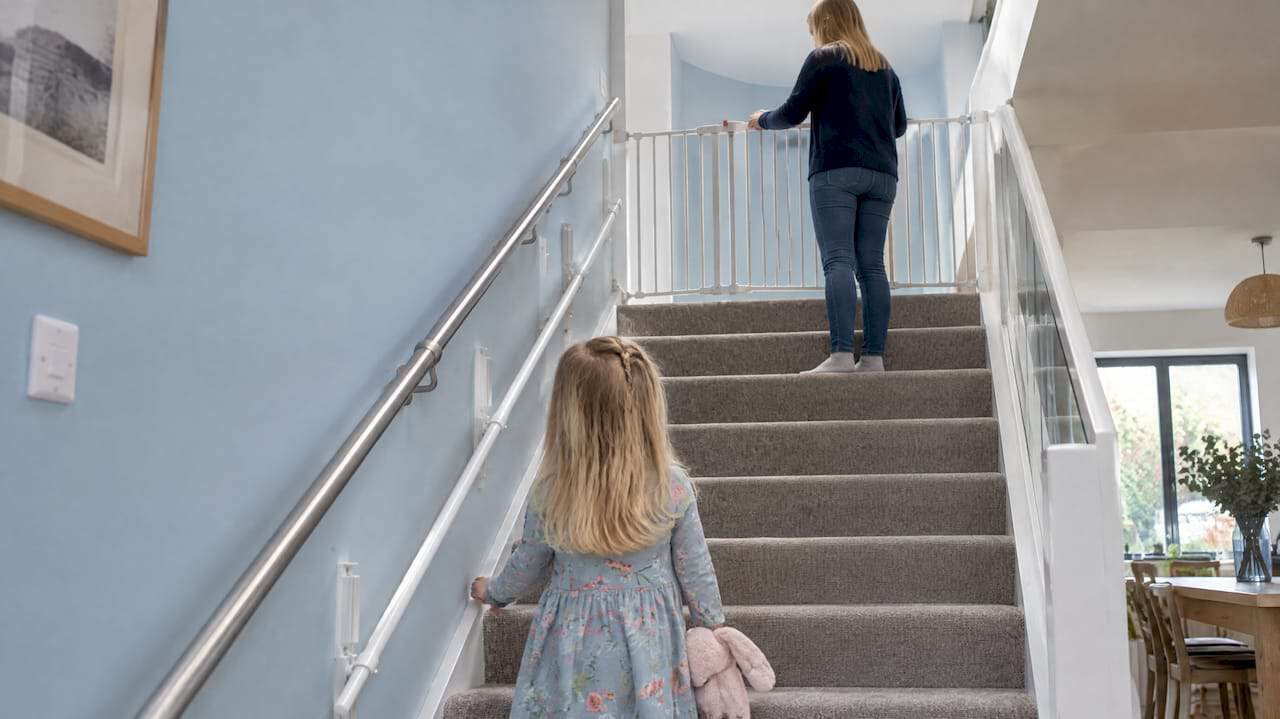
The safest approach for a wide staircase is a hardware-mounted barrier fitted at the top, paired with a configurable multi-panel gate or a child-height handrail where a standard-width gate will not fit the opening. Keep every gate closed and check the mounts regularly. If your toddler takes a significant fall, use NHS guidance to decide whether urgent care is needed. For many unusually wide openings, an adjustable child stair handrail works as a direct-fit solution alongside your gate.
TL;DR:
- A hardware-mounted gate at the top of the stairs is essential, and it should always be kept closed to prevent falls in children under five.
- For wide stair openings, use configurable multi-panel gates or extension panels to ensure a gapless and secure fit that prevents squeezing through.
- Install banister adapters, such as clamp-style or Y-spindle types, to securely attach gates to decorative or round banisters without drilling into the spindles.
- Check stair banister gaps to ensure they are less than 10 centimeters to prevent entrapment, and consider adding mesh guards or rigid panels if gaps are wider.
- Supervised stair practice with a child-height handrail supports motor development while reducing fall risks, combined with environmental fixes like non-slip treads and proper lighting.
Table of Contents
- Options when a standard gate won’t fit
- Measure, select and install stair gates for irregular openings
- Structural and environmental changes that reduce risk on wide stairs
- How to supervise and teach toddlers to use wide stairs safely
- Evidence and proof points behind this guidance
- Balancing safety and letting toddlers learn
- How KiddieRail fits into a wide staircase safety plan
- FAQ
- Sources
Options when a standard gate won’t fit
Most stair gates are built for openings up to a typical medium width, so a wide landing or an open-plan staircase often needs a different approach. A configurable multi-panel gate extends in stages, letting you close off an opening of almost any width without leaving a gap a toddler could squeeze through or push against. Where you only need a small amount of extra width, a gate extender panel does the job more cheaply than buying a new, larger gate outright.
Banister adapters solve a different problem: fitting hardware to a round, tapered or decorative banister that a standard bracket cannot grip. A clamp-style or Y-spindle adapter creates a flat, stable surface for the gate hardware without drilling into the spindle itself, and choosing one designed for your banister’s profile matters more than most parents expect, according to installation guidance from the University of Wisconsin Oshkosh.
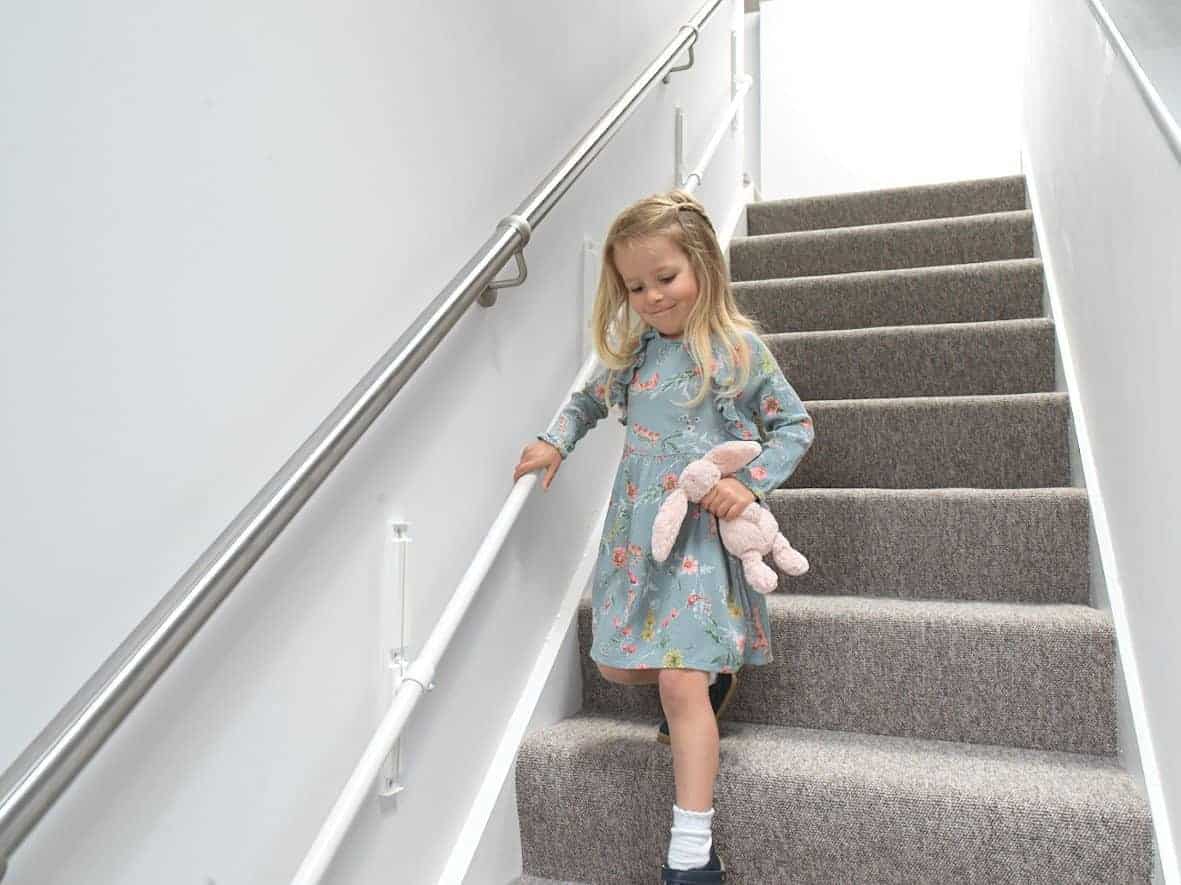
A child-height handrail plays a complementary role rather than replacing a gate. Fitted below the standard adult rail, it gives a toddler something at their own reach to hold while practising stairs under supervision, and because it adjusts as the child grows, it stays useful well beyond the toddler years.
The trade-off between mounting types is not a matter of preference. At the top of any staircase, a hardware-mounted gate is required because a pressure-fit gate can pop loose under a child’s weight, with a fall at the top carrying far greater risk than one near the bottom, as Nationwide Children’s safety guidance explains. Pressure-mounted gates are only appropriate at the foot of the stairs, where a fall has a shorter distance.
Common installation mistakes include:
- Fitting a pressure-mounted gate at the top of the stairs instead of a hardware-mounted one.
- Anchoring screws into plasterboard or a hollow banister rather than a stud or solid timber.
- Stacking two mismatched gates to cover a wide gap instead of using panels designed to connect.
- Leaving a gap larger than a few centimetres between the gate and the wall or banister.
Pro Tip: Before buying, measure your opening at its widest point and add a small margin, since most configurable gates perform better slightly oversized than stretched to their absolute limit.
Measure, select and install stair gates for irregular openings
Getting the fit right starts with measuring, not shopping. Take three measurements, at the top, middle and bottom of the opening, since many “wide” staircases are not a uniform width, and newel posts or skirting boards can narrow the gap partway down.
- Measure the narrowest and widest points of the opening and note both figures.
- Choose a gate or panel system rated for a maximum width above your widest measurement, never below it.
- Check the gate’s height against your child’s size: taller toddlers can climb lower gates, so a taller barrier reduces that risk.
- Identify your mounting surface: locate wall studs with a stud finder, or assess whether the banister is solid enough to anchor hardware.
- Decide whether you need a banister adapter, an extension kit, or a professional fitter for an unusual layout.
Once you have the right product, installation follows a consistent sequence. Position the gate or panel frame against the opening, mark the fixing points, and drill into studs or solid banister material rather than plasterboard or thin spindles. Secure every bracket fully, then push-test the gate firmly from both sides to confirm it does not shift or flex. Check the gap beneath the gate: a floor clearance of no more than roughly 2.5 to 5 centimetres prevents a small foot or toy from becoming trapped. Finally, test the latch mechanism several times to confirm it closes automatically and that an adult can operate it in one motion while a toddler cannot.
Multi-panel layouts need the same scrutiny applied to each joint. Every panel should overlap its neighbour enough to leave no gap a child could push through, and the full run should feel rigid when you lean on it at several points, not just at the ends. Avoid angling panels in a way that creates a V-shaped pocket, since that shape can trap an arm or leg.
A quick verification checklist after any installation:
- The gate does not move when pushed firmly from either side.
- The latch closes on its own and resists a toddler’s grip.
- No gap exceeds the recommended floor clearance.
- Every panel joint is flush, with no sharp edges or pinch points.
Our guide to childproofing stairs properly walks through this process in more detail for layouts with landings, turns or split levels.
Structural and environmental changes that reduce risk on wide stairs
Gates handle access, but the staircase itself often needs attention too. Banister spindles spaced more than 10 centimetres apart, roughly the gap a young child’s head can pass through, create a real entrapment risk, and practical stair-proofing guidance from KidsHealth recommends checking spacing and fitting mesh or banister guards where gaps are too wide. A clear banister guard or a rigid mesh panel closes that gap without blocking the view through the staircase.
A lower, child-height handrail addresses a separate issue: most standard handrails sit too high for a toddler to use properly, which means they either hold nothing or grip the spindles instead. A rail fitted at their height gives them a stable point of contact while they learn the rhythm of stepping and holding, which supports both confidence and balance.
Other fixes worth tackling at the same time:
- Secure a runner or carpet to the treads, since case-control research on stair falls found carpeted stairs are associated with a lower risk of injury than bare or slippery surfaces.
- Add adhesive non-slip strips to the leading edge of each step if a full runner is not practical.
- Repair any uneven, loose or worn treads promptly rather than working around them.
- Improve lighting at both ends of the staircase and keep the treads clear of toys, shoes or laundry baskets.
Pro Tip: Walk the staircase yourself at your toddler’s eye level once a month: loose carpet edges, dim corners and clutter are far easier to spot from a crouch than from standing height.
Some fixes are not a weekend job. A wobbly banister, a missing handrail, or a structural repair to the staircase itself calls for a qualified tradesperson rather than a DIY patch, and the guidance on modifying a home safely after an injury from Fracture Club is a useful reference for why professional fixings matter when a repair affects structural stability. If your staircase has other awkward fittings nearby, such as cabinets under the stairs, Happy Doors’ advice on childproofing cabinet doors is worth a look while you’re addressing the area as a whole.
How to supervise and teach toddlers to use wide stairs safely
Most toddlers begin attempting stairs around two years old, and supervised practice at this stage supports the motor skills they need rather than working against them, according to developmental guidance from HeadStart. Practising one step at a time while holding a hand, or holding a lowered rail, builds the coordination they will eventually use unsupervised.
A few habits make a real difference:
- Teach your toddler to hold the handrail every time, even on short staircases, so it becomes automatic.
- Discourage carrying toys, drinks or anything else while on the stairs, since it removes a free hand.
- Set a household rule that gates are closed immediately after passing through, every time, by every adult.
- Keep sight lines clear so you can see the staircase from the rooms your toddler uses most.
A child-height rail is particularly useful during this teaching phase, since it gives a toddler their own grip point rather than relying entirely on an adult’s hand.
Evidence and proof points behind this guidance
The case for strict stair gate discipline is not just intuition. A multicentre case-control study found that not having a stair gate, and leaving an existing gate open, were both associated with significantly higher odds of a stair-fall injury in children under five, while having gates kept closed and carpeted stairs and landings were protective factors, according to research published via PMC. In practice, that means owning a gate is only half the job: closing it every time is what reduces risk.
Medical guidance is equally specific about when a fall needs more than reassurance. NHS advice on head injury and concussion treats a fall from more than one metre, or more than five stairs, as a standard reason to seek urgent assessment, alongside signs such as loss of consciousness, a seizure, vomiting or a change in behaviour.
Taken together, the evidence points to a layered approach:
- Hardware-mounted gates at the top, used consistently and never left open.
- Carpeted or non-slip treads and well-lit landings.
- Supervised practice and handrail habits built early.
- A clear sense of when a fall needs medical attention rather than just comfort.
No single measure covers every risk. Combining secure equipment, environmental fixes and active supervision gives the most reliable protection.
Balancing safety and letting toddlers learn
Over-restricting a toddler’s access to stairs can backfire, since children who never practise under supervision often take more risks the first time they encounter stairs unsupervised. Our approach favours stepwise confidence: secure the top of the stairs properly, then let supervised practice do the rest. A child-height rail, a closed gate and a few minutes of patient practice each day tend to achieve more than either strict prohibition or unrestricted access on their own, and most families find their routine settles within a few weeks.
— Paul
How KiddieRail fits into a wide staircase safety plan
A gate controls access, but it does not teach a toddler how to move on stairs confidently, which is where the KiddieRail Adjustable Child Stair Handrail comes in. Fitted below your existing handrail, it gives a toddler a grip point at their own height, adjusts as they grow, and has been tested for durability so it holds up to daily use rather than loosening over time.

We also stock an Extension Pack for staircases that run longer than a single rail section covers, priced between £24.99 and £36.99 depending on the length you need. Together with a hardware-mounted gate at the top of the stairs, the rail supports the kind of supervised practice outlined earlier in this guide:
- Fits below a standard adult handrail without replacing it.
- Adjusts in height as your toddler grows, extending its use for years.
- Works alongside any gate setup rather than replacing the need for one.
Browse the full range in our shop to find the right fit for your staircase.
This article is general information, not a substitute for advice from a qualified doctor. Consult a qualified healthcare professional about your own circumstances before acting on anything here.
FAQ
How can I make my toddler’s stairs more safe?
Fit a hardware-mounted gate at the top of the stairs and keep it closed every time, since leaving a gate open is linked to significantly higher injury risk according to case-control research. Add a secure runner or non-slip treads, check banister spindle gaps, and consider a child-height handrail so your toddler has a stable grip point during supervised practice.
What is the 4-inch rule for stair banisters?
The widely used guidance is that gaps in a banister or staircase railing should be narrow enough that a sphere of around 10 centimetres (roughly 4 inches) cannot pass through, since that is close to the size of a young child’s head. Where spindles are spaced wider than this, a banister guard or mesh panel closes the gap without obscuring the staircase.
Should a two-year-old be able to climb stairs?
Most toddlers begin attempting stairs around two years old, and supervised practice at this age supports their developing motor skills rather than working against them, according to developmental guidance. They should not be climbing stairs unsupervised at this stage, and a gate at the top remains necessary even once they can manage individual steps.
My two-year-old fell down the stairs. What should I do?
Stay calm and check for signs such as loss of consciousness, a seizure, vomiting or unusual drowsiness, and seek urgent medical care if the fall was from more than one metre or more than five stairs, per NHS guidance. For a minor fall with no concerning symptoms, continue to watch your child closely over the next 24 hours and contact a GP if anything changes.
Sources
- Head injury and concussion – NHS
- Risk and protective factors for falls on stairs in young children: multicentre case–control study – PMC
- Tips for keeping children safe: a developmental guide — HeadStart


