
Currently Empty: £0.00


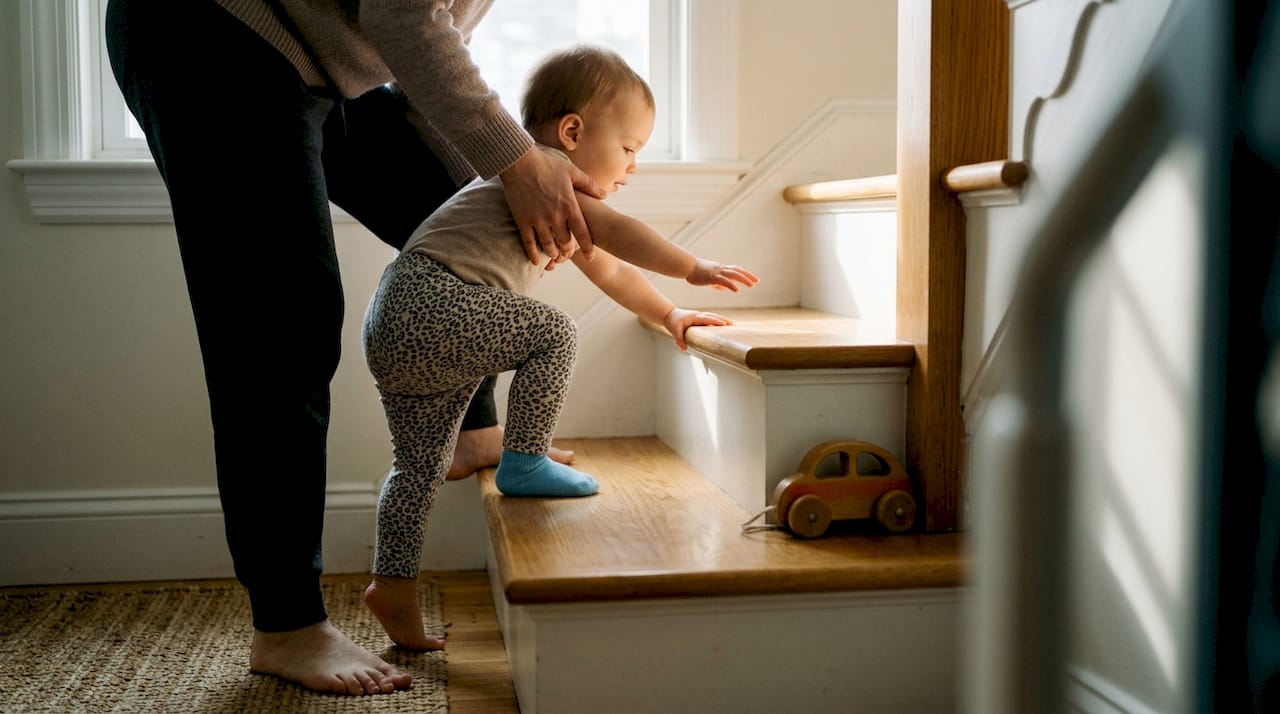
The most effective way to prevent toddler stair injuries combines three things: hardware-mounted gates at the top and bottom of stairs, direct teaching of handrail use, and fixing slip hazards on the treads themselves. Research from the Centre for Injury Research and Policy shows how common these falls are, while CPSC and ASTM standards set the safety bar for gates. Avoid pressure-mounted gates at the top of any staircase, and pair physical barriers with a child-height handrail once your toddler starts practising stairs.
TL;DR:
- Hardware-mounted gates should be installed at the top of stairs, with screws anchored into wall studs, and checked regularly for stability and damage.
- A child-height adjustable handrail is essential for teaching toddlers to safely hold the rail while climbing or descending stairs.
- Non-slip treads, proper lighting, and clearing clutter on stairs significantly reduce slip and trip hazards for young children.
- Gates must meet current safety standards, feature easy-to-use latches, and be retired once a child can climb over or if hardware loosens.
- Regular maintenance, supervision, and reinforcement of stair safety routines are crucial, as gate performance alone cannot prevent all injuries.
Table of Contents
- Quick actionable checklist parents can follow today
- Stair gates: why hardware-mounted gates are essential and how to choose one
- Handrails and teaching: how to help toddlers learn safe stair use
- Surface, lighting and environment: reduce slips and trips
- Installation and measurement checklist: what installers and handy parents must know
- Routine checks and maintenance: how to keep stair safety measures effective
- Evidence and standards: what research and regulators say about stair injuries and gates
- Author Paul’s perspective: balancing safety and fostering independence
- How KiddieRail helps: a practical complement to gates and teaching
- Sources
- FAQ
Quick actionable checklist parents can follow today
You do not need a weekend project to make stairs safer. Most of these fixes take under an hour.
- Install hardware-mounted gates at the top of the stairs and a secure gate (hardware or sturdy pressure-mounted) at the bottom, checking that screws reach wall studs where possible.
- Fit non-slip treads or a runner, and clear toys, shoes and laundry off every step.
- Teach a simple routine: one hand on the rail, one step at a time, no running.
- Check lighting works at both ends of the stairs, remove loose rugs near the top or bottom, and tighten any wobbly balusters or handrails.
Stair gates: why hardware-mounted gates are essential and how to choose one
Not all stair gates do the same job. Hardware-mounted gates bolt into the wall or door frame and stay put under pressure, which is why guidance from Head Start recommends them specifically for the top of stairs. Pressure-mounted gates rely on tension bars pressing against the walls, and a determined toddler leaning on one can push it loose, so it should never sit at the top of a flight.
CPSC rulemaking incorporated the ASTM F1004 standard, which sets performance tests for push-out resistance and latch durability, along with labelling requirements gate makers must follow, according to CPSC’s own guidance. That standard exists because a gate that fails under load is worse than no gate at all.
When buying or checking a gate, look for:
- A label stating it meets current gate and enclosure safety requirements.
- Clear installation instructions, including minimum distance from the first step.
- A latch that closes with one motion and cannot be opened by a small child.
- No visible cracking, loosened hardware or gaps a child could squeeze through.
Retire a gate once your child can climb over it, the latch sticks, or the mounting hardware has loosened beyond a simple retightening.
Handrails and teaching: how to help toddlers learn safe stair use
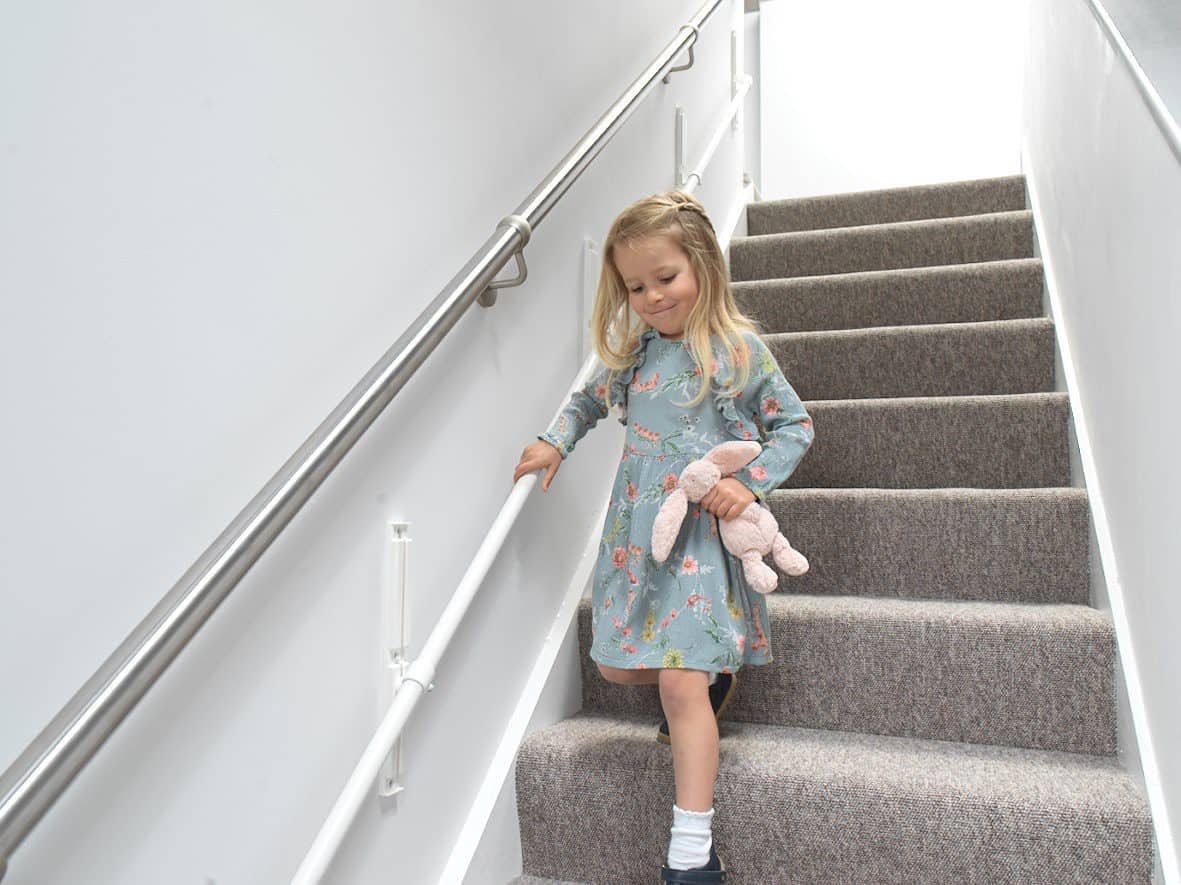
A handrail only helps if a child can actually reach and use it. Standard rails sit far above a toddler’s grip height, which is one reason falls remain common as children begin climbing stairs independently between roughly one and three years old.
Teaching stair skills works best as a short, repeated routine rather than a single lesson:
- Practise going up and down with your hand ready to steady, not carry, your child.
- Model the behaviour yourself: hold the rail, take one step at a time.
- Discourage carrying toys, cups or anything else while on the stairs.
Once your child is walking confidently and reaching for a rail, a child-height adjustable handrail gives them something to actually hold, working alongside the gate rather than replacing it. Keep the top and bottom gates in place through the whole learning period. Judgement about speed, balance and distraction lags well behind physical ability at this age.
Pro Tip: Practise stair skills on a few steps at the bottom of the flight first, where a stumble means inches, not a full fall.
Surface, lighting and environment: reduce slips and trips
Even a well-guarded staircase can be a hazard if the treads themselves are slippery or hard to see. A few environmental fixes lower the risk substantially:
- Add a runner, non-slip nosing strips, or non-slip paint to bare wooden or tiled steps.
- Fit light switches at both the top and bottom, and consider a plug-in night-light for the landing.
- Add contrast strips or paint to step edges so they are easier to judge in low light.
- Keep decorations, plant pots and stored items off the stairs and railings entirely.
Socks alone on painted or laminated steps are a common cause of slips, so appropriate grip footwear or bare feet often work better than smooth-soled slippers.
Installation and measurement checklist: what installers and handy parents must know
Correct installation is what makes a gate’s safety rating mean anything in practice. Before fitting anything permanent, check the label for exact clearance and height requirements, since these vary by product and are tested under specific configurations by manufacturers following ASTM F1004 requirements.
- Locate wall studs with a stud finder and mount hardware gates into them wherever the doorway allows.
- Where studs are not available, use the wall cups supplied with the gate. They redistribute pressure and matter more than people assume.
- Follow the label’s minimum distance from the first step, and check the opening size against your child’s age and size.
- Test the latch several times before trusting the gate, and check it again after the first week of use.
If your staircase has an unusual angle, an open banister, or the wall studs are hard to locate, hiring a professional to fit gates or repair loose treads is often worth the cost. Give them the product label and required clearances so the job matches the standard the gate was tested against, rather than a rough estimate. Our dedicated childproofing guide walks through this in more detail. For structural repairs beyond a simple gate fit, Ohana Property Services’ guide to hiring for stair and structural work is a useful reference before calling anyone in.
Routine checks and maintenance: how to keep stair safety measures effective
Safety gear degrades quietly, so a short weekly check catches problems before they matter.
- Test every latch and check for cracking, warping or loosened wall cups.
- Give the handrail and any spindles a firm push to check for movement, and look at treads for wear or lifting carpet.
- Retire a gate or handrail the moment it is damaged, has been disassembled for cleaning and not properly rebuilt, or your child has learned to climb or unlatch it.
A reminder on your phone or a note by the stairs keeps this from slipping down the list once the novelty of a new gate wears off.
Evidence and standards: what research and regulators say about stair injuries and gates
Stair falls are not a minor risk. Between 1999 and 2008, more than 93,000 children under five were treated in US emergency departments every year for stair-related injuries, roughly one child every six minutes. That single figure explains why regulators treat gate design as a safety issue, not a convenience feature.
- CPSC rulemaking incorporated ASTM F1004 into 16 C.F.R. part 1239, setting mechanical tests for push-out resistance and latch durability.
- NHS guidance recommends keeping stair gates in place until around two years old.
- Gates are one part of a layered approach: NHS guidance is explicit that a gate is not a substitute for supervision.
What this means for parents buying a gate: check the label carries a current safety standard reference, follow the fitting instructions exactly, and never assume a gate that worked for a younger sibling still fits or performs the same way for a more mobile toddler.
Author Paul’s perspective: balancing safety and fostering independence
No gate or handrail replaces watching your child, and no amount of supervision is perfect either. The families who manage stairs well tend to rely on small, repeated routines rather than one dramatic fix, pairing physical barriers with steady teaching. Engineering controls buy you time; education is what your child actually keeps.
— Paul
How KiddieRail helps: a practical complement to gates and teaching
Standard handrails sit too high for a toddler to grip properly, which leaves a gap between “gate in place” and “child can steady themselves.” The KiddieRail Adjustable Child Stair Handrail fits below your existing handrail at a height a young child can actually reach, and adjusts as they grow rather than needing replacement each year.
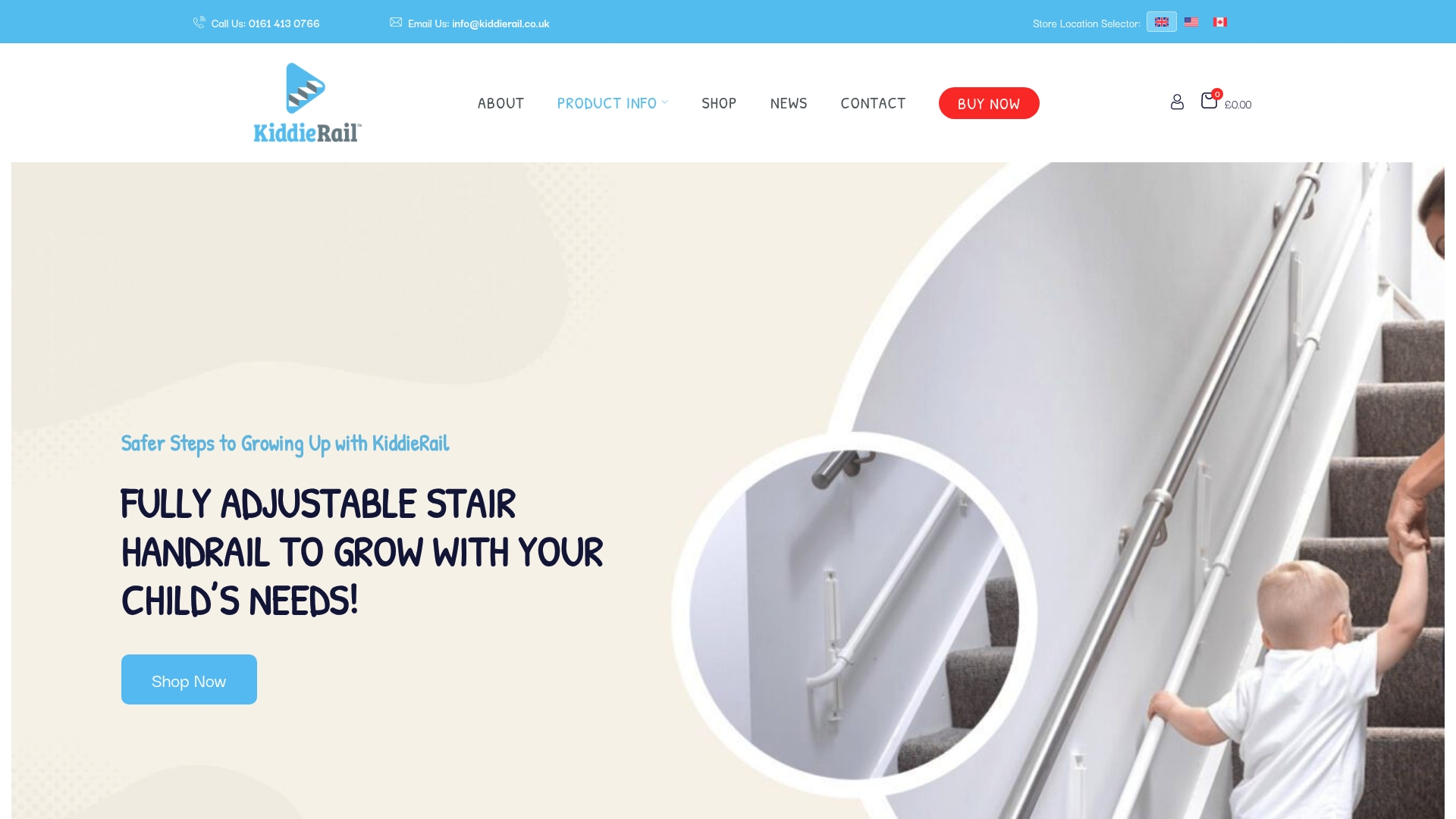
- Fits alongside your current handrail without altering the staircase.
- Adjusts in height, so it keeps working as your child grows
- Suits any home staircase layout.
If your child is at the stage of practising stairs with supervision, a child-height rail gives them something proper to hold while your gates stay exactly where they are. Extension packs are available separately for longer staircases, priced at £24.99 to £36.99 one-off. Browse the KiddieRail Adjustable Child Stair Handrail and fit it alongside your existing gates this week.
Sources
- Emergency department visits for stair-related injuries among children in the United States, 1999–2008 (PubMed)
- Baby gates guidance (UW Oshkosh / Head Start)
- Gates requirements transcript (CPSC)
- How to baby-proof your home – safety tips from a health visitor (NHS)
FAQ
How to toddler proof stairs?
Fit hardware-mounted gates at the top of the stairs and a secure gate at the bottom, add non-slip treads, and keep the stairway clear of clutter. Combine this with active teaching of handrail use, since NHS guidance notes gates work best alongside supervision, not instead of it.
What is the best steps protector for kids?
There is no single “best” product, since the right combination depends on your staircase and your child’s stage. A hardware-mounted gate handles the barrier side, non-slip treads or runners handle grip, and a child-height handrail like the KiddieRail Adjustable Child Stair Handrail gives them something to hold once they start climbing independently.
How to make stairs more safe for kids?
Improve grip with non-slip treads or runners, add lighting at both ends of the flight, and fix any loose balusters or handrails. Pair these environmental fixes with hardware-mounted gates and consistent teaching of “hold the rail, one step at a time.”
How to safety proof stairs?
Start with hardware-mounted gates at the top, since pressure-mounted gates are not recommended there because they can be pushed loose. Add non-slip surfaces, check lighting, and teach safe stair behaviour early, keeping gates in place until your child reliably manages stairs alone, generally around two years old per NHS guidance.


