
Currently Empty: £0.00


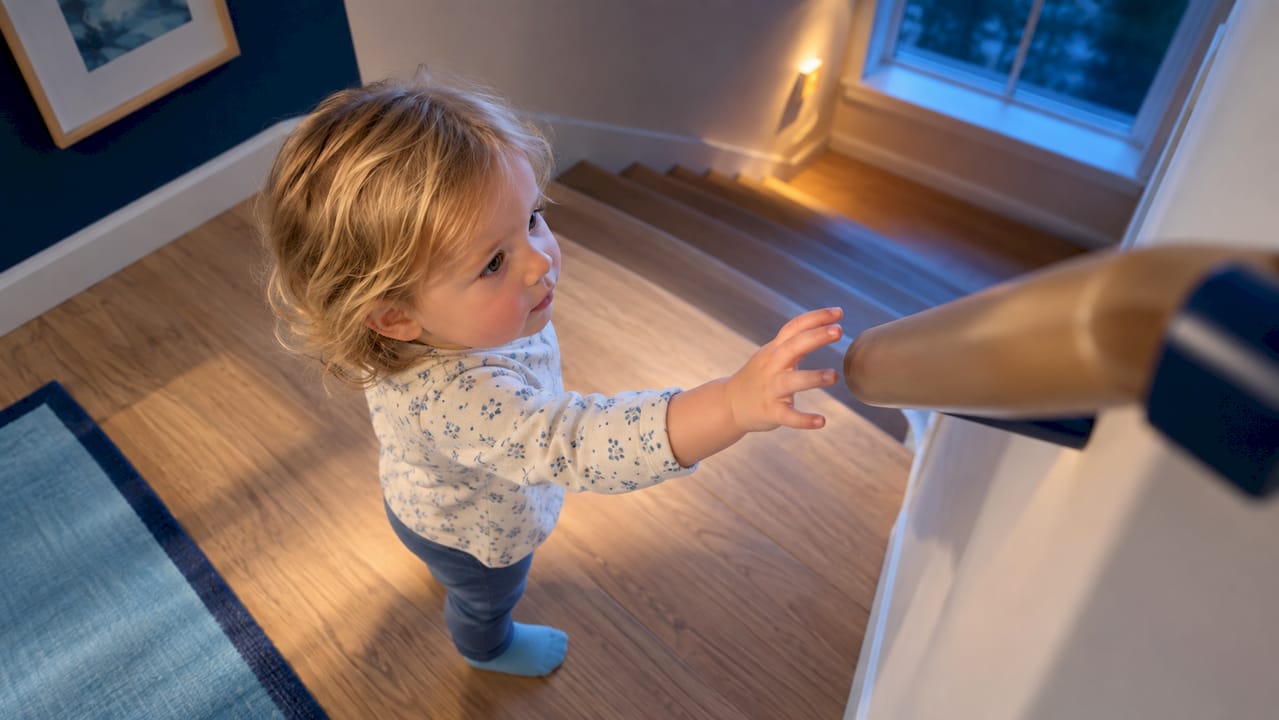
Fit an adjustable child-height handrail at 600–750mm and your landing goes from a hazard to a training ground. Extend it 300mm past the top and bottom step, keep the grip within child-friendly reach, and you have addressed the single biggest gap in most homes: no rail your toddler can actually use. Everything else, from lighting to nosings. It builds on that one change.
TL;DR:
- An adjustable child-height handrail should be installed between 600 and 750mm above the tread nosing, extending 300mm beyond the top and bottom steps for optimal support.
- The grip diameter should be around 30-50mm, with softer materials like timber or plastic preferred over metal for comfort and safety.
- Fixing brackets must be spaced every 800–1000mm and tested for strength, with secure wall fixing essential for safety and stability.
- Regular monthly and annual inspections are necessary to identify loose brackets, wear, or any damage that could compromise safety.
- Combining a lower handrail with proper lighting, clear nosings, clutter-free landings, and safety features like closing gaps in guardrails enhances overall stair landing safety for young children.
Table of Contents
- What is stair landing safety for children, and why does a lower rail matter?
- How do you choose the right child-height handrail for your landing?
- What does a safe installation look like?
- How often should you check and maintain the handrail?
- What other landing safety measures work alongside a handrail?
- What makes a stair landing itself safe, beyond the handrail?
- What guardrail height keeps a landing safe around open drops?
- What hazards commonly appear on stair landings, and how do you fix them?
- Do stair landings need to meet accessibility standards?
- A note from Paul on adjustable handrails
- Where a Kiddierail handrail fits into your landing setup
- Sources
- FAQ
What is stair landing safety for children, and why does a lower rail matter?
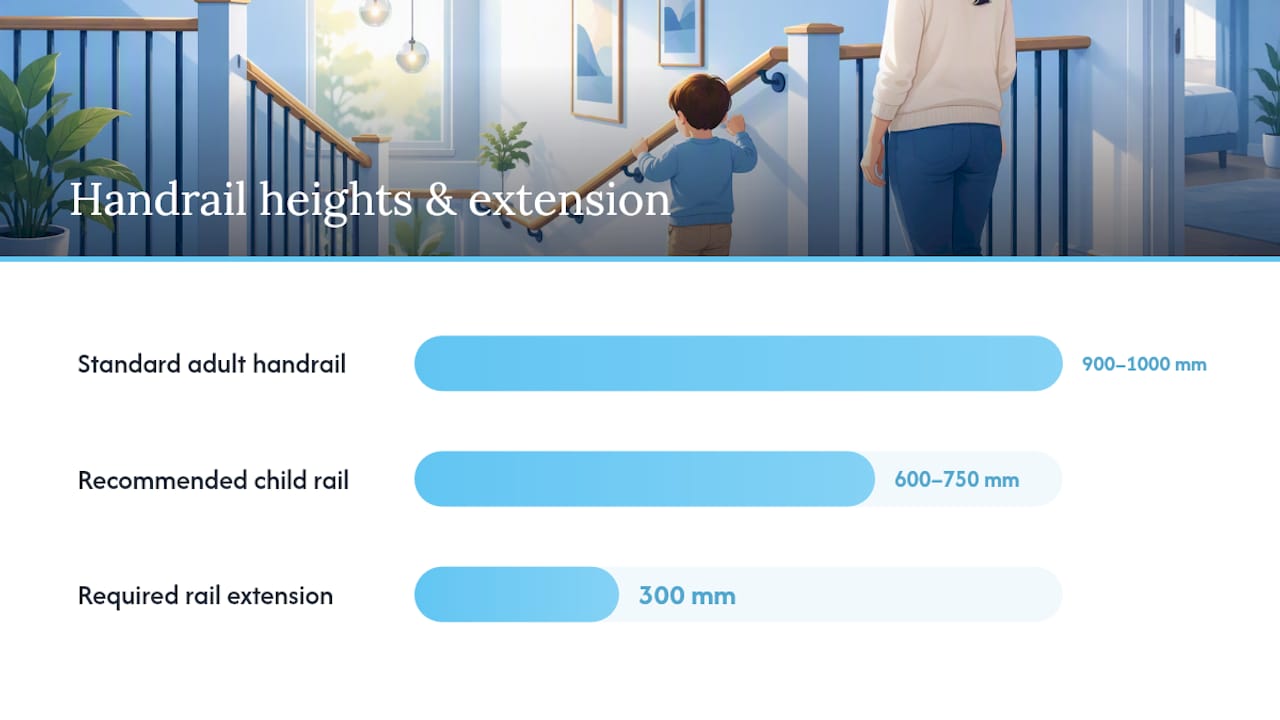
Stair landing safety for young children means giving them a rail they can physically use, not just one that exists. A standard adult handrail sits at 900 to 1000mm, which is roughly at a two-year-old’s eye level rather than their hand. An adjustable low-level handrail, fitted below or beside the main rail, brings a gripping surface down to where small arms naturally fall.
The ergonomics matter more than most parents realise. When a rail sits too high, a child either stretches upward, which twists their posture and pulls their centre of gravity forward, or ignores it altogether and grabs at a wall, a banister spindle, or nothing at all. A rail positioned near hip height for a toddler lets the arm hang in a natural bent position, which keeps the body braced and stable through each step.
Design guidance for early-years settings consistently backs this up. Recommendations for child-centred stair design call for an additional lower handrail between 600 and 750mm above the pitch line, with the rail continuing 300mm beyond the top and bottom of the flight so a child has something to hold before and after the step itself. The World Health Organization goes further, listing stair rails among the primary environmental interventions proven to reduce fall risk in the home, alongside better lighting and surface treatments.
A few things a lower rail does for a developing child:
- Gives their hand a natural gripping height instead of forcing an upward reach
- Keeps the arm bent, which stabilises posture through each step
- Builds confidence for independent stair use rather than relying on being carried
- Works alongside a stairgate rather than replacing the need for one
One fact worth sitting with: the same guidance body that sets rail heights for children also treats handrail extensions as non-negotiable, not optional. A rail that stops exactly at the top step leaves the most dangerous single moment, the step onto or off the landing, without support at all.
This article covers child-height rails specifically. General building-code stair regulations for adults are a separate subject, and not what follows here.
How do you choose the right child-height handrail for your landing?
Picking a rail isn’t about grabbing the first product that mentions “child safety” on the box. A handful of measurements and questions will tell you whether something actually fits your stairs and your child.
- Measure from the tread nosing, not the floor. Height should be read from the front edge of each step, aiming for 600–750mm, matching the range set out in guidance for early learning and care environments. A fixed-height rail bought for a two-year-old will be wrong within a year, so an adjustable model is worth the extra thought.
- Check the grip diameter. Guidance on handrail specifications recommends a gripping circumference of roughly 30–50mm, which usually works out to a 25–32mm diameter, small enough for a child’s hand to close around properly. Timber or coated plastic profiles are far more comfortable for small hands than bare metal, which turns painfully cold in winter.
- Ask about fixing strength and bracket spacing. Brackets spaced roughly every 800–1000mm give a rail the rigidity to withstand a child pulling their full bodyweight against it, and any manufacturer worth buying from should be able to tell you what load the fittings are tested to.
- Look for visibility features. Contrasting colour against the wall, clearly finished end returns, and that 300mm extension past the top and bottom step all help a child spot exactly where to reach.
- Confirm compatibility with your stair type. Straight flights are straightforward for most adjustable rails. Winders, curved stairs, or unusual balustrade spacing often need a bespoke fitting, so check this before ordering.
Pro Tip: Measure your child’s natural standing hand height against the stairs before you buy anything. Most parents guess too high, because they’re measuring from where they’d want to hold a rail, not where a two-year-old’s hand actually sits.
What does a safe installation look like?
Fitting an adjustable rail is not a job to rush, but it’s not complicated either. A professional or confident DIYer typically works through the same sequence.
- Locate the studs or solid fixing points behind the wall before drilling anything.
- Mark the height from the tread nosing at 600–750mm, checking it stays level across the full run.
- Fix brackets at the manufacturer’s recommended spacing, generally every 800–1000mm.
- Confirm the rail extends 300mm beyond the top and bottom step before final fixing.
Once it’s up, don’t assume it’s safe just because it looks solid. A firm wiggle-and-pull test at several points along the rail will reveal any flex or give. Check visually for gaps at the wall brackets, and run a hand along the full extension to make sure there’s nothing a child’s sleeve or fingers could catch on.
Call a professional if the wall substrate is unclear (stud partitions and solid masonry need different fixings), if you’re in a property with party-wall considerations, or if the rail shows any movement after fitting. Renters aren’t excluded from this either: non-permanent options, including removable-sleeve rails and pressure-fit systems, exist specifically for households that can’t drill into shared walls.
How often should you check and maintain the handrail?
A rail fitted once and forgotten stops doing its job the moment a bracket loosens. Build a simple habit around it.
- Monthly: a quick wiggle test and a visual scan for loose screws or gaps.
- Annually: a full inspection of every bracket, the grip surface, and the end returns.
- Watch for: creaking, visible wear on sleeves or grip coating, loosening at any bracket, or sharp edges appearing where a coating has worn through.
Clean with a damp cloth and avoid rough sanding or repainting with anything other than a child-safe, non-toxic finish, since small hands are in constant contact with the surface. When your child has clearly outgrown the current height, an adjustable rail should let you raise it in stages rather than needing a full replacement, which is the entire point of choosing one that grows with them.
Pro Tip: Check the rail on the same day each month, ideally alongside another household task like changing smoke alarm batteries, so it doesn’t quietly slip off the list.
What other landing safety measures work alongside a handrail?
A rail solves grip and stability, but a landing has other failure points worth closing off at the same time.
Lighting matters more than most parents budget for. A dim landing hides the exact spot where a step ends and flat floor begins, which is precisely where trips happen. Night lights or motion-sensor fittings on the landing and stairwell remove that guesswork for a child moving around after dark.
Contrast nosings, fitted to the front edge of each step in a colour that visibly differs from the tread, are recommended at 50–70mm in child-focused design guidance, and they make a real difference to how clearly a young child can judge where one step ends and the next begins. Clear the landing itself of loose rugs, toy boxes, or anything that could shift underfoot.
Stairgates and handrails do different jobs, and one doesn’t replace the other. A gate controls access when nobody’s supervising; a rail teaches grip, balance, and the physical skill of navigating steps independently. Relying on a gate alone means a child never gets the practice, while relying on a rail alone leaves the stairs open when you’re not watching. Broader guidance on stair safety for UK parents covers how to phase gates out as a child’s confidence grows.
Families supporting children with additional needs often need adaptations beyond standard rail heights and grip profiles; a dedicated page on SEN stair handrail considerations covers those specifics in more depth.
What makes a stair landing itself safe, beyond the handrail?
The landing floor deserves as much attention as the rail bolted to its wall. A landing that’s too shallow forces a child to turn or stop awkwardly mid-stride, right at the point where a flight changes direction, which is exactly where a stumble turns into a fall down a full run of stairs rather than a single step.
Surface grip is the other half of the equation. Polished wood, laminate, or worn carpet on a landing all reduce traction in exactly the spot where a child needs to plant their feet and reorient before continuing. A non-slip mat, textured flooring, or a low-pile carpet with a secured underlay all reduce that risk without needing structural changes.
Clutter is the quiet hazard most families underestimate. Toy boxes, laundry piles, and shoes left “just for a minute” near a landing edge turn a stable floor into a trip hazard, and a child moving quickly, or backing away from a sibling, won’t see it in time. Keeping the landing itself completely clear, with nothing stored there even temporarily, closes that gap for free.
Combined with adjustable child-height handrails, a stable, well-lit, clutter-free landing surface removes the two conditions, poor grip and poor footing, that turn a wobble into an actual fall.
What guardrail height keeps a landing safe around open drops?
Open landings, the kind that overlook a stairwell, hallway, or lower floor, need a guardrail with no gaps a child could squeeze through or climb over. The core principle that matters for families is spacing and height rather than any specific number you need to memorise: balusters set close enough together that a small body cannot pass through, and a rail height that a determined toddler cannot use as a climbing aid.
Horizontal balustrade designs are worth avoiding in homes with young children, since horizontal rails effectively form a ladder a curious three-year-old will climb without a second thought. Vertical spindles, closely spaced, remove that temptation.
Existing balustrades with wider historic spacing, common in older properties, can often be retrofitted with clear infill panels or mesh guards rather than replaced outright, which keeps the original staircase intact while closing the safety gap. If you’re renovating or extending a landing, checking the guardrail against current safety guidance before finishing the work saves an expensive redo later.
None of this replaces a lower handrail on the stairs themselves. A guardrail stops a fall over an edge; a child-height handrail prevents the stumble on the steps that leads to one.
What hazards commonly appear on stair landings, and how do you fix them?
Most landing accidents trace back to a small number of repeat offenders, and nearly all of them are cheap to fix.
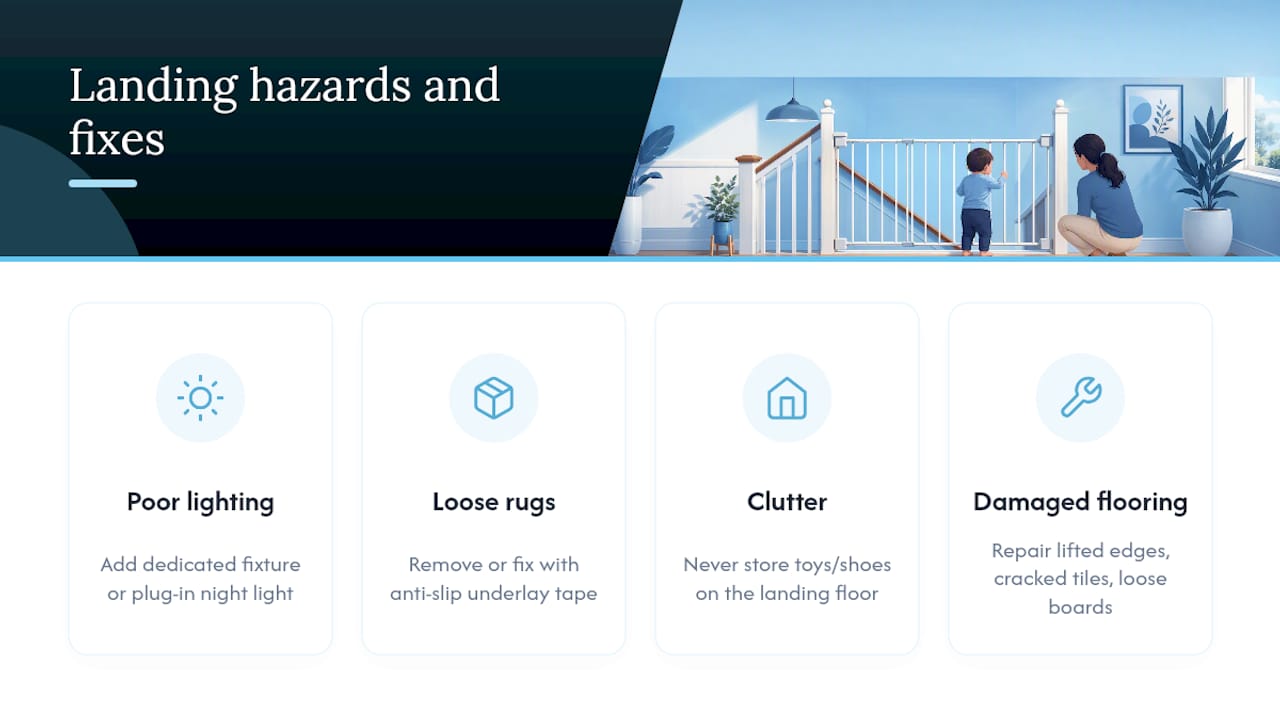
Poor lighting tops the list. A landing lit only by a hallway bulb several metres away leaves shadows exactly where step edges need to be visible. Adding a dedicated fixture or a plug-in night light closes this gap in an afternoon.
Loose rugs and runners are the second most common culprit, sliding underfoot the moment a foot lands on the edge rather than the centre. Either remove them from landings entirely or fix them down with proper anti-slip underlay tape, not just a rubber-backed mat that still shifts on smooth flooring.
Toys, shoes, and general clutter left on a landing “temporarily” cause a disproportionate number of falls, particularly with siblings running between rooms. A simple rule, nothing stored on the landing floor, ever, removes the hazard without needing a single purchase.
Finally, worn or damaged flooring, a lifted carpet edge, a cracked tile, a loose floorboard, tends to get ignored until someone catches a toe on it. A landing is not the place to defer a repair.
Do stair landings need to meet accessibility standards?
Yes, where a home or building falls under accessibility regulation, landing design typically has to account for wheelchair users, older adults, and anyone with mobility differences, not just children. That usually means adequate landing depth to allow a turn, handrails continuous on both sides of a flight, and non-slip surfacing that performs safely when wet.
For most private family homes, these aren’t legal requirements in the way they are for public buildings or new-build developments, but the same principles pay off for households with grandparents visiting regularly or anyone recovering from an injury. A landing designed with a lower handrail for a toddler and a full-height rail for an adult already covers most of what accessibility guidance asks for, because both age groups benefit from a rail sized to their reach and a floor that doesn’t slip.
If you’re planning a renovation, checking your landing against relevant accessibility standards for your country or region before finalising the design avoids retrofitting later, which is almost always more expensive than building it in from the start.
A note from Paul on adjustable handrails
Adjustable rails sit at the centre of how Kiddierail approaches stair safety, because a fixed-height rail is only correct for a matter of months. We’ve watched the same pattern repeatedly in customer feedback and durability testing: children use a rail far more consistently once it’s actually within their reach, and parents report noticeably more confident stair use within weeks. Testing for load and wear gives us the confidence to back the product’s durability claims, which matters more to us than any single feature on a spec sheet.
— Paul
Where a Kiddierail handrail fits into your landing setup
Kiddierail is the practical alternative to fixed-height rails built for adults: a single adjustable child stair handrail that fits below your existing rail and adjusts as your child grows, rather than needing replacement every year or two.
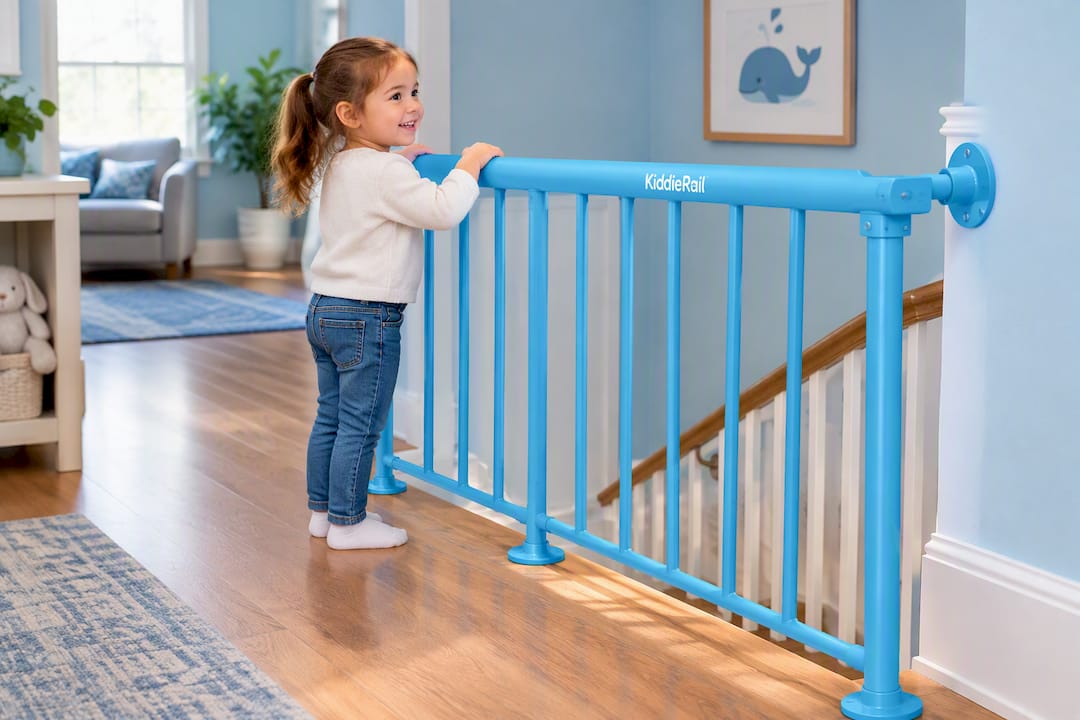
These rails are typically designed for straight staircases, intended to be durable and to act as training aids rather than just barriers, helping a child learn to grip and balance rather than simply being kept off the stairs. If your landing needs extra length to meet that 300mm extension guidance, the extension pack (£24.99–£36.99) adds compatible reach without buying a second rail. Browse the full range in the Kiddierail shop, check fitting compatibility against your own stair layout on the product page, and get in touch with support first if you’re unsure how it will sit against your existing balustrade.
Sources
- Internal circulation: vertical circulation (stairs) — early learning and care guidance
- WHO technical package: interventions to prevent falls
- WHO: assistive product specifications — handrails and grab bars
FAQ
What height should a child-height handrail be?
Guidance for child-centred stair design recommends fitting a lower handrail between 600 and 750mm above the pitch line, measured from the tread nosing. An adjustable rail lets you raise that height in stages as your child grows.
How far should a handrail extend past the top and bottom step?
Handrails should extend roughly 300mm beyond both the top and bottom of the stairs, giving a child something to grip before and after the actual step change. This detail is often missed on standard adult rails, which typically stop flush with the last step.
Does Kiddierail work on any staircase?
The Kiddierail adjustable handrail is designed for straight staircases and fits below a standard existing rail. For winders, curved flights, or unusual balustrade spacing, check compatibility on the product page before ordering.
What does a Kiddierail handrail cost?
Kiddierail’s extension pack is priced at £24.99–£36.99 for the accessory, while current pricing for the main adjustable handrail is listed on the site rather than fixed here.
Is a handrail enough, or do I still need a stairgate?
A handrail and a stairgate serve different purposes and work best together. The gate restricts access when nobody’s supervising, while the rail teaches your child to grip, balance, and eventually manage stairs independently.


