
Currently Empty: £0.00


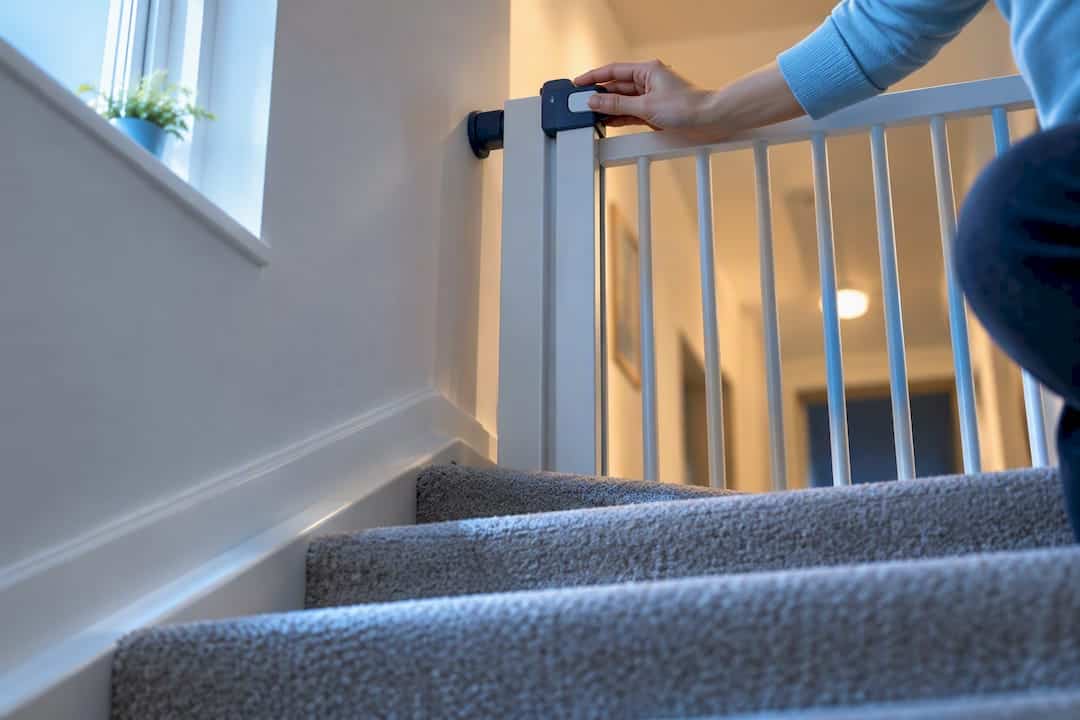
Fit a hardware-mounted gate at the top of the stairs and a pressure or hardware gate at the bottom, add a child-height handrail your toddler can actually grip. Clear every loose object off the treads, and supervise closely while your child learns to climb. The CPSC’s guidance on gates and enclosures backs fixed mounting at the top, and a tested product such as KiddieRail supports safe practice underneath.
TL;DR:
- Fix a hardware-mounted gate at the top of the stairs and a pressure gate at the bottom, with an adjustable child-height handrail for better grip and practice.
- Regularly check stair surfaces, lighting, and eliminate clutter on all treads to reduce slips and falls, especially during busy household routines.
- Measure stair openings carefully before purchasing gates and verify the latch’s two-step action; avoid pressure-mounted gates at the top due to safety risks.
- Teach toddlers to climb stairs gradually, starting with supervised practice on low steps, and reinforce rules to prevent rushing or carrying objects on stairs.
- Monitor children closely after any fall, looking for red flags like loss of consciousness or vomiting, and seek urgent care if signs of head injury or severe pain appear.
Table of Contents
- Practical apartment safety checklist: barriers, handrails, surfaces and daily checks
- How to choose and install a stair gate in an apartment (including renters)
- Teaching a toddler to use stairs safely: a short progression plan
- After a fall: immediate checks and red flags that need urgent care
- Why a child-height handrail matters and how KiddieRail contributes
- Safe design and spacing of stair balusters to prevent toddler falls
- Supervision best practices when toddlers are near stairs
- Emergency preparedness: first aid basics for stair-related injuries
- Alternatives to traditional stairs or modifications for toddler safety
- First-person perspective on balancing safety and family life in an apartment
- Where KiddieRail fits: product summary and direct link to buy or learn more
- Primary safety guidance and recall pages to check
- Sources
- FAQ
Practical apartment safety checklist: barriers, handrails, surfaces and daily checks
No single product keeps a toddler safe on stairs. A gate stops access when you’re not watching, a handrail gives your child something to hold that actually fits their hand, and supervision catches the moments neither of those can cover. Layering these three means a failure in one area rarely turns into an injury, because the others are still working.
Choosing the right gate matters more in a flat than in a house, because apartment staircases are often narrower, shared, or fitted with skirting boards that limit your mounting options. Wherever possible, fix the top gate to the wall or banister with screws rather than pressure bars, since a pressure-mounted gate can be pushed out by a child leaning on it from above. At the bottom, a pressure-mounted gate is generally acceptable because a fall there is a much shorter drop.
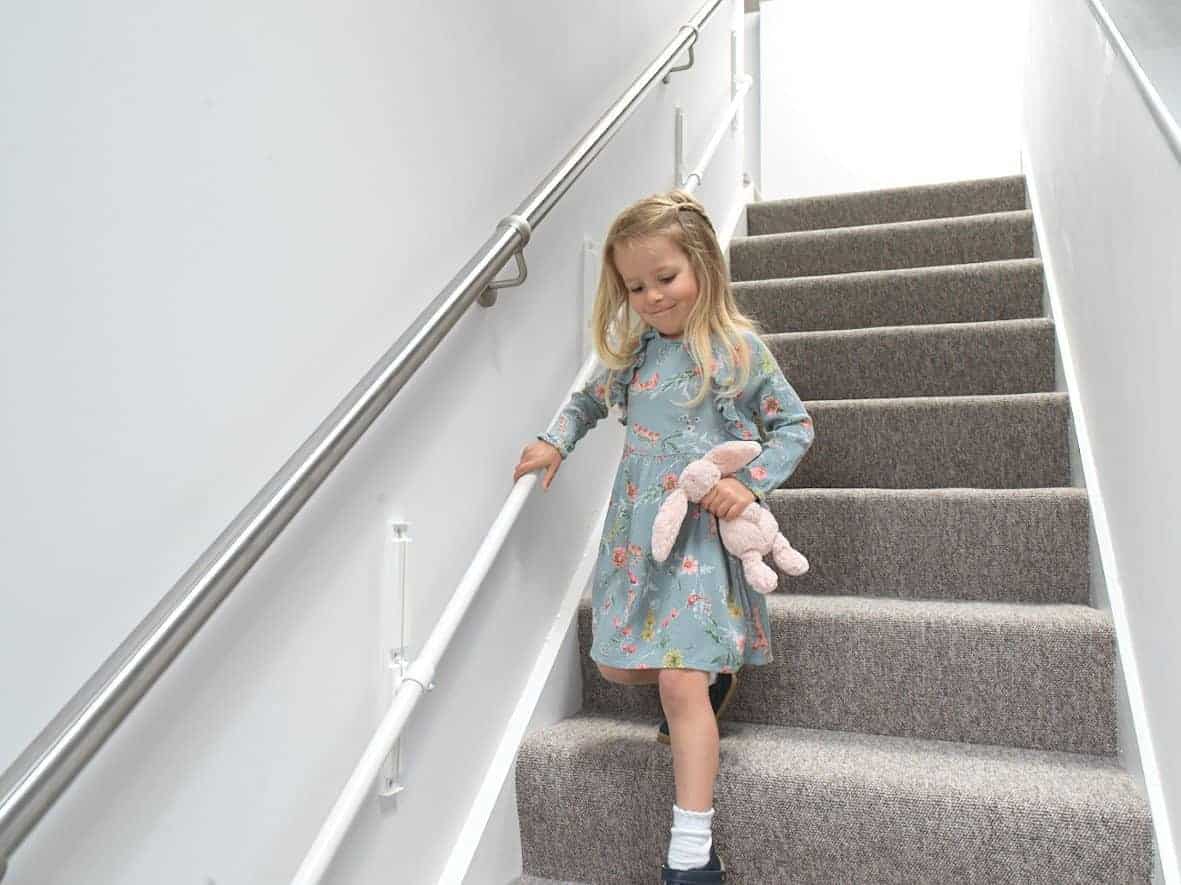
A standard adult handrail sits well above a toddler’s reach, which means your child either grips nothing or grabs at balusters that were never designed to be held. An adjustable child-height handrail, fitted below the main rail, gives a toddler a grip point at their own height and lets them practise the same climbing motion they’ll use as an adult, rather than crawling or being carried every time.
Surfaces and lighting cause as many near-misses as missing barriers. Fix these on the same day you fit a gate:
- Add non-slip nosing or a securely fixed stair runner to reduce slipping on bare treads.
- Repair or report any loose, wobbly or uneven steps immediately, especially in a rented block.
- Improve lighting on the staircase so shadows don’t hide the edge of a step.
- Clear toys, shoes, laundry and bags off every tread, every time, not just before visitors arrive.
Pro Tip: Do a “stair sweep” each evening: two minutes to clear clutter, check both gate latches, and confirm the handrail bracket hasn’t loosened.
How to choose and install a stair gate in an apartment (including renters)
Measure the opening width and depth of your staircase before you shop, and check the gate’s swing clearance against any door or cupboard nearby. A gate that looks secure in a listing photo can still fail if the frame doesn’t match your stairwell or the latch doesn’t hold under a toddler’s full weight, which is why fit and hardware detail matter more than price or appearance.
Multiple recalled child safety gates were flagged by the CPSC in recent years, sold cheaply online with entrapment and push-out defects. A recall doesn’t mean every gate on the market is unsafe, but it does mean a bargain listing deserves a closer look beforehand.
Before fitting anything, work through this order:
- Confirm whether the top of the stairs needs a hardware-mounted gate; the CPSC is clear that pressure-mounted gates are not suitable there.
- Check the latch: it should need a deliberate two-step action, not a single push a toddler could learn to copy.
- Look for a model with complete instructions, a visible product ID, and an option to register the product with the manufacturer.
- Search the model name against current recall notices, including the Ikuso gates recalled in 2026, before installing.
- Test the mounting weekly by leaning firmly on the gate from both sides.
Renting adds a layer of practical constraint. If your tenancy agreement restricts drilling into walls or banisters, ask your landlord directly about fitting a screw-mounted gate at the top of the stairs, since most landlords would rather approve a safety fixing than deal with an incident. Where drilling genuinely isn’t possible, use only a gate specifically rated for the location it’s going in, and get it professionally checked rather than improvising a fit. Latch quality and hinge strength are worth understanding in more depth if you’re unsure what “hardware-mounted” really involves; Fence Guru’s explainer on gate latches and hinges covers the mechanics in plain terms, and the same principles apply indoors.
Teaching a toddler to use stairs safely: a short progression plan
Most toddlers can start practising stairs from around 18 months, but readiness varies widely, and a child who isn’t climbing yet at that age isn’t necessarily behind. Break the skill down rather than expecting your child to manage a full flight on day one.
- Start on two or three steps with you directly behind, hands free of anything else, so you can catch a stumble immediately.
- Teach the “one step at a time” method going up before introducing alternating feet, since it’s the more stable pattern for beginners.
- Practise descending backwards on hands and knees before your toddler tries walking down forwards, since going down is harder to control.
- Keep one of your hands on the child-height rail alongside them so they learn the grip-and-step rhythm rather than relying on your hand instead of the rail.
- Set clear household rules early: no running on stairs, no toys left on treads, and always ask an adult for help carrying something up or down.
As your child’s balance and confidence improve, step back gradually rather than removing supervision all at once. A toddler who manages a supervised flight confidently for several weeks still shouldn’t be left to use it alone, because judgement about speed and carrying objects develops much later than the physical skill.
After a fall: immediate checks and red flags that need urgent care
Stay calm and check responsiveness and breathing first, before you check for visible injury. Look at how the fall happened, how far your child fell, what surface they landed on, and what they did immediately afterwards, since a clinician will ask exactly this.
Watch closely for warning signs rather than relying on how upset your child seems, because pain reaction doesn’t reliably predict a serious injury. According to Healthier Together’s head injury guidance, seek urgent medical care for:
- Loss of consciousness, even briefly, at any point after the fall.
- Repeated vomiting, a seizure, or worsening headache.
- Unusual drowsiness, confusion, or difficulty waking your child.
- Inability or refusal to bear weight, or new weakness in an arm or leg.
For a minor bump with no red flags, comfort your child, apply a cold compress if there’s swelling, and watch them closely for the next 24 to 48 hours. Contact a clinician if anything changes, however small it seems, because a delayed symptom is still worth checking.
Why a child-height handrail matters and how KiddieRail contributes
A standard handrail is fitted for adult reach, which leaves most toddlers gripping nothing at all while they climb. A rail set at a toddler’s own height gives them a stable, learnable grip point instead of a wall, a banister spindle, or your trouser leg.
An adjustable child stair handrail designed to sit below a standard rail and grow with the child allows the same fitting to be used from early climbing attempts through to independent use years later. Such rails are tested for durability and designed to suit a range of home staircase layouts, including those common in flats.
- Fits below an existing handrail without replacing it.
- Adjusts in height to accommodate growth.
- Suitable for many apartment staircase layouts.
A child-height rail is particularly useful during supervised practice sessions, and in moments when a gate is briefly open, such as while you’re carrying laundry up or down.
Pro Tip: Fit the child-height rail on the same side as your main handrail, so your toddler learns one consistent hand position going up and down.
Safe design and spacing of stair balusters to prevent toddler falls
Wide gaps between balusters, the vertical posts supporting a handrail, let a small child slip a head or body through and become trapped or fall through the gap entirely. Most modern building regulations limit baluster spacing to under 100mm, but older apartment blocks and converted properties often predate these standards, so don’t assume your staircase automatically complies.
Measure the gap between balusters yourself if your building is older or the layout looks unusual. Where gaps are wider than a small fist, fit a clear plastic guard or mesh barrier along the run of the staircase rather than relying on the balusters alone. This is especially relevant in shared apartment stairwells, where you may not have chosen the original design and can’t simply replace it.
Horizontal balusters or decorative rails that create a ladder-like structure are worth checking too, since a toddler can climb these in ways a vertical design doesn’t allow. If your building has this style, a mesh guard fitted over the horizontal elements removes the climbing risk without needing structural changes.
Check the handrail height and baluster condition together during the same inspection. A loose or wobbling baluster is both a structural fault and a grip hazard if your toddler leans on it expecting stability, so report or repair it before treating the staircase as childproofed.
Supervision best practices when toddlers are near stairs
Gates and rails buy you time, they don’t replace watching your child. A toddler doesn’t reliably understand fall risk, and a closed gate left open for thirty seconds is often the exact window in which an incident happens.
Keep both hands free whenever you’re on the stairs with your toddler, and avoid carrying anything else, including a phone, at the same time. The Child Injury Prevention Alliance’s stair safety guidance is specific that a child should never be carried on stairs in a stroller or carriage, and that keeping a hand on the handrail yourself sets the example your toddler will copy.
Position yourself below your child on the way down and above on the way up, so you’re placed to catch a stumble in the direction it’s most likely to happen. Close and check gate latches every single time you pass through, even when you’re only stepping through for a moment, since a gate left ajar is functionally the same as no gate.
Routine slips cause more incidents than equipment failure. A forgotten open gate, a cluttered landing, or furniture moved in front of a handrail are the everyday lapses that catch families out, not a gate breaking on its own. Building a habit of checking the stairs each time you use them matters as much as the equipment itself.
Emergency preparedness: first aid basics for stair-related injuries
Knowing what to do in the first minute after a fall matters more than any product on the staircase. Stay with your child, keep them still if you suspect a neck or back injury, and avoid moving them unnecessarily while you assess breathing and responsiveness.
For a visible cut or graze, clean it gently and apply a plaster or dressing once you’ve confirmed there’s no deeper injury. For a bump with swelling but no red flags, a cold compress wrapped in a cloth, held for ten to fifteen minutes, helps limit bruising. Keep a small first aid kit near the stairs in an apartment, including plasters, a cold pack, and a thermometer, so you’re not searching for supplies while your child is distressed.

Watch for changes in behaviour rather than only visible injury in the hours after a fall. Unusual sleepiness, confusion, refusal to use a limb, or persistent vomiting can appear without an obvious bruise, and any of these warrants medical attention regardless of how minor the fall looked.
Save your local emergency number and the nearest urgent care or accident and emergency department in your phone before you need them, not after. If in doubt, call for medical advice rather than waiting to see if symptoms pass, particularly with a head injury, where the Healthier Together guidance recommends erring towards assessment.
Alternatives to traditional stairs or modifications for toddler safety
A securely fixed stair runner does more than soften a fall. It also improves grip underfoot, which reduces the slips that cause falls in the first place, particularly on hard flooring common in apartment blocks. Choose a runner rated for stairs specifically, fixed with grippers or rods rather than loose-laid, since a shifting runner creates its own trip hazard.
Foam or padded stair treads offer a softer landing on individual steps, which some families use during the early practice stage before a toddler’s balance is reliable. They’re a supplement to the barrier and handrail setup, not a replacement for either, and shouldn’t be relied on as the main safety measure.
Flooring choice around the base and top of the stairs also affects fall severity. Hard, high-gloss tile at the bottom of a staircase increases both slip risk and impact severity compared with a textured or matte surface; Hardrock Stone and Tile’s guide to slip ratings explains how these ratings work if you’re choosing flooring for a family home.
If your apartment has an unusually steep or narrow staircase, sometimes found in converted or loft-style buildings, it’s worth understanding the geometry constraints before assuming a standard gate or rail will fit; Tenen Ltd’s guide to loft staircase installation gives useful background on how bespoke stair layouts are measured and adapted, which can help you work out what modifications are realistic in your own space.
First-person perspective on balancing safety and family life in an apartment
Fitting a gate that needs drilling in a rented flat is a genuine hassle, and no parent enjoys the disruption of installation day. But the trade-off is straightforward: a short inconvenience now against a fall later. Layered protection, a gate, a rail your child can actually use, and steady supervision, matters more than any single product. None of it replaces watching your toddler on the stairs yourself.
— Paul
Where KiddieRail fits: product summary and direct link to buy or learn more
Once your gates and household rules are in place, the missing piece for most families is a handrail your toddler can genuinely use. KiddieRail’s adjustable child stair handrail fits below your existing rail and grows with your child, so it stays useful from first climbing attempts through years of independent use, rather than being outgrown within months.
It’s particularly useful during supervised practice sessions, on longer flights common in multi-storey flats, and in the moments when a gate is briefly open and your toddler still needs a stable grip.
- Fits underneath a standard handrail without replacing it.
- Adjusts in height as your child grows.
- Suited to a range of apartment staircase layouts.
You can view the KiddieRail Adjustable Child Stair Handrail directly, browse the full range in the shop, or pick up an Extension Pack priced at £24.99 to £36.99 one-off if your existing rail needs extending for a longer staircase.
Primary safety guidance and recall pages to check
Before fitting any gate or rail, check these sources for current standards and recall status.
- CPSC gates and enclosures FAQ for installation standards.
- CPSC recall notices for current product safety issues.
- Child Injury Prevention Alliance stair safety guidance for carrying and handrail advice.
- KiddieRail’s own guide to checking stair gate condition and recalls.
This article is general information, not a substitute for advice from a qualified doctor. Consult a qualified healthcare professional about your own circumstances before acting on anything here.
Sources
- Gates and enclosures — CPSC FAQ
- CPSC recalls summary (2025) — child safety gates
- Stair safety — Child Injury Prevention Alliance
- Healthier Together — head injury guidance
- CPSC recall and safety advice (Ikuso gates, 2026)
FAQ
Should a 2 year old be able to climb stairs?
Many two-year-olds can climb stairs with a handrail or supervision, often one step at a time before alternating feet, but the range of normal development is wide. If your toddler shows no interest or ability to attempt steps by this age, mention it at their next check-up rather than assuming it will resolve on its own.
My 2 year old fell down the stairs, what should I do?
Check responsiveness and breathing first, then watch closely for red flags such as loss of consciousness, repeated vomiting, seizures, or unusual drowsiness, as outlined in Healthier Together’s head injury guidance. Seek urgent medical care if any of these appear, and contact a clinician for advice even with a seemingly minor fall if anything changes over the following day.
How can I make my toddler’s stairs more safe?
Fit a hardware-mounted gate at the top of the stairs and a gate at the bottom, add a child-height handrail your toddler can grip, and clear toys and loose items off every tread. Improve lighting, check baluster spacing for gaps a small child could slip through, and supervise closely while your child is learning to climb.
My 3 year old can’t climb stairs, what should I do?
Developmental pace varies, and a three-year-old who avoids or struggles with stairs isn’t automatically a cause for alarm, but new or worsening difficulty is worth raising with a clinician. Mention any accompanying signs such as frequent falls, pain, imbalance or weakness, since these point to something worth investigating rather than a simple delay in confidence.
Is a pressure-mounted gate safe at the top of the stairs?
No, pressure-mounted gates are not recommended at the top of stairs because a child leaning against them can push the gate loose. The CPSC recommends a hardware-mounted gate, fixed to the wall or banister with screws, for the top position specifically.


