
Currently Empty: £0.00


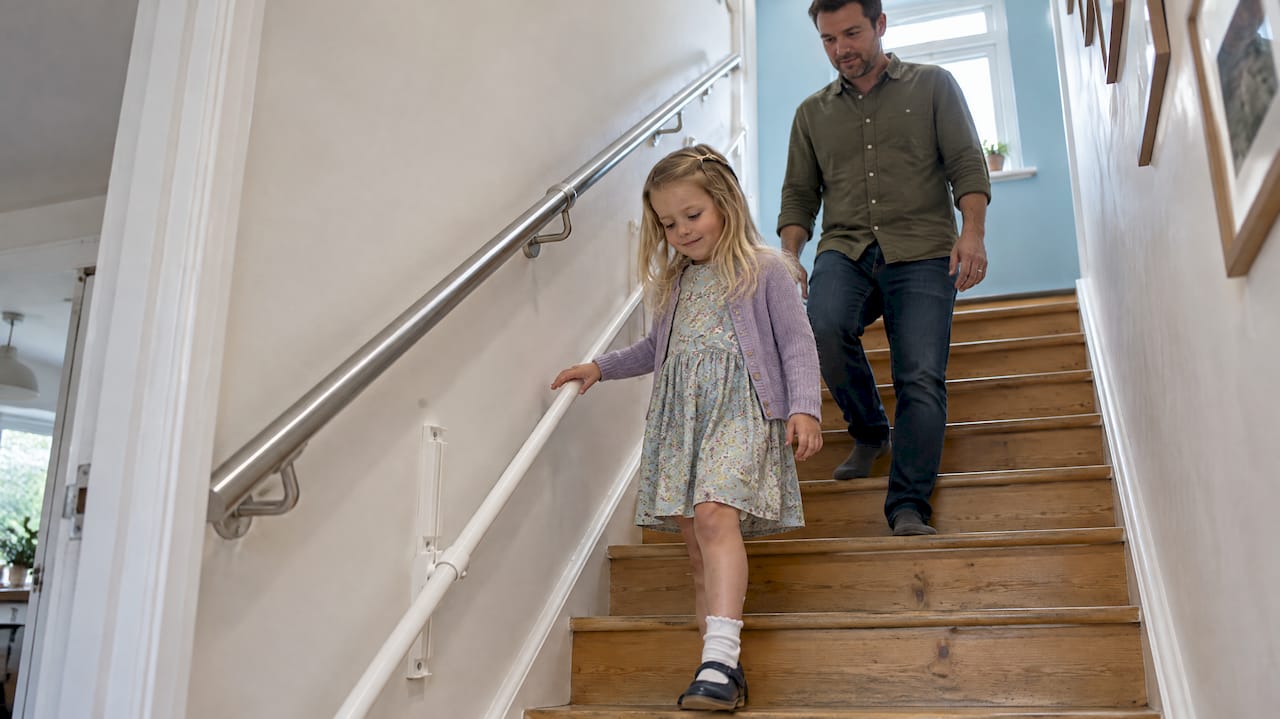
A child handrail for hardwood stairs should sit roughly 600 to 750 mm above the stair nosings, be smooth and easy for small hands to grip, and be fixed into solid structure, not just the surface finish. On polished hardwood, where small feet and socks slip easily, a rail at the child’s own height gives them something to hold at every step. This guide covers the height to aim for, the features that matter, and how to fit a rail to hardwood without damaging the stairs.
TL;DR
- Standard adult handrails are too high for toddlers. A second, lower rail at around 600 to 750 mm suits young children.
- Choose a smooth, continuous rail with rounded edges and a grip a small hand can close around.
- Fix into solid timber or a backing board, never into plaster alone, and pre-drill hardwood to avoid splitting.
- A handrail works best alongside stair gates for the youngest children, clear steps and a free hand for the rail.
- Check the fixings every few months and move the rail up as your child grows.
Table of Contents
- Why hardwood stairs call for a child-height rail
- What height should a child handrail be?
- Features of a safe handrail for children
- Fitting a child handrail to hardwood stairs
- Our view: a rail that grows with your child
- Fitting KiddieRail to your staircase
- Checking and maintaining the rail
- Other ways to reduce stair falls
- FAQ
- Sources
Why hardwood stairs call for a child-height rail
Hardwood stairs look wonderful, but they are hard and often smooth. Carpet cushions a fall and adds grip. Bare wood does neither. A UK study of young children’s stair falls found that not having carpeted stairs was linked to higher risk, with an adjusted odds ratio of 1.52. The same study found that falls on stairs or steps made up 18% of emergency department attendances for falls in children under 5 in England and Wales.
That does not mean you should cover up a beautiful staircase. It means a child on hardwood benefits from one extra thing to hold. An adult rail at 900 mm or more is well out of reach of a two-year-old. A handrail at the right height gives them support and reassurance, which is exactly what UK Department for Education guidance says handrails offer younger pupils and people of short stature.
It also teaches a habit. A child who learns early to reach for the rail, and keep a hand on it, carries that habit through the years when they are too big for a gate and too fast for a parent to catch.
What height should a child handrail be?
There is no single number that suits every child, which is why adjustability matters. The official guidance gives a useful range, though.
| Source | Guidance for children’s handrails |
|---|---|
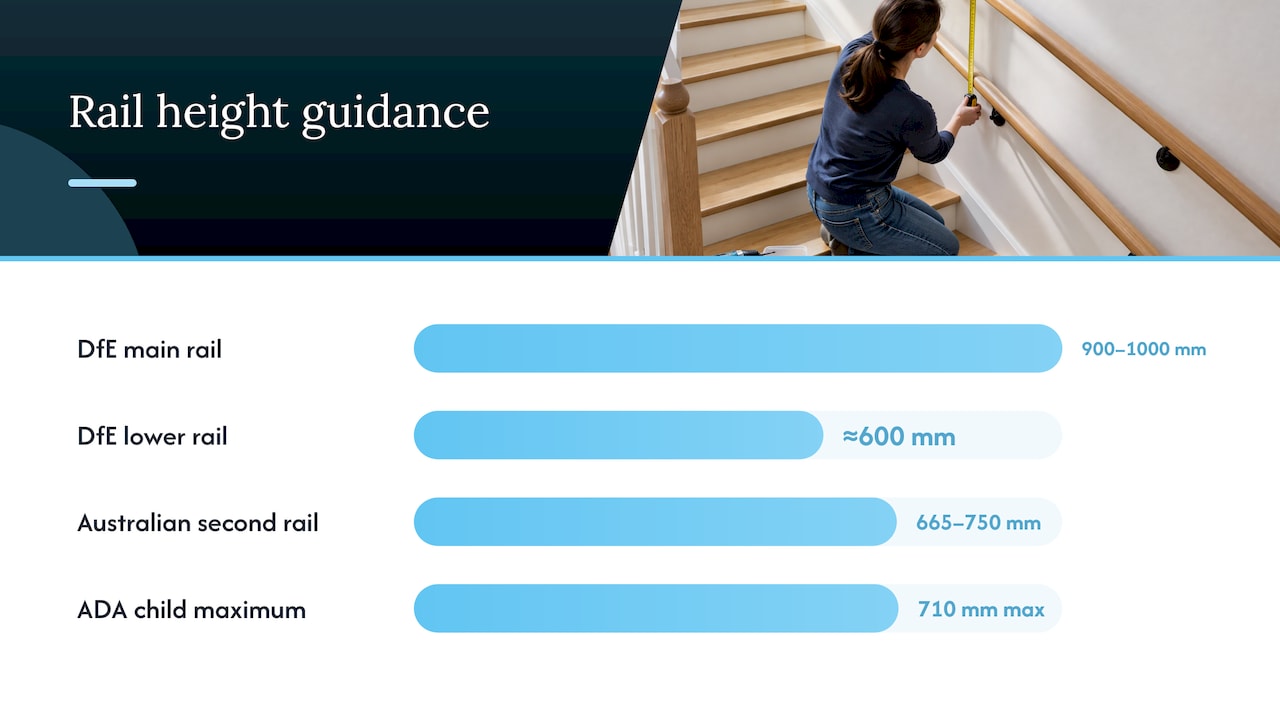
| UK DfE guidance on school stairs | Main handrail at 900 to 1000 mm above the nosing line. For pupils aged 12 or under, an additional lower rail at approximately 600 mm is preferred |
| Australian Building Codes Board | In primary schools, a second handrail at a practical height between 665 mm and 750 mm |
| 2010 ADA Standards, section 505 | Advisory maximum of 28 inches (710 mm) for handrails designed for children where they are the main users |
| US Access Board, Chapter 5 | Second rail at 28 inches maximum above nosings, with at least 9 inches of clearance between rails to help prevent entrapment |
These are school and public-building rules, not a legal requirement for your hallway, but they show a consistent picture. A child rail belongs somewhere between about 600 and 750 mm above the nosings, measured vertically from the front edge of the tread. For a toddler, aim for the lower end. For a confident five-year-old, the upper end.
A practical test: have your child stand on a step with their arm relaxed and slightly bent. The rail should be about where their hand naturally falls, so they can hold it without reaching up or stooping. Measure from the nosing, not the floor, because the stair slopes.
Our own page on child handrail placement goes through how to find that position on your staircase.
Features of a safe handrail for children
When you compare options, look at these in order.
A grip a small hand can close around
Adult handrail guidance sets a round section at roughly 1¼ to 2 inches (about 32 to 50 mm) in diameter. A UK school staircase guide describes a continuous, smooth, round or oval section of 40 to 50 mm as ideal. Those are adult-sized figures. For a toddler, a rail towards the slimmer end of the range is easier to hold, so avoid anything chunky or flat that a small hand cannot wrap around.
Smooth, rounded surfaces
The US Access Board says gripping surfaces must be free of sharp or abrasive elements. For children, that includes rounded ends and edges, no rough joints and no protruding screw heads. Children slide their hands along rails, so anything that snags is a problem.
Continuity
The same guidance says a handrail should be continuous along the full flight, with nothing that breaks a handhold. A child who has to let go halfway has lost their support at the moment they need it. If your stair turns a corner or has a landing, think about how the rail continues around it. This is where extension lengths are useful.
Non-toxic finishes
Children chew rails. Guidance on child-safe handrails says materials should be non-toxic and free from lead-based paint or toxic varnishes. If you are adding your own timber rail, check the finish is suitable for a nursery or toy and fully cured before use.
Contrast with the wall
DfE guidance says handrails should have clear visual contrast with their background without being highly reflective. On a hardwood staircase with a pale wall, a rail in a similar colour can disappear. Pick something a child can easily see.
Gaps and climbing
The rail is only part of the picture. Balustrades should not let a child climb or slip through. UK school guidance says any opening should stop a 100 mm sphere passing through and that horizontal rails should be avoided, because they make a ladder. A New Zealand hospital report recommends vertical rungs with uprights no more than 80 mm apart. If your existing spindles are wider, a gate or infill is worth considering alongside the handrail.
Fitting a child handrail to hardwood stairs
Hardwood is dense, which is good news for strength and bad news for careless drilling. Take your time.
Where the rail goes
Most child rails mount to the wall alongside the stairs, below the adult rail. Others fit to the balustrade. Which one suits you depends on your staircase, but the principle is the same: the fixing needs something solid behind it.
Fixing into something solid
A rail a child leans on or catches themselves with takes real load. DIY guidance for stair handrails advises that brackets must be anchored securely to the wood framing behind drywall or plaster, not just the surface. The same guide suggests bracket spacing of two at the top, one at the bottom and one about every 48 inches between. Check the spacing your chosen rail specifies, as designs differ.
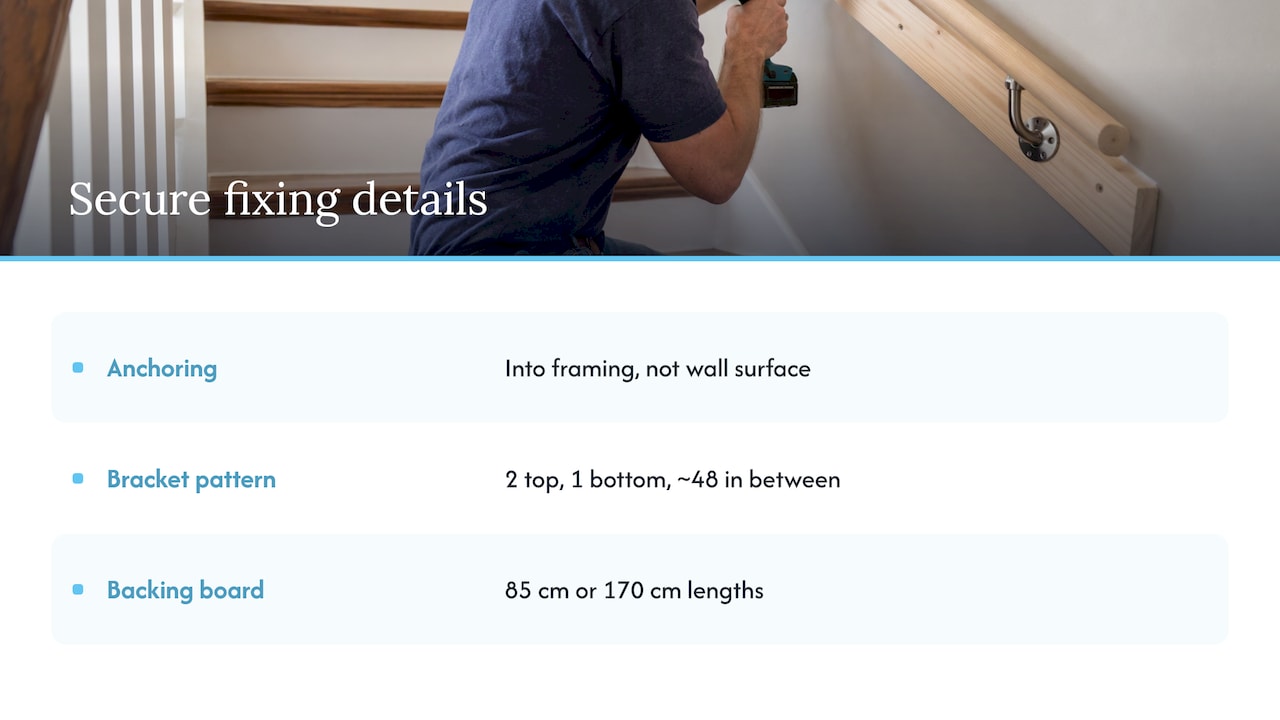
If there is no timber behind the wall at the heights you need, a backing board gives you something to screw into. We cover the options in our guide to installing a handrail backing board, in 85 cm and 170 cm lengths.
Step by step
- Measure your child. Stand them on a step and mark where their hand falls, then measure vertically from the nosing.
- Find the structure. Use a stud finder or check from the loft or cupboard under the stairs to locate timber behind the wall.
- Mark the bracket positions. Use a spirit level or laser line. Set the rail parallel to the stair slope, not horizontal.
- Pre-drill. In hardwood, always drill a pilot hole slightly narrower than the screw. Without it, the timber can split, especially close to an edge.
- Fix and tighten. Use the screws and fixings supplied with the rail. Do not overtighten, as that can strip the thread or crack the wood.
- Test the load. Pull and lean on the rail yourself, firmly, before your child uses it. It should not flex or shift.
- Check the ends. Make sure there are no sharp edges, and that the rail starts before the first step and continues to the last, so your child can take hold before they climb.
Handrails matter most at the ends. The Seattle building department notes that trips are most likely at the top and bottom of stairs, so make sure the rail reaches both.
If you are refinishing or renovating the staircase at the same time, fit the rail after the finish has cured. Home renovations often involve several trades on the stairs, so it helps to plan the order of work before anyone picks up a drill.
Our view: a rail that grows with your child
Parents often tell us they have a gate on the stairs and think the job is done. A gate keeps a toddler off the stairs. It does nothing for them once they are climbing, and every child gets there, usually sooner than expected.
That is why we designed KiddieRail as a handrail, not a barrier. It sits below a standard handrail, at a height a young child can reach, and it adjusts, so the same rail serves a toddler and a school-age child. It is designed to suit any home staircase layout, including hardwood, and parents can fit it themselves.
We would rather a child learned to use the stairs well than only be kept away from them. A rail at the right height supports that, and gives them a little confidence on every step.
Paul
Fitting KiddieRail to your staircase
KiddieRail is an adjustable child stair handrail that fits below your standard handrail, so your hardwood staircase keeps its look and your child gets a rail at their level. It has been tested for durability and is designed for straightforward self-installation.
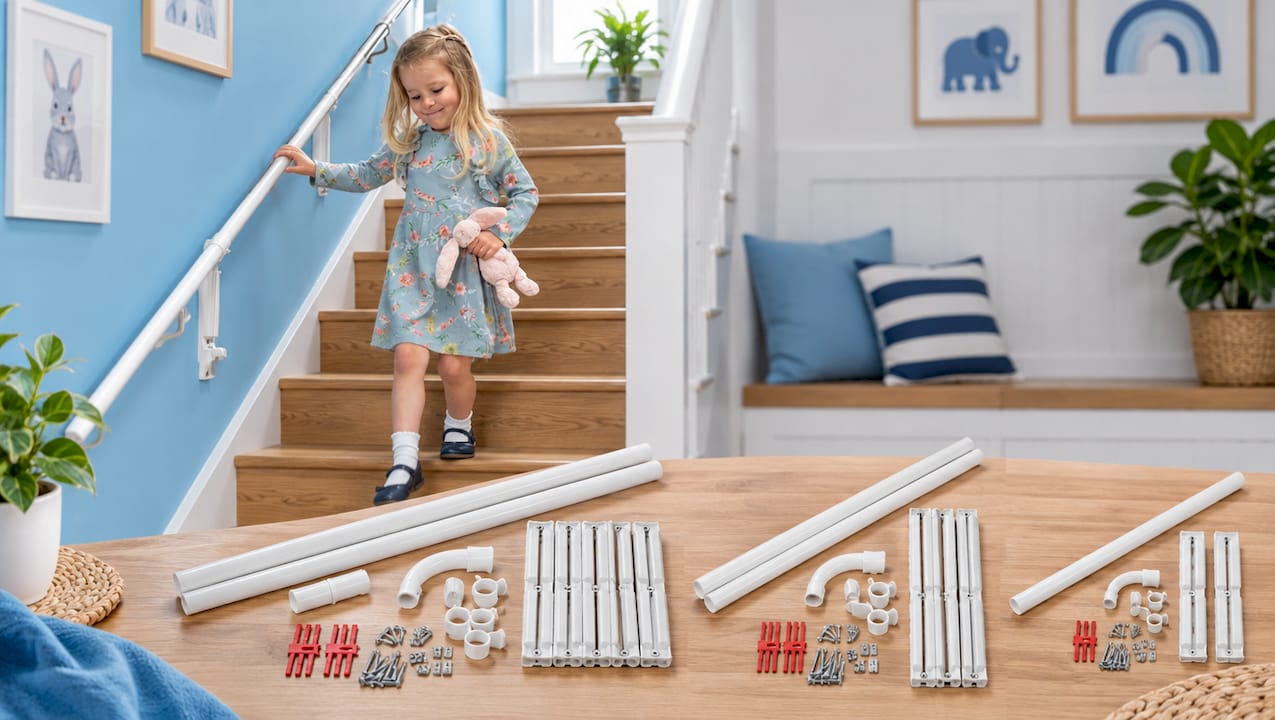
You can see the full range on our shop page, or go straight to the KiddieRail Adjustable Child Stair Handrail. For longer flights, or staircases with a turn, extension packs add more length. They cost from £24.99 to £36.99 one-off, depending on size, and come in 85 cm and 170 cm additional lengths.
Checking and maintaining the rail
A handrail is only useful if it stays firm. Build a quick check into your routine, perhaps whenever you vacuum the stairs.
- Wobble test. Hold the rail and push it down and sideways. Nothing should move.
- Fixings. Queensland’s guidance on balcony and stair safety advises checking fixings for rust, bending or fractures and inspecting fasteners for deterioration. Do the same with brackets and screws.
- Wood movement. Hardwood can shrink and swell slightly with heating and humidity. If a screw loosens, tighten it, and if the hole is worn, move to a new position or use a longer screw into solid timber.
- Height. Children grow quickly. Re-measure every few months and raise the rail as they grow. This is where an adjustable rail pays off.
- Surface. Run a hand along the rail and check for splinters, chips or rough joints.
Other ways to reduce stair falls
A handrail is one layer. The best results come from combining several.
Nationwide Children’s Hospital in the US recommends keeping stairs free of clutter and in good repair, using stair gates at the top and bottom, avoiding carrying a child on stairs when possible, and avoiding baby walkers. It also advises teaching children to keep a free hand for the handrail and to keep toys off the steps. Its study found more than 93,000 children under 5 were treated in US emergency departments for stair-related injuries from 1999 to 2008, and that the head and neck were the most commonly injured regions.
The UK evidence points the same way. In the English and Welsh study, parents of children who had fallen were significantly more likely not to have stair gates (adjusted OR 2.50) or to leave gates open (adjusted OR 3.09). The study also found that a landing part-way up the stairs was protective.
So for a crawling baby, a gate is the first thing to fit. For a child who is walking and climbing, add the handrail. Our guides on stair safety for toddlers and pairing gates and teaching set out a sensible order.
Other habits that help on hardwood in particular:
- Avoid socks without grip on the stairs. Bare feet or non-slip slippers are better.
- Keep the stairs well lit, including at night.
- Teach one step at a time, a hand on the rail, and looking where they put their feet.
- Never leave items on the steps, even briefly.
If you look after other people’s children, or have grandparents visiting, share the same rules with them. Our advice for grandparents on keeping children safe on stairs is written for exactly that.
FAQ
Can I fit a child handrail to hardwood stairs without damaging them?
Yes, if you fix to the wall or the structure beside the stairs and pre-drill every hole. Mark positions carefully before drilling, and use the fixings supplied. If you want to avoid marking the wall in the future, a backing board gives a solid fixing point that you can plan around.
What height should a child handrail be on stairs?
Guidance for children’s stairs points to roughly 600 to 750 mm above the stair nosings, for example 665 to 750 mm in Australian school guidance and about 600 mm in UK DfE guidance. Pick the lower end for a toddler, then raise the rail as your child grows. An adjustable rail lets you do this without refitting.
Is a child handrail enough, or do I still need a stair gate?
They do different jobs. A gate stops a very young child reaching the stairs unsupervised, while a handrail supports them once they are climbing. Research from England and Wales links missing or open stair gates with more falls, so use both while your child is small.
Does a second handrail replace the main one?
No. The child rail is an addition, fitted below the standard handrail, so adults and older children keep using the main rail. Both should be continuous and firmly fixed.
Sources
- Internal stairways in schools, UK Department for Education
- D3D22 Handrails, Australian Building Codes Board
- Handrails: ADA Standard Section 505
- Chapter 5: Stairways, US Access Board
- Seattle SDCI Tip #319, Getting a Grip on Handrails
- School Staircase Regulations UK 2026, Continox
- Installing Child-Safe Handrails in Your Home, Live to Plant
- Install a New Stair Handrail, Family Handyman
- Deck, balcony and window safety guideline, Queensland Government
- Risk and protective factors for falls on stairs in young children, 2015
- New Study Examines Stair-Related Injuries Among Children, Nationwide Children’s Hospital
- Safe as Houses 2020, Starship Hospital
- Home renovations


