
Currently Empty: £0.00


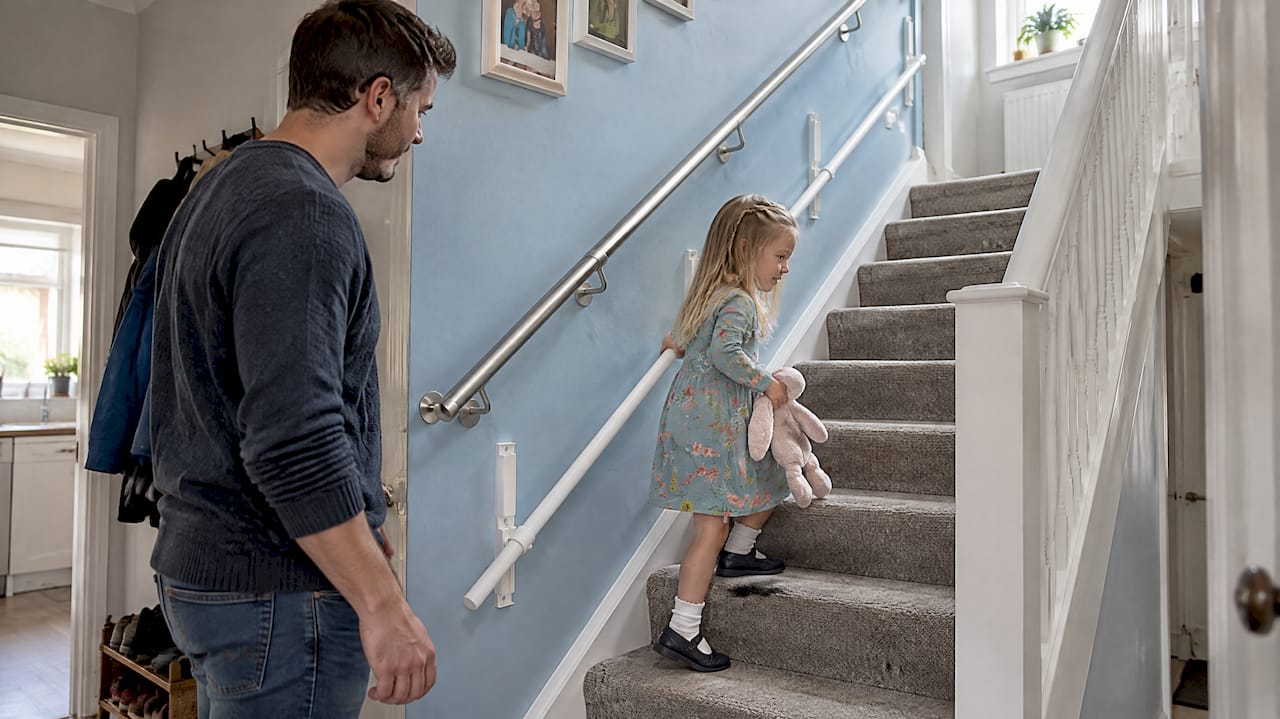
Montessori-minded parents want toddlers to learn stairs by doing them, not by being carried past them. That is a sound aim, and it only works when the staircase is set up for a child’s body: a handrail at their height, gates where they are not ready to be alone, clear steps and an adult within reach. A child-height handrail is the piece that turns stairs from a hazard into a place to practise, which is why we make the KiddieRail Adjustable Child Stair Handrail.
TL;DR
- Stairs are a leading cause of injury for young children, so independence on stairs needs a prepared staircase and an adult beside the child.
- A standard adult handrail is too high for a toddler to grip. A rail fitted lower gives them something they can wrap a hand around.
- Keep wall-mounted gates at the top and bottom until at least two years old, and remove them once a child can climb over.
- Clear the steps, keep lighting good and check fittings regularly.
- Teach one step at a time, never leave a small child to go up or down alone.
Table of Contents
- What Montessori stair practice means at home
- Step one: fit the stairs to the child
- Step two: teach the climb
- Checking the set-up over time
- Different homes, different set-ups
- Our view
- Fitting a rail to your staircase
- FAQ
- Sources
What Montessori stair practice means at home
In Montessori thinking, the home is prepared so a child can do things for themselves: low shelves, a step stool, a small jug. Stairs fit the same idea. Climbing builds balance, strength and judgement, and a toddler who is only ever carried misses that practice.
The catch is that stairs are one of the few places where a mistake costs a lot. In the United States, more than 900,000 children under 5 were treated in emergency rooms for stair injuries between 1999 and 2008, roughly one every six minutes, mostly from falling down the stairs, with head, neck and broken-bone injuries the main outcomes. The numbers are American, but the mechanics of a small child on a steep flight are the same in a British terrace.
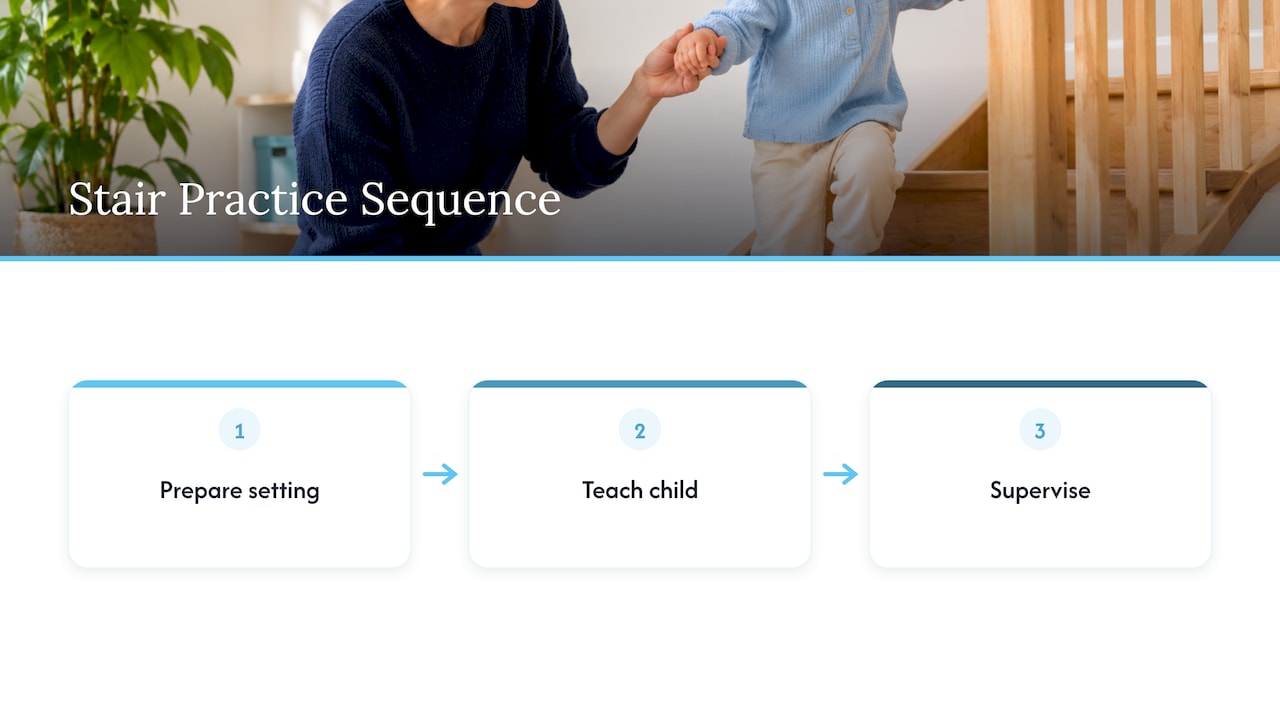
So the Montessori approach to stairs is not “let them get on with it”. It is: prepare the environment, then teach, then supervise.
Step one: fit the stairs to the child
A handrail a toddler can actually hold
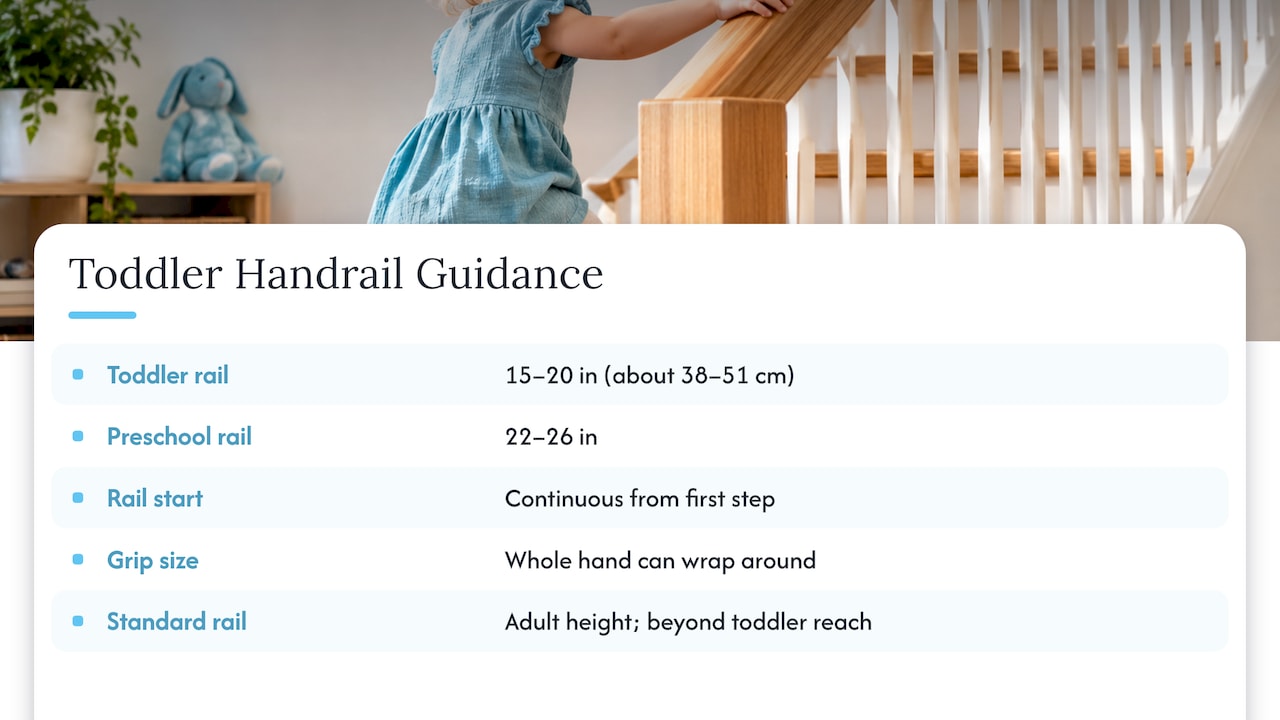
Building-standard handrails sit at adult height, well out of a toddler’s reach. The US Consumer Product Safety Commission’s 2025 handbook gives toddler handrail heights of 15 to 20 inches (about 38 to 51 cm) above the step, and 22 to 26 inches for preschoolers. It also asks for a rail that runs continuously from the first step. Nationwide Children’s adds that a rail should be small enough for a child to put their whole hand around.
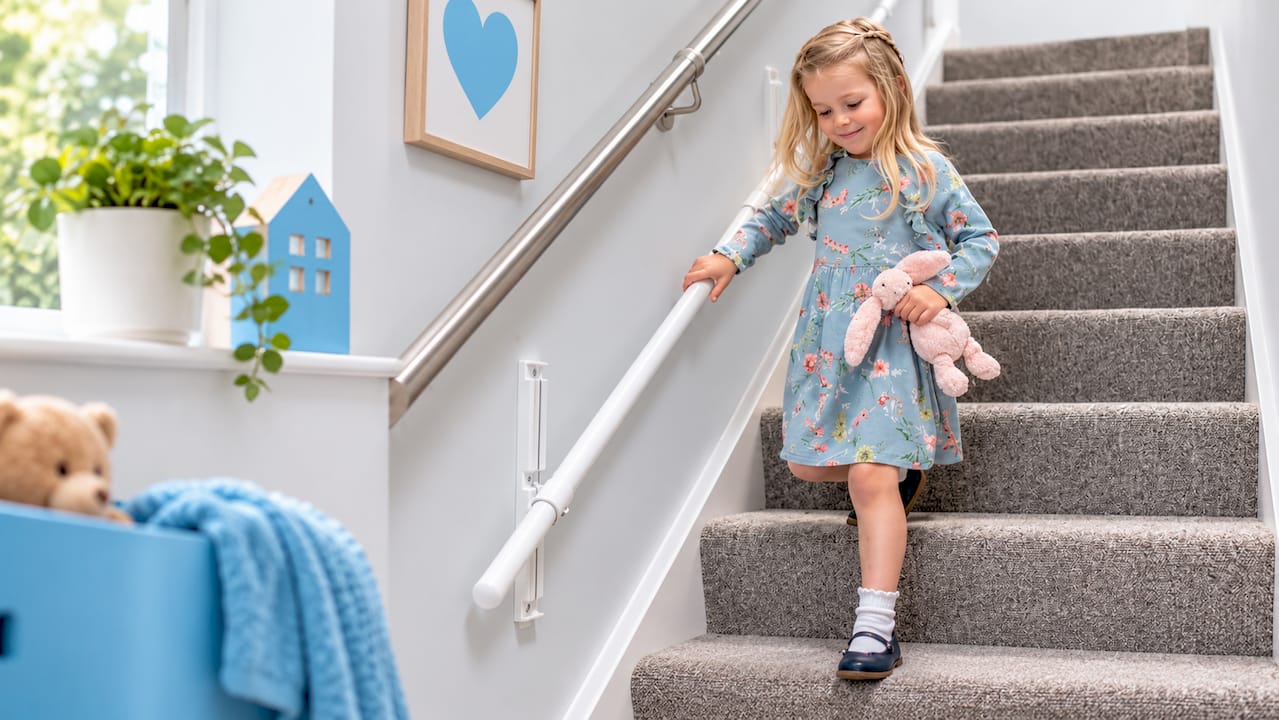
This is the job the KiddieRail does. It is an adjustable handrail that fits below a standard handrail, so a child has their own rail at their own height. Because it is adjustable, it grows with the child rather than being outgrown, and it suits any staircase layout. Our rail has been tested for durability and is designed for straightforward self-installation. If your staircase is longer or has an awkward run, the KiddieRail Extension Pack extends coverage, so the rail can stay continuous.
Gates where the child is not ready
Practice does not mean free access at all times. The NHS advice for under-fives is to keep safety gates at the top and bottom of the stairs until a child is at least two. RoSPA says the gates should be wall-mounted for children under 24 months, comply with EN 1930:2011 and be fitted following the maker’s instructions.
Two practical points from the guidance:
- At the top of the stairs use a gate that screws into the wall, not a pressure-fit one. Ottawa Public Health accepts pressure-mounted gates only at the bottom.
- Remove the gate once your child can open it or climb over it, usually around two, because a climbable gate becomes a hazard itself (Nationwide Children’s).
The gate and the child-height rail do different jobs. The gate controls when the child is on the stairs. The rail supports them once they are. Our rail actively supports a child walking the stairs, which a gate cannot do. For wide staircases, see our guide to fitting a gate with panels and a child rail.
Close the gaps and clear the clutter
A child who is practising will look at everything around them, so check the surroundings:
- Banister gaps. The NHS advises covering gaps wider than 6.5 cm (2.5 in) with boards or safety netting.
- Steps. Keep them free of toys, shoes and post. Our page on stair clutter and toddler safety explains what to clear and why.
- Light and surfaces. RoSPA recommends well-lit stairs, secure banisters without footholds for climbing, and replacing worn carpet. If your stairs are carpeted, see what still needs fixing on carpeted stairs.
Step two: teach the climb
Once the set-up is right, teaching can start. The HSE in Ireland suggests that when a child is old enough you show them how to climb stairs slowly and safely while keeping the steps clear. A simple routine works well:
- Start at the bottom. Open the bottom gate, and let your child practise the first few steps with you right behind them.
- Hand on the rail. Show them where to put their hand on their own rail and say the same words each time, such as “hand on the rail, one step at a time”.
- Going up first. Climbing up is easier to control than coming down. Add descent once they are confident, with you a step below.
- Feet, not carrying. The AAP reports that 25% of stair injuries in children under one happened while being carried. Avoid carrying a child on stairs where you can, do not carry other things at the same time if you must, and always use the handrail yourself.
- Repeat in short sessions. Little and often beats one long attempt, and tired toddlers fall.
The NHS is clear that children should never go up or down alone, and that even four-year-olds may need help. Independent does not mean unsupervised. The Nationwide Children’s research team is explicit that gates are not a substitute for adult supervision, and the same is true of any handrail.
For a fuller routine that pairs gates with teaching, read our guide on making stairs safer in under an hour.
Checking the set-up over time
A prepared staircase stays prepared only if you look at it. RoSPA advises checking gate fittings regularly. A 2026 UK guide to gate standards is not needed to start: build a habit instead.
- Each month, test that the gate’s wall fixings are tight and the latch closes firmly.
- Check that the child-height rail has not loosened, especially as you adjust it for growth.
- Look over the banister and steps for loose or damaged parts.
- Check any gate you own for recalls. Nationwide Children’s points parents to recalls.gov for US products; in the UK, look at the government’s product safety pages.
- Never use a pet gate as a child gate, and replace old gates with V-shaped openings big enough to trap a child’s head and neck (CPSC).
As your child grows, raise the rail to match their reach. That is the reason an adjustable rail makes sense: the staircase keeps fitting the child.
Different homes, different set-ups
- New homeowners. Do the stairs before anything else. Our guide to moving house with a toddler covers the order.
- Open staircases. Gaps and drops need extra care, covered in our open staircase guide for UK homes.
- Flats. Shared or short flights still need a top gate and a sweep of the steps: see apartment stair safety.
- Childminders. Several children of different ages share the same stairs, so a rail at child height and gates that are reliably closed matter even more.
- Expecting parents. Fit everything before the baby arrives, so your hands are free once they are mobile. For the wider picture, see how to prevent toddler falls.
Our view
Montessori taught many of us that children grow through doing, and stairs are no exception. A toddler who climbs with a hand on a rail that fits them learns balance and confidence far better than one who is lifted over the problem.
That is why we built KiddieRail as an adjustable handrail that sits below the standard one and grows with the child. A gate keeps a child off the stairs when they are not ready. A rail at the right height supports them when they are. We think a prepared staircase needs both, together with an adult close by.
Fit it once, adjust it as they grow, and let the practice begin.
Paul
Fitting a rail to your staircase
The KiddieRail Adjustable Child Stair Handrail is designed to fit below a standard handrail on any home staircase and to be self-installed. It is the piece that gives your child their own rail.
For longer flights, the Extension Pack costs £24.99 to £36.99, one-off. Browse the full range in our shop.
FAQ
At what age can a toddler start practising stairs?
There is no single age, but guidance keeps gates at the top and bottom until a child is at least two. Start practice as your child becomes steady on their feet, with you directly beside or behind them every time.
Do I still need a stair gate if I have a child-height handrail?
Yes, for young children. The gate controls when the child can reach the stairs, while the rail supports them while they climb. RoSPA recommends wall-mounted gates at the top and bottom for under-twos.
How high should a toddler’s handrail be?
The CPSC’s 2025 handbook gives 15 to 20 inches (about 38 to 51 cm) above the step for toddlers. An adjustable rail lets you raise it as your child grows.
Is it safe to let my toddler go up and down alone?
No. The NHS advises that young children should never use stairs alone and that even four-year-olds may need help. Practise with an adult close by every time.
Sources
- AAP News: Stairs are a leading cause of injury
- CPSC Public Playground Safety Handbook 2025
- Nationwide Children’s: Stair Safety
- Nationwide Children’s: Stairs and Hallways
- NHS Healthier Together: Child Safety at Home
- RoSPA: Preventing Falls in Children
- Ottawa Public Health: Child Falls
- HSE: Preventing falls in toddlers and children
- CPSC: Childproofing Your Home


