
Currently Empty: £0.00


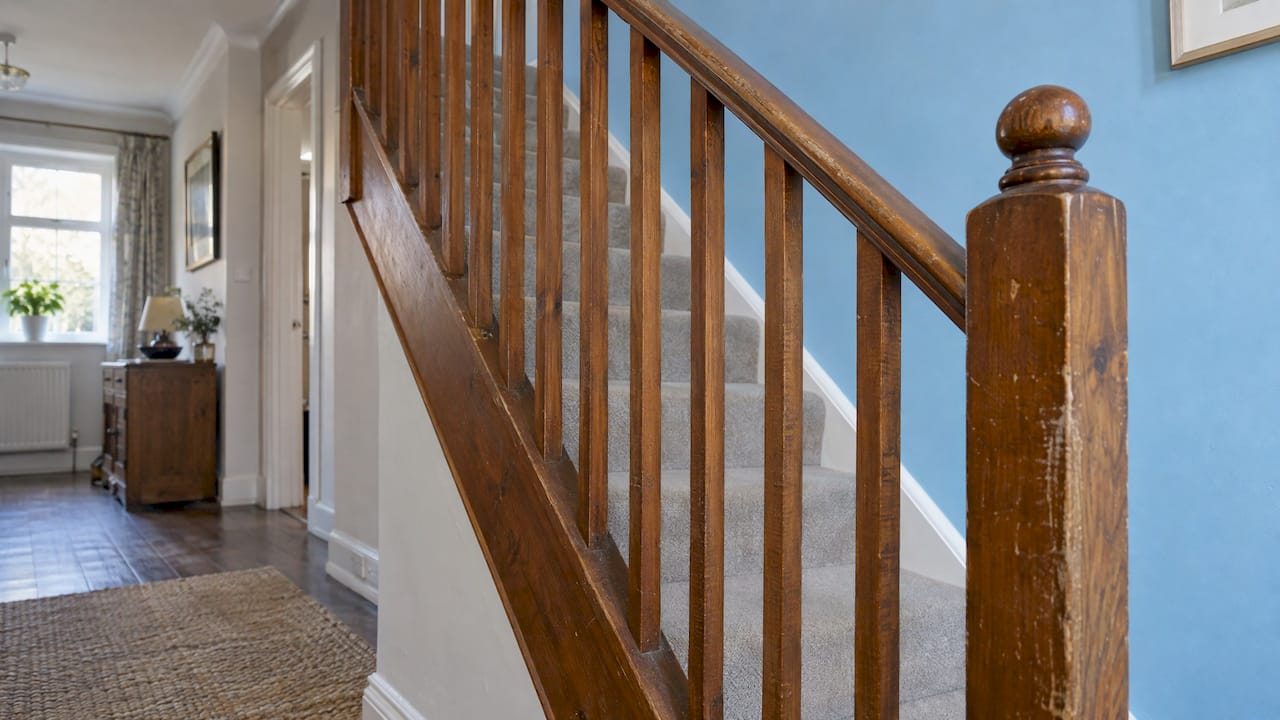
The NHS says gaps in banisters or balcony railings wider than 6.5 cm (2.5 inches) should be covered with boards or safety netting. That is the number to check first. Measure the gap between your spindles at the widest point, cover anything over 6.5 cm, and then deal with the second half of stair safety: giving your child something sound to hold at their own height while they learn to walk up and down. We make a handrail for exactly that, and we come back to it below.
TL;DR
- Gaps wider than 6.5 cm (2.5 inches) should be covered with boards or safety netting, according to the NHS.
- New stair guarding in England must stop a 100 mm sphere passing through where children under five may be present. A compliant gap can still be too wide for a very small baby, so measure your own.
- Horizontal rails and footholds invite climbing. A covering that is loose, or that stops short of the handrail, can create a new hazard.
- Gates protect the top and bottom of the stairs. A child-height handrail helps them while they are actually on the steps.
- Whatever you fit, push, pull and press it at several points, and repeat the check regularly.
Table of Contents
- Why banister gaps matter to a toddler
- The numbers: 6.5 cm, 100 mm and 99 mm
- How to measure your banister gaps
- Covering gaps that are too wide
- How to check that your fix is secure
- The other half of stair safety: something to hold at their height
- Our view
- Add a child-height rail to your stairs
- FAQ
- Sources
Why banister gaps matter to a toddler
Two things go wrong at a gap. A small body slips through, or a head goes in and cannot come back out. The NHS notes that small babies may be able to squeeze their bodies through gaps wider than 6.5 cm. The US Consumer Product Safety Commission’s playground handbook explains the second problem: openings between roughly 3.5 and 9 inches (about 9 to 23 cm) can trap a head. A child who turns their head to get in often cannot reverse out, particularly when panicking.
That is why a gap that looks small to an adult can still matter. A toddler is curious, flexible and has no sense of what will fit.
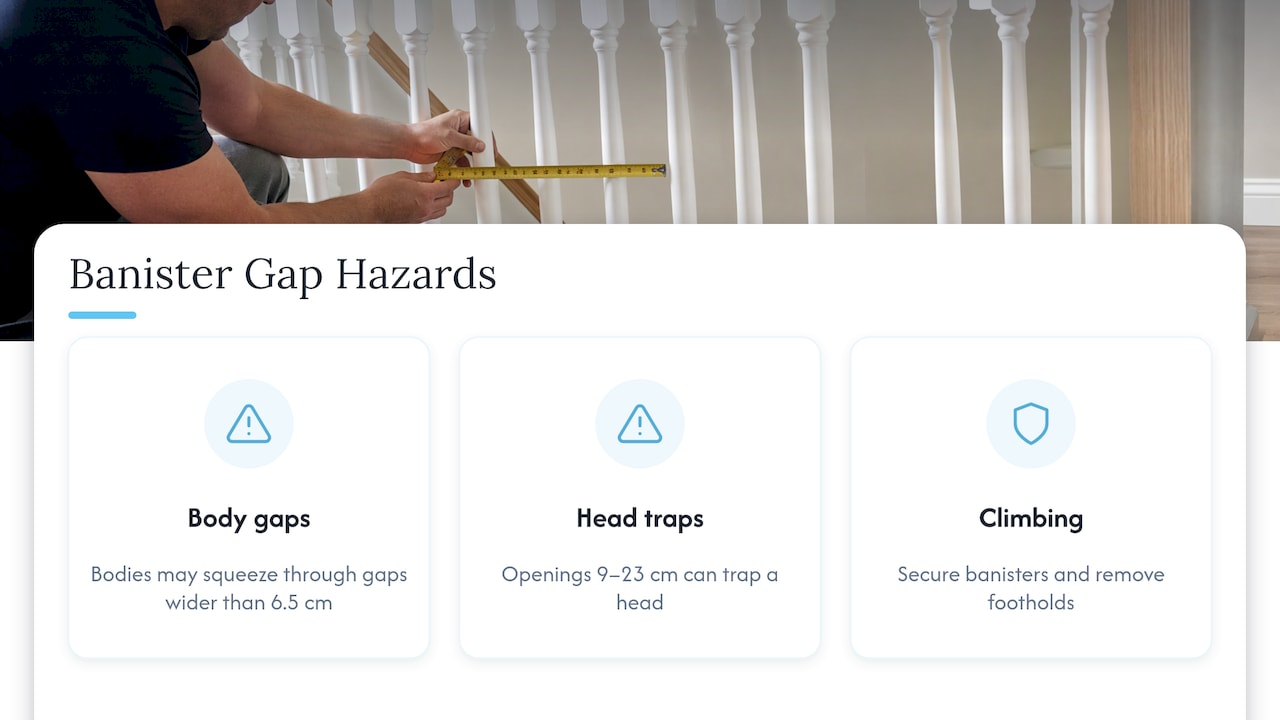
Gaps are only part of the picture. Toddlers climb. RoSPA, the Royal Society for the Prevention of Accidents, advises making sure banisters are secure and give no footholds for climbing, and keeping stairs and handrails in good repair. So you are checking three things: the width of the gaps, whether the structure can be climbed, and whether it is solid.
The numbers: 6.5 cm, 100 mm and 99 mm
You will see several figures quoted, and they do not contradict each other. They answer different questions.
| Figure | Where it comes from | What it is for |
|---|---|---|
| 6.5 cm (2.5 in) | NHS guidance | Gaps to cover when you have a baby or small toddler at home |
| 100 mm sphere | Approved Document K (England, 2013 edition) | Stair guarding in buildings children under five may use |
| 100 mm maximum | nidirect (Northern Ireland) | Gap between vertical rods |
The 100 mm sphere rule is a building-work standard: no opening in the guarding may let a 100 mm ball pass through. In practice that means a gap of 99 mm or less. Approved Document K also says guarding in such buildings should avoid horizontal rails that children could readily climb. Scotland applies a similar 100 mm sphere approach to balustrade openings. Building regulations differ between the UK nations, so check the guidance for where you live.
The practical point is this. If your gaps are 9 cm, a new staircase would pass the building rule. The NHS still suggests covering anything wider than 6.5 cm while your child is small. Parents tend to assume that “to regulations” means “safe for a baby”. Use the tighter figure while your child is little.
How to measure your banister gaps
- Measure the narrowest and widest point. Older and turned spindles are often wider at the bottom, and gaps near the stair nosing can differ from gaps higher up. Use a tape or a ruler.
- Check every flight and landing. Balcony and landing railings often have different spacing from the stair itself.
- Look at the triangle at the bottom. The space between the underside of the rail, the step and the nosing is where many stair gaps sit. Measure it too.
- Check for footholds. Horizontal bars, decorative rails and wide ledges all give a toddler something to step on.
- Wiggle the spindles. A loose spindle or newel post is a problem whatever the gap size. Fix loose fittings promptly: nidirect advises repairing loose balustrades as soon as possible.
- Write down your numbers. You will want them when you buy a cover, and when you re-check.
If you rent, ask your landlord before drilling or altering anything. A non-permanent covering is often the practical route.
Covering gaps that are too wide
The NHS and Healthier Together both point to the same options: boards or safety netting over wide gaps. Other approaches exist, and the right one depends on your staircase:
- Clear panels or board. A rigid panel cut to fit leaves no gap to push through. Scottish guidance for older buildings suggests adding balusters, fitting mesh or laminated glass panels that fit the opening accurately.
- Safety netting. Useful on balcony and landing railings. It needs to be taut and fixed at every anchor point, with no sagging.
- Extra spindles. For permanent change on a stair you own, adding balusters to bring the gaps under the limit is the most solid fix, and often best done by a joiner.
Whichever you choose, watch for three mistakes:
- A loose covering. Fabric, plastic sheeting or netting that is tied rather than fixed can stretch, detach or become something to climb. A decorative panel is not a substitute for sound guarding.
- A gap above the cover. A guard that stops short of the top handrail can leave a new gap where a head can enter. Run it from the step right up to the underside of the rail.
- A cover that gives a foothold. A rigid, horizontal edge a toddler can stand on makes climbing easier. Smooth and vertical is better.
RoSPA’s guidance on gates is a good reminder that gaps are one piece of a system. Where a gate is needed, it should comply with EN 1930:2011 and its fittings should be checked regularly. The NHS advises fitting gates to that standard once a baby starts crawling, and Healthier Together says to keep them at the top and bottom of the stairs until the child is at least two. Even with gates, never leave a small child alone on the stairs.
For wider staircases, open sides and open risers, our own guides cover the layout problems in more detail: open staircase child safety, open riser stairs and fitting a gate to wide stairs.
How to check that your fix is secure
A covering is only as good as its fixings. Do this when you fit it, and again on a routine, say monthly while your child is a toddler:
- Push and pull at several points. Test near the top, middle and bottom. There should be no wobble or give.
- Press individual spindles and panels. Each should feel tight. A loose one points to a fixing that needs tightening.
- Check the newel posts. They anchor everything else.
- Run your hand along the edges. Look for sharp edges, frayed netting, cracked panels or exposed screws.
- Check for gaps again. Panels can shift. A gap that opens at the top or bottom of a cover is exactly the one a child will find.
- Follow the maker’s instructions. Every board, net or gate you buy will come with fitting instructions. Use the fixings supplied and replace anything damaged.
Building professionals who write about home safety make the same point: a fix that was tight at installation can loosen with use, so recheck it.
The other half of stair safety: something to hold at their height
Covering gaps stops falls through the banister. It does not help a child while they are on the steps. A standard handrail sits at adult height, well out of reach of a toddler learning to climb. Gates keep them off the stairs, but they cannot teach a child to use them.
That is the job of a child-height handrail. Ours is an adjustable child stair handrail that fits below your standard handrail and grows with your child. It suits any home staircase layout, and you can fit it yourself. It has been tested for durability, and unlike a gate it actively supports a child while they walk on stairs. If you are planning how to combine gates and teaching, our guide to making stairs safer in under an hour walks through it. If you have a baby who is not yet crawling, babyproofing stairs before crawling starts is a good place to begin.
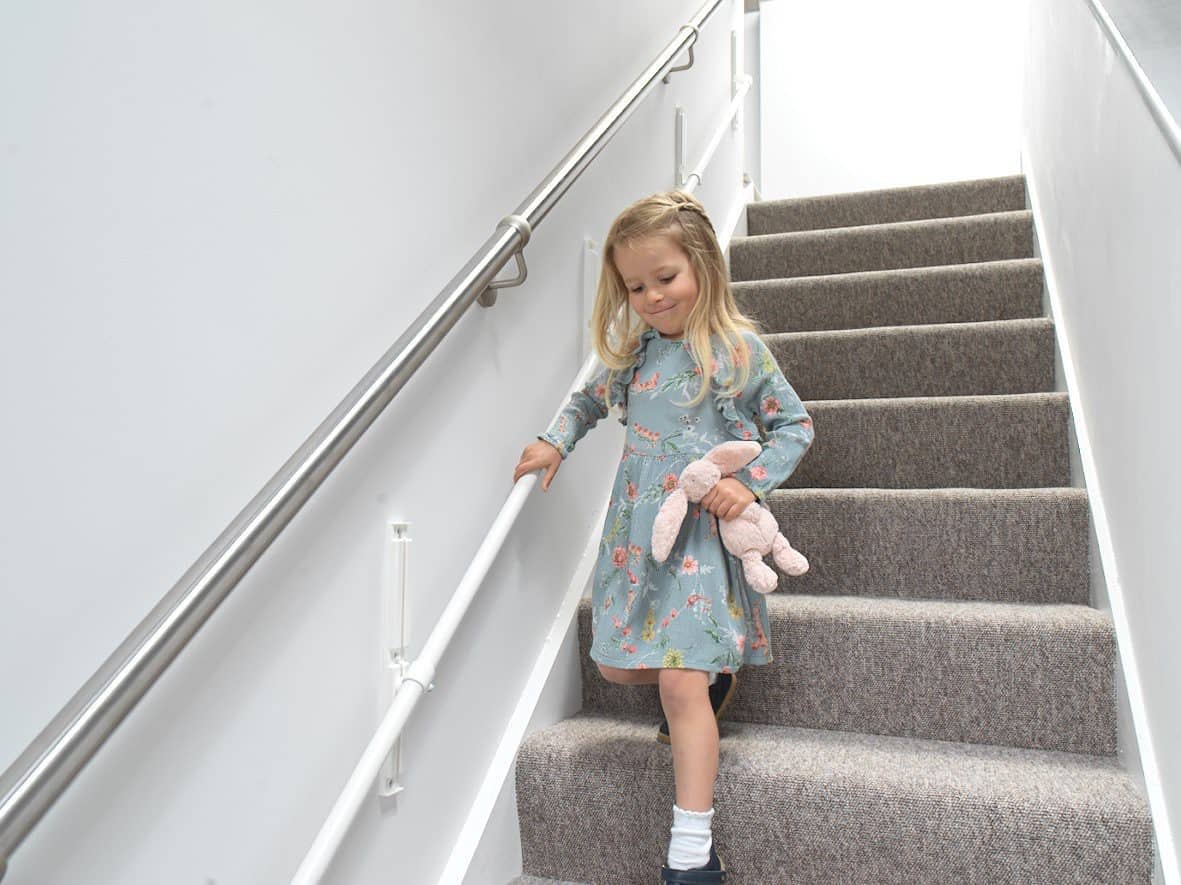
Childminders have their own needs, with several children of different ages on one staircase. We cover those in stair handrails for childminders and daycare settings.
Our view
Parents often ask us one question about stairs: “Is it the gap or is it the rail?” It is both, and they are different problems.
The gap is a fixed fact of your staircase. You measure it, you cover it, and you check the fixings. That is a job you finish.
The second problem never finishes, because the child keeps growing. A toddler who can only reach an adult handrail by stretching is a toddler who is not holding anything. That is why we built KiddieRail to be adjustable and to sit below the standard handrail. It changes height as your child does, so the support is in the right place at two, at four and beyond.
Our view is simple. Sort the gaps, use gates where they are needed, and give your child a rail they can really grip. The three work together.
Paul
Add a child-height rail to your stairs
Once your gaps are covered, the KiddieRail Adjustable Child Stair Handrail gives your child a rail at their height, fitted below your standard handrail and ready to be adjusted as they grow. If your staircase needs more length, the KiddieRail Extension Pack is £24.99 to £36.99, one-off.
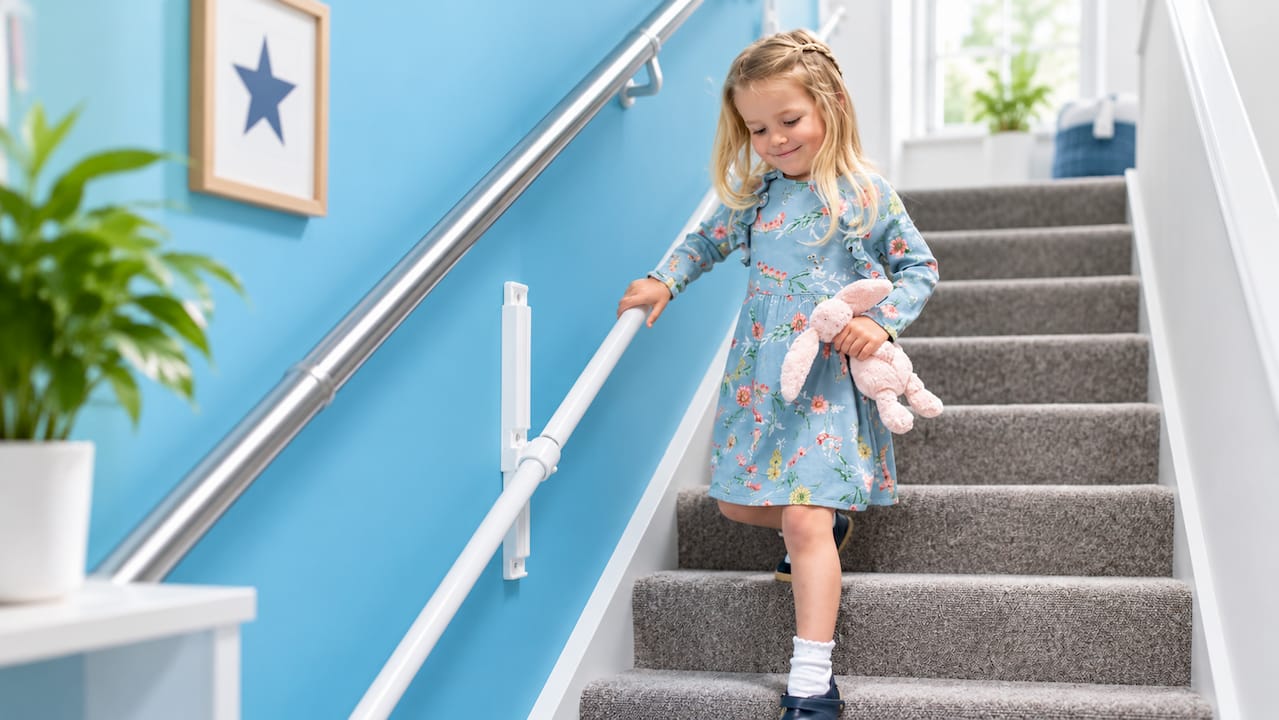
You can also see everything on the KiddieRail shop page.
FAQ
How far apart should stair spindles be?
For new stair guarding in England where children under five may be present, the gap must stop a 100 mm sphere passing, so 99 mm at most. For a baby or small toddler, the NHS advises covering any gap over 6.5 cm. Measure your own and use the tighter figure while your child is small.
What is a banister cover?
It is a guard fixed along the banister or railing to close gaps a child could slip or put their head through. The NHS names boards and safety netting as the options. Whatever form it takes, it must be fixed firmly, run right up to the handrail and give no foothold.
Do I still need a stair gate if I cover the gaps?
Yes. Covering gaps deals with the railing, while gates keep a young child off the stairs. Healthier Together advises keeping gates at the top and bottom until your child is at least two. Choose gates that meet BS EN 1930:2011.
Can a child climb a banister?
Yes, particularly where there are horizontal rails or other footholds. Approved Document K says guarding where under-fives may be present should avoid horizontal rails that children can readily climb. RoSPA advises that banisters should not provide footholds.
Do the rules differ outside England?
Yes. Scotland applies a 100 mm sphere rule to balustrade openings, and Northern Ireland’s nidirect advises gaps of no more than 100 mm between vertical rods. Other countries use different limits, so check local guidance.
Sources
- Baby and toddler safety, NHS
- Child safety at home, Healthier Together
- Guarding children against trips and falls, nidirect
- Preventing falls in children, RoSPA
- Approved Document K: Protection from falling, collision and impact
- Pedestrian protective barriers, gov.scot
- Public Playground Safety Handbook, CPSC


