
Currently Empty: £0.00


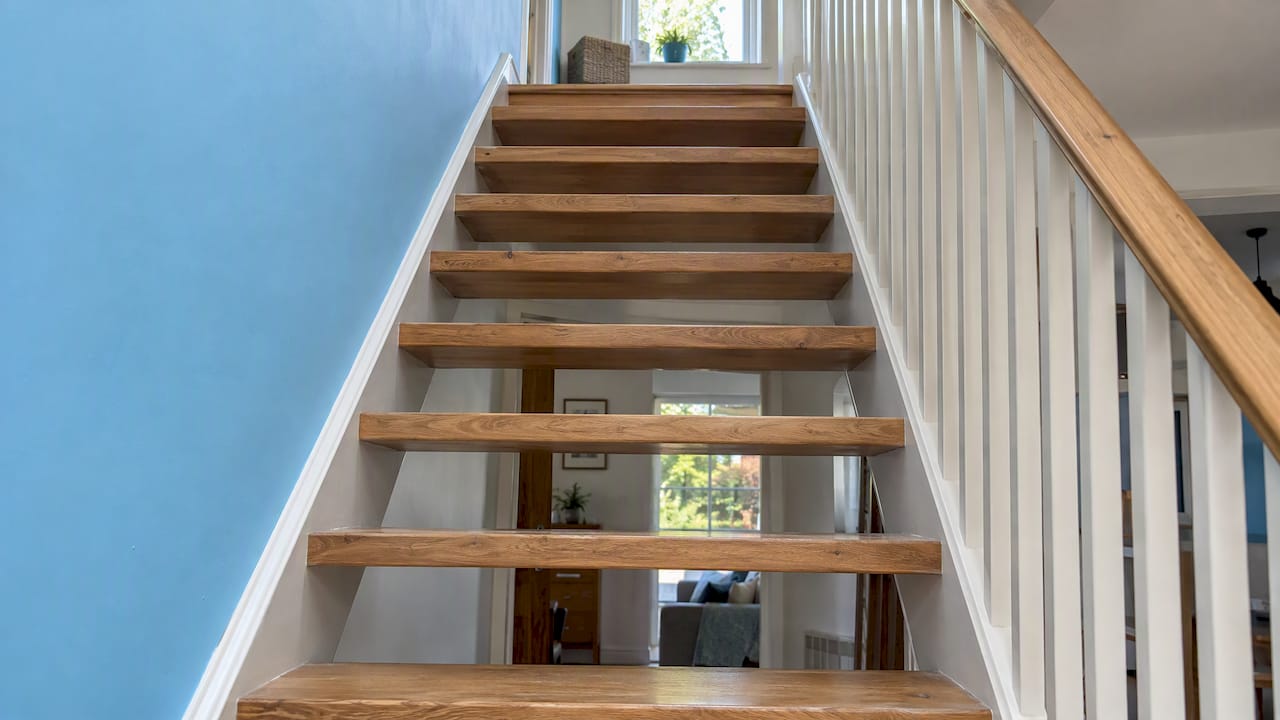
Open riser stairs are safe enough for a toddler only when the gaps are small, the guarding cannot be climbed and the child has something to hold at their own height. In the UK, the gap rule is a 100mm sphere, and you can check it in a minute with a tape measure. If your stairs fail, you can close the gaps, add guarding, gate the stairs while your child is small, and fit a handrail they can actually reach.
This guide is for parents, childminders, new homeowners and anyone preparing a home for a baby. It shows what to measure, what the rules say, how to fix common problems and where a child-height rail fits in.
TL;DR
- In England and Wales, open risers should be built so a 100mm sphere cannot pass through. Measure your gaps, because older or custom stairs may not meet this.
- Gaps are only half the problem. Guarding that a toddler can climb, or a handrail set too high for small hands, can be just as risky.
- Closing gaps with riser boards, filler panels or clear guarding is usually the simplest fix. A qualified joiner or building control can confirm what is right for your staircase.
- A stair gate helps with the youngest children. A lower handrail helps once they start walking stairs on their own.
- We make an adjustable child handrail that fits below a standard handrail, so your child has a grip at the right height.
Table of Contents
- Why open risers worry parents of young children
- What UK rules say about open risers and children
- A five-minute check of your open riser stairs
- Ways to make open riser stairs safer
- The handrail problem: adult height, child hands
- Perspective
- Fitting a child handrail to an open riser staircase
- KiddieRail for your staircase
- When to call a professional
- A simple plan by age
- FAQ
- Sources
Why open risers worry parents of young children
An open riser staircase has treads with nothing behind them. It looks light and modern, but for a child it creates three problems.
Fall-through. A small body, feet first or head first, can pass through a wide gap. Child safety guidance from New Zealand’s Starship Foundation treats open-riser design as an entrapment and fall-through issue, not just a style choice. It says treads should be visible and designed so children cannot get stuck or fall through.
Entrapment. A head can slip through a gap that a body cannot, and then be held. This is why the gap limits exist.
Climbing. Horizontal rails and decorative members on a balustrade work like a ladder. Home inspection guidance from InterNACHI says guards should lack horizontal or ornamental features that help children climb.
There is also the ordinary risk of stairs themselves. A UK multicentre study of 610 injured children under five found that stair falls most often caused head bangs (66%), then cuts or grazes and fractures. Open risers are not singled out in that study, but it is a reminder of why every detail of a staircase matters when a child is small.
What UK rules say about open risers and children
The building regulations for England, Approved Document K, set the main limits. The guidance says steps may have open risers if the treads overlap by at least 16mm and the steps are built so a 100mm sphere cannot pass through. The same document says that in a building that may be used by children under five, guarding to a flight of stairs should prevent children being held fast by the guarding and should not be easy to climb.
A few points follow from that:
- The 100mm figure is a sphere test, not a ruler test. A gap that is 90mm high but long and wide can still be a problem for a head or limb if it is not blocked in other places, so check every opening, including those at the side of the stair.
- Rules apply to new work. Stairs built before the current guidance, or bought from abroad, may have wider gaps. Check yours rather than assuming.
- Scotland, Wales and Northern Ireland have their own technical standards. If you are altering stairs there, ask your local building control what applies.
- Handrail height is also set out in the guidance. One UK cost guide summarises the Part K handrail height as 900 to 1,000mm above the pitch line. That is an adult height, which is why a small child cannot use it.
How other countries compare
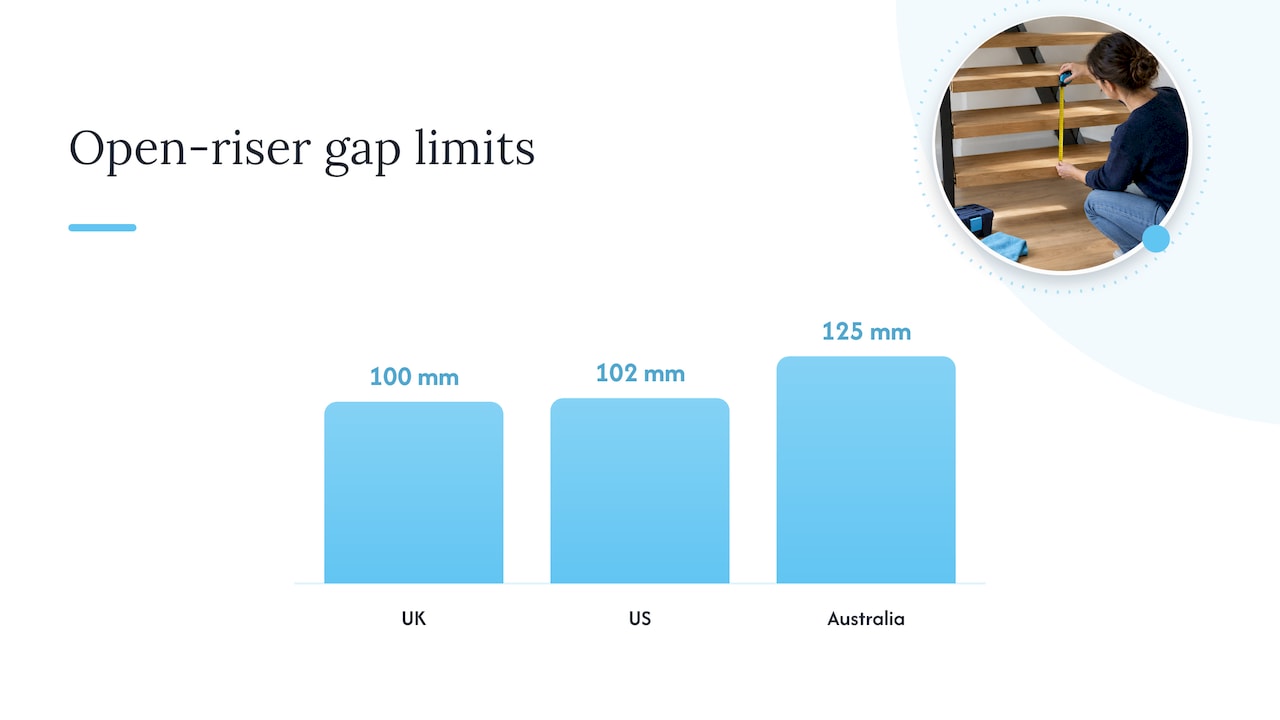
If you read American advice online, the number you see is 4 inches. The International Residential Code, as adopted by cities such as Baltimore, permits open risers if a 4-inch (102mm) sphere cannot pass through. It also allows an exception where the total rise is 30 inches (762mm) or less. That exception is a US rule and does not apply in the UK. Australian guidance, as set out by one stair supplier, uses a 125mm sphere. The UK limit of 100mm is the tightest of the three, which suits small children.
A five-minute check of your open riser stairs
You need a tape measure, a ball or tin around 100mm across, and a phone torch for dark corners. Walk the staircase from bottom to top and work through the list.
- Measure each gap between treads. Push the 100mm ball at the opening. If it passes through, or nearly does, treat the gap as unsafe for a toddler.
- Check the balustrade. Look for gaps between spindles, cables or glass panels. InterNACHI advises that balustrades should have no more than 4 inches between members, which matches the UK 100mm limit closely.
- Look for climbing points. Horizontal wires, rails and ledges let a child climb up and over. Vertical members are safer.
- Check the tread overlap. Treads should overlap so there is no direct view through, and so a foot is less likely to slip into the void.
- Test the handrail. It should be continuous and firmly fixed. Workplace stair guidance from the US National Institute for Occupational Safety and Health says there should be at least 2¼ inches (57mm) of clearance around the rail so a hand can wrap around it.
- Check the top and bottom. Look at the gap between the last step and the wall or landing edge, and at any side opening that a child can reach from the stairs.
- Check the surface. Bare, polished or worn treads are slippery. Pick a finish with grip, or add treads that do. If you are resurfacing, a guide to luxury vinyl plank stairs shows what to think about with a new tread covering.
Write down what fails. That list is your plan.
Ways to make open riser stairs safer
You can mix several of these, depending on your staircase, your budget and whether you rent or own.
Close the gaps
The most direct fix is to fill the opening. This Old House notes that gaps over 4 inches can let small children slip through or get stuck, and suggests closing them with riser boards or filler strips. It also recommends a licensed contractor or home inspector to check that the change meets local code.
Options include:
- Solid riser boards, painted or stained to match. This is permanent and removes the open look.
- Clear acrylic or toughened glass panels, which keep the light and sightlines. Fixings must be secure and the edges safe.
- Fine stainless steel mesh or vertical rods, if spacing stays well under 100mm and nothing can be climbed.
- Removable panels if you rent or want to restore the original look when children are older.
If the staircase is a designer or listed feature, or you are unsure how it is fixed, ask a joiner. Anything that adds load to the treads or changes the structure needs proper advice.
Fix the balustrade
If spindles or wires are too wide, a joiner can add intermediate balusters or a fine infill panel. Remove or cover horizontal rails that a child could use as steps. Stairs that are altered need to keep their handrails and guards, so do not remove protection to make a change easier.
Use a stair gate while your child is small
Gates still matter. The UK case-control study found that not having a stair gate carried a population attributable fraction of 21%, and leaving the gate open 24%, compared with a closed gate. The authors caution that these are associations that may not be causal, but the practical lesson is simple: fit the gate and shut it every time.
On open riser stairs, gate choice needs care. A gate at the top should be hardware-mounted and a gate at the bottom should stop a crawler getting onto the first steps. If your stairs are wide or have an open side, our guide to fitting a secure gate to wide stairs covers panels and rails. For a broader routine, see our page on pairing gates and teaching.
Carpet, landings and repair
The same UK study linked carpeted stairs, intermediate landings and stairs in good repair with a lower risk of injury from stair falls. Loose treads, worn edges and bad lighting all count. A runner on open treads must be fixed firmly so it cannot become a trip hazard itself.
Think about the whole home at height
Stairs are one of several places where a child can fall. If you are working through a childproofing list, window safety belongs on it too, and these child safety options for windows are worth a look when you reach that room.
The handrail problem: adult height, child hands
Even a perfect staircase usually has one handrail, set for adults. A child who is learning to climb has nothing to hold. They reach for the spindles, the wall or a parent’s trousers. On open riser stairs, reaching sideways through gaps or leaning over the edge is a real hazard.
Guidance for children’s settings has recognised this. The US Access Board recommends a second, lower handrail in facilities mainly serving children, no higher than 28 inches, with at least 9 inches of clearance between rails to cut entrapment risk. That is American guidance for specific buildings, not a UK rule, but the logic holds at home: a child-height rail with proper spacing gives small hands a safe place to hold.
Our own rails work at 600 to 750mm, and we explain how to choose the height in our guide to child handrail placement. If you are fitting to a wall, see the page on wall-mounted child handrails. Leave enough space behind the rail too, which is covered in our note on handrail wall clearance.
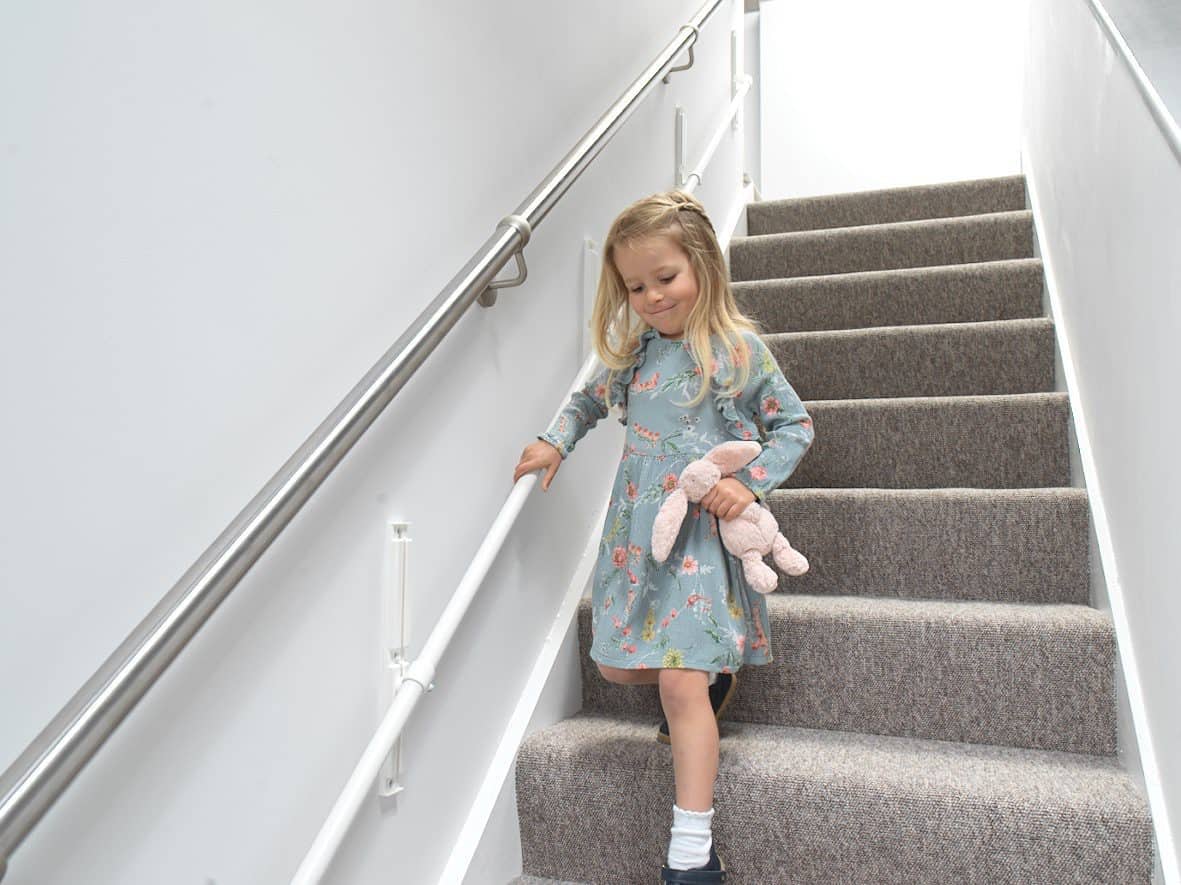
A child rail does not fill gaps and is not a replacement for guarding or a gate. It does the other job: it gives a walking child a grip, and teaches them to hold on.
Perspective
Parents often ask us whether open riser stairs are a deal-breaker. They are not, but they need honest attention. Most of the risk sits in three things: gaps, climbable guarding and a handrail nobody small can reach.
We designed KiddieRail for the third. An adult handrail does nothing for a two-year-old, and a gate only helps while the gate is closed. A rail at the child’s own height lets them practise going up and down with a real hold, and it adjusts as they grow, so it is not something you replace at every birthday.
Our approach is to fix the structure first, with riser boards or proper guarding, then add the rail. Tested, adjustable and straightforward to self-install, it is built to fit below a standard handrail on most home staircases.
Paul
Fitting a child handrail to an open riser staircase
A few practical points make the install go smoothly.
- Fix to a wall, not a spindle. Wall fixings give the most solid hold. If your open riser stairs have a wall on one side, put the rail there.
- Set the height for your child. Kneel at your child’s level and see where their hand falls naturally. Our adjustable rails are made to move up as they grow.
- Keep clearance. Leave room for fingers to wrap around the rail and avoid a gap behind it where a hand could be trapped.
- Check the landings. Where a flight turns or stops, the rail should not leave a break. Our page on stair landing safety explains how to handle those gaps.
- Check what the rail is attached to. If the wall is plasterboard or something unusual, use fixings suited to it.
Childminders and nurseries have extra duties. If you look after children professionally, our guide to stair handrails for childminders and daycare is a good starting point, and your local authority or inspectorate can tell you what applies to your setting. Rental hosts can read about a permanent child-proof fix for short-let stairs.
A note on supervision: no product replaces it. Very young children should not be on stairs alone. A Virginia childcare regulation in the US, for example, says children under two, and older children not ready to use stairs alone, must not have access to stairs without supervision. That is a US rule, but sensible practice in any home.
KiddieRail for your staircase
Our adjustable child stair handrail is designed to fit below a standard handrail and to grow with your child, and it suits any home staircase layout. We tested it for durability, and it is straightforward to install yourself. You can see the range in our shop or go straight to the KiddieRail Adjustable Child Stair Handrail.

If your staircase is long, or has several flights, the KiddieRail Extension Pack adds length. Extension packs are priced from £24.99 to £36.99, one-off.
When to call a professional
Get help rather than guess in these cases:
- Your gaps are wider than 100mm and you are not sure how the stair is built.
- The staircase is a floating design fixed to a single wall or a central spine.
- You want to remove or change a balustrade.
- You are in a listed building or a conservation area.
- You are altering stairs as part of a larger project.
A joiner or builder can advise on the work, and your local authority building control team can explain what rules apply to your alteration. For existing stairs, some dimensions may stay as they are if the stairs are not altered, but reconstructed stairs need handrails and guards where required, according to UpCodes guidance. That is US code material, so in the UK check with building control.
The Health and Safety Executive makes a related point for people with limited mobility: stairs should ideally not be winding, curved or have open risers. Toddlers are not the same as adults with a mobility problem, but the principle that open risers raise the demands on the person using them is worth keeping in mind.
A simple plan by age
Crawlers and early walkers. Gate the top and bottom. Close every gap that a 100mm ball can pass. Cover or remove climbable horizontal rails.
Confident walkers, around two to three. Keep the gates for unsupervised times. Fit a child-height handrail and practise: one hand on the rail, one step at a time, feet together if needed.
Older preschoolers. Raise the rail as they grow and keep the stairs clear of toys and shoes. Teach them to hold on, even when they are in a rush.
FAQ
Are open riser stairs safe for toddlers?
They can be, if the gaps are small enough, the guarding cannot be climbed and the stairs are used with supervision. In England, guidance says a 100mm sphere should not pass through open risers. Measure your stairs and close any gaps that fail.
What is the maximum gap for open riser stairs in the UK?
The guidance for England says the steps should be built so a 100mm sphere cannot pass through the open risers. It also sets a minimum tread overlap of 16mm. Other nations of the UK have their own standards, so check with local building control.
How can I stop a child falling through open risers?
Close the gaps with riser boards, clear panels or fine vertical infill, and use a gate at the top and bottom while your child is small. Ask a joiner if you are unsure how to fix the panels. A child-height handrail then gives a walking child a safe hold.
Do I need a child handrail if I already have a standard one?
A standard handrail is set at adult height, typically 900 to 1,000mm above the pitch line. A toddler cannot reach it. A second, lower rail lets them hold on safely, and an adjustable one can be raised as they grow.
Sources
- Approved Document K, Building Regulations
- SAFE AS HOUSES, Starship Foundation
- Child-Proofing Windows and Stairs, InterNACHI
- Risk and protective factors for falls on stairs in young children, PMC
- Risk and protective factors for falls on stairs in young children, PubMed
- Staircase Installation Cost UK, squote
- Section 311. Means of Egress, City of Baltimore
- Tread Standards Australia
- ErgoMine 2.0: Stairway Checklist, CDC NIOSH
- How To Identify and Address Dangerous Staircases, This Old House
- Stairways, US Access Board
- 8 Va. Admin. Code § 20-800-430, Stairs
- Stairways, Handrails and Guards, UpCodes
- Slips and trips in health and social care, HSE
- Luxury vinyl plank stairs guide
- Child safety options for windows


