
Currently Empty: £0.00


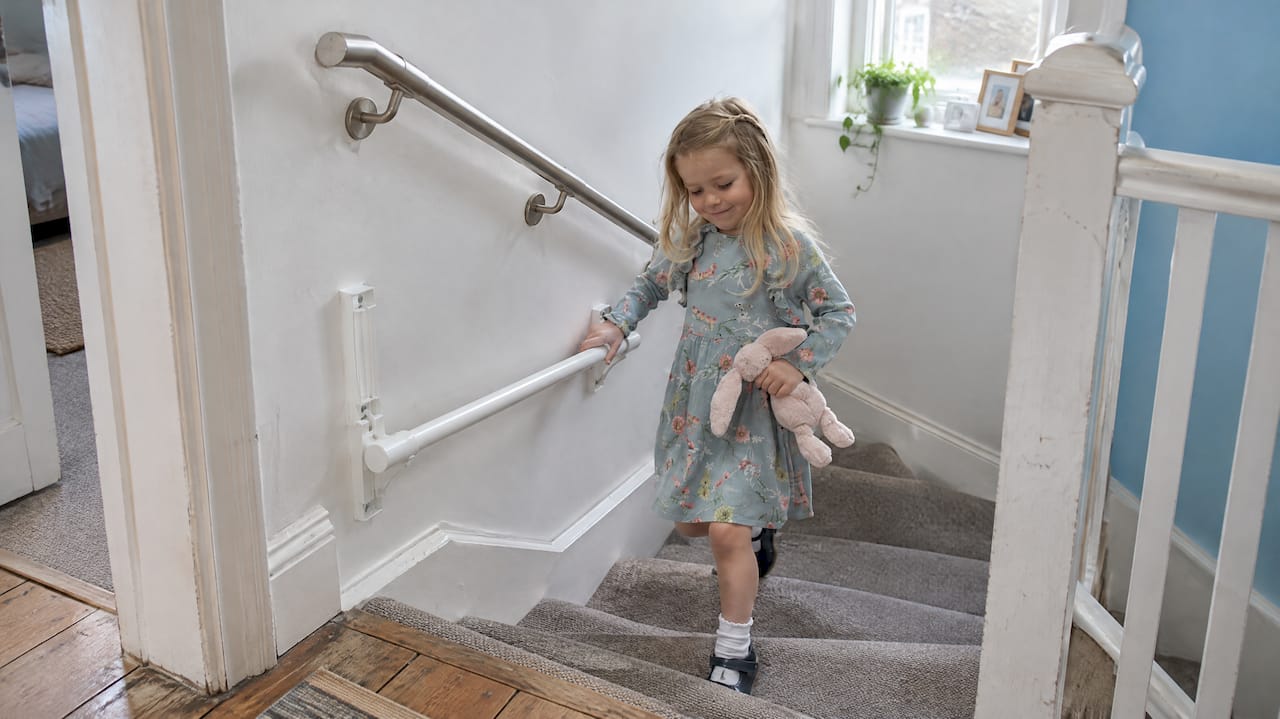
A second stair handrail is an extra rail fixed below or beside your existing one, so that a child, or anyone who needs a different grip, has something to hold at a comfortable height. For young children the standard rail sits well above their reach, so the useful second rail is a lower one, fitted on the same side as the first or on the opposite wall. Below we cover what the term means, where the rail goes, what height suits children, how to fit it securely and how to keep checking it.
TL;DR
- A second handrail is an additional rail, and for families it usually means a lower child-height rail beneath the adult one. On wide stairs it can also mean a rail on both sides or a central rail.
- Guidance from other countries for children’s settings puts the lower rail at about 665 to 750 mm (Australia) or no higher than 28 inches, roughly 710 mm (US), above the stair nosings.
- Leave a clear gap between the two rails so small hands, arms and heads cannot be trapped. US guidance suggests at least 230 mm.
- Fix to solid structure, not just plasterboard, and re-check the fixings regularly.
- Our adjustable KiddieRail is designed to fit below a standard handrail and move up as your child grows.
Table of Contents
- What a second stair handrail actually means
- Why a child needs their own rail
- How high should the second rail be?
- Where to put it
- What the rules say
- Choosing a second handrail
- How to fit a second handrail securely
- How to check it stays safe
- Perspective
- Get a child-height rail for your stairs
- FAQ
- Sources
What a second stair handrail actually means
People use “second handrail” and “double handrail” for three slightly different set-ups, and it helps to know which one you are after.
A lower rail under the main one. This is the family version. The existing adult rail stays where it is and a second rail is fitted lower down for children. It is the arrangement official guidance has in mind for places mostly used by children: the US Access Board advises a second set of stairway handrails in facilities primarily serving children.
A rail on each side. If your stairs have a wall on one side and an open side or a different wall on the other, a matching rail opposite gives users a choice of hand. Research by the BRE for the UK government, cited in the 2025 evidence paper for Approved Document K, suggests two handrails are preferred because they give a choice in descent. A user can hold a rail with both hands and walk with a more normal gait instead of turning sideways to face it.
An intermediate rail on wide stairs. NFPA explains that additional or intermediate rails exist so that nobody is too far from a handhold on a wide stair. The aim is to keep a rail within comfortable reach, not to put two rails at every height on every staircase.
For most households searching this topic, the second rail is the first of these: a lower rail for a toddler or small child. The rest of this guide focuses on that.
Why a child needs their own rail
A standard handrail is built for adult hands. A toddler cannot reach it, so they either grab the wall, crawl, hold your hand or reach for the spindles. None of those gives steady, continuous support.
An additional rail within reach does three things, according to the evidence paper prepared for the English building regulations review. It gives children reachable support to keep their balance, it lets a carer keep a more normal gait while carrying something, and it gives steady low-level feedback that builds confidence.
There is a habit side too. Children’s hospital guidance says children learning stairs should always keep one hand free for the handrail and ask an adult for help when carrying things. A rail at the right height makes that habit possible. A rail they cannot reach makes it a rule they cannot follow.
For more on the wider picture, our stair safety advice for UK parents covers supervision, lighting and everyday routines alongside rails.
How high should the second rail be?
There is no single magic number, and the figures below come from official guidance for children’s settings in other countries. Use them as a sensible reference range, not as a UK legal requirement for your home.
| Source | Second (lower) rail height | Notes |
|---|---|---|
| US Access Board | No more than 28 inches (710 mm) above stair nosings | Advised for facilities mainly serving children; at least 9 inches (230 mm) clear between upper and lower rails |
| Australian Building Codes Board | 665 to 750 mm | Applies to primary schools; ordinary handrail at least 865 mm |
The two ranges overlap neatly at roughly 665 to 710 mm, which is why you will see child rails sold in the 600 to 750 mm band. Measure from the line joining the stair nosings (the front edges of the treads), not from the floor, because the rail follows the slope of the stairs.
A fixed height only suits one stage of childhood. A rail that suits a two-year-old is too low for an eight-year-old, and one that suits the eight-year-old is out of reach for the two-year-old. That is the main reason we designed KiddieRail to be adjustable. Our guide to handrail height for kids and the page on child handrail placement at 665 to 750 mm go into measuring in more detail.
A quick way to find the right height for your child
- Stand your child on a stair with their arm relaxed and bent slightly at the elbow.
- Note where their open hand naturally falls, measured straight up from the nosing line.
- Mark that point on the wall at the top, middle and bottom of the flight.
- Check the marks form a line parallel to the stairs. Adjust if one of them is out.
Repeat every few months while your child is growing quickly.
Where to put it
Same side as your existing rail
If you already have a rail on one wall, the simplest option is to add the child rail directly below it on that wall. You already know the wall is solid and the rail line follows the stairs. Keep a generous vertical gap between the two. The US Access Board guidance asks for at least 9 inches (230 mm) of vertical clearance between upper and lower rails to prevent entrapment. Do not squeeze a child rail in just a few centimetres under the adult one.
If the clearance above your stairs matters too, for example under a landing or a hanging light, stairwell clearance ideas by stair type shows how to think about space around the flight so nothing interferes with a rail or the person using it.
The opposite wall
Where both walls are available, putting the child rail on the opposite side from the adult rail means a parent can hold the adult rail with one hand while the child holds theirs on the other side. It also gives a child their own side of the stairs. Check the stair is wide enough that you do not squeeze past each other.
Open sides, turns and landings
An open side with spindles is the hardest to work with because there is no wall to fix into. Spindles are not a substitute for a rail and are not designed to take sideways load. Look for a solution that fixes to the newel posts or to a solid backing. We cover the options in our guide on installing a handrail backing board.
On winders, quarter turns and half landings, the rail should run as continuously as you can manage. US residential guidance describes handrails as continuous for the full flight, with ends returned toward the wall or terminated at a post, so a hand is not left with nothing to grip at the end. Where a short break is unavoidable, keep it small and make sure each section ends cleanly.
Wide staircases
On a wide stair, a child on the far side of a single rail may be well out of reach. Ergonomic work in the English evidence paper suggests that when rails are 800 to 1200 mm apart, some users can comfortably hold both at once. If your stair is much wider than that, you may want a rail on each side or a sectioned arrangement. Our page on wide stair child handrails explains how we measure and when we split a long flight.
What the rules say
The rules differ by country, and none of the figures below is a rule for fitting a child rail in a UK home.
- England. Building regulations for stairs sit in Approved Document K, and the government has published an evidence paper on potential changes to its domestic stairs guidance. Check your local building control or the current version of the document before work that changes the main stair or its guarding.
- United States. Rules vary by state. In California, workplace stairways generally need a rail on each side, with exceptions for narrow or very short stairs, and rails installed after 3 April 1997 must sit 34 to 38 inches high. The same regulation requires the mounting to withstand at least 200 pounds applied in any direction.
- Australia. The National Construction Code requires a second handrail in primary schools at 665 to 750 mm, with the ordinary handrail at least 865 mm.
The load figure from California is a useful benchmark for fixing quality, even though it is not a home requirement: a child rail is gripped, pulled and swung from. A rail that moves is worse than no rail, because it teaches a child to trust something unstable.
If you rent, ask your landlord before drilling. If you run a holiday let, our page on a lower rail for rental stairs covers a permanent but tidy fix.
Choosing a second handrail
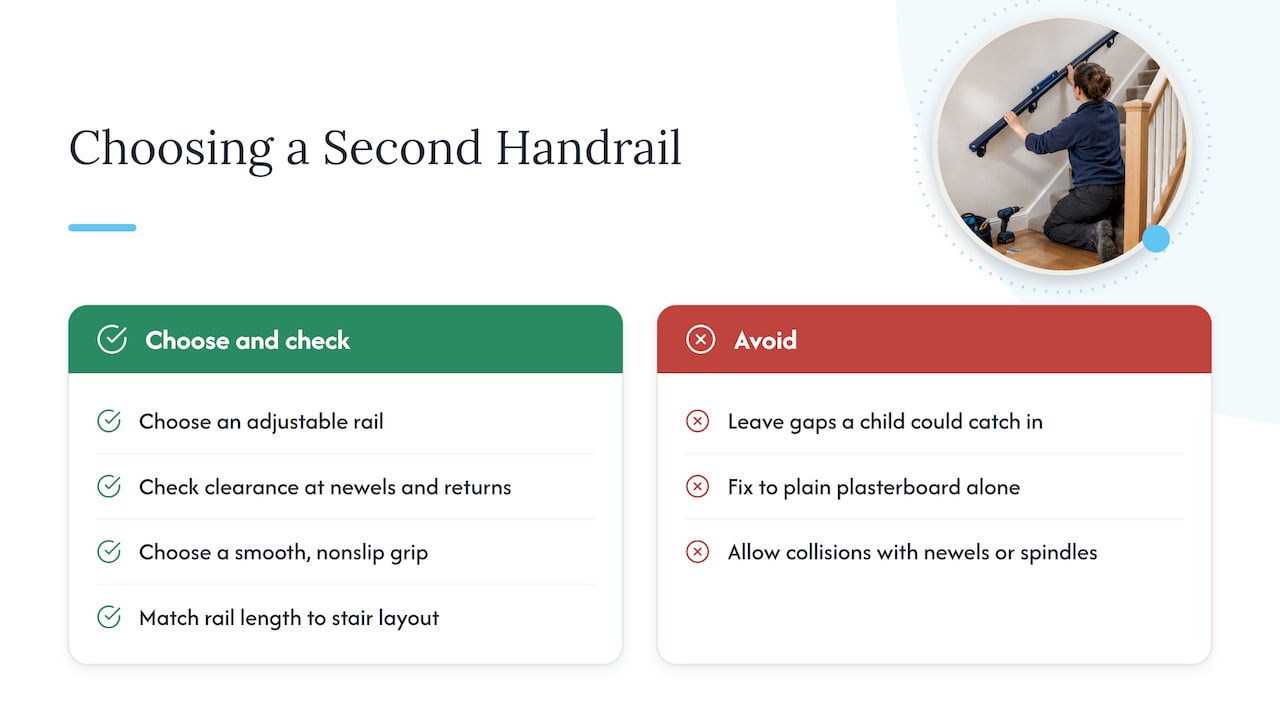
These are the points that matter, in order.
1. Adjustability. Children grow quickly. A rail you can raise avoids buying a second one in two years. It also means the same rail can serve a toddler, a five-year-old and a visiting grandparent who wants something lower to hand.
2. Fit with your existing rail. Check that a lower rail leaves clear space beneath the main one and does not collide with newels, spindles or returns at the top and bottom.
3. Grip and surface. A rail small hands can close around is easier to hold. Smooth surfaces without splinters or sharp edges matter, and so does a finish that is not slippery. See our notes on handrail materials for kids.
4. Gaps. Look for a design with no gaps a child’s hand, foot or head could catch in.
5. Fixing method. Wall-mounted rails need solid structure behind them. A wall mounted child handrail designed for 600 to 750 mm is straightforward on a plain wall, but a plasterboard stud wall may need a timber backing board first.
6. Stair layout. Straight, turning, open-sided and wide stairs each need different lengths and joints. Extension options are useful where a single length does not reach.
Why not just rely on a stair gate?
A gate stops a child getting onto the stairs. It does nothing to help them once they are on them. Gates remain useful for the youngest babies, but as soon as a child is learning to climb, they need something to hold. A child rail supports them while they walk, which is what a gate cannot do, and it stays useful long after a gate is taken down.
How to fit a second handrail securely
The steps below describe the general method. Always follow the instructions for the specific rail you buy, and ask a competent tradesperson if you are unsure about fixing into your walls.
- Plan the line. Mark the height on the wall at the top, middle and bottom of the flight, using your child’s hand height and the 665 to 750 mm reference range. Join the marks with a straight line parallel to the nosing line.
- Check the gap. Make sure there is generous clearance to the existing rail above. Remember the 230 mm US benchmark for entrapment.
- Find what is behind the wall. Use a stud finder or detector for timber studs, pipes and cables before you drill. Solid brick or block and timber studs are good fixing points. Plain plasterboard is not.
- Use the right fixings. Match plugs and screws to the wall type. Brick and block need wall plugs. Timber needs wood screws into the stud. Hollow walls may need a backing board across several studs.
- Fix at every bracket. Do not skip any. Each bracket shares the load.
- Test it. Hang your own weight on it gently, pull sideways, and push down. Nothing should shift or creak.
- Finish the ends. Make sure the ends do not leave a snag for sleeves or bags.
The NFPA and Access Board material is aimed at commercial buildings, but the logic carries over: a rail is only as good as what it is fixed to.
If you mind a child professionally, see our pages on handrails for childminders and daycare settings and measuring and fitting for childminder stairs.
How to check it stays safe
A rail is not a fit-and-forget item. Home inspectors checking stairs look for loose, incomplete, missing or splintery handrails and insufficient finger clearance, and for cracked, worn or poorly supported treads. Turn that into a monthly routine:
- Shake the rail firmly at each bracket. Tighten anything that moves.
- Run your hand along the whole length for splinters, burrs or chips.
- Check that your child can still reach the rail comfortably. Re-adjust the height after growth spurts.
- Look at the stair treads too. A solid rail does little on a loose or worn tread.
- Clear the stairs of toys, shoes and laundry, and keep the lighting good.
Also keep teaching the habit: one hand on the rail, nothing carried that blocks the other, and call an adult for help with bigger loads.
Perspective
We built KiddieRail because the usual stair is designed around one height: an adult’s. Children spend years climbing stairs that offer them nothing to hold, and the usual answer is a gate, which keeps them off the stairs rather than helping them on them.
Our view is that a child rail should do the job a rail does for an adult: give steady support all the way up and all the way down. It should sit where a child’s hand actually falls, below your standard handrail, and it should move as your child grows rather than being replaced.
That is why KiddieRail is fully adjustable, designed to suit any home staircase layout, and tested for durability. It is built for self-installation, so most families can fit it themselves, and extension packs let you cover longer or more awkward flights.
Paul
Get a child-height rail for your stairs
The KiddieRail Adjustable Child Stair Handrail fits below your standard handrail and adjusts as your child grows. It is designed for any home staircase layout and for straightforward self-installation.
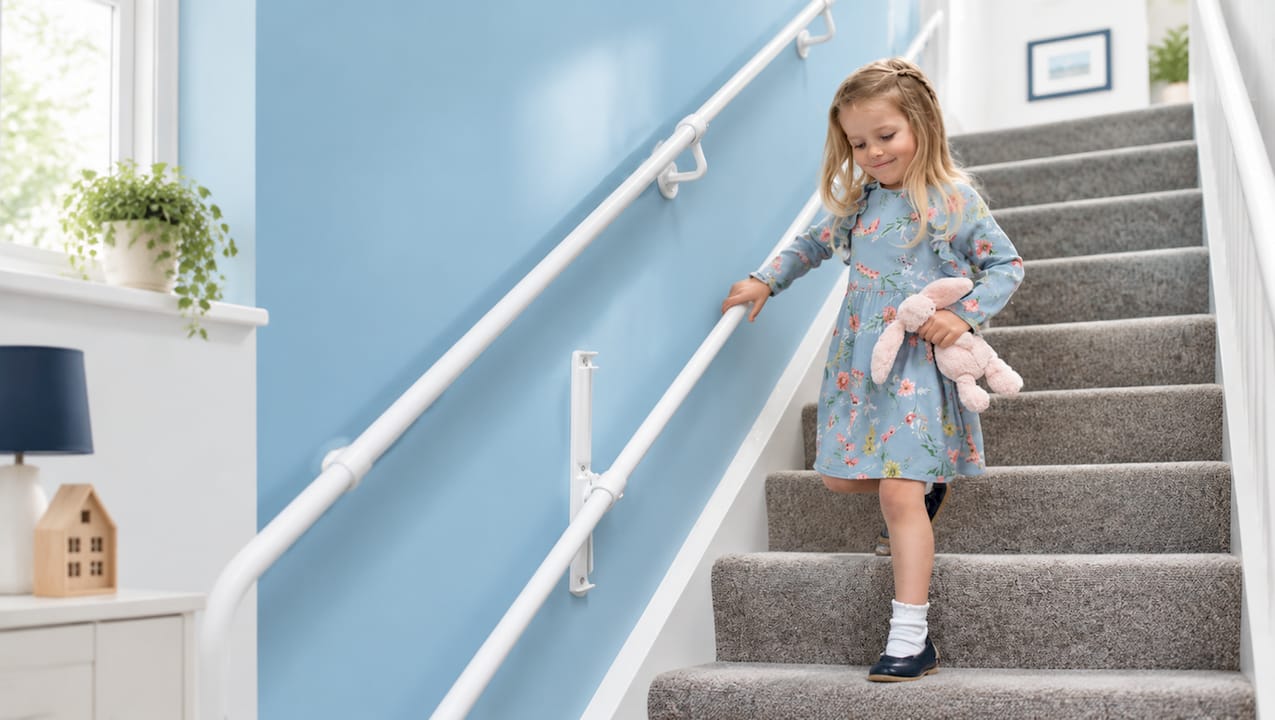
If your flight is longer or has turns, the KiddieRail Extension Pack costs £24.99 to £36.99 one-off. You can see the full range in our shop, or start from the KiddieRail home page.
FAQ
What is a double handrail on stairs?
It means two rails on the same stair. That can be one above the other on the same wall, a rail on each wall, or a middle rail on a wide flight. In family homes it normally means a lower child-height rail under the standard adult one.
How far below the main handrail should a second rail be?
Keep a generous gap. US guidance for children’s settings advises at least 9 inches (230 mm) of vertical clearance between upper and lower rails, to reduce the risk of entrapment. The lower rail itself is usually placed at around 600 to 750 mm above the stair nosings, depending on your child’s size.
Do I need building regulations approval to add one?
A lower child rail added to an existing stair is not the same as replacing or altering the main stair, but rules depend on your property and the work. Check the current Approved Document K and ask your local building control if you are changing the main handrail or guarding. Tenants should ask their landlord first.
Can I fix a second handrail to a plasterboard wall?
Not directly if the wall is hollow. Fix into timber studs, masonry, or a backing board screwed across several studs. Test the rail by pulling and hanging your weight on it before your child uses it.
Sources
- Chapter 5: Stairways, US Access Board
- Evidence to support potential changes to Approved Document K guidance on domestic stairs, GOV.UK
- Guards vs Handrails in NFPA 101, NFPA
- Stair Safety, Nationwide Children’s Hospital
- D3D22 Handrails, Australian Building Codes Board
- California Code of Regulations, Title 8, Section 3214
- Residential Handrail Guide, Simplified Building
- Stairway Inspection, InterNACHI
- Stairwell chandelier ideas by stair type, Lights & Things


