
Currently Empty: £0.00


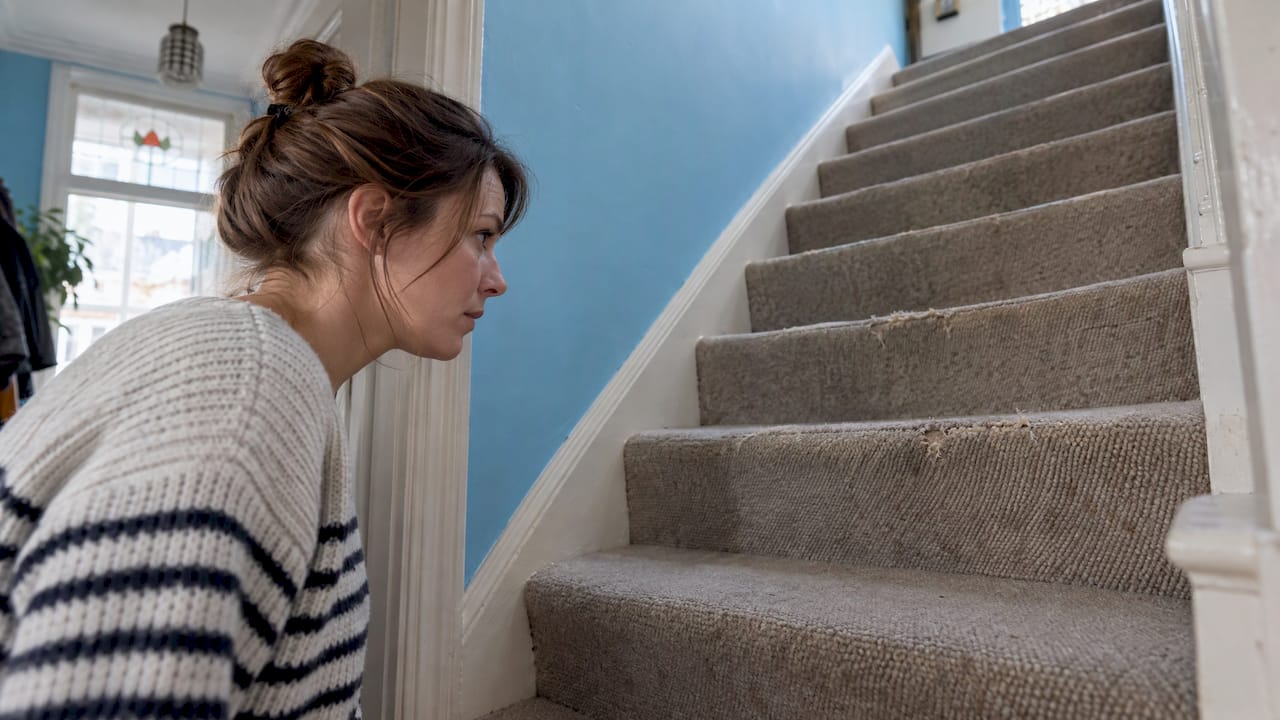
Carpet is one of the better surfaces a toddler can meet on stairs, but it only solves part of the problem. A UK study of children under 5 found that stairs without carpet carried higher odds of a fall injury, so a fitted, well-kept stair carpet is worth having. What carpet cannot do is give a small hand something to hold, stop a child reaching the top unsupervised or light the way. That takes a gate while they are tiny, a handrail they can actually reach, and a few habits. A KiddieRail child handrail fits below your standard rail, so a toddler gets a grip at their own height as they learn.
TL;DR
- Carpet in good repair is protective: UK research found children were 1.52 times more likely to have a stair-fall injury where stairs were not carpeted, and 1.71 times more likely where stairs needed repair.
- Loose, worn or badly fixed carpet turns a protective surface into a trip hazard, so check it before anything else.
- Under 24 months, use gates at the top and bottom that meet EN 1930:2011, with a screwed-in gate at the top.
- Once a toddler starts climbing, they need a handrail at their height and a free hand to use it. A standard adult rail is too high for them.
- Add light, clear steps and supervised practice. None of these replaces another.
Table of Contents
- Why carpet helps, and what the evidence says
- Check the carpet itself first
- Gates: what they are for, and where they go wrong
- When toddlers start using the stairs, they need something to hold
- Teaching the climb: a short routine that works on carpet
- Light, clutter and carrying
- A staged plan for a carpeted staircase
- Our view: the rail is the part most homes miss
- Giving a toddler a rail of their own
- FAQ
- Sources
Why carpet helps, and what the evidence says
The most useful UK evidence comes from a multicentre case-control study (Kendrick and colleagues, published in 2015) that compared 610 children under 5 injured in stair falls with 2,658 children who were not. It found that children were 1.52 times more likely to have a stair-fall injury if their stairs were not carpeted, and 1.71 times more likely if the stairs were in need of repair.
The same study points at things carpet does not fix:
- Not having a landing partway up the stairs was linked to higher odds of injury (adjusted odds ratio 1.34).
- Parents who considered their own stairs unsafe had higher odds of a child injury (adjusted odds ratio 1.46).
In plain terms: carpet protects, but the layout of your staircase and how safe it feels to you matter as well. If you already think your stairs are risky, trust that instinct and act on it.
One reading of the figures is worth keeping in mind. Carpet in good condition is the protective factor, not carpet as such. Stairs “in need of repair” were a separate risk in the same study, and that is why the first job in a carpeted home is an honest look at the carpet.
Check the carpet itself first
A stair carpet earns its protective effect only while it is flat, tight and fixed. RoSPA, the UK’s accident-prevention charity, advises replacing worn carpet or damaged stair coverings and keeping stairs and handrails in good repair. nidirect, the Northern Ireland government’s public information service, says damaged or worn carpet should be repaired or removed, and that stairs should be well lit and free of clutter.
Walk your stairs slowly, ideally with a toddler’s eye view, and check:
- Edges at the nosing. The nosing is the rounded front edge of each step. Frayed or lifting carpet here is where a small foot catches.
- Ripples and loose sections. Carpet that moves underfoot should be re-stretched or refitted. A home inspectors’ stairway checklist lists carpet that slides or is not firmly attached as a defect.
- Stair rods, grippers and tacks. Look for any that have worked loose or are sticking up.
- Worn patches. Shiny, thin areas lose grip and can hide damage underneath.
- Runners. If you have a runner with exposed boards either side, make sure it is fixed at every step. Nationwide Children’s Hospital advises keeping carpets and runners secure.
It helps to treat this as part of your regular home maintenance. A general home maintenance checklist is a handy way to put stair checks on the same routine as everything else, so repairs don’t wait until someone trips.
While you are there, look at the banisters too. RoSPA advises making sure banisters are secure with no footholds a child could use to climb, and nidirect advises vertical gaps of no more than 100mm and prompt repair of loose balustrades.
Gates: what they are for, and where they go wrong
Carpet does nothing to stop a crawling baby or an early walker reaching the stairs. That is the job of a gate, and the guidance is consistent. RoSPA recommends that for children under 24 months, wall-mounted gates restrict access to both the top and bottom of the stairs, that they comply with EN 1930:2011 (the European standard for safety gates), and that fittings are checked regularly to remain secure. nidirect gives the same standard and the same age window.
A few details decide whether a gate does its job:
- Top of the stairs: screw it in. Dr Lara McKenzie of Nationwide Children’s Hospital advises that pressure-mounted gates should only be used as room dividers or at the bottom of stairs, because they cannot withstand much force. Only hardware-mounted gates fixed to the wall or railing are strong enough at the top.
- Close it every time. The same release reports that over 60% of the injured children in a US study of baby-gate injuries were under 2, most often falling down stairs after a gate collapsed or was left open.
- Mind the gap at the bottom. Nationwide Children’s advises mounting gates less than 3 inches from the floor so a baby cannot crawl underneath.
- Avoid accordion-style gates. HealthLink BC, a Canadian health information service, advises against them because a child’s head can get caught.
- Never treat a gate as supervision. Nemours KidsHealth says never to leave a child alone around stairs even when gated, since babies can climb a top gate and fall from a greater height.
The McKenzie advice is also clear that gates should come out when the child turns 2 or learns to open or climb them. That is the moment the stairs stop being something to block and become something to learn, and it is where most homes have a gap.
When toddlers start using the stairs, they need something to hold
According to HealthyChildren.org, the American Academy of Pediatrics’ parent site, the usual pattern runs like this:
| Age | What many toddlers can do on stairs |
|---|---|
| 19 to 24 months | Walk up and down while holding a parent’s hand |
| 25 to 30 months | Climb stairs holding the rail |
| 31 to 36 months | Climb one foot after the other |
Children vary, so treat these as a guide rather than a deadline. The point is that the stage when a child is “holding the rail” arrives well before they are tall enough to hold a standard one comfortably. Nationwide Children’s stair safety advice recommends a handrail small enough for the child to grip with the whole hand, and teaching them to keep a free hand on the rail.
That is exactly the gap a child handrail fills. A typical adult handrail sits at a height a toddler can barely reach, so the child ends up reaching up at an awkward angle or not holding anything at all. Carpet gives grip underfoot, but only a rail at the right height gives a small hand something to hold.
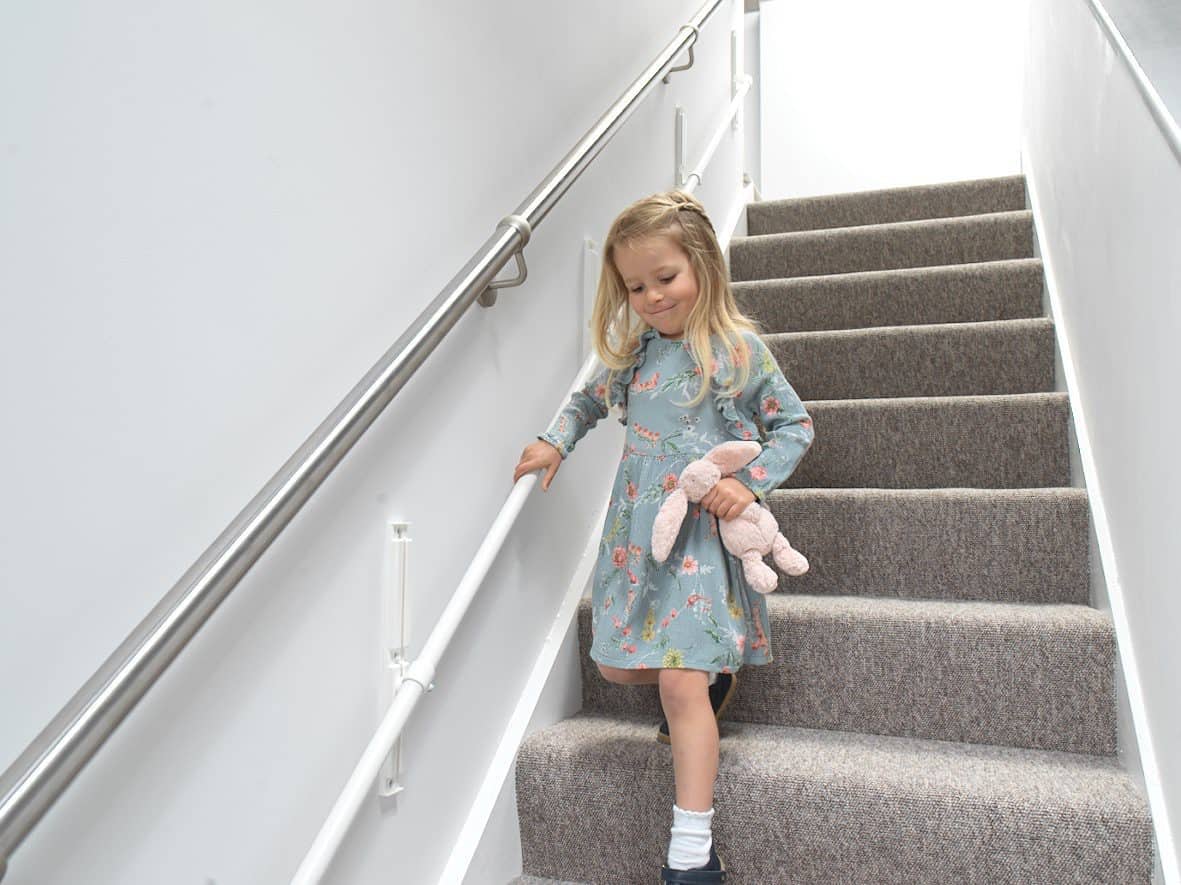
Our guide to toddler handrail ideas covers heights, options and safe fitting in more detail.
Teaching the climb: a short routine that works on carpet
Carpeted stairs are a good place to practise because they are forgiving. A routine you can start straight away:
- Start with the bottom steps. HealthyChildren.org suggests placing a toy a few steps up and letting the child crawl to it, or hold your hand while walking up and down.
- Make it a rhythm. Singing “up, up, up” going up and “down, down, down” coming down keeps the pace slow.
- Practise together, then re-gate. Nemours KidsHealth suggests going up and down together on carpeted stairs and replacing the gates when you are done.
- Teach the rail habit. One hand on the rail, one step at a time. OHSU Doernbecher Children’s Hospital also advises teaching children not to slide down railings.
- Try going down backwards. Nemours explains that a child’s only model is an adult walking down forwards, so it suggests teaching toddlers to go down stairs backwards.
- Hold hands until they are independent. Nationwide Children’s advises holding a toddler’s hand on stairs until they can manage alone.
If a child is climbing with a handrail at their own height, the “free hand on the rail” rule stops being theoretical. They can reach it, which means they will actually use it.
Light, clutter and carrying
Three everyday habits cover most of what is left:
- Light. nidirect and RoSPA both advise keeping stairs well lit. Nationwide Children’s suggests nightlights in dark spaces, which helps with night-time wandering.
- Clear steps. Toys, shoes and laundry waiting to go up are classic trip hazards. Our page on what to clear from stairs and why gives a quick list, and the two-minute stair sweep works well as a daily habit.
- Carrying. A US study of stair injuries across 1999 to 2008 found that one quarter of stair injuries to children under 1 happened while being carried, and those children were more than three times as likely to be hospitalised. If you carry a baby, keep a hand free for the rail and don’t carry anything else.
If your stairs are open-sided, wide or have a half landing, the layout may need extra thought. We have guides for open staircases in UK homes, wide stairs and landings. The landing point matters: in the UK study, stairs without a mid-stair landing carried higher odds of a child injury.
A staged plan for a carpeted staircase
You don’t need to do everything on one day. This order matches what children can do:
| Stage | What to do |
|---|---|
| Before crawling (around 6 months) | Fix the carpet, secure banisters, sort lighting. Our guide to babyproofing stairs before crawling helps with timing. |
| Crawling to 24 months | Gates at top and bottom, with a screwed-in gate at the top. Close them every time. |
| First steps on the stairs | Supervised practice, hand-holding, and a handrail at toddler height. |
| 2 years and over | Gates come off as the child learns to open or climb them. The handrail and good habits carry on. |
There is also a short guide to pairing gates and teaching that takes under an hour, and a wider look at stair safety for toddlers.
Our view: the rail is the part most homes miss
Most families we talk to about carpeted stairs have done the sensible things already. The carpet is fitted, a gate is up and the clutter is cleared. Then the child turns two, the gate comes down and nothing replaces it.
That is the moment a toddler most needs support, because they are learning to climb and they cannot reach the handrail on the wall. A gate stops a child reaching the stairs. It does not help them move on them. That is why we designed KiddieRail as an adjustable handrail that sits below your standard rail and grows with the child.
We built it to be tested for durability, to suit any home staircase and to be straightforward to fit yourself. Carpet, good light and supervision all matter, and a rail at the right height is what turns them into a habit your child can keep.
Paul
Giving a toddler a rail of their own
The KiddieRail Adjustable Child Stair Handrail is an award-winning, fully adjustable handrail designed to grow with your child. It fits below a standard handrail, suits any type of staircase layout and is designed for straightforward self-installation. Unlike a gate, which blocks the way, it actively supports a child as they walk the stairs. Its price is on the KiddieRail product page.

If your staircase is longer or has an unusual shape, the KiddieRail Extension Pack is available for £24.99 to £36.99, one-off. You can see the full range in the KiddieRail shop.
FAQ
Are carpeted stairs safer for toddlers than bare wood?
In UK research, children under 5 were 1.52 times more likely to have a stair-fall injury where stairs were not carpeted. That only holds while the carpet is fitted firmly and in good repair, because stairs needing repair carried higher odds too. Add gates, light and a handrail at toddler height as well.
When can a toddler use the stairs?
Many toddlers can walk up and down holding a hand at 19 to 24 months, and climb holding the rail at 25 to 30 months. Every child is different, so practise with them on carpeted stairs and keep gates up when you are not there. Hold their hand until they can manage alone.
Do I need a stair gate if my stairs are carpeted?
Yes, for babies and toddlers under 24 months. RoSPA and nidirect both advise EN 1930:2011 gates at the top and bottom, and a screwed-in gate at the top. Carpet softens the surface but does not stop a child reaching the stairs unsupervised.
How do I keep a toddler safe on stairs once the gate comes off?
Give them a handrail they can actually grip, keep steps clear and well lit, and teach one step at a time with a free hand on the rail. A KiddieRail fits below your standard handrail so your child can hold on at their own height.
Sources
- Risk and protective factors for falls on stairs in young children (UK case-control study)
- Guarding children against trips and falls, nidirect
- Preventing falls in children, RoSPA
- Stairway inspection guide
- Home safety series: stairs and hallways, Nationwide Children’s Hospital
- New study finds number of children treated for baby-gate-related injuries, Nationwide Children’s Hospital
- Child safety: preventing falls, HealthLink BC
- Preventing injuries from falling, climbing and grabbing, Nemours KidsHealth
- How active is your toddler? HealthyChildren.org
- Safe exploring for toddlers, Nemours KidsHealth
- Stair safety, Nationwide Children’s Hospital
- Home and yard safety, OHSU Doernbecher Children’s Hospital
- New study examines stair-related injuries among children, Nationwide Children’s Hospital


