
Currently Empty: £0.00


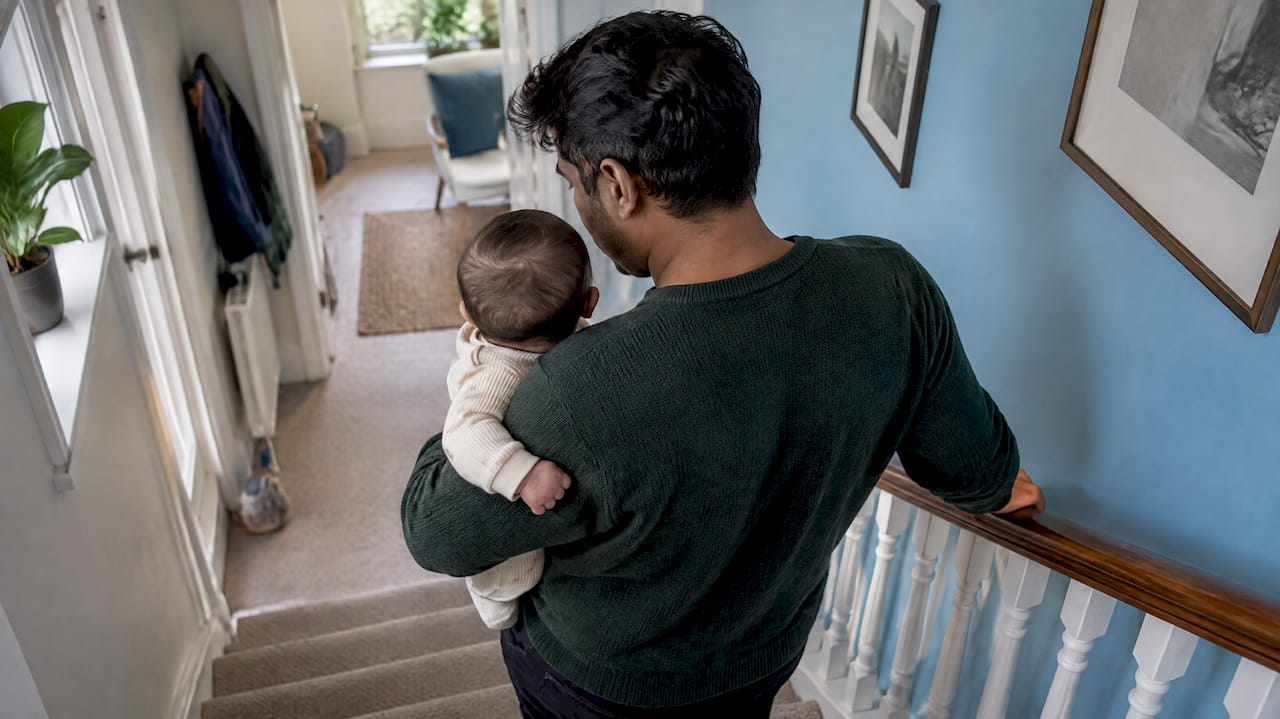
The safest way to carry a baby on stairs is to avoid doing it when you can. When you can’t, carry only the baby, keep one hand on a sturdy handrail, keep every step clear and take your time. The NHS advises holding the handrail when you carry a baby up or down, and removing toys and other trip hazards from the steps. The rest of this guide covers why the risk is higher than it feels, how to build a routine around it, and what to do if the worst happens.
TL;DR
- Carrying a baby changes your balance, and in one large US study a quarter of stair injuries in under-ones happened while the baby was being carried.
- Keep one hand on the handrail, carry nothing else, and clear the steps before you start.
- Leave the baby somewhere safe, such as a cot, while you fetch things, rather than making extra trips with them in your arms.
- Use gates to BS EN 1930:2011 while your child is little, and give a mobile child a handrail at their own height.
- After a fall, watch for danger signs such as repeated vomiting, unusual drowsiness or a seizure, and get urgent medical help.
Table of Contents
- Why carrying a baby on stairs is riskier than it feels
- How to carry a baby up and down stairs
- Making the stairs themselves safer
- Gates, crawling and the first steps down
- Perspective: what we see at KiddieRail
- Choosing the right height and position for a child’s rail
- Add a rail your child can reach
- If you fall while carrying your baby
- A simple stair routine for the whole household
- FAQ
- Sources
Why carrying a baby on stairs is riskier than it feels
Most of us do it a dozen times a day without a thought. The trouble is that a baby in your arms changes how your body moves. The Child Accident Prevention Trust explains that carrying a baby shifts your centre of gravity, which raises your chance of falling. It advises holding on and watching your footing, especially on narrow or steep stairs.
The numbers are sobering. A study from Nationwide Children’s Hospital in the US counted more than 93,000 emergency-department-treated stair injuries in children under five between 1999 and 2008, roughly one every six minutes. In the same study, one quarter of the injuries in children under one happened while they were being carried on the stairs. Those babies were also more than three times as likely to be admitted to hospital as children hurt in other ways.
This is American data, so treat it as a pattern rather than a UK statistic. But the mechanics are the same in a Victorian terrace in Leeds as in a house in Ohio: a tired adult, a full arm, a step that is not quite where you expected.
The usual set-up for a fall looks very ordinary:
- You are holding the baby with both arms, so no hand is free for the rail.
- You are also carrying a bag, a basket of washing or a phone.
- Something is on the step: a sock, a toy, a slipper.
- You are in socks on a worn carpet, or the light is dim at night.
- You are rushing, or half asleep during a night feed.
Each one is fixable, and the next sections go through them.
How to carry a baby up and down stairs
Nationwide Children’s Hospital’s stair safety guidance is clear that you should avoid carrying the baby on stairs when possible and put them somewhere safe, such as a cot. If you do have to carry them, the child should be the only thing in your arms and one hand should stay on the handrail. Here is that advice turned into a routine.
Before you pick the baby up
- Look at the stairs first. Clear toys, laundry, shoes and post from every step. The NHS and RoSPA both stress keeping stairs clear.
- Gather what you need, then lift the baby last. Put bags and baskets at the top or bottom beforehand, or ask someone to bring them.
- Switch on the light. RoSPA lists good lighting, a well-maintained handrail and repaired stair coverings among its basics.
- Put your shoes on, or wear grippy socks. Smooth socks on carpet are a classic slip.
On the stairs
- Hold the baby on the side away from the rail, so your rail hand stays free.
- Keep your hand on the rail for the whole flight, not just when you feel wobbly.
- Take one step at a time and look at your feet, not at the baby.
- Do not use a pushchair or buggy on stairs, and do not carry one with the baby in it.
- Do not answer your phone or read a message until you are standing on flat ground.
If you need both hands
Sometimes a baby carrier seems the obvious answer. Raising Children Network says a carrier may help when going down stairs because it leaves at least one hand free for the banister. A carrier has to be used correctly to be safe, though. Health Canada warns that slings and carriers can cause falls or suffocation if the baby is badly positioned, slips through an opening or has their face covered by fabric.
The Australian consumer regulator’s TICKS checklist is a handy way to remember what good positioning looks like. The baby should be Tight, In view, Close enough to kiss, with the Chin off the chest and a Supported back. The same page says to check for ripped seams, loose or missing fasteners and frayed straps, and to use all the restraining straps. Choose a carrier made for your baby’s age and weight, and practise putting the baby in and out on flat ground before you use it near stairs.
Making the stairs themselves safer
A good technique helps, but the stairs do half the work. Three things matter most: the surface, the lighting and what you hold on to.
Surface. Worn or loose carpet, a frayed stair runner or a cracked tread is a trip waiting to happen. If your home is older, a quick look at how renovation improves home safety in older homes can help you spot the kinds of stair surface problems worth fixing before a baby arrives. Even a small repair to a loose tread nosing is worth doing.
Light. Put a switch at both the top and the bottom, or fit a plug-in night light on the landing. Night-time feeds are when many parents are most unsteady.
Handrail. It needs to be firmly fixed, continuous and within reach on the side you use. For an adult, that’s the standard rail. For a baby who is learning to move on their own, it is not much use at all, which brings us to the next point.
Gates, crawling and the first steps down
Once your baby starts to crawl, the question changes from “how do I carry them” to “how do I stop them going up alone”. For babies who are crawling or becoming mobile, the NHS recommends safety gates that comply with BS EN 1930:2011, closed properly each time you go through. It advises keeping gates at the top and bottom of the stairs until your child is at least two.
RoSPA goes into more detail for children under 24 months. It recommends wall-mounted gates at the top and bottom of the stairs, checking for EN 1930:2011 compliance, following the fitting instructions and checking the fixings regularly. Nationwide Children’s Hospital says only wall-mounted gates should be used at the top, because pressure-fitted gates can be knocked over. A US study of gate-related injuries found that among under-twos, falls down the stairs after a gate collapsed were the most common way of being hurt. So a gate needs to be properly fitted and properly shut, every single time.
Teaching a baby to go down
At around eight months babies get more mobile. The American Academy of Pediatrics’ parenting site says they may learn to come down stairs backwards, but that stairs should stay gated and babies should never play on them alone. It suggests encouraging backward descent and showing a standing baby how to bend the knees to lower themselves.
Supervision does not end when the child can walk. Healthier Together, a UK NHS-backed service, says children should never use stairs alone, and that even four-year-olds may need help.
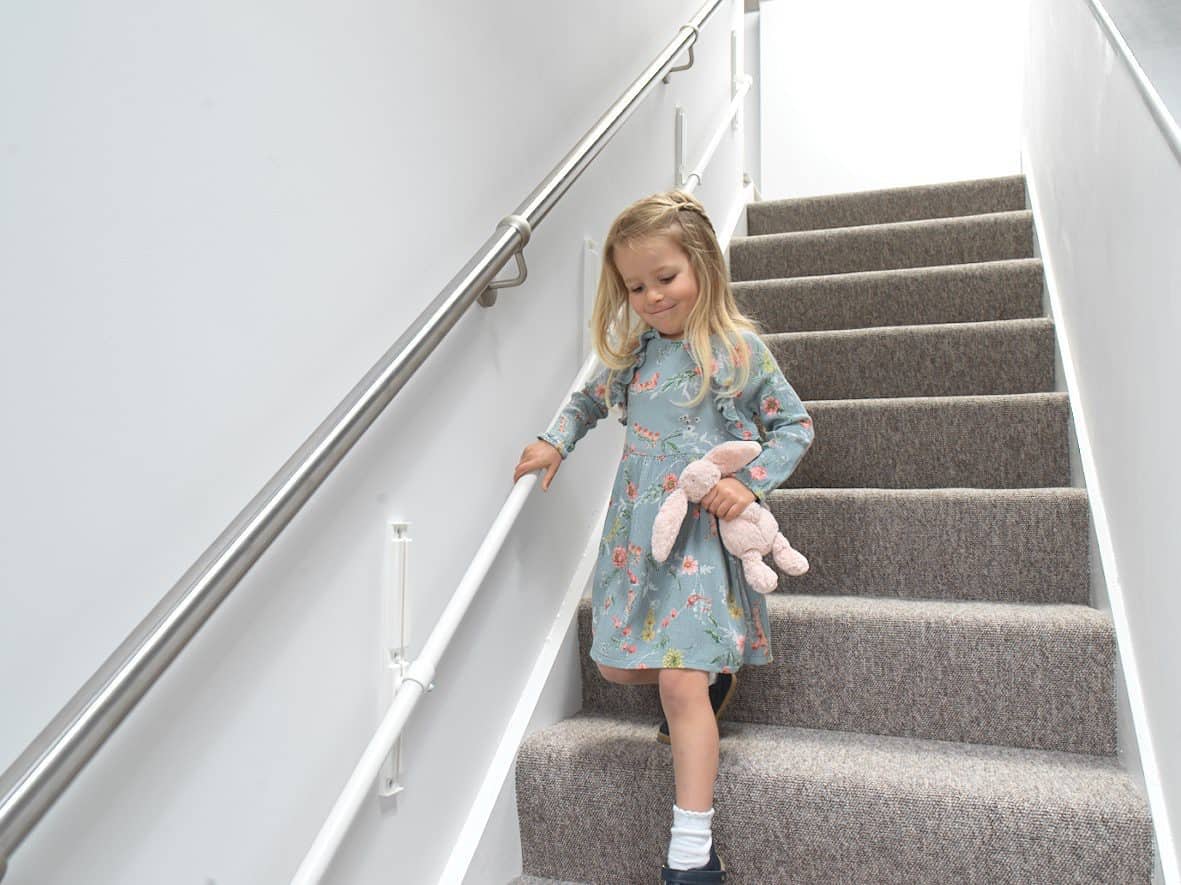
This is where the growing child becomes the interesting part. A toddler who is allowed to practise stairs with you beside them needs something to hold that is the right size. A standard handrail sits at an adult’s height, far above a small child’s reach. That’s the gap a child-height rail fills.
Perspective: what we see at KiddieRail
We spend our days thinking about one problem: a small child on a staircase built for adults. Parents quite rightly focus on how to carry the baby safely. Fewer think about what happens six months later, when that baby wants to climb up and walk down by themselves.
Gates stop a child reaching the stairs. That matters, and we would never suggest dropping them. But a gate does nothing for a toddler who is supposed to be using the stairs with you. They are reaching up for a rail that is far above their head, or reaching for your hand, or the wall.
That is why we designed KiddieRail as an adjustable rail that fits below the standard handrail and grows with the child. We have tested it for durability, and it is built for the layouts people really have: straight flights, landings, wide stairs and turns. A child who can hold on at their own height is a child who learns to use stairs with a steady grip, and an adult who can keep a hand on the main rail while helping.
Our advice is simple. Carry less, hold on more, and give the smallest person in the house a rail they can reach.
Paul
Choosing the right height and position for a child’s rail
If you are thinking about adding a lower rail, the practical questions are height, fixing and layout. Our own guidance is that a child rail should sit well below the adult rail, and our wall-mounted rail is adjustable between 600 and 750 mm for UK stairs. Our page on handrail height for kids explains what works on typical British staircases, and child handrail placement shows where along the flight it should go.
A few practical points:
- Fixing. A rail needs solid fixing into the wall. If you have plasterboard or an awkward wall, a handrail backing board gives the brackets something firm to bite into.
- Landings. Many falls happen at turns and landings, where the rail often stops. Our guide to stair landing safety covers closing those gaps.
- Wide stairs. If the flight is wide, a rail on one side may be out of reach of a small child in the middle. See our advice on wide stair child handrails before you measure.
- Childminders and nurseries. If you look after other people’s children, our pages on childminder stairs safety and daycare stair handrails cover setting up a rail where several children use the same stairs.
Measure before you buy, and fit the rail at a height your child can reach comfortably without stretching or ducking.
Add a rail your child can reach
If you want your little one to hold on at their own height while you keep a hand on the main rail, the KiddieRail Adjustable Child Stair Handrail is designed to do exactly that. It fits below a standard handrail, adjusts as your child grows and is made for straightforward self-installation.

For longer flights or awkward layouts, the KiddieRail Extension Pack costs from £24.99 to £36.99, one-off. You can see the full range in the shop.
If you fall while carrying your baby
It is every parent’s fear, and it helps to know the plan in advance. Stay as calm as you can, and check the baby first.
Call 999 straight away if the baby is unresponsive, struggling to breathe, having a seizure, bleeding heavily or you suspect a head, neck or hip injury. Banner Health advises that unless there is immediate danger, you should keep the child still until help arrives.
If the baby has hit their head or body, the American Academy of Pediatrics lists the signs that need emergency care:
- repeated vomiting
- being unable to wake them
- seizures
- unusual behaviour or slurred speech
- refusing to feed or eat
- crying that cannot be comforted
- any loss of consciousness
The same source notes that concussion symptoms may show up straight away or in the following days, and may get worse with activity. Banner Health adds that after a fall that seemed minor, you should keep watching for worsening sleepiness, trouble waking, confusion, repeated vomiting, headaches or changes in how the limbs move, because some bleeding in the brain develops slowly.
For possible broken bones, Ireland’s HSE says to check for injuries and see a GP or injury unit if you are worried. Signs of a fracture include pain and swelling, not using the limb, or an odd angle. In the UK, you can also call NHS 111 if you are unsure whether your baby needs to be seen. If you were hurt yourself, particularly if you are pregnant or hit your head, get checked as well.
A simple stair routine for the whole household
Safety is easiest when everyone does the same thing. Agree a few house rules:
- Nothing on the stairs. Anything that needs to go up gets put in a basket at the bottom, and whoever goes up next takes it.
- Hand on the rail. Adults, too. Children copy what they see.
- Gates closed, every time. Teach older siblings and visitors as well.
- No phones on the stairs. Not even for a second.
- Check the stairs monthly. Loose carpet, wobbling rails or loose treads get fixed straight away.
- Review as your child grows. What worked for a newborn does not work for a determined toddler, so adjust the gates, the rail height and your own habits.
FAQ
What age can babies go down the stairs?
Most babies begin to try stairs at about eight months, usually going backwards, but they still need supervision and a gate. The NHS advises keeping gates at the top and bottom until your child is at least two. Even older children should not use the stairs alone.
Is it safe to carry a baby down the stairs?
It can be done safely if you keep one hand on the handrail, carry nothing else, and keep the steps clear and well lit. Where you can, leave the baby somewhere safe while you fetch things so you make fewer trips with them in your arms. A correctly fitted baby carrier can free your hands, but it needs to be used carefully.
Should you go to A&E if you fall down the stairs with a baby?
Call 999 if the baby is unresponsive, having a seizure, struggling to breathe or may have a head, neck or hip injury. For repeated vomiting, unusual sleepiness, inconsolable crying or refusing to feed after a fall, get urgent medical help. If you are unsure, NHS 111 can advise, and it’s sensible to be seen yourself too.
Do I still need a stair gate if I have a child handrail?
Yes, they do different jobs. A gate keeps a crawling baby off the stairs when you aren’t there, and the NHS recommends BS EN 1930:2011 gates until at least age two. A child-height handrail helps a toddler hold on when they are using the stairs with you.
Sources
- Baby and toddler safety, NHS
- Stair Safety, Nationwide Children’s Hospital
- New Study Examines Stair-Related Injuries Among Children, Nationwide Children’s Hospital
- How to prevent falls in children, Child Accident Prevention Trust
- Preventing Falls in Children, RoSPA
- Falls prevention: babies and young children, Raising Children Network
- Baby sling and carrier safety, Health Canada
- Baby carriers, wraps and slings guide, ACCC Product Safety
- Baby gate-related injuries among children in the United States, PubMed
- Movement Milestones in Babies 8 to 12 Months Old, HealthyChildren.org
- Concussions in Babies, HealthyChildren.org
- Steps to Take If Your Child Has a Serious Fall, Banner Health
- Preventing falls in toddlers and children, HSE
- How renovation increases home safety in older homes


