
Currently Empty: £0.00


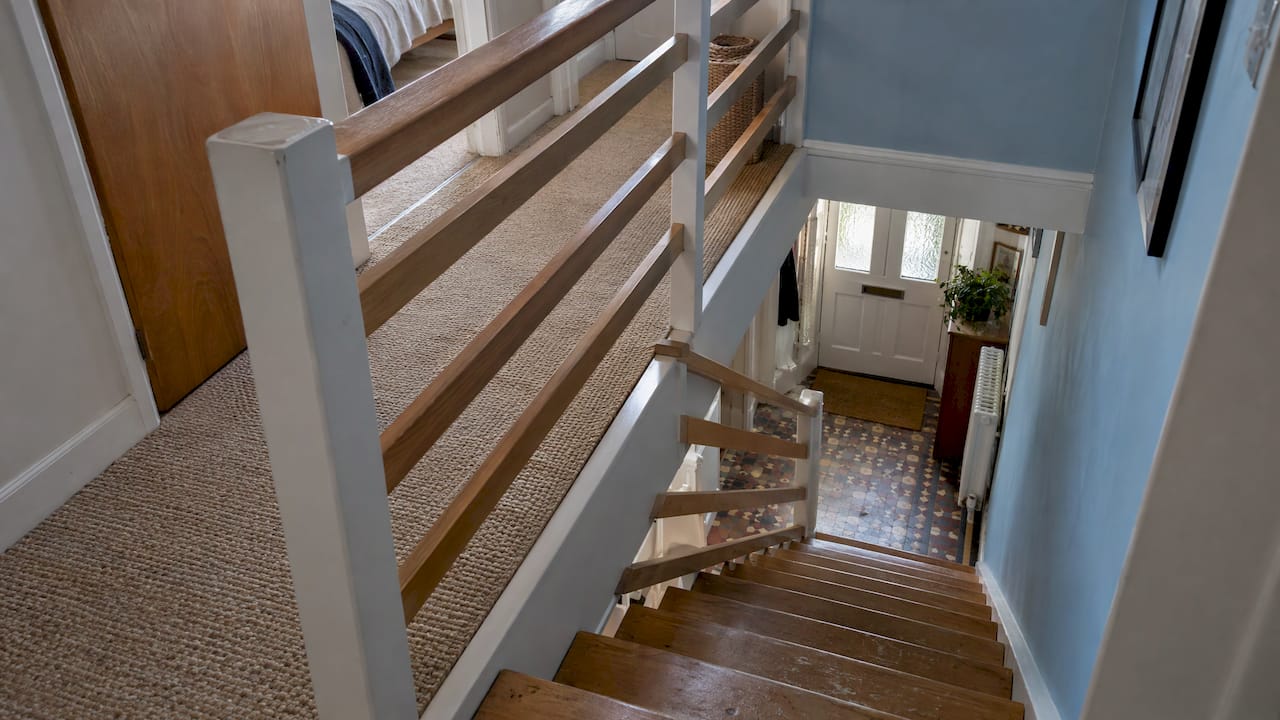
An open staircase can be made safe for a toddler with four things: guarding any gap wider than about 6.5 cm, a properly fitted gate at the top and bottom, a handrail a small hand can grip, and regular checks as your child grows. Open stairs look lovely, but they have more gaps, edges and drops than a closed flight, so each of those four jobs matters more. This guide shows you how to assess your own staircase and fix what you find.
TL;DR
- Measure every gap between rails, balusters and treads. The NHS advises covering gaps wider than 6.5 cm with boards or safety netting once a child starts crawling.
- Keep gates in place until your child can climb stairs safely, and keep teaching them. Gates do not replace supervision.
- An adult-height handrail is out of reach for a toddler. A child-height rail gives small hands something to hold.
- Check rails, attachments and treads regularly, because a staircase that was safe at one age may not be at the next.
Table of Contents
- Why open staircases need extra attention
- How to assess your staircase, step by step
- Guarding the gaps without creating new hazards
- Gates at the top and bottom
- Teaching children to use the stairs
- Handrails: the missing piece on most open staircases
- Perspective
- Keeping the stairs clear and well lit
- Fitting a child-height rail to your staircase
- Checks to repeat as your child grows
- A note on rules and standards
- FAQ
- Sources
Why open staircases need extra attention
A solid, closed staircase has walls or boxed-in sides. An open one may have gaps between treads, slim balusters, a floating design or glass panels. A toddler can see through those spaces, climb on horizontal bars, and in the worst case put a head or body through a gap that is wide enough.
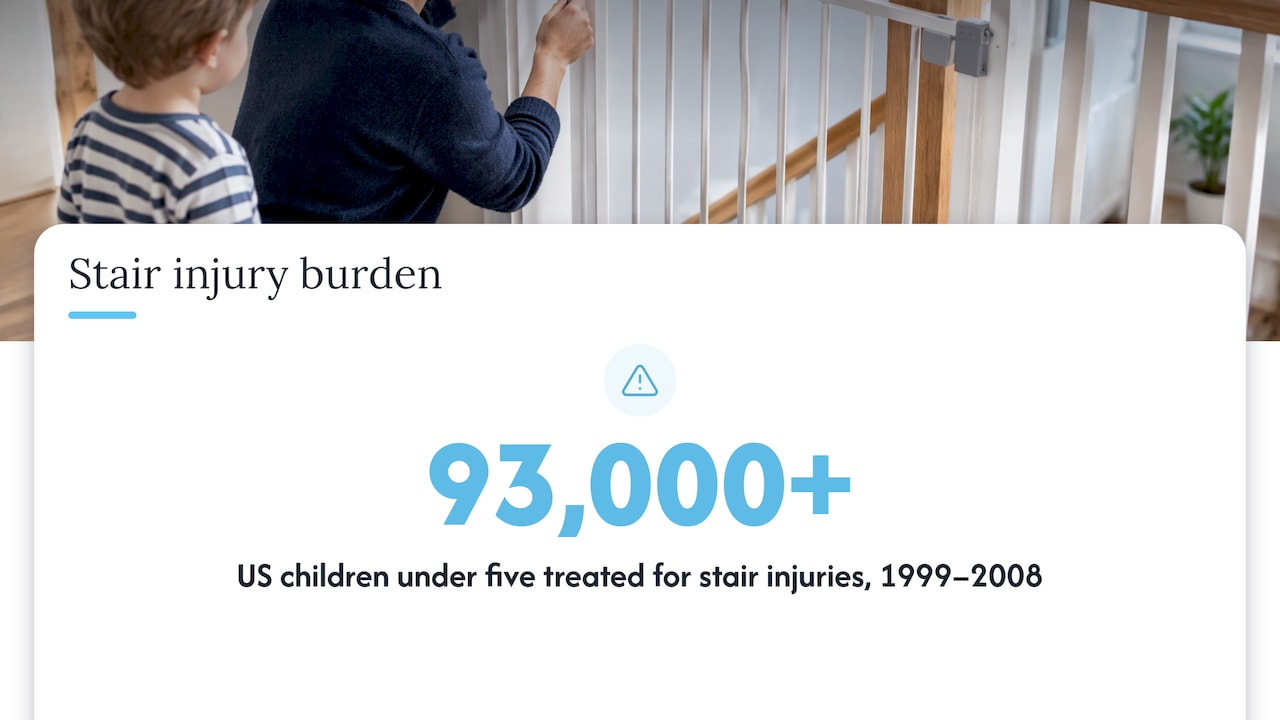
Stairs are a well-documented source of injury for small children. A study from the Center for Injury Research and Policy found that between 1999 and 2008, more than 93,000 children under five were treated in US emergency departments for stair-related injuries, about one every six minutes. Those figures are American, but toddlers everywhere have the same proportions and the same urge to climb.
Research on stair injuries also shows that children under 10 are more often treated for head and neck injuries than other age groups. That is a good reason to deal with falls from height and gaps at head level first.
A staircase built to current rules is generally designed with children in mind, but the rules set a minimum. Your own home may be older, altered or fitted with a design feature that leaves wider openings. The next section shows you how to find out.
How to assess your staircase, step by step
Set aside half an hour. Take a tape measure and a small ball or a tin of about the size of a toddler’s head to hand, and go through the flight from the bottom to the top.
1. Measure the gaps
Check the spaces between vertical rails, balusters and any open risers. The NHS figure is 6.5 cm (2.5 inches) for gaps between banisters or balcony railings. US checklists use tighter numbers: one children’s hospital checklist says slats should be less than 3 inches apart. If you are choosing between figures, the tighter one is the safer working rule for a baby or young toddler.
Do not rely on one measurement at the middle of the flight. Guidance on childproofing stairs points to several spots where children get trapped: gaps between treads, at newel posts, where the railing meets a wall, and triangular openings beside the tread. Measure each of them.
2. Look for climbable patterns
Horizontal bars, cable runs and decorative cross-pieces work like ladders. An inspection checklist for stairways asks you to look for guard openings and climbable patterns alongside loose or missing rails. If your child could put a foot on it and pull up, treat it as a climbing frame and cover it.
3. Test the handrail and fixings
Grab the rail and pull. A handrail should be securely attached and continuous along the flight, with a grip you can wrap your hand around without letting go. Check where it meets the wall and at each end.
4. Check the treads and the surface
Look for cracked, damaged or loose treads, and for worn or loose carpet. Nemours KidsHealth recommends keeping stairs free of loose carpeting and toys and making sure lighting is adequate.
Guarding the gaps without creating new hazards
When you find a gap that is too wide, the aim is to close it so that nothing can pass through and nothing can be climbed. A few principles keep the fix safe:
- Cover the whole opening. Use boards, clear panels or safety netting designed for the job. The NHS suggests boards or safety netting over wider gaps once your child starts crawling.
- Fix it firmly. A barrier that a child can push, pull or unclip becomes another hazard. Screw-fix or tie it so it cannot be dislodged.
- Avoid footholds. A panel with horizontal ribs or a mesh with big holes invites climbing. A flat, smooth face is better.
- Keep light and sightlines if you want them. Clear acrylic or glass panels block the opening while still letting light through, which is why they are popular on open staircases.
If your staircase is wide, a single gate may not cover it. Our guide to fitting a gate to wide stairs with panels and a child rail covers that layout.
Gates at the top and bottom
Gates are the first line of defence for the crawling and early walking stage. Health guidance says to keep safety gates on the stairs until your child can climb them safely. Some practical points for open staircases:
- Top of the stairs: use a gate that is fixed to the wall or post with screws rather than a pressure-fit one, and have it open towards you, not out over the stairs. Otherwise you can fall forward while opening it.
- Bottom of the stairs: a gate stops a crawler from starting to climb while you are in another room.
- Check the mounting points. On a floating or glass-sided staircase there may be no solid post to fix to. In that case look at wall-mounted solutions or a dedicated panel rather than forcing a gate onto an unsuitable surface.
- Look for a recognised standard. UK child safety barriers are made to BS EN 1930, and the NHS says to fit gates that comply with it once your baby crawls.
A gate keeps a child off the stairs. It does not teach them how to use them. For that you need the next step.
Teaching children to use the stairs
Children eventually have to climb stairs, and learning with you beside them is safer than their first attempt happening when you are not looking. Injury prevention specialists suggest you teach children to keep a free hand on the rail, ask an adult for help, keep toys off the stairs and not play or jump on them. They also say a gate is no substitute for an adult watching.
A short routine works well:
- Start at the bottom, with you one step below your child.
- Show them where to put their hand: on the rail, not on the wall or on you.
- Go up and down a few steps at a time, then increase as they gain confidence.
- Always keep going up and down facing the stairs until they are steady.
For a wider look at pairing gates and teaching, see our page on making stairs safer for young children in under an hour.
Handrails: the missing piece on most open staircases
Most handrails are fitted for adults. On an open staircase, where the sides may be a thin balustrade or a glass panel, a small child often has nothing at the right height to hold. Stair safety guidance advises you to install a handrail if there is none, and use one small enough for a whole-hand grip. Another checklist adds that sturdy handrails should run the full length of the stairs and be narrow enough for a child to grasp completely.
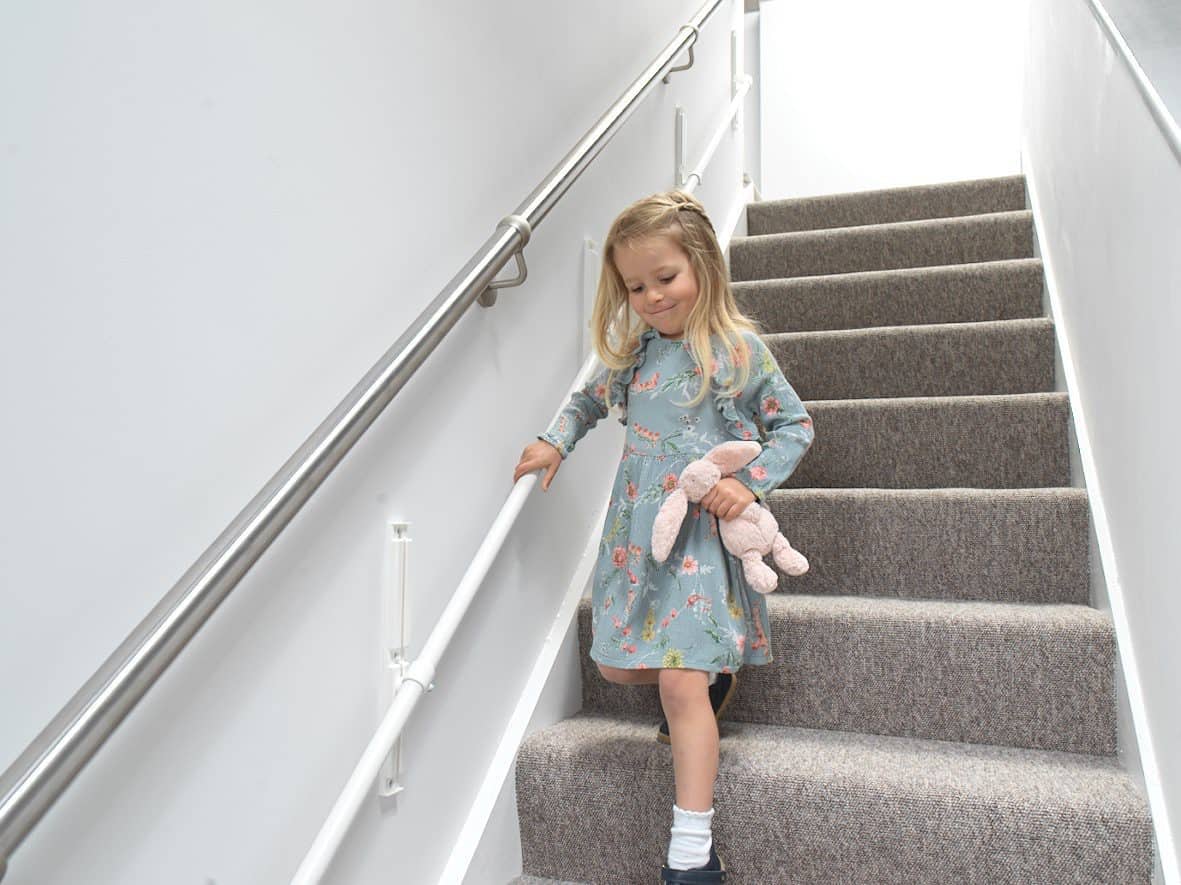
That is the gap a child-height rail fills. It does not replace the adult rail or the guarding. It adds a second, lower rail that your child can actually reach. If you want to know where to put it, read our pages on handrail height for kids on UK stairs and child handrail placement. Landings are a common weak spot too, and our note on stair landing safety gaps explains how a lower rail helps there.
Perspective
We designed KiddieRail because we kept seeing the same problem: families fit gates, which is right, but the moment a child is allowed on the stairs there is nothing at their height to hold. A gate stops a child. A handrail helps a child to walk.
On an open staircase that matters even more. The sides are often slim or glass, and the only rail is set for an adult. Our adjustable rail fits below a standard handrail, so a young child has a grip that suits them, and you can raise it as they grow rather than buying again.
We would always suggest layering your approach: guard the gaps, gate the top and bottom while your child is small, teach them to use the stairs, and give them a rail they can reach. Each step covers something the others cannot.
Paul
Keeping the stairs clear and well lit
A safe structure is wasted if the steps are covered in toys, laundry or shoes. Keep every step clear, keep the stairway lit, and fix loose carpet. If you want a quick routine, our guide to what to clear from stairs and why lists the usual culprits, and the two-minute stair sweep is useful for flats and shared stairwells.
If you are rethinking a hallway as a whole, these kid-friendly home decor ideas for UK families are worth a look when you choose what to place near the stairs.
Fitting a child-height rail to your staircase
If you have decided a lower rail is what your staircase needs, KiddieRail is designed to fit below a standard handrail, to suit any home staircase layout, and to be installed by yourself. It adjusts so it can stay useful as your child grows, and it is made to be durable and tested for safety.
The KiddieRail Adjustable Child Stair Handrail is the main product. If your flight is longer than one rail covers, the KiddieRail Extension Pack costs £24.99 to £36.99, one-off. You can see the full range in the shop.
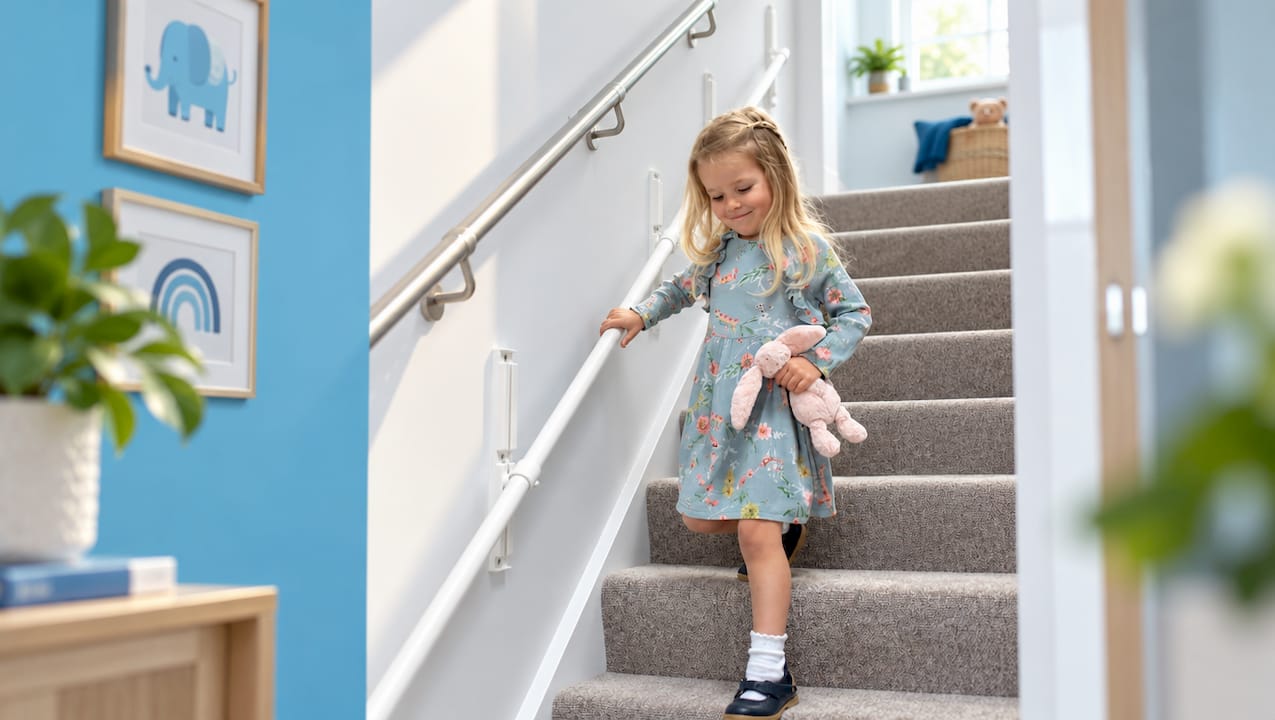
Childminders and day-care settings use stairs with several children at a time, and a lower rail helps there too. Our page on stair handrails for childminders and daycare covers it.
Checks to repeat as your child grows
A staircase that is safe for a crawler may not be for a four-year-old. Put a reminder in your calendar every few months and go through this list, which follows the stair inspection checklist:
- Handrail attachments are tight and the rail is continuous.
- No rails are cracked, loose or missing.
- No new climbable patterns have appeared, such as stored items against the balustrade.
- Treads are not cracked, damaged or loose.
- Gates still latch and their fixings are tight.
- Any child-height rail is set at a height that suits your child now.
Also check railings and banisters are secure and add a guard if a child can fit through the rails. Children grow, but they also get stronger, and a fixing that held a one-year-old may not hold a three-year-old.
A note on rules and standards
Building standards differ by country. US codes, for example, set guards at least 34 inches high and allow openings that a 4⅜-inch sphere cannot pass, which is a US rule and not a UK one. In the UK, use the NHS gap guidance above for home safety and speak to a building control officer or qualified joiner if you plan structural changes to a staircase. Regulations set a minimum for new work. They do not guarantee that an older or altered staircase suits a toddler.
FAQ
At what age can I take the stair gates down?
Health guidance says to keep gates until your child can climb the stairs safely. That varies by child, so judge by ability rather than a birthday. Keep supervising and teaching even after the gates come down.
How wide can the gaps in an open staircase be?
The NHS advises covering gaps wider than 6.5 cm (2.5 inches) once your child begins to crawl. Measure at every point, including beside the treads and where the rail meets a wall, not just the middle of the flight.
Is a stair gate enough on its own?
No. A gate keeps a child off the stairs, but it does not replace adult supervision. Combine it with guarded gaps, teaching and a handrail your child can hold.
Can I fit a child-height handrail to a glass or slim balustrade?
It depends on what you can fix to. KiddieRail is designed to fit below a standard handrail and suit any home staircase layout. Our stair safety for toddlers guide explains how to plan the fitting.
Sources
- New Study Examines Stair-Related Injuries Among Children in the United States
- Stair-related injuries treated in United States emergency departments
- Child Safety at Home, NHS Healthier Together
- Hallway & Stairwell Safety Checklist
- How to Childproof Stairs: Gates, Spacing, and Safety Tips
- General checklist for inspecting stairways
- Walls & Floors, Doors & Windows, Furniture, Stairways
- Keeping Your Toddler and Preschooler Safe from Falls
- Stair Safety, Center for Injury Research and Policy
- IRC 2018 Guard Height and Baluster Spacing
- Kid-Friendly Home Decor: Safe, Stylish Ideas for UK Families


