
Currently Empty: £0.00


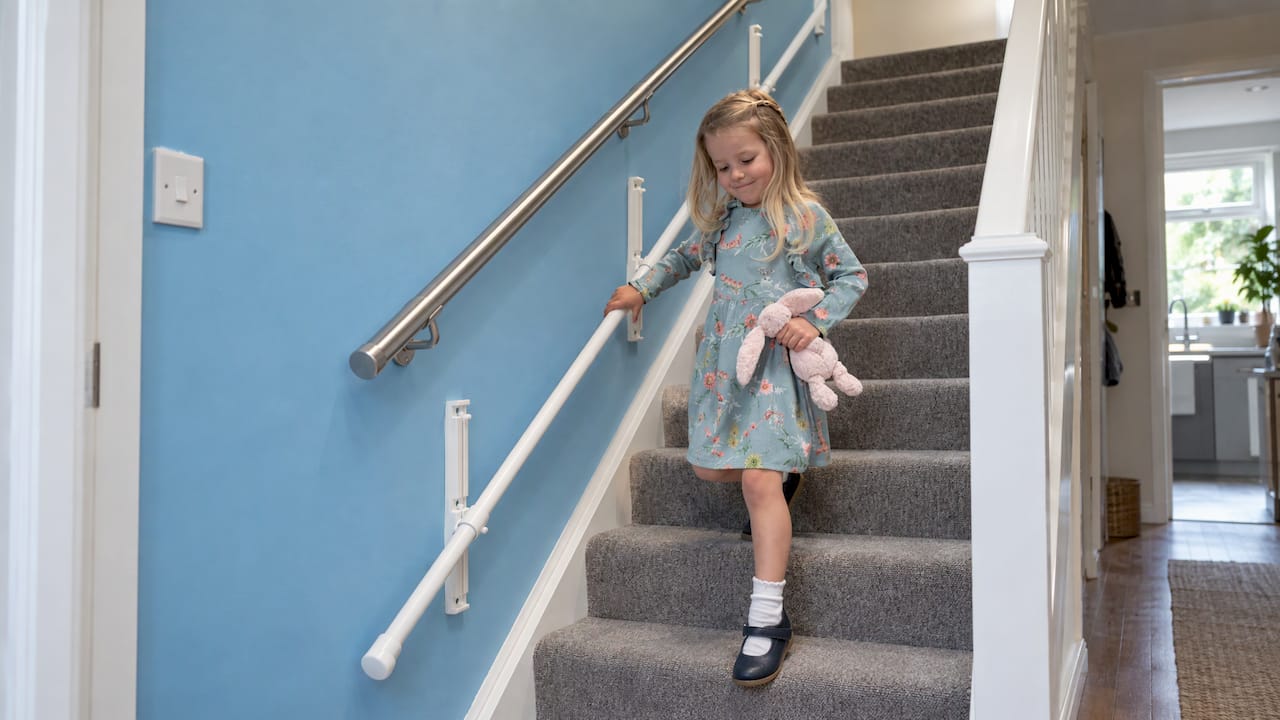
A child-friendly staircase does five things: it keeps babies off the stairs until they are ready, gives a walking child something to hold at their own height, leaves no gaps they can slip through or climb, gives their feet a clear and grippy surface, and is well lit. Most homes already have some of these. The one that is most often missing is a handrail a small child can actually reach, and it is also the easiest to add to stairs you already own. A child-height rail such as KiddieRail, which fits below your standard handrail, closes that gap without rebuilding anything.
TL;DR
- Adult handrails sit at 900 to 1000mm, far above a toddler’s reach, so children need a second, lower rail they can grip with their whole hand.
- Gaps between balusters should stop a 100mm sphere passing through, and banisters should give no footholds for climbing.
- Fit gates to EN 1930 at the top and bottom while your child is under 24 months, then support independent stair use with a rail at the right height.
- Good lighting at the top and bottom, secure treads and visible nosings reduce trips for everyone.
- You rarely need a new staircase: an adjustable child rail, a few checks and a weekend are usually enough.
Table of Contents
- Why stairs deserve special attention
- The handrail: the feature that most often fails children
- Gaps, balusters and open risers
- Treads, nosings and lighting
- Gates: where they go and how long you need them
- Making existing stairs child-friendly without rebuilding
- A quick design check
- Add a child-height rail with KiddieRail
- Our view on child-friendly stairs
- FAQ
- Sources
Why stairs deserve special attention
Stairs are one of the most common places for young children to get hurt at home. RoSPA’s flipchart says that in the UK over 40,000 children under five are hurt each year after a fall down stairs. Its design report adds that falls on steps and stairs are a leading cause of accidental death in the home, with at least 700 people dying each year from falls on domestic stairs in the UK. Those deaths cover all ages, but the pattern for toddlers is clear: they climb early, they descend badly, and they are rarely able to reach what is meant to catch them.
US figures show the same thing. A study from Nationwide Children’s Hospital’s injury research centre found that more than 93,000 children under five were treated in US emergency departments each year between 1999 and 2008 for stair-related injuries, about one child every six minutes.
The good news is that stair design is not mysterious. A handful of measurements and habits make most of the difference, and you can check each one with a tape measure.
The handrail: the feature that most often fails children
UK guidance is written around adults. RoSPA’s design criteria, based on BS 5395-1:2010, put the top of a handrail between 900 and 1000mm above the pitch line, meaning the sloping line joining the front edges of the steps. That is sensible for adults. For a two-year-old it is above head height.
The pitch line is the line running along the nosings, the front edges of the treads. Your handrail height is measured vertically from there, and should be the same all the way up the flight.
A second, lower rail
The design world already recognises the gap. The UN’s accessibility design manual says a third handrail at 0.60m can help children, and RIBA’s handrail checklist asks whether there is an additional lower handrail for children and people of short stature. Our own adjustable rail is built around a 600 to 750mm range, which is the band where a toddler to early-primary child can reach it comfortably. See our guide to handrail height for kids and to where to place a child handrail for the detail.
A fixed rail at one height works for a few months. An adjustable one moves up as the child grows, which is why we designed KiddieRail to grow with the child rather than be replaced.
The grip matters as much as the height
A child’s hand is small. The UN manual says circular cross-sections of about 40mm are preferable for a firm grip, and Nationwide Children’s Hospital advises handrails small enough that a child can put a whole hand around them. A wide, flat or chunky timber top rail is hard for a toddler to hold, so the lower rail should be a profile they can wrap their fingers round.
Rails need to be within reach the whole way
The Building Watch Foundation points out that people often don’t touch a handrail on a comfortable stair, but when balance is lost, a suitable rail lets them stabilise within a fraction of a second. It only works if it is there at that moment, which means continuous along the flight. For a child who is unsteady at every step, that is every step.
Also check the ends. RIBA’s checklist asks that open ends are turned to the horizontal so clothing and bag straps are not caught. The UN manual suggests handrails extend horizontally 0.30 to 0.45m at the top and bottom, which gives a child something to hold before the first step and after the last.
Gaps, balusters and open risers
Balusters are the vertical rods under a handrail. If they are too far apart a child’s head or body can pass between them, and if they form a ladder a child can climb them.
- Maximum gap: nidirect says gaps between vertical rods should be no more than 100mm. A 100mm sphere, about the size of a large grapefruit’s smaller cousin, the sort of ball a toddler could not get through, is the usual test.
- No footholds: the same guidance says banisters should give no footholds for climbing, and loose balustrades should be repaired as soon as possible. Horizontal rails are the classic problem.
- Guarding: the Building Watch Foundation says any drop of more than 600mm should have guarding strong enough not to give way under weight, with gaps small enough to stop a 100mm sphere.
Open-riser stairs, where there is no solid vertical board between treads, need the same test. Scotland’s Building Standards handbook says that in open-rise flights treads should overlap by at least 15mm and that any opening between adjacent treads should stop a 100mm sphere. That is a Scottish standard, but it is a useful yardstick anywhere in the UK. Our guide to open riser stairs and child safety walks through what to check, and our open staircase guide covers the wider layout.
If you are comparing your balustrade with rules elsewhere, for example fall-prevention fencing rules, local code checks for homeowners show how heights and openings are regulated in a different setting. In the UK, rely on the UK guidance above for stairs.
Treads, nosings and lighting
Design details underfoot decide whether a stumble becomes a fall.
Consistent steps
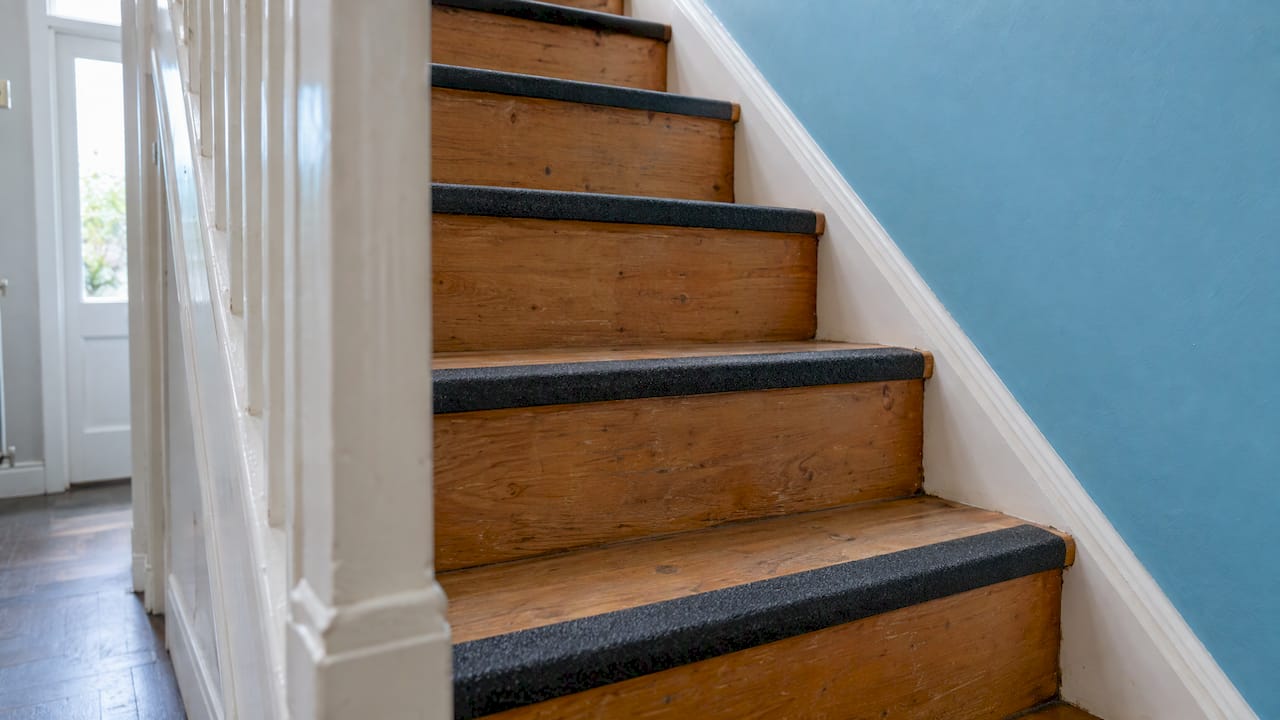
RoSPA’s report recommends private-stair dimensions of 250 to 400mm going and 150 to 200mm rise. The going is the depth of a tread, and the rise is the height of a step. Scottish standards set private stair limits of 100 to 220mm rise, a minimum 225mm going and a maximum 42 degree pitch, and ask for contrasting nosings so tread edges are easy to see. You cannot change the geometry of an existing flight cheaply, but you can see whether yours is unusually steep and plan extra support accordingly.
Grip underfoot
A fact sheet from a Canadian safety-training provider suggests non-slip surfaces cover whole steps or at least their leading edges, and that matte finishes help depth perception. Polished timber and loose stair carpet are the usual culprits. Socks on varnished wood are a particular hazard for toddlers. Our page on child handrails for hardwood stairs deals with fixing to timber staircases.
Light at both ends
RoSPA’s design guidance calls for two-way lighting at the top and bottom of the stairs, so you can switch on a light whichever end you start from. Consumer Reports advises checking that lights at the top and bottom of every stairway work. A low-level motion-sensing LED is a simple way to cover night-time trips to the bathroom.
A monthly look
A Canadian safety guide suggests inspecting home stairways monthly for loose nails, broken treads and rail integrity. Add the stair rail to that list: check screws, wobble and height as the child grows.
Gates: where they go and how long you need them
A rail helps a child who is walking the stairs. A gate keeps a baby who is not ready off them. Both belong in a child-friendly design, at different stages.
nidirect advises fitting BS EN 1930:2011 gates at both the top and bottom of the stairs from when a baby starts moving until 24 months. Screw-fixed gates are suitable for the top, while pressure-mounted gates are suitable only for the bottom. RoSPA’s home-safety advice also says wall-mounted gates should restrict access to both ends for children under 24 months. Nationwide Children’s Hospital adds that gates are not a substitute for adult supervision.
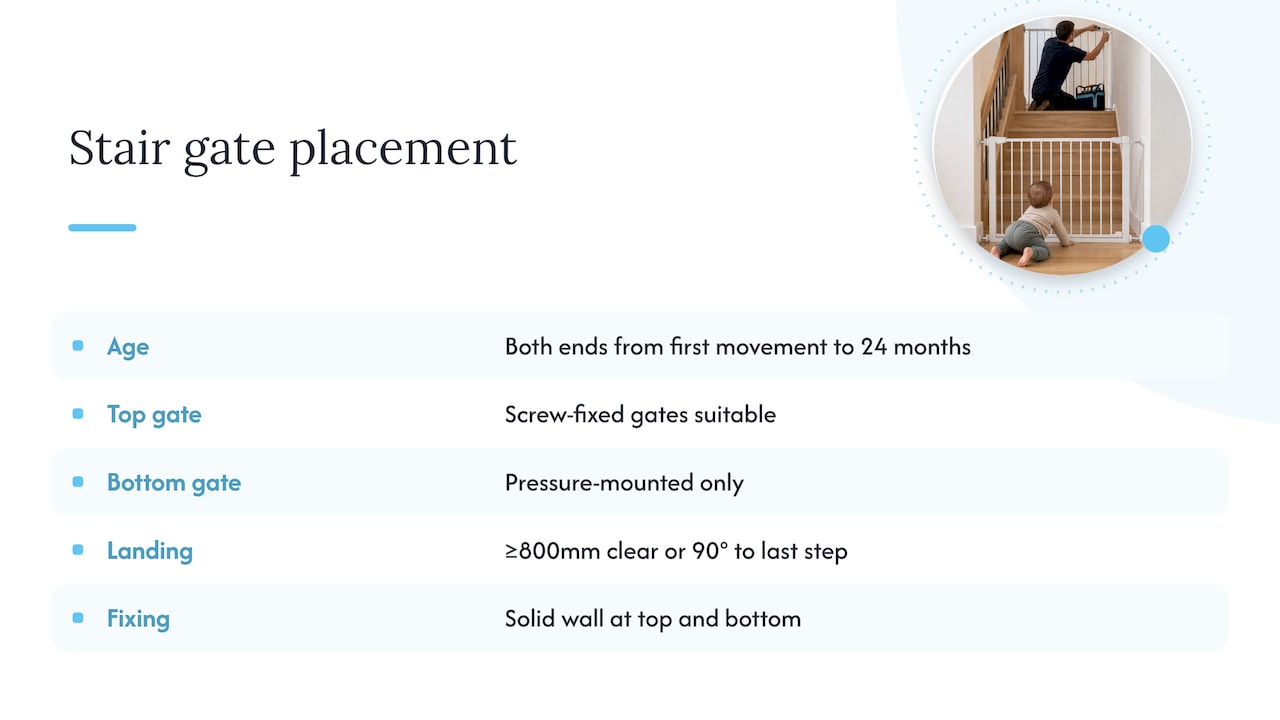
If you are building or reconfiguring, RoSPA recommends leaving solid wall at the top and bottom for fixing, and landing space so a gate can sit at least 800mm clear of the flight or at 90 degrees to the last step.
The point of a gate is to control access. Once your child is walking on the stairs with you, which is a skill they need to learn, they need to be able to hold on. That is where a low rail comes in, and where a gate on its own does not help: it stops a child, but it does not support one.
Making existing stairs child-friendly without rebuilding
Most families do not get to design a staircase. You inherit one, often beautiful, often built for adults only. The practical approach is to leave the structure alone and add the missing support.
- Measure the pitch line. Run a tape from a nosing up to your existing handrail. If it is around 900mm or more, the child cannot reach it.
- Decide on the child’s height range. Our adjustable rail is designed for a 600 to 750mm range, so one fitting covers several years. See wall-mounted child handrails for the detail.
- Fit a rail below the standard one. KiddieRail fits below a standard handrail and suits any home staircase layout. It is designed for straightforward self-installation, so you do not need a joiner.
- Check the whole flight. If your stairs turn, or are long, an extension pack lets you continue the rail so there is something to hold from the first step to the last.
- Retest as they grow. Raise the rail as your child gets taller and look over the fixings monthly.
If you are a childminder, a new homeowner or a parent-to-be, the same sequence applies. Our page for childminder stairs covers the measure-and-fit routine, and the child stair safety advice for UK parents and prevention advice give wider guidance.
A quick design check
| Feature | What to aim for | Source |
|---|---|---|
| Adult handrail | 900 to 1000mm above the pitch line | RoSPA |
| Child handrail | Lower rail, around 600mm upward, with a grippable profile | UN manual |
| Baluster gaps | No more than 100mm | nidirect |
| Climbing footholds | None on the banister | RoSPA |
| Gates | EN 1930 at top and bottom until 24 months | nidirect |
| Lighting | Working lights at both ends of the flight | Consumer Reports |
Add a child-height rail with KiddieRail
The KiddieRail Adjustable Child Stair Handrail is an award-winning, fully adjustable rail that grows with your child, has been tested for durability and suits any type of home staircase. Unlike a safety gate, it actively supports a child while they walk the stairs. If your flight is long or turns, the KiddieRail Extension Pack is priced from £24.99 to £36.99 as a one-off. Browse the full range in our shop.
Our view on child-friendly stairs
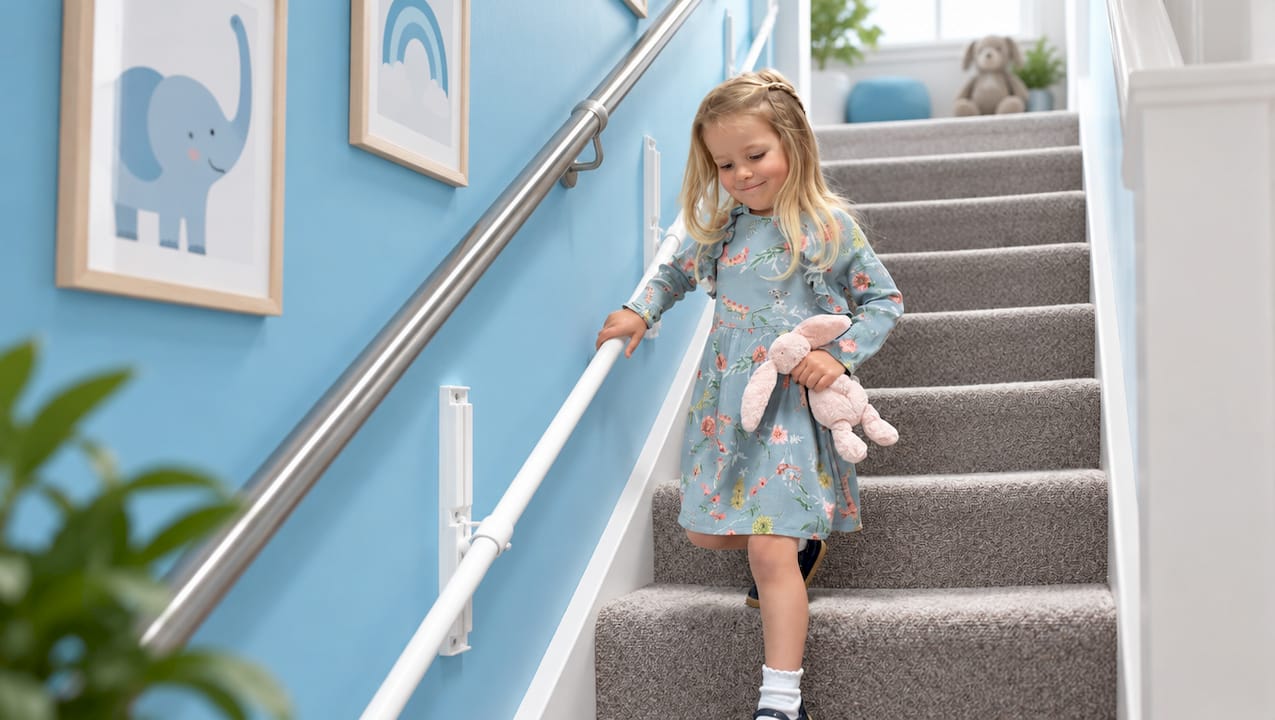
Parents often ask us which staircase to build or which gate to buy. We think the better question is what a child can hold on to. A staircase is designed once for adults, and every standard we know of puts the rail at adult height. Children spend years learning stairs with nothing within reach.
That is why we made KiddieRail adjustable. A rail that moves with the child is a long-term answer rather than a stage. It sits below your existing handrail, so you keep the staircase you chose, and you give a small hand something to hold from the first step to the last.
Gates have their place for babies, and you should follow the guidance on them. But learning to climb and descend safely is part of growing up, and a rail at the right height is how a child does it with support.
Paul
FAQ
What is the safest staircase design for toddlers?
One with consistent steps, visible nosings, good lighting, balusters no more than 100mm apart, no footholds on the banister and a graspable handrail. Toddlers also need a rail at their own height, since adult rails sit at 900 to 1000mm. Add gates while your child is under 24 months.
What height should a child’s handrail be?
The UN accessibility manual suggests a third rail at 0.60m for children. Our adjustable rail covers 600 to 750mm, so you can raise it as your child grows. Measure from the front edge of the steps to get it right.
Do I need a stair gate if I have a child handrail?
Yes, for babies and young toddlers. nidirect advises EN 1930 gates at the top and bottom from when a baby starts moving until 24 months. A child rail then helps once your child is walking the stairs with you.
Can I make my existing staircase child-friendly without replacing it?
Yes. Check baluster gaps against the 100mm rule, secure loose parts, improve lighting and add a lower handrail. KiddieRail is designed for self-installation below your standard rail.
Sources
- RoSPA, Safer by design
- RoSPA, Keep Me Safe at Home
- RoSPA, Preventing falls in children
- nidirect, Guarding children against trips and falls
- Nationwide Children’s Hospital, Stair safety
- UN Accessibility Design Manual
- RIBA, Handrails
- Building Watch Foundation, Stair safety
- Scottish Building Standards Technical Handbook 2022, Stairs and ramps
- SafetyNow ILT, Stairways fall prevention
- Consumer Reports, Home safety fixes
- OHSE, Safety on stairs


