
Currently Empty: £0.00


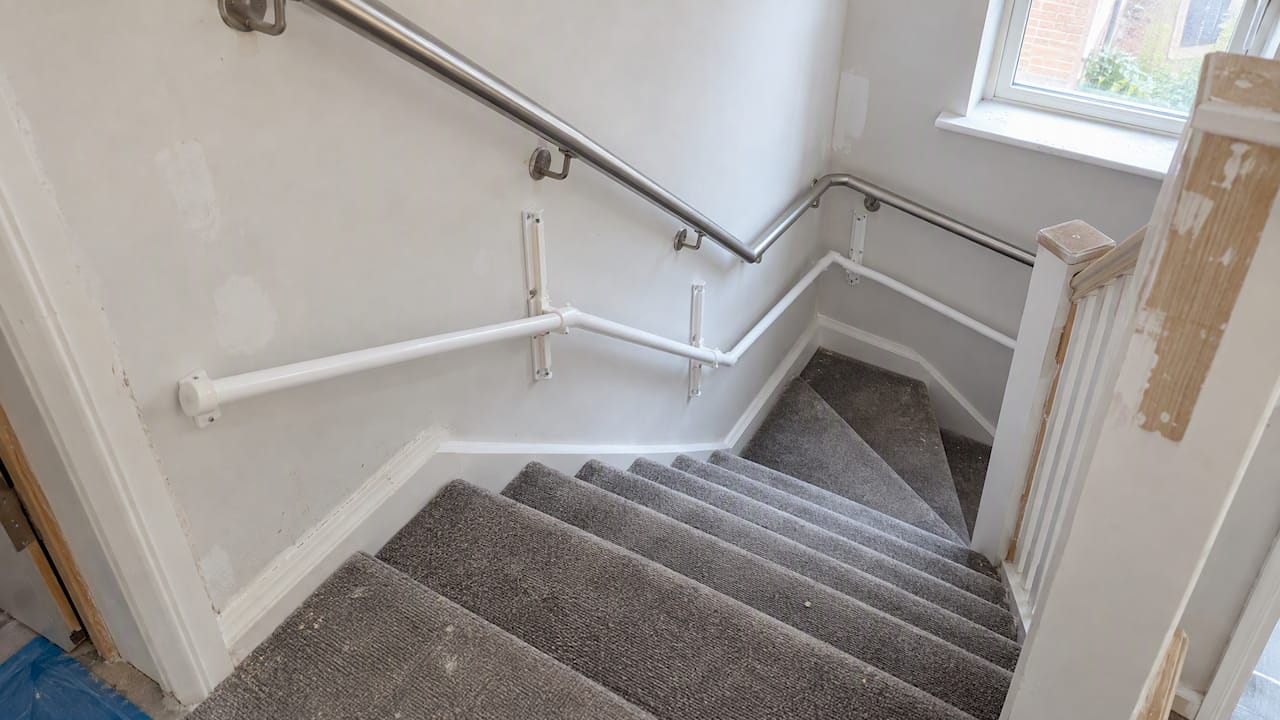
The best handrail material for kids combines a small-diameter grip, a child-safe finish and continuous length at the right height, not just a specific wood or metal. Properly finished wood or coated metal both work when the grip is comfortable for small hands and the rail runs without gaps. An adjustable child-height rail, such as the KiddieRail Adjustable Child Stair Handrail, with extension packs for longer runs, meets these practical needs without replacing your existing handrail.
TL;DR:
- Set an adjustable second rail 20–28 inches above stair nosings and raise it as a child grows; choose a rounded grip 1 to 1¼ inches across.
- Keep the rail continuous beyond the top and bottom steps; use extensions for long flights or turns, and anchor brackets into solid framing.
- Check that no guarding opening allows a 100 mm sphere to pass through, and choose returned rail ends to reduce snagging.
- Wood rails need water based, low VOC lacquer; metal rails need a textured or coated finish, while plastic or composite rails require strength and grip checks.
- Test brackets for movement and inspect finishes every few months, checking more often in high traffic homes; repair loose fixings or worn surfaces promptly.
Table of Contents
- Wood, metal or plastic: comparing handrail materials for children
- How big should a child’s handrail grip be?
- Safety checks: entrapment, gaps and projecting ends
- Finishes and upkeep that keep a child handrail safe
- Measuring and fitting a child handrail correctly
- Why an adjustable rail often beats a fixed child-height one
- Finding the right KiddieRail kit for your staircase
- FAQ
- Sources
Wood, metal or plastic: comparing handrail materials for children
Each material can work for a child’s handrail, but the finish matters as much as the material itself.
Wood feels warm under small hands and can be sanded into a rounded, comfortable profile that suits a child’s grip. For it to be genuinely child-safe, it needs a water-based, low-VOC lacquer rather than solvent-based finishes, which limits the toxins and odour a child is exposed to when gripping or leaning against the rail, as Cpsc notes for child-heavy environments.
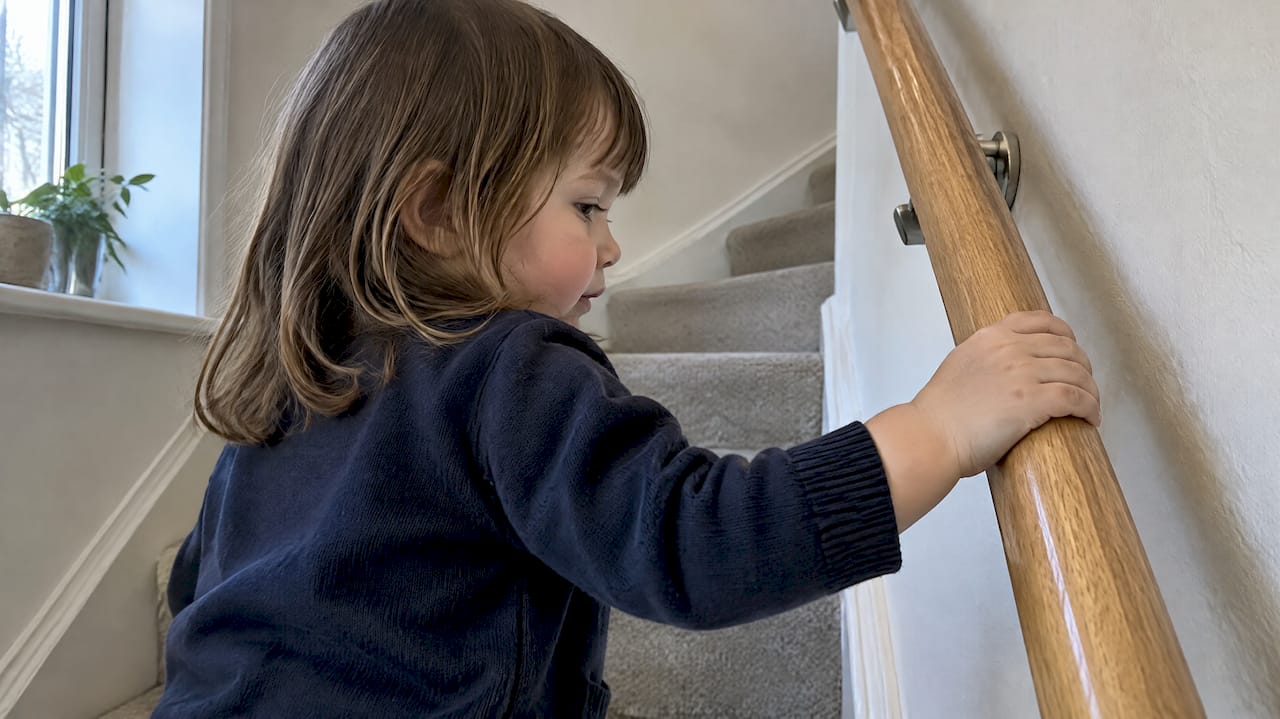
Metal, whether stainless steel or aluminium, holds up well to daily handling and wipes clean easily, which matters on a surface touched frequently. Plain metal can feel uncomfortably cold, so a textured or coated finish helps both comfort and grip. Electrostatic spray coatings are a common way to achieve a durable, child-safe metal finish, according to the same cpsc.gov guidance, and Approved Document K guidance also points to slip-resistant, visually contrasting surfaces as part of safe handrail design.
Plastic and composite rails can be low-maintenance and resistant to weather, which suits conservatories or outdoor steps, but check structural strength and grip texture before buying, since quality varies widely between products.
- Wood: warm grip, needs low-VOC finish to be child-safe
- Metal: durable and easy to clean, needs texture or coating for grip and comfort
- Plastic or composite: low-maintenance, but verify strength and texture first
The right coating or surface texture can turn almost any base material into a workable child rail. The material is the starting point, not the deciding factor.
How big should a child’s handrail grip be?
A handrail only helps a child if their hand can stay on it the whole way down the stairs, which is why continuous graspability matters more than most parents expect. An unbroken rail lets a child keep one hand in place from top to bottom instead of letting go and reaching for the next section, a point installers stress when fitting rails correctly according to Thehortongroup.
Guidance written for children’s use recommends a lower, second handrail mounted between 20 and 28 inches above the stair nosing, with a gripping surface of roughly 1 to 1¼ inches in diameter, smaller than a standard adult rail, according to Archive. This sits below the main adult handrail rather than replacing it.
- Mount a child-height rail within the 20 to 28 inch range above the nosing
- Choose a gripping surface close to 1 to 1¼ inches in diameter
- Add visual contrast and a slip-resistant profile so the rail is easy to spot and hold
Pro Tip: Run your hand along the full length of the rail before fitting it: any snag, gap or rough patch is exactly what a small hand will catch on first.
Safety checks: entrapment, gaps and projecting ends
Before fitting any child handrail, check for the gaps and edges that cause the most common accidents around stairs.
Approved Document K sets out that guarding and balustrades should be built so a 100mm sphere cannot pass through any opening, a rule aimed squarely at preventing young children from slipping through gaps or getting a limb stuck. The same guidance recommends continuous handrails with ends that return into the wall or newel post, reducing the chance that loose clothing or drawstrings catch on a protruding end, a point also raised by thehortongroup.com when describing proper rail extensions.
A rail with openings wider than 100mm fails the entrapment check that UK guidance applies to guarding used by young children. That single measurement is worth checking on any existing balustrade before adding a child rail to it.
- Check that no gap in the guarding exceeds 100mm
- Fit continuous rails with returned, rounded ends rather than exposed terminations
- Avoid sharp edges and choose slip-resistant surfaces throughout
For a domestic installation, the same principles in Approved Document K apply whether you are fitting a full staircase rail or a lower, child-specific one.
Finishes and upkeep that keep a child handrail safe
The finish is what a child’s hand actually touches, so it deserves as much attention as the material underneath.
For wood, a water-based, low-VOC lacquer limits the odour and chemical exposure that solvent-based products carry, a standard cpsc.gov associates with child-safe fittings. For metal, a textured or coated finish, often an electrostatic spray coating, reduces the cold, slippery feel of bare steel or aluminium and adds grip without changing the rail’s shape.
- Choose water-based, low-VOC lacquer for wooden rails
- Pick textured or coated metal finishes over bare, polished surfaces
- Check fixings and surface wear every few months, more often in high-traffic homes
A simple inspection routine, a quick wiggle test on brackets and a glance for chipped or worn finish, catches most problems before they become a safety issue.
Measuring and fitting a child handrail correctly
Getting the fit right starts before you buy anything.
- Measure the mounting height from the stair nosing or pitch line, choosing either a dedicated lower rail or an adjustable system that can be set to a child’s height, following the practical approach described by This Old House.
- Plan for a continuous run with extensions beyond the top and bottom steps, since a rail that stops short of the landing leaves a child without support exactly where falls are most likely.
- Choose an 85cm extension pack or a 170cm extension pack to cover longer flights, and check our corner stairs guidance if your staircase turns.
- Anchor brackets into solid framing or use a backing board where the wall behind the rail is hollow or uneven.
- After fitting, check for any movement in the rail and re-anchor immediately if you find play, since loose brackets usually mean they missed solid framing, as thehortongroup.com advises.
A confident DIYer may be able to fit a single-flight rail, but call a professional for masonry walls, unusual stair geometry or anything that will not sit flush against solid backing.
Why an adjustable rail often beats a fixed child-height one
A fixed low rail suits a toddler for a time, then may become too short, while an adjustable rail can be reset as a child grows, which avoids replacing the whole fitting every stage. That flexibility also helps on awkward staircases, where extension packs let a single system stretch across a long flight or wrap around a corner rather than forcing a custom build.
The practical upshot is that one well-chosen adjustable rail can adapt as a child grows, supporting them as they learn rather than just fencing the stairs off.
— Paul
Finding the right KiddieRail kit for your staircase
We designed the KiddieRail Adjustable Child Stair Handrail around the same principles this guide covers: a child-height gripping surface, a continuous rail rather than a short add-on, and a finish built to handle daily use without chipping or feeling rough.

For longer flights or staircases with a turn, our 85cm extension pack and 170cm extension pack extend the same rail without breaking the continuous grip a child relies on. If you are preparing a wooden rail for fitting first, proper sanding between coats, using a finer grit as you go, gives a smoother surface for the lacquer to bond to, a step professional decorators such as Alex Trend Painters treat as standard before any finish goes on.
Measure your stairs using the placement guidance in our handrail placement for kids page first, then visit our shop to pick the kit that matches your flight length and layout.
FAQ
What is the best handrail material for a child?
There is no single best material: a well-finished wood rail and a textured or coated metal rail both work well, provided the grip diameter suits small hands and the finish is non-toxic, as outlined by cpsc.gov. What matters most is continuous length and the correct mounting height, not the base material alone.
How high should a handrail be for a child?
Guidance written for children’s use recommends a lower handrail positioned between 20 and 28 inches above the stair nosing, in addition to the standard adult rail, according to archive.ada.gov. An adjustable rail lets you set this height precisely and move it as your child grows.
What grip diameter is best for small hands?
A gripping surface of roughly 1 to 1¼ inches in diameter suits most children’s hands better than a standard adult handrail profile, based on the same archive.ada.gov guidance. Rounded, slip-resistant profiles in that range are easier for small hands to hold securely.
Can I add a child handrail without replacing the existing one?
Yes, a lower child-height rail is typically fitted alongside the existing adult handrail rather than instead of it, which is how products like the KiddieRail Adjustable Child Stair Handrail are designed to work. Extension packs let the same system cover longer flights or stairs with a corner.
How do I know if my handrail has unsafe gaps?
Check that no opening in the guarding or balustrade is wide enough for a 100mm sphere to pass through, the threshold used in Approved Document K to prevent entrapment around young children. Any gap wider than that should be addressed before fitting a child rail nearby.


