
Currently Empty: £0.00


Keep the handrail continuous through the turn. That’s the entire goal. On a corner stairway, you have two realistic ways to get there: a factory bent rail that curves through the corner in one piece, or a corner hinge fitting that joins two straight sections at an angle without breaking the graspable surface. If young children use the stairs, add a lower adjustable rail underneath the primary one so their hands never lose contact through the turn.
TL;DR:
- Bending rails are ideal for wide-radius curves, providing a seamless appearance, while corner hinges are better suited for sharp turns like 90-degree or dogleg staircases.
- Ensuring consistent handrail height and wall clearance at corners is crucial, as variations can cause pinch points or gaps that violate safety codes.
- Installing a lower child-height rail beneath the primary handrail offers a continuous grip for children without compromising the stair’s aesthetic or structural integrity.
- Regular maintenance, including cleaning with non-abrasive methods and checking joint integrity, is essential to maintain safety and durability at stair corners.
- Local building codes and inspecting for proper spacing, hardware anchoring, and hardware finishes ensure safe, compliant, and visually coordinated corner handrail systems.
Table of Contents
- Why Continuity Matters for a Corner Stairs Handrail
- Bending Rail Versus Corner Hinges: Which One Fits Your Stairs?
- Choosing the Right Handrail Profile and Material for Corners
- Step-by-Step Installation Checklist for Corner Handrails
- Adding a Child-Height Rail Through the Corner
- Maintenance and Cleaning Tips for Corner Stair Handrails
- Matching Your Corner Handrail to Your Home’s Interior Style
- Slip Resistance and Sturdiness: Safety Beyond the Code Minimum
- What I’d Actually Do on a Real Staircase
- Get a Continuous Grip for Kids With KiddieRail
- Sources
- FAQ
Why Continuity Matters for a Corner Stairs Handrail
A handrail that stops, drops, or juts out at a corner defeats its own purpose. If someone stumbles mid turn and their hand slides off the rail because it dead ends into a newel post, the rail failed at the exact moment it mattered most. Code language and accessibility guides both stress uninterrupted graspable surfaces through changes in direction, precisely because falls cluster around transitions like landings, winders, and doglegs.
Most residential codes recommend handrail height generally between a range commonly around three feet to just over three feet measured vertically from the tread nosing, with enough clearance between the rail and the wall to allow a hand to wrap fully around the grip. At corners, that clearance and height need to hold steady. A rail that suddenly rises, drops, or pinches inward at the turn creates a snag point.
The 4-inch sphere rule matters here too. It requires that no gap in a guard or baluster system allow a 4-inch sphere to pass through, and corner geometry is where that spacing most often slips, since angled cuts and hardware can widen a gap without anyone noticing until an inspection flags it.
Before you commit to a method, check with your local building department. Requirements shift slightly by jurisdiction, and an inspector can tell you in five minutes whether your planned approach meets local amendments to the IRC or IBC. Key things to confirm:
- Minimum and maximum handrail height for your jurisdiction
- Required wall clearance and grip diameter
- Whether your stair run requires handrails on one side or both
- Return requirements at the top and bottom of the run
Bending Rail Versus Corner Hinges: Which One Fits Your Stairs?
Bending rail is a laminated handrail built from multiple thin plies, typically several layers, glued and pressed into a curve. It comes in lengths of several feet, with two main varieties: keyed (tongue and groove) and unkeyed. Keyed bending rail uses interlocking plies that snap into alignment as you assemble the curve, which cuts down on clamping time and guesswork. Unkeyed rail is cheaper but demands more skill to keep the plies flush while the glue sets.
Corner hinges work differently. Instead of curving material, you cut two straight rail sections and join them with a hardware fitting that has an adjustable core, often good for close to 45 degrees of angle. That lets the fitting match whatever pitch your stairway actually has, and the top surface stays level and continuous across the joint.
- Smooth, sweeping curves (helical stairs, wide radius turns): choose bending rail. It preserves the profile shape through the whole curve with no visible joint.
- Sharp 90 degree or dogleg corners: choose a corner hinge. Bending rail struggles with tight radii, and a hinge handles an abrupt turn cleanly.
- Budget-conscious DIY projects: lean toward hinges. They involve less specialized tooling and fewer failure points during glue up.
- High-end finish work where an unbroken wood grain matters: bending rail wins, especially keyed stock, since it avoids a visible hardware seam.
Pro Tip: If you’re not sure which way your stairway turns, walk it with a piece of string held at handrail height. Wherever the string kinks instead of curving smoothly tells you whether you need a hinge or a bent rail.
Choosing the Right Handrail Profile and Material for Corners
Profile shape affects how well a hand actually grips the rail, not just how it looks. Two of the most common residential profiles, often labeled 6010 and 6210 in supplier catalogs, are rounded enough for a full hand wrap while still reading as a traditional wood molding shape. A flat or heavily ornamented profile might look nice on a straight run, but through a corner it can create pinch points where fingers catch on ridges.
Stick to these sizing basics regardless of which profile you pick:
- Grip diameter should let an adult hand close around the rail with the thumb and fingers nearly touching, typically 1.25 to 2 inches across.
- Maintain roughly 1.5 inches of clearance between the rail and the wall.
- Maple, oak, and poplar are the standard choices for bending rail because they laminate well and hold a finish; metal profiles (steel or aluminum) work better with hinge fittings than with steam or ply bending.
- Softer woods bend more easily but dent more easily too, which matters on a rail that gets gripped daily for decades.
One caution worth repeating: bending rail flexes horizontally, following the curve of the stair. It is not built to twist or bend vertically, and forcing it to climb a slope while also curving usually stresses the laminations past their limit. If your stairs need both a curve and a steep rise change at the same point, a corner hinge is almost always the safer engineering choice.
Step-by-Step Installation Checklist for Corner Handrails
Getting a corner handrail right comes down to sequencing. Skip a step and you’ll be pulling brackets back out of the wall.
- Snap a chalk line from the tread nosings, extending it through the full run including the corner, so your height reference stays consistent.
- Mark newel post and bracket locations before cutting anything. Corners often need an extra bracket close to the joint for support.
- Dry fit every segment, bent rail or hinge assembly, and physically run your hand along the full path to feel for snags or height jumps.
- Anchor brackets into studs or blocking rated for structural handrail loads, not just drywall anchors.
- Check baluster and cable spacing at the corner against the 4-inch sphere rule, since angled hardware can open gaps wider than a straight run would.
- Confirm the rail returns to the wall or a post at both the top and bottom of the run, rather than ending in an exposed point.
Falls on stairs remain one of the most common home injury causes, which is exactly why corners deserve extra attention rather than less. The most common DIY mistakes are predictable: cutting a bend radius too tight for the rail stock, mitering joints without enough surface contact for a strong glue bond, skipping the wall return at the ends, and anchoring into drywall alone instead of framing. Any one of these turns a good looking rail into a weak one.
Adding a Child-Height Rail Through the Corner
Standard handrails sit 34 to 38 inches up, a height built around adult hands. A toddler or young child can’t reach that rail at all, and a child who can’t grip anything going up or down a staircase is at far higher risk of a fall. That gap between code height and child reach is one of the most overlooked safety issues in homes with young kids.
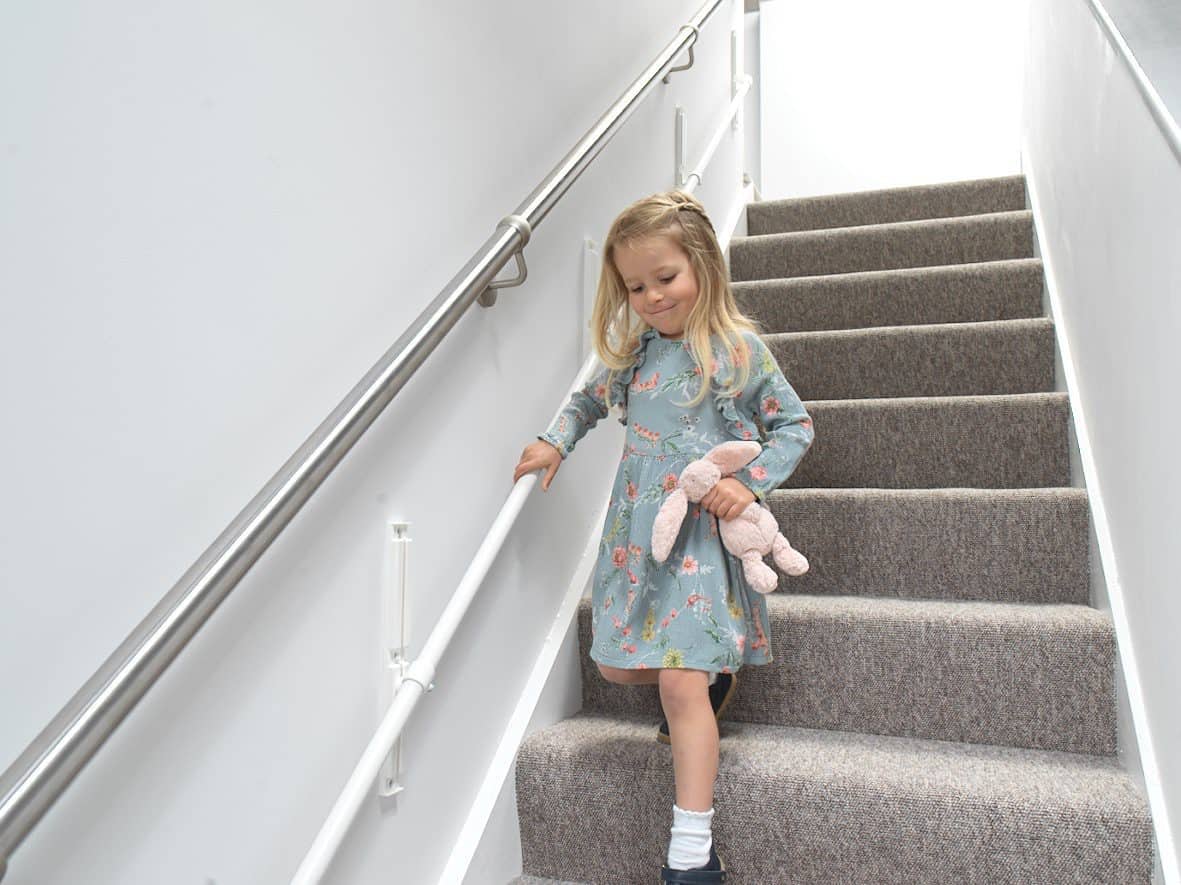
You have two paths here. One is installing a second, permanent lower rail, which works but usually requires its own brackets, its own continuity plan through the corner, and often a professional install. The other is a below rail solution that mounts under the existing primary handrail without requiring new structural brackets or altering your main rail’s path.
The KiddieRail Adjustable Child Stair Handrail fits this second category. It mounts beneath a standard handrail and is built to follow the same path through corners, so a child’s hand stays on a continuous grip exactly where an adult’s does. It’s designed to grow with the child rather than get replaced every couple of years, and it has gone through durability testing aimed at daily household use rather than a one-time demo.
- Confirm at least 1.5 inches of clearance for small fingers to wrap the lower grip.
- Match the lower rail’s path to the primary rail through the corner so the handhold never breaks.
- Check extension pack availability if your run is longer than the base kit covers.
Pro Tip: Install the child rail after you’ve finalized your primary rail’s corner solution, not before. Trying to fit a lower rail around an unfinished bend or hinge often means redoing brackets twice.
Maintenance and Cleaning Tips for Corner Stair Handrails
Corners collect more grime than straight runs, mostly because hands grip harder and shift position going through a turn. Wipe wood rails down every couple of weeks with a slightly damp cloth and a mild dish soap solution, then dry immediately. Standing moisture is the fastest way to lift a finish or, worse, loosen a glued lamination joint on a bent rail section.
Check the joint at the corner itself every few months, whether it’s a glued bend or a hinge fitting. Wood expands and contracts with humidity swings, and a corner joint under constant hand pressure is the first place a hairline crack shows up. On hinge fittings, a light drop of machine oil on the pivot point once or twice a year keeps hardware from developing a squeak or stiffness, though most quality fittings are built to run dry for years.
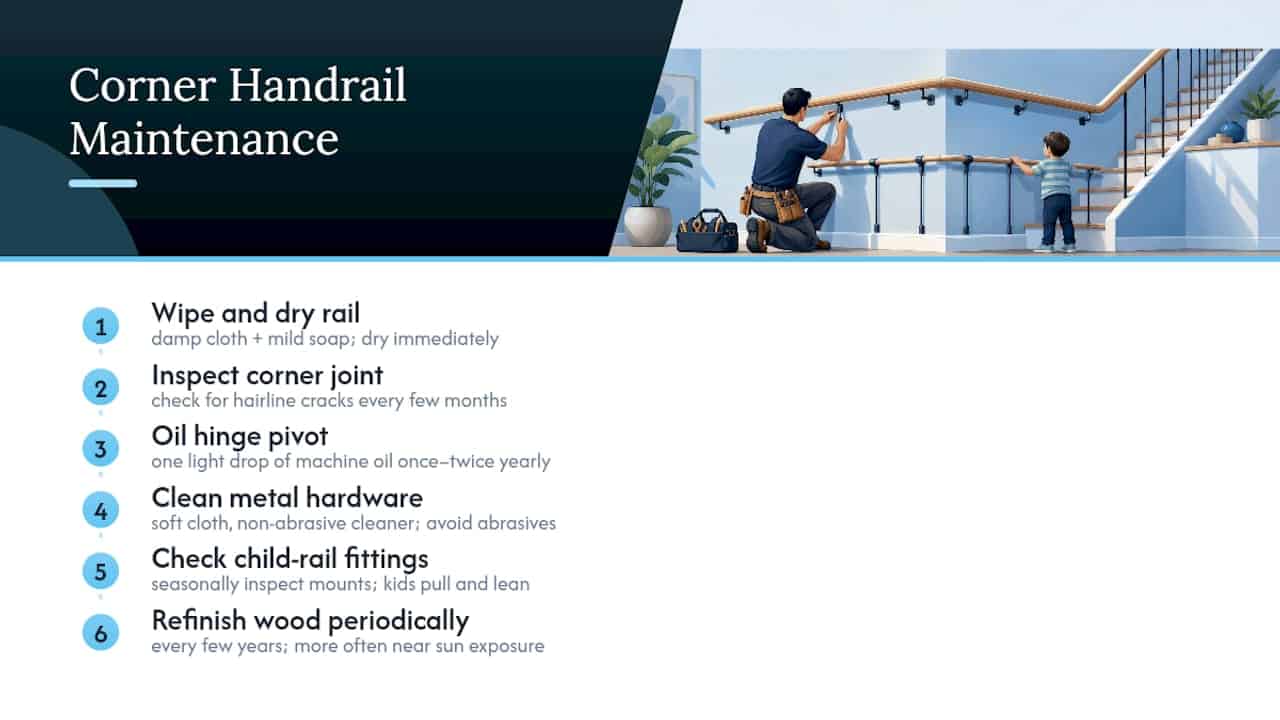
Metal hardware, especially anodized or stainless corner hinges, holds up well against regular wiping but can dull if you use abrasive cleaners. Stick to a soft cloth and a non abrasive cleaner rated for metal finishes. Avoid ammonia based glass cleaners on brass or bronze fittings since they can strip the protective coating over time.
For any lower child rail mounted under the primary one, wipe it down as often as the main rail, since it takes more direct contact from smaller, often sticky hands. Check its mounting hardware seasonally too; kids pull and lean on rails in ways adults generally don’t, and a below rail fitting takes that stress differently than a wall bracket does.
Refinish or reseal wood handrails every few years depending on sun exposure and foot traffic near the stairway. A rail near a south facing window will fade and dry out faster than one in an interior stairwell, and a dried out finish is what eventually leads to splinters at the exact spot people grip hardest, the corner.
Matching Your Corner Handrail to Your Home’s Interior Style
A handrail is one of the few fixtures in a house that gets touched every single day, so its finish and shape carry more visual weight than most homeowners expect. Bending rail in stained maple or oak reads as traditional and pairs naturally with wood balusters, wainscoting, and older or colonial style homes. The unbroken curve through a corner is part of the appeal. It shows off the woodworking rather than hiding a seam.
Corner hinge fittings tend to suit a more contemporary look. A brushed stainless or matte black hinge against a straight wood or metal rail gives a clean, almost architectural line, which fits open concept homes with cable railing or glass panel guards. Because the hinge itself is a visible hardware piece rather than a hidden joint, some homeowners actually choose a contrasting metal finish on purpose, treating it as a design detail instead of something to disguise.
Color and material consistency matters more at corners than on a straight run, simply because that’s where the eye naturally pauses. If your balusters are painted white but your handrail is a natural wood tone, a poorly matched corner joint will draw attention to the mismatch every time someone walks the stairs. Match your bracket and hinge finishes to your existing door hardware or light fixtures where possible. A rail that ties into the rest of a room’s metal tones looks intentional rather than added on.
If you’re adding a lower child rail, you don’t have to sacrifice style for safety. Many below rail products come in finishes that can complement, rather than compete with, the primary rail above them, so the addition reads as a coordinated system instead of an obvious retrofit.
Slip Resistance and Sturdiness: Safety Beyond the Code Minimum
Meeting code height and clearance numbers is the floor, not the finish line. A rail can technically pass inspection and still fail the people using it if the surface itself doesn’t perform under real conditions like sweaty palms, wet hands from outdoor shoes, or a panicked grab during an actual stumble.
Slip resistance comes down mostly to finish choice. A glossy, heavily lacquered wood rail looks sharp in photos but can turn slick when hands are damp, which is exactly the moment grip matters most. A satin or matte finish holds friction better without looking unfinished. Textured or slightly grooved profiles, common in some 6010 style moldings, also give fingers something to catch beyond smooth roundness alone.
Sturdiness is a separate question from finish, and it’s the one DIYers most often shortchange. A handrail needs to resist a firm sideways pull, not just hold its own weight. That’s why anchoring into studs or blocking rated for structural loads matters more at corners than anywhere else on the run, since a corner joint concentrates stress differently than a straight span of bracketed rail. A rail that wobbles under hand pressure at the turn is a repair waiting to happen, not a cosmetic issue to live with.
Test your finished installation the way an actual fall would stress it: grab the rail hard at the corner and pull sideways and downward at the same time. If you feel any flex in the bracket or movement in the joint itself, tighten hardware or add blocking before calling the job done.
What I’d Actually Do on a Real Staircase
For a smooth, sweeping curve, bending rail wins on looks and feel every time. For a sharp dogleg or 90 degree turn, a corner hinge is faster and just as strong. Add an adjustable child rail whenever children under about ten use the stairs. Call a professional for tight radii, masonry anchoring, or anything that touches a permit or inspection.
— Paul
Get a Continuous Grip for Kids With KiddieRail
Kiddierail is the practical fix for the gap every bending rail and corner hinge still leaves behind: a handrail built for adult hands, sitting inches above where a small child can actually reach it. Instead of a full second permanent rail with its own brackets and its own corner engineering, the KiddieRail Adjustable Child Stair Handrail mounts beneath your existing rail and follows the same path through corners, so a child keeps a continuous grip exactly where you already solved the continuity problem for adults.

It’s built to grow with your child rather than get swapped out year after year, and it’s gone through durability testing meant for the kind of daily, sometimes rough, use stairs actually get in a house with kids. Getting started is simple: measure your existing rail’s length and height, confirm compatibility with your stairway layout, and order an extension pack if your run is longer than the base kit covers. If child safety on stairs is something you’re already thinking through, the KiddieRail homepage has the full product lineup and installation details to help you plan the fit before you buy.
Sources
- Bending rail: product and technical overview — Commercial Forest Products
- Signature Classic Stair Corner Handrail Hinge — Cable Bullet
- Stair corner continuity and 4-inch sphere guidance — Senmit Academy
FAQ
What can I use instead of a handrail?
Nothing legally substitutes for a code-required handrail on a stairway with a certain number of risers, since the rail is what keeps a hand in continuous contact during a fall. For extra security, some homes add a secondary lower rail or grab points, but that supplements a handrail rather than replacing it.
What are the trends for stair railing design going into 2026?
Clean lined metal corner hinges paired with wood rails, matte rather than glossy finishes for better grip, and family focused additions like below rail child handrails are all gaining traction as homeowners prioritize both looks and everyday safety.
What is the 4-inch sphere rule for railing?
The 4-inch sphere rule requires that no opening in a guard or baluster system be wide enough for a 4-inch sphere to pass through, a standard meant to keep small children from slipping through gaps, and it applies with extra attention at corners where spacing can drift.
Do I need a handrail on both sides of my stairs?
That depends on your local code and stair width; many jurisdictions require handrails on both sides once a stairway exceeds a certain width, so checking with your local building department is the only reliable way to confirm your specific requirement.


