
Currently Empty: £0.00


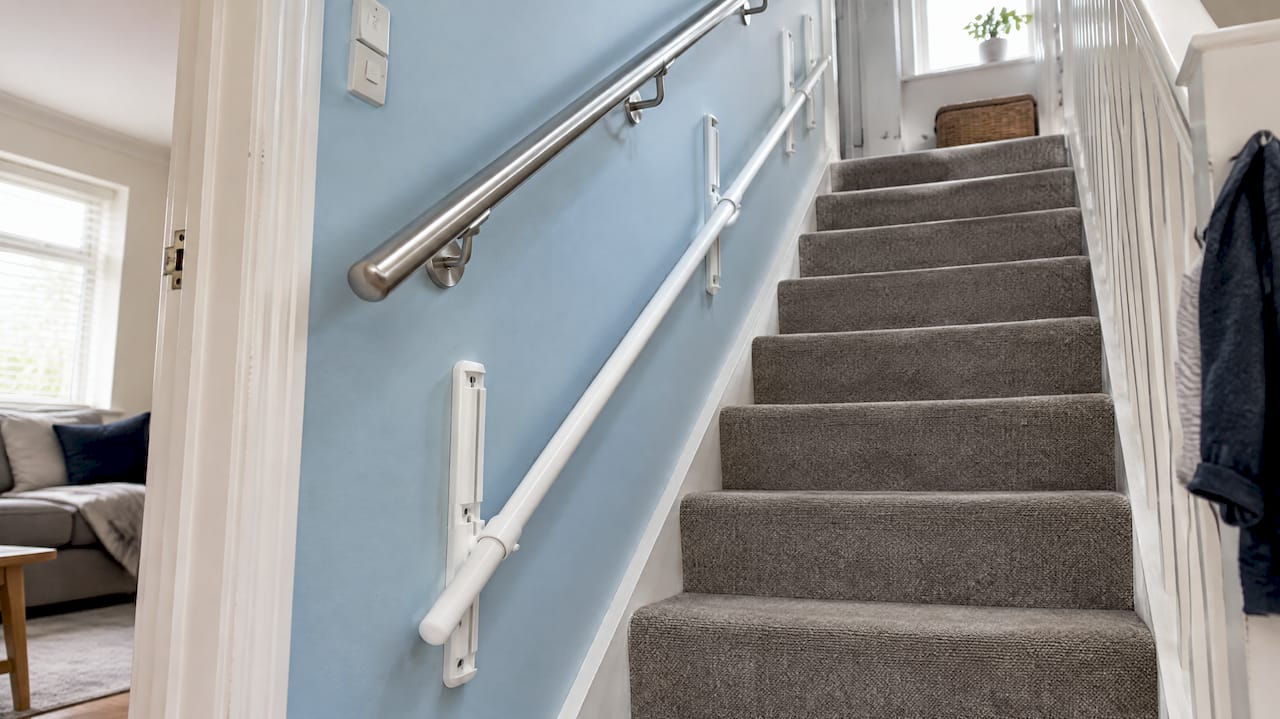
An adjustable child handrail is a second, lower rail that fits beneath your existing stair handrail, so a toddler can hold on at their own height and you can raise it as they grow. It does a different job from a stairgate: a gate keeps a child off the stairs, a child-height rail helps them use the stairs safely once they are ready. This guide explains how the two fit together, what to compare before you buy, and how to fit and adjust a rail so it stays safe.
TL;DR
- A child handrail sits below your adult rail and gives small hands something they can actually grip. It supplements the adult rail rather than replacing it.
- It does not replace gates or supervision. Use gates while your child is too young to manage stairs, then use the rail to teach them to climb and descend holding on.
- Compare adjustability range, graspable shape, smooth surfaces with no gaps, fixing method and whether it covers your whole staircase, including turns and landings.
- Fix into solid wall or a backing board, not plaster alone, and check the fixings and height every few months as your child grows.
- KiddieRail is our adjustable rail: it covers 348 cm as standard, with extension packs from £24.99 to £36.99 for longer or wider runs.
Table of Contents
- What an adjustable child handrail actually is
- Why a rail at child height is worth having
- What to compare when choosing an adjustable child handrail
- Where the rail should sit
- Does it fit your staircase?
- Using a child rail with gates and supervision
- As your child grows: checking and adjusting
- Beyond family homes: childminders, rentals and flats
- Our view: why we built the rail to adjust
- Getting a KiddieRail
- FAQ
- Sources
What an adjustable child handrail actually is
Most stair handrails are set for adults. A patent filing in this field makes the point plainly: most handrails sit at a height suited to adults and may be out of a small child’s reach. A toddler who has just learned to walk reaches for the balusters, the wall or your hand instead, and none of those is designed to be gripped.
An adjustable child handrail solves this by adding a rail at a lower height, supported so you can move it up as your child gets taller. In the UK, the standard adult handrail is normally fitted well above a toddler’s shoulder, which is why a lower rail matters in the first place.
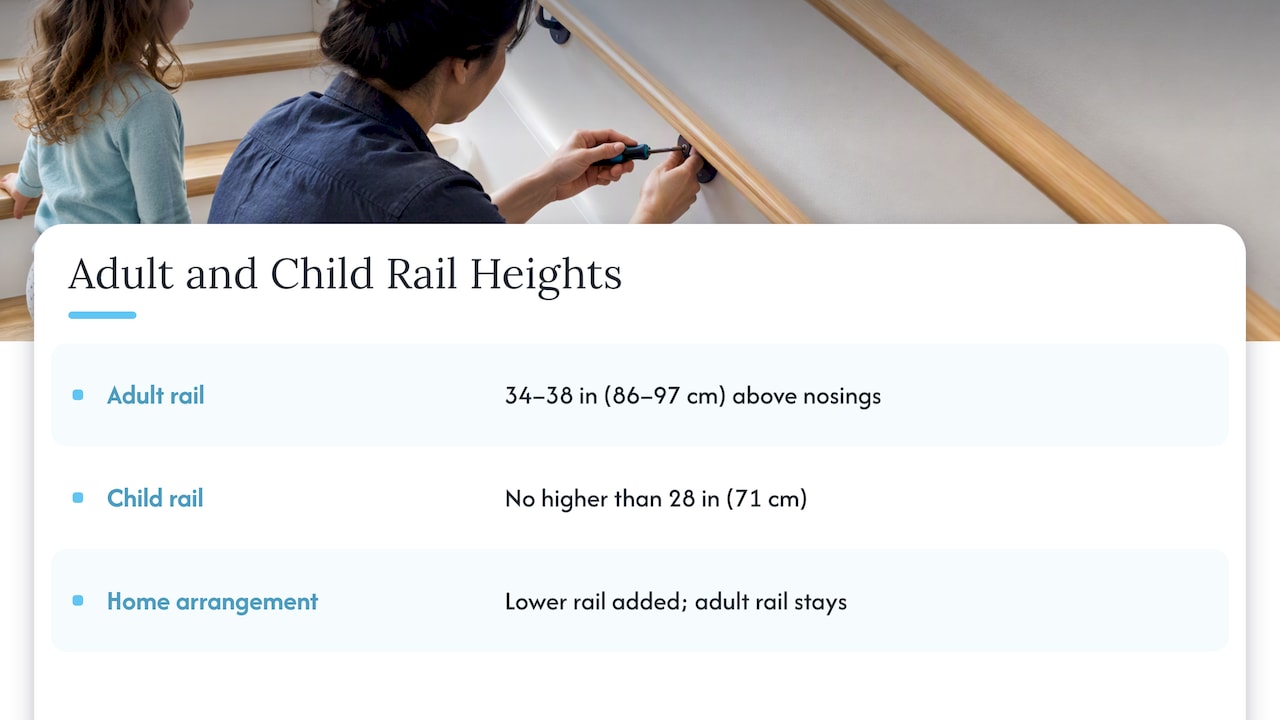
The idea is not unique to homes. The US Access Board’s stair guidance gives the standard handrail height as 34 to 38 inches (86 to 97 cm) above the stair nosings and, for buildings that mainly serve children, recommends a second rail no higher than 28 inches (71 cm). Notice what that means: the lower rail is added, and the adult rail stays. That is exactly how a home child rail works.
How it differs from a stairgate
A stairgate restricts access. A handrail supports use. They answer two different questions:
- Gate: how do I stop my baby or crawler reaching the stairs unsupervised?
- Child rail: how do I help my walking toddler learn to manage the stairs safely, with me beside them?
The Alberta health service puts the sequence clearly: keep gates on stairs until a child can climb safely, then teach them to use the stairs holding the handrail. A rail at the right height is what makes that second stage practical, because otherwise there is nothing at child height to hold.
Why a rail at child height is worth having
Stairs are a common place for serious falls at home. RoSPA, the UK’s accident prevention charity, advises using the handrail, fitting gates at both ends before a baby becomes mobile, keeping stairs in good repair and well lit, and making sure banisters give no footholds. For children under 24 months it recommends wall-mounted gates at the top and bottom.
The handrail part of that advice only works if a child can use it. Nationwide Children’s Hospital says children should be taught to keep a free hand on the handrail, and recommends a rail small enough for an adult hand to grip fully. Canadian workplace safety guidance adds that a rail must be graspable, so a person can hold it quickly, easily and firmly when they begin to lose balance. A toddler cannot do any of that with a rail above their head.
What a child rail cannot do
Be honest about the limits. A rail does not make stairs safe on its own, and it does not mean a young child can be left to climb alone. It will not stop a crawler reaching the stairs, and a determined toddler can still sit down, slip or let go. Treat it as one layer: gates while your child is small, a rail while they learn, clear and well-lit steps, and an adult close by. Our own guides on child safety on stairs and stair safety for toddlers go through the full set of measures.
What to compare when choosing an adjustable child handrail
With few products on the market, the differences that matter are practical ones. Use this checklist.
| Feature | What to look for | Why it matters |
|---|---|---|
| Height range | Adjustable across the whole period from first steps to when your child can use the adult rail | A fixed-height rail is outgrown within a year or two |
| Grip | A shape and thickness a small hand can wrap around | A rail must be held firmly to be any use |
| Surface | Smooth, continuous, no gaps or openings | No catch points for fingers, clothing or limbs |
| Materials | Smooth finishes that suit hands that end up in mouths | Children touch surfaces and then their faces |
| Clearance | A gap between the upper and lower rails that avoids entrapment | US guidance recommends at least 9 inches (230 mm) |
| Coverage | Enough length for the full flight, plus turns and landings | A rail that stops halfway leaves a gap in support |
| Fixing | Screws into solid wall or a backing board | A rail has to take a sudden pull |
| Installation | Doable with ordinary tools in one session | Fewer mistakes, less mess |
Two of those rows deserve a closer look.
Clearance between the two rails
The Access Board recommends at least 9 inches (230 mm) of vertical clearance between the upper and lower handrails to help prevent entrapment. That is a US accessibility recommendation, not a UK rule for homes, but it is a sensible check: you do not want a gap where a small head or limb can get stuck. When you measure, look at the space between the two rails as well as the height of the lower one.
Smooth, gap-free and child-friendly materials
Children grab, lick and chew. Guidance aimed at homeowners suggests choosing non-toxic materials and finishes, with a smooth, continuous surface and no gaps. Beauty is secondary: the Canadian guidance is firm that design must not compromise how easily a rail can be grasped. If you want to read more on this, we have a page on handrail materials and gap-free design for kids.
Where the rail should sit
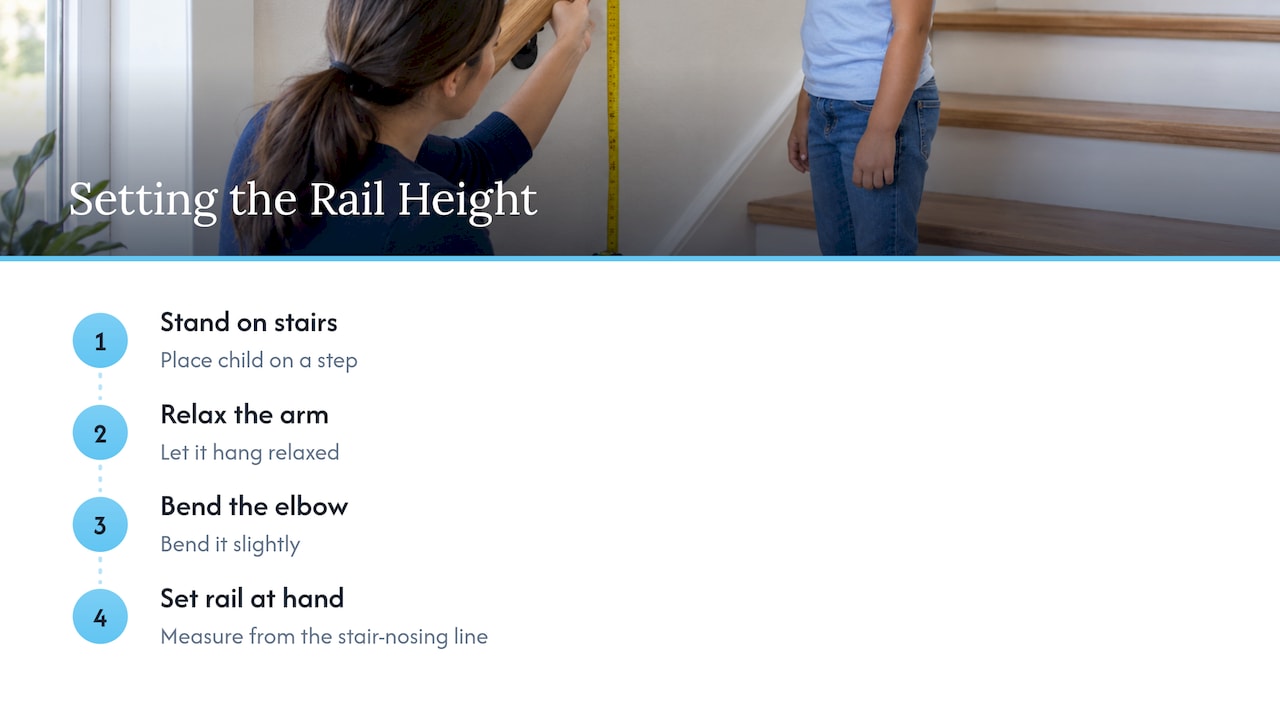
Height is the question every parent asks first. Our guidance for UK stairs is a lower rail that adjusts across roughly 600 to 750 mm, measured from the stair nosings, which lets you set it to your child’s own reach and move it as they grow. Our page on child handrail placement shows how to find the right setting for your child, and our guide to wall-mounted child handrails covers the fixing side.
A simple way to set the height: stand your child on the stairs, let their arm hang relaxed, then bend the elbow slightly. The rail should sit about where their hand naturally falls, so they hold it without reaching up or hunching down. Check it on a step, not on the floor, because the rail height is measured from the nosing line.
Does it fit your staircase?
This is the part most guides skip. Before buying any child rail, do four checks.
- Measure the run. Measure along the wall, following the slope of the stairs, from the first to the last step you want covered. KiddieRail covers 348 cm as standard, and extension packs add further length where you need more wall coverage.
- Look at the wall. Is it solid masonry, plasterboard over studs, or a thin partition? The fixing method depends on the answer.
- Note turns, landings and winders. Layout changes mean you will need more length and careful planning of where each section ends.
- Check the width. On wide stairs, one rail along one side may not be enough. See our notes on wide stair child handrails, including how to split long flights.
If your stairs have a plasterboard wall, fix to a handrail backing board so screws bite into something solid. We cover how to choose between 85 cm and 170 cm lengths on that page.
Installing it securely
KiddieRail’s installation needs a drill, a spirit level, a tape measure, a 4 m length of string, a pencil and two screwdrivers, one flathead and one crosshead. The string is a neat trick: pulled taut along the nosings, it shows you the stair line and lets you mark the rail height consistently from step to step.
The general sequence for any wall-mounted rail is:
- Mark the nosing line with the string and the pencil.
- Mark the rail height at the first and last step, then join the marks.
- Mark bracket positions on solid fixings, avoiding cables and pipes (use a detector if you are unsure).
- Drill, plug and fix the brackets, checking with the spirit level as you go.
- Mount the rail and tighten everything fully.
- Pull hard on the rail in several places, the way a toddler’s whole weight might.
If the rail moves at all, refix it. If you are not confident drilling into your walls, ask a competent tradesperson. That is better than guessing.
While you are working on the stairs, it is a good moment to look at the surfaces under little feet too. If your treads or landing are wooden and due a refinish, a baby-safe floor finish is worth choosing with the stage your child is at in mind, since crawlers and new walkers spend a lot of time touching the floor.
Using a child rail with gates and supervision
The order matters.
- Before your baby is mobile: fit gates. RoSPA advises gates at both ends of the stairs, wall-mounted for children under 24 months.
- When your child starts to walk and wants to climb: add the child rail and start supervised practice. Ottawa Public Health says to remove a gate when the child tries to climb over it, or at the manufacturer’s recommended stage, usually around age two in its guidance.
- As your child gains confidence: keep the rail, keep watching, and teach them to hold on every time, with a free hand on the rail.
For the top of the stairs, a screw-fixed gate is the sturdier option. Ottawa’s advice is a screw-mounted gate at the top, with a pressure-mounted one acceptable at the bottom.
A few habits make a big difference: keep steps clear of toys and laundry, keep the light on, and teach “one hand on the rail” as a routine. Watch the way your child comes down as well as up. Going down is where most toddlers wobble, and many will want to turn and crawl backwards at first, which is fine.
As your child grows: checking and adjusting
A rail that was perfect at 18 months will be wrong at three. Build a simple routine.
- Every few months, stand your child on a step and recheck the height against their relaxed hand.
- After each adjustment, tighten every fixing and give the rail a firm pull.
- Check the gap between the two rails is still comfortable for your child’s size and cannot trap a limb.
- Look for wear: loose brackets, rough patches, sticky residue or anything that catches.
- Retire the rail when your child can comfortably and reliably use the adult handrail.
Adjustability is the whole point. One rail covers the stretch from first steps to when the adult handrail becomes usable, so you are not buying again at each stage.
Beyond family homes: childminders, rentals and flats
The same logic applies wherever small children use stairs. If you look after other people’s children, our page on childminder stair safety explains how to measure and fit a 600 to 750 mm rail. Hosts and landlords can read how a permanent lower rail works in holiday lets, and flat dwellers will find a two-minute sweep routine and top-gate tips in our apartment stairs guide.
Our view: why we built the rail to adjust
We started from a simple observation: parents were doing the right things with gates, then reaching a point where the gate came down and there was nothing at child height to hold. A fixed low rail solves that for a few months and then is wrong. Making the rail adjustable means one fitting follows your child through the awkward years, and keeping it below the adult rail means you never lose the proper rail you rely on.
We also think a rail should be honest about its job. It supports a child learning stairs; it does not replace you standing close. We would rather parents use it as a teaching tool alongside gates, good lighting and clear steps than treat it as a guarantee. Tested for durability, easy to fit yourself, and able to cope with most layouts: those are the three things we kept returning to.
— Paul
Getting a KiddieRail
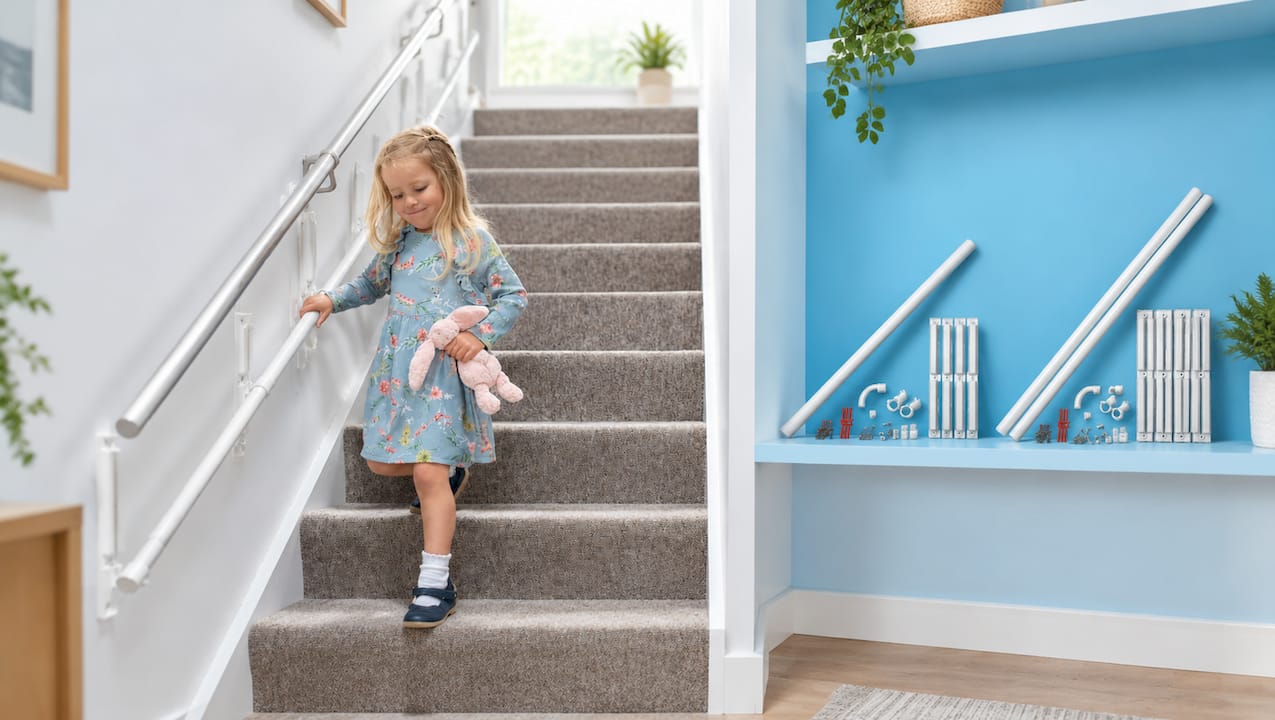
The KiddieRail Adjustable Child Stair Handrail is our award-winning rail. It fits below your standard handrail at a height suited to young children, adjusts as they grow, and covers 348 cm as standard. If your staircase is longer, has a turn or is wider, the KiddieRail extension packs cost from £24.99 to £36.99, with 85 cm and 170 cm lengths. You can see the full range in our shop.
FAQ
Is an adjustable child handrail a replacement for a stairgate?
No. A gate restricts access while your child is too young to use stairs, and a rail helps them learn once they are ready. RoSPA advises gates at both ends for children under 24 months, so the rail comes in as your child starts walking and climbing, with you nearby.
At what age should I fit a child handrail?
Fit it when your child begins to walk and wants to use the stairs, which is typically when you start to think about removing gates. Fitting it a little before that gives you time to get the height and fixings right and lets your child get used to it.
Can I fit one myself?
In most homes, yes, if you are comfortable using a drill and spirit level. KiddieRail is designed for self-installation with common tools. If your wall is hollow or you are unsure what is behind it, use a backing board or ask a tradesperson.
Will it work on curved, wide or turning stairs?
Usually, with planning. Measure the full run, note where the stairs turn, and add an extension pack for extra length. On very wide stairs, consider how to split the flight so the rail is always within your child’s reach.
Sources
- Handrail for staircase patent application (TREA)
- Stairways guide, US Access Board
- Keeping Your Toddler and Preschooler Safe from Falls, Alberta Health Services
- Preventing Falls in Children, RoSPA
- Stair Safety, Nationwide Children’s Hospital
- Stairways: Fall Prevention, CCOHS
- Installing Child-Safe Handrails in Your Home
- Child Falls, Ottawa Public Health


