
Currently Empty: £0.00


You can childproof rented stairs well, but the top of the staircase is the one place where a shortcut is risky. The safest set-up is a gate that screws into the wall at the top, a suitable gate at the bottom, clear treads and a secure handrail. All of that is easiest with your landlord’s written permission. This guide shows how to get that permission, what to fit, and how to cope when you only have a short stay.
TL;DR
- At the top of stairs, use a hardware-mounted gate that screws to the wall. Pressure-mounted gates are not the recommended protection above a drop.
- Ask your landlord in writing before you drill, and agree who fills and repaints the holes.
- A gate blocks unsupervised access. A child-height handrail supports a child who is learning stairs. They do different jobs, and you need the gate first.
- Sort this out before your child is mobile, not after the first climb.
- On holiday lets, ask the host about a gate before you book, and bring your own if the stairs are steep.
Table of Contents
- Why rented stairs are the tricky part
- Before you sign or move in
- How to ask your landlord for permission
- What to fit, and where
- Where a child-height handrail fits in
- Perspective: gates first, then support
- Fitting it and checking it
- When to start
- Short stays, holiday lets and visits
- Your rental stairs checklist
- Add a child-height rail to your stairs
- FAQ
- Sources
Why rented stairs are the tricky part
In your own home you drill where you like. In a rental, the same fix can cost you part of your deposit or cause an argument. Many baby-proofing tactics involve drilling, so tenants need permission from the landlord or letting agent before making significant changes.
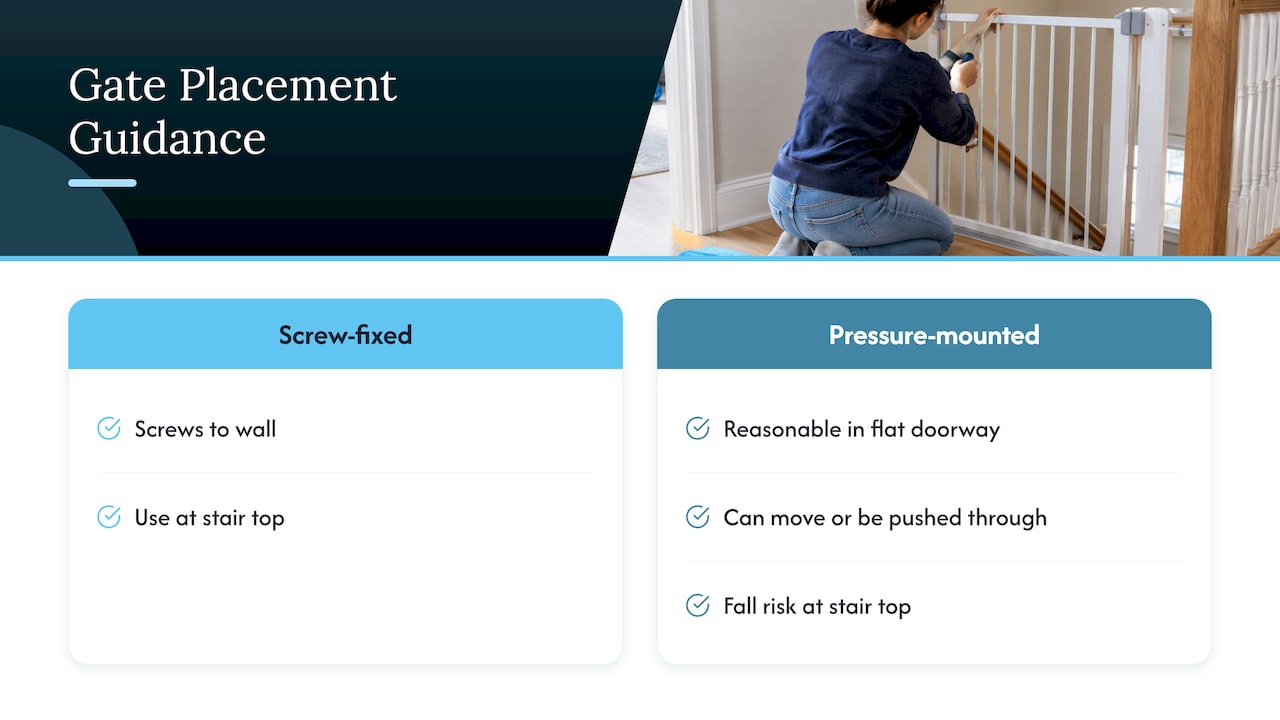
The temptation is to choose a no-drill gate everywhere. Downstairs, in a flat doorway, that can be reasonable. At the top of the stairs it is the wrong trade. The US Consumer Product Safety Commission says to block a stairway with a gate at both top and bottom, and that at the top you should use only a gate that screws to the wall. A pressure-mounted gate can move or be pushed through, and the consequence is a fall.
So the real rental question is not “how do I avoid holes?”. It is “how do I get permission for a few small, repairable ones?”.
Before you sign or move in
If you are still choosing a property, use the viewing. Look at the staircase the way a toddler would.
- How steep is it, and are the treads even?
- Are there wide gaps between the balusters?
- Is there a solid surface at the top landing, such as a wall or a sturdy newel post, where a gate could be fixed?
- Is the existing handrail firmly fixed?
- Is there a winder section or a half-landing that complicates gating?
Government renting guidance for England names stairs and falls among common home hazards, and says tenants can ask landlords to remove or minimise hazards before agreeing to a tenancy. That guide is specific to England. Scotland, Wales and Northern Ireland have their own tenancy rules, so check the position where you live.
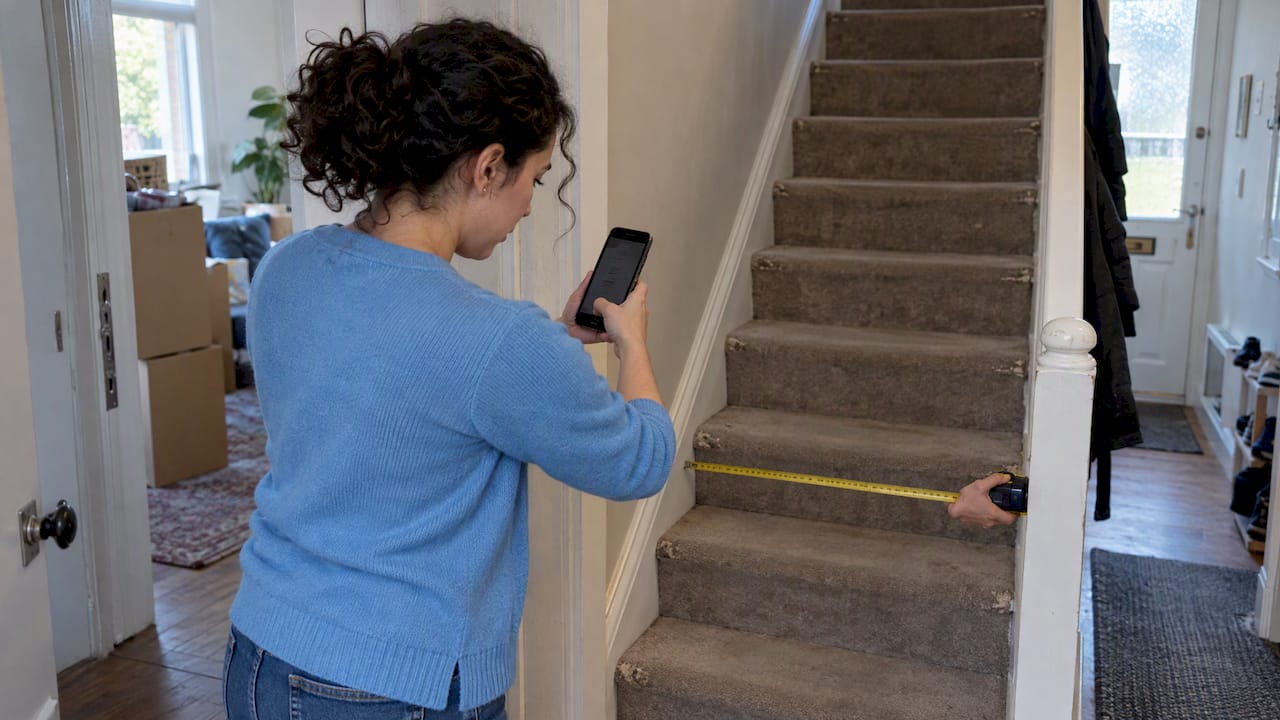
Photograph and measure the staircase before you move anything. You will need the measurements to buy the right gate, and the photos show the condition you started with.
How to ask your landlord for permission
Keep it short, specific and in writing. Email works, and it leaves a record.
- Say what you want to fit and why. For example: one wall-mounted safety gate at the top of the stairs, because you have a baby or toddler.
- Say where, and how many fixings. Attach your photo and measurements.
- Offer the repair. Agree who will fill and repaint the holes when you leave, and whether you will do it or the landlord will.
- Ask for a reply in writing, then keep it with your tenancy paperwork.
A landlord worried about damage often relaxes once they see that the fixings are few and the fix is cheap. Safety gates are also a reasonable request: genuine safety hardware is not decoration. If they refuse, ask whether they would fit the gate themselves, or whether a different fixing point, such as a post rather than plaster, would be acceptable.
The same logic applies to anything else that marks surfaces. Our advice on avoiding deposit disputes with small fixings is similar to the practical checklist for hanging art in a UK rental: photograph first, get consent, fix small, repair neatly.
What to fit, and where
The top of the stairs
Use a hardware-mounted gate that screws into the wall. Check that it:
- meets the applicable safety standard for child gates where you live;
- cannot easily be dislodged by the child;
- has no large openings that could trap a head or neck, and no bottom trip bar at the top of the stairs;
- can still be opened quickly by an adult, including while carrying a child.
Never substitute a pet gate. CPSC specifically warns against pet gates and older gates with large V-shaped openings.
The bottom of the stairs
A suitable gate at the bottom stops a crawling baby heading upward. Here a pressure-mounted gate can be more acceptable if the opening is flat and the gate fits snugly. The NHS-backed advice from one local safeguarding partnership is to think about where gates are needed before your baby is on the move, so you are not caught out when they suddenly can get around.
On the treads
Keep toys, shoes and laundry off the stairs. Make sure the existing handrail is secure. If you want non-slip treatment, get your landlord’s approval first, because adhesive products can damage flooring or paint.
Quick comparison of options in a rental
| Option | Where it suits | Rental pros | Rental cons |
|---|---|---|---|
| Wall-mounted gate | Top of stairs | Recommended above a drop | Needs screw holes and permission |
| Pressure-mounted gate | Bottom of stairs, flat doorways | No drilling | Can be pushed or dislodged, not for the top |
| Child-height handrail | Whole flight, when teaching stairs | Supports the child’s own grip | Does not block access, so it does not replace a gate |
| Furniture or luggage barrier | Short stays only | Nothing to fit | Not reliable, needs constant supervision |
Where a child-height handrail fits in
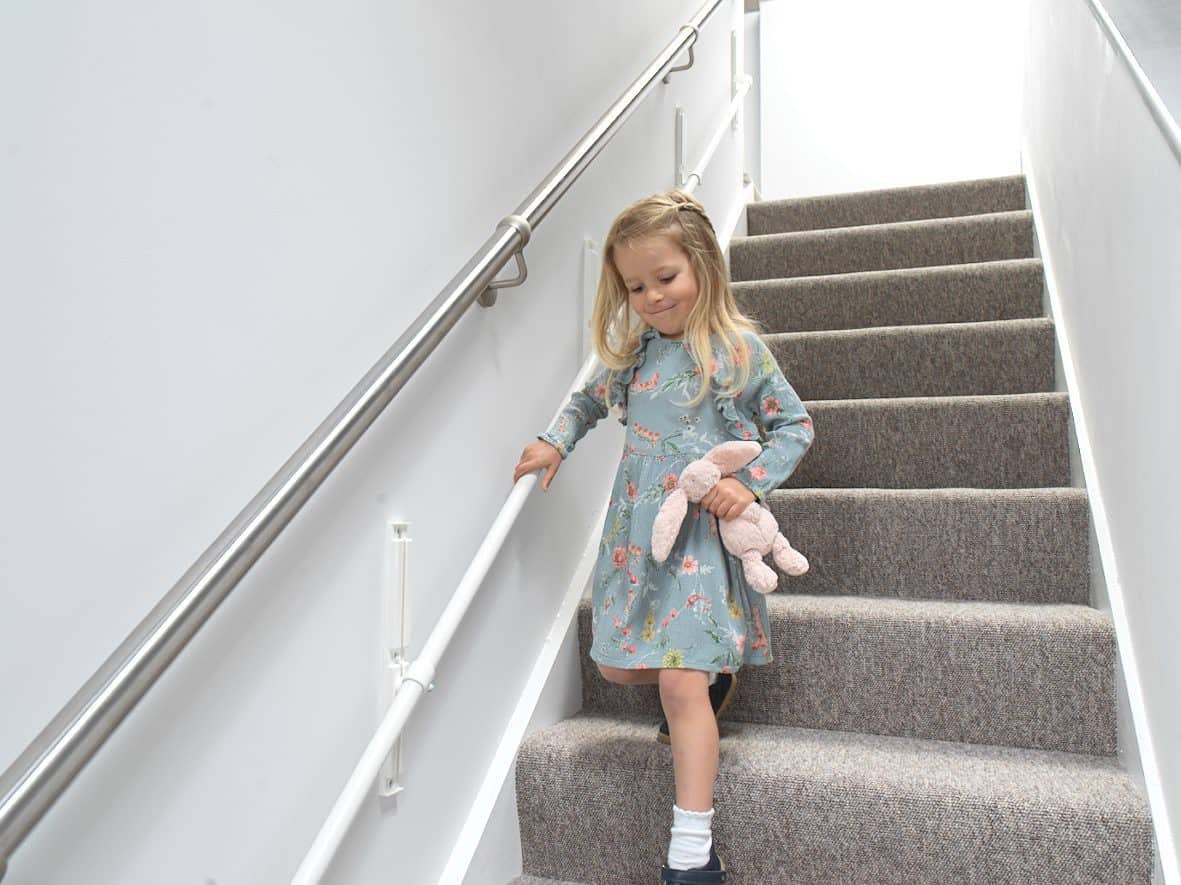
A gate and a handrail solve different problems. A gate blocks unsupervised access. A correctly positioned handrail supports a child who is being taught to use the stairs. Even with a handrail, supervision and a gate remain necessary while a child is still learning. The American Academy of Pediatrics advises teaching a child to descend backward, but says this does not replace keeping the stairs gated.
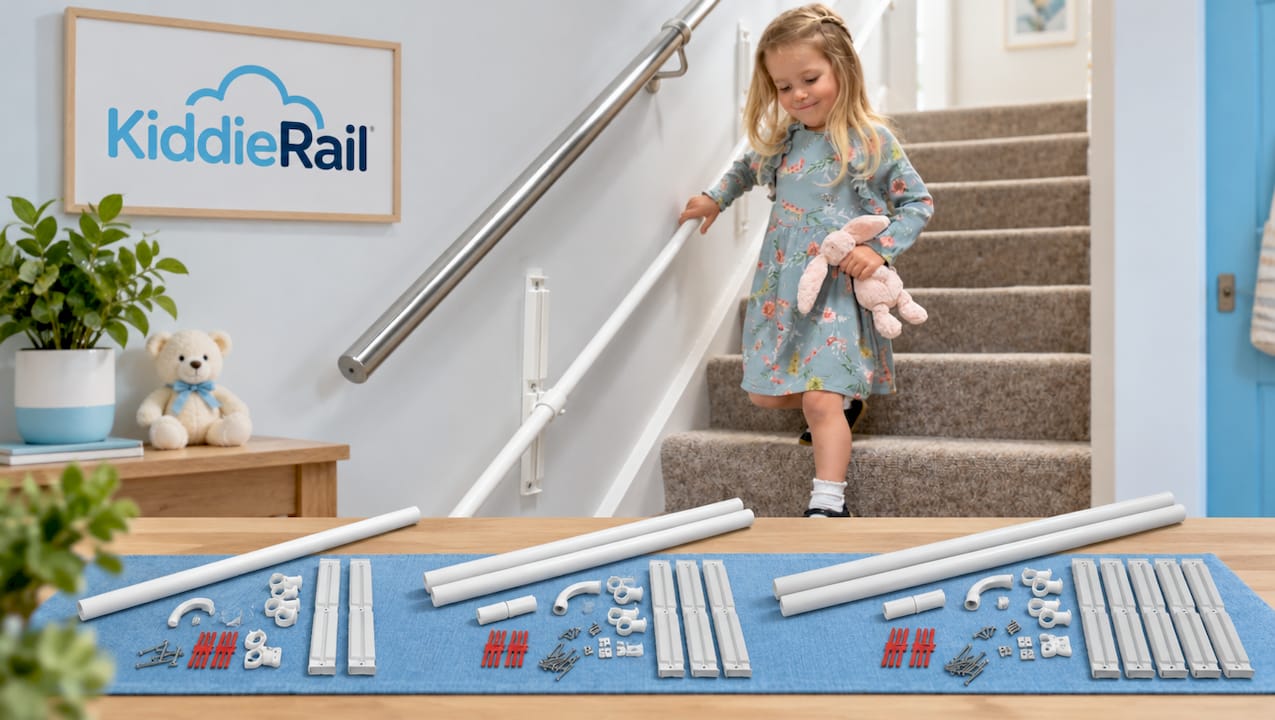
Standard adult handrails sit far too high for a toddler to grip. That is the gap KiddieRail fills: an adjustable child stair handrail that fits below a standard handrail and can be raised as your child grows. It is designed to suit any home staircase layout, and it is built for straightforward self-installation. For a rental, do two things: read the product page for how it fixes to your staircase, and include it in your written request to the landlord, in the same email as the gate.
Perspective: gates first, then support
We talk to a lot of parents who ask whether a handrail can replace a gate. It cannot, and we would not want you to think so. Our view is that a stair is a skill children have to learn, and they learn it best when they can hold on at their own height, with you beside them.
That is why we designed KiddieRail to grow with the child instead of being outgrown in a year. Safety gates are the first layer, when your child cannot yet manage the stairs. The child rail is the second layer, when you start teaching. In a rental, the second layer matters even more, because you may live there for years and your child’s height will change several times.
Our practical advice is to plan both layers in one conversation with your landlord, so you only have to ask once.
— Paul
Fitting it and checking it
Once a gate or rail is up, test it. CPSC warns that safety devices only work when correctly installed and re-engaged, and that determined toddlers can overcome or disable them. So check:
- the latch closes every time and is not easy for small hands to open;
- the mounting points are firm;
- there is no gap at the sides or the bottom threshold;
- no furniture nearby gives the child a step to climb over.
Repeat the check regularly. No safety device is completely childproof, and a gate should reduce access, not give you permission to leave a toddler unattended near stairs.
For a fast routine, our two-minute stair sweep and top gate fixes page is written for flats. If your staircase is unusually wide, see how to fit a gate and child rail to wide stairs. For half-landings, there is a guide to stair landing safety gaps.
When to start
Start before crawling begins. The AAP notes that around 8 months babies become much more mobile and may head straight for stairs, so it advises sturdy gates at both ends and no stair play alone. It is a developmental guide, not a single universal age: prepare before your baby is crawling, then reassess when they can climb, open or defeat the gate.
If you are expecting a baby, that is your cue to have the landlord conversation now. Safe Kids Worldwide describes falls as a leading cause of non-fatal injury in children in the United States, and recommends approved gates at the top and bottom of stairs, installed per the manufacturer’s instructions. Resolve permission before your child is mobile, not after an incident. Our guide to babyproofing stairs before crawling starts goes through the timeline.
Short stays, holiday lets and visits
Travel changes the problem. You cannot drill into a holiday let, and you cannot assume the host has thought about stairs.
- Ask first. Contact the host or manager before booking. One travel guide suggests asking the accommodation manager about baby safety concerns before you book, and a human reply is more useful than a listing tick-box.
- Ask whether a gate is provided, and whether it is fixed or loose.
- Choose a single-level unit if your child is mobile and the stairs look steep.
- Bring a portable gate for stairs, as Frommers suggests for rentals with treacherous stairs. Furniture across a stairhead is a stopgap, not a barrier.
- Do not use a pressure gate at a stairhead, even for a weekend. If the stairs cannot be secured, keep your child on the level below, or sleep downstairs.
The same applies to grandparents’ homes, where stairs are often steep and rails are far too high for small children. Our advice for grandparents covers it.
Your rental stairs checklist
- Photograph and measure the staircase.
- Check the top landing has a safe fixing surface.
- Email your landlord for written permission, and agree who repairs the holes.
- Fit a wall-mounted gate at the top and a suitable gate at the bottom.
- Clear the treads and confirm the existing handrail is secure.
- Add a child-height handrail for teaching, and non-slip treatment only with approval.
- Test everything, then retest regularly.
- Keep the written approval with your tenancy records.
Add a child-height rail to your stairs
Once the gates are in, a handrail at your child’s height is the next step. The KiddieRail Adjustable Child Stair Handrail is our core product, and you can browse the full range in the shop. For longer or wider staircases, the extension packs cost £24.99 to £36.99 depending on the length you choose. Please check the product page for the options and fixing details before you write to your landlord.
FAQ
Do I need a baby gate on the stairs in a rented home?
If your child is crawling or newly walking, yes. Paediatric guidance advises sturdy gates at both ends of the stairs, kept in place while the child is learning, with supervision for every practice session. Renting does not change the risk, only how you fit the gate.
Can I use a pressure-mounted gate at the top of the stairs to avoid drilling?
We would not. A pressure-mounted gate can shift or be pushed through under a child’s weight, and the top of the stairs is where that matters most. Ask your landlord for written permission to fit a wall-mounted gate instead.
What if my landlord says no to drilling?
Offer to cover the repair and suggest a more discreet fixing point, such as a post. If they still refuse, consider whether the property is suitable while your child is mobile. For a short stay, sleeping and playing on one level is a safer fallback than a pressure gate over a drop.
How do I block off stairs from a toddler on holiday?
Ask the host before booking whether a gate is provided, and bring a portable one if not. Do not rely on furniture or luggage across a stairhead. If the stairs cannot be secured, keep your child on a single level.
Does a child handrail replace a stair gate?
No. A gate stops unsupervised access, and a child-height handrail supports a child who is learning to use stairs with an adult beside them. You need both while your child is still learning.
Sources
- CPSC: Childproofing Your Home
- HealthyChildren.org (AAP): Movement, 8 to 12 months
- Safe Kids Worldwide: Falls
- How to rent a safe home (England)
- HomeLet: Baby proofing your rented home
- Just One Norfolk: Safety gates
- Half Half Travel: Baby-proof a hotel room or Airbnb
- Frommers: Childproof a vacation


