
Currently Empty: £0.00


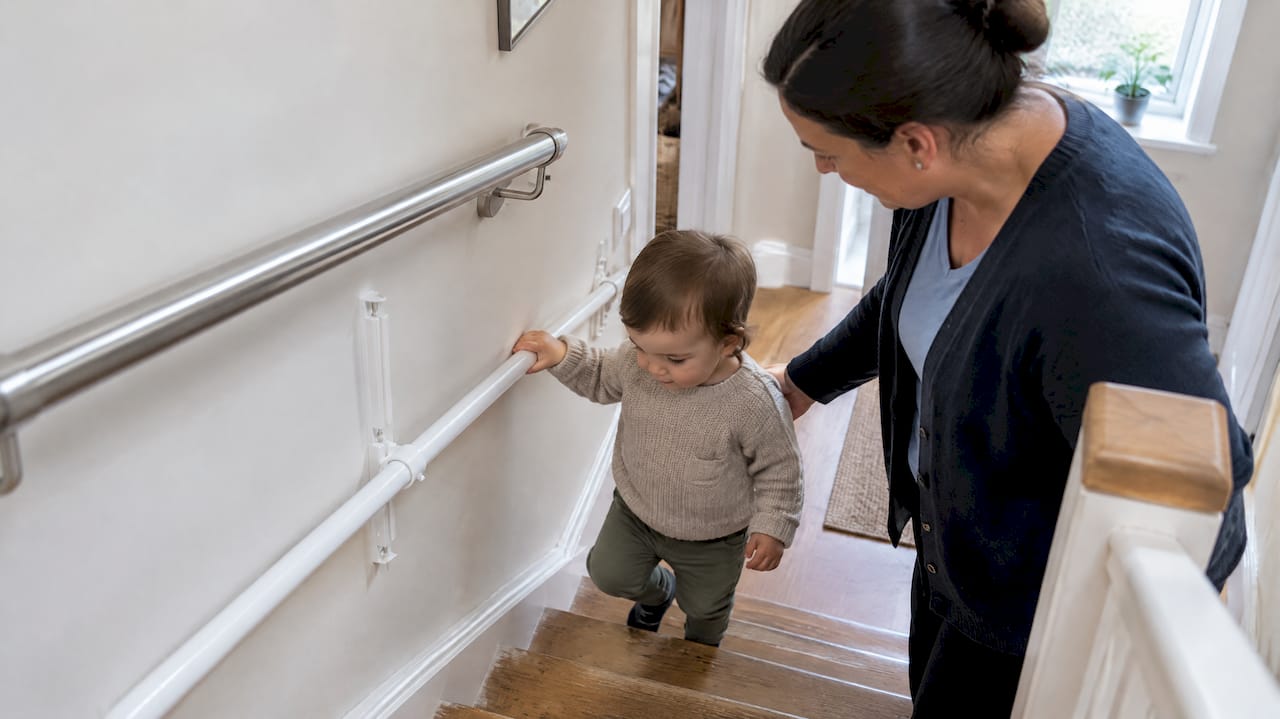
If you mind children at home or run a small setting with stairs, the short answer is this: keep the standard adult handrail, and add a second, lower rail on the wall side at a height small children can actually grip. Guidance for early years settings points to roughly 500 to 600mm for that lower rail. Then pair it with sensible gate use and close supervision, because no rail does the supervising for you.
This guide covers what the guidance says, how to choose and fit a lower rail, where gates fit in, and what it costs. It is written for childminders, nursery managers and parents who share a staircase with very young children.
TL;DR
- A standard UK handrail sits at 900 to 1,000mm above the pitch line, which is far too high for a toddler’s reach.
- Early years design guidance recommends an additional lower rail at about 500 to 600mm, fixed to the wall side.
- Gates are a temporary measure. Once a child can manage stairs, or starts climbing the gate, the gate becomes the hazard.
- A lower rail supports learning to climb safely. It does not replace an adult on the stairs.
- A clip-on, adjustable child rail such as KiddieRail costs far less than rebuilding a balustrade and can be fitted without a joiner.
Table of Contents
- Why the standard handrail fails very young children
- Handrail, guardrail, balustrade: what each one does
- How high should a child’s handrail be?
- Fix it to the wall side only
- Material and finish
- Where gates fit in
- Active risk management beats hardware
- Our view: why a rail beats relying on a gate
- What it costs
- Add a KiddieRail to your stairs
- Checklist before you fit
- FAQ
- Sources
Why the standard handrail fails very young children
An adult handrail is designed for adult hands. For a child of two or three, it is above shoulder height, so they either reach up awkwardly, grab the spindles, or crawl and rely on the carer’s hand. None of these gives a secure grip.
Guidance for schools in England recognises this. The old DCSF design notes on internal stairs in schools say a secondary handrail at a lower level is expected where it is safe to do so, to support and reassure younger children. Early learning design guidance from Ireland, which is widely used as a reference by UK providers, recommends the same approach for settings serving young children.
The point is simple: if you want a child to use a rail, it has to be where their hand naturally falls.
Handrail, guardrail, balustrade: what each one does
The words get mixed up, and the mix-up causes real mistakes.
- Handrail: the surface you grip for support. Adult height is typically 900 to 1,000mm.
- Guardrail or balustrade: the barrier that stops a fall from the open side of the stairs. Domestic balustrades are typically at least 900mm high, according to the same cost guide that summarises Part K.
Safety professionals stress that a handrail on its own is not enough where there is a drop. Access guidance says a drop-off needs a separate, robust guarding barrier. A child rail is therefore a grip aid, not a guard. Check your existing balustrade first, and fix gaps before you think about extras.
Gaps and entrapment
Building and childcare guidance in the UK and Ireland expects openings in guarding to stop a 100mm sphere from passing through. Some US states are stricter: Washington State uses 3.5 inches, about 89mm. If you can pass a tennis ball sized object between your spindles, a toddler’s head may follow. Mention it in your risk assessment and talk to a qualified joiner if the gaps are wide.
How high should a child’s handrail be?
The published guidance for early years settings puts the lower rail at 500 to 600mm above the pitch line. Germany’s accident insurers (DGUV) suggest around 600mm in their guidance for settings caring for the youngest children, in their publication on safe childcare.
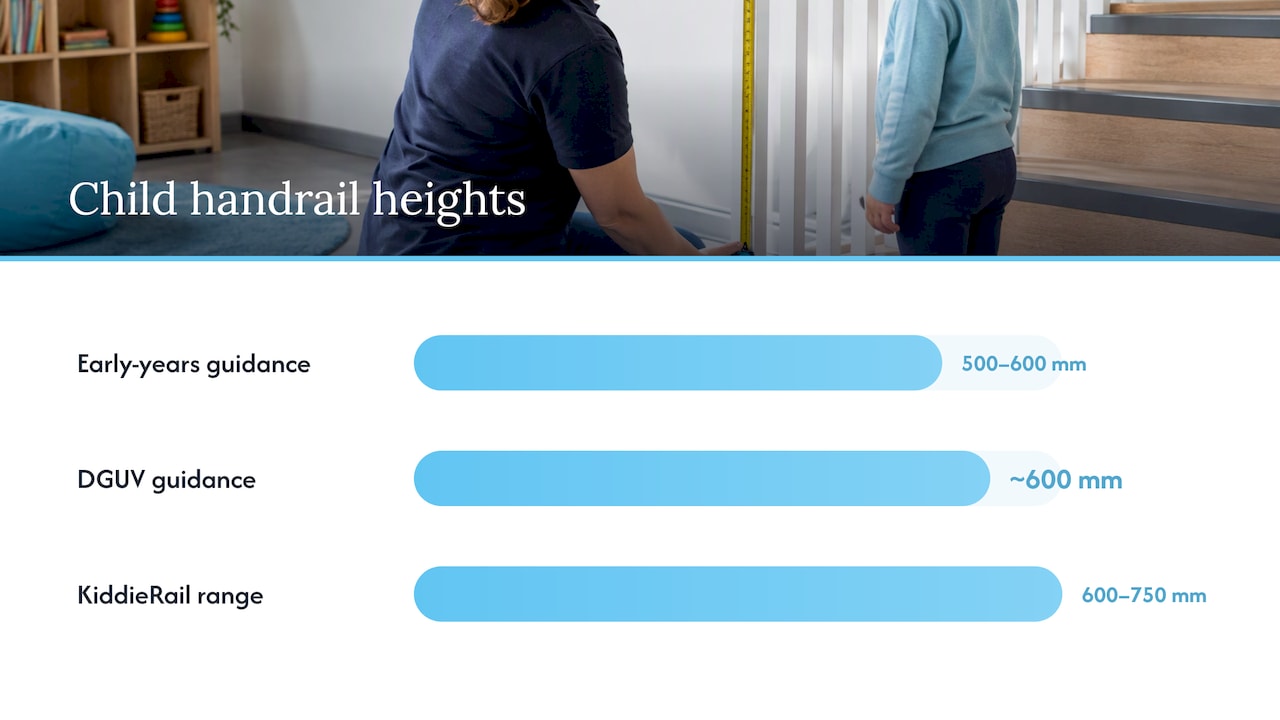
That is a floor for the youngest walkers. For a home-based setting with mixed ages, an adjustable rail is more practical than a fixed one, because a one-year-old cruising and a four-year-old confidently climbing need different heights. KiddieRail adjusts across a 600 to 750mm range, so you can raise it as the children in your care grow. Our childminder stair safety guide shows how to measure for it, and our page on handrail placement for kids goes further into positioning.
Measure like this
- Stand a child of the youngest age you mind on the bottom step.
- Note where their hand falls with a relaxed, slightly bent elbow.
- Measure that height up from the pitch line (an imaginary line joining the front edges of the steps), not from the floor or wall.
- Repeat for the oldest child who still needs the rail, and check your chosen rail covers both.
Fix it to the wall side only
Childcare guidance advises fixing lower rails only to the wall side of the staircase. On the open side, a low rail can act as a foothold, a sort of ladder, and a child may climb it and go over the edge. Keep any child-height rail away from open balustrades.
Wall fixing also means you need solid backing. Plasterboard alone will not hold a child’s weight if they fall against it. Our guides on handrail backing boards and wall clearance explain how to get a firm fixing and enough room for small fingers and hands to wrap round the rail.
Material and finish
Many childcare design guides advise against cold metal rails in settings with young children. They feel uncomfortable in cold weather and give less grip than timber or plastic. Universal design guidance also suggests a finish that contrasts with the wall behind it without being shiny, so the rail is easy to see and does not cause glare.
In practice, ask three questions of any rail:
- Can a small hand close fully round it?
- Does it stay comfortable in a cold hallway?
- Does it stand out against your wall colour?
Our handrail materials guide covers the sizes and gaps that matter for children.
Where gates fit in
Gates and rails do different jobs. A gate keeps a child off the stairs when no adult is there. A rail helps a child use the stairs safely when an adult is with them.
NHS Norfolk guidance says gates stop small children using stairs unsupervised, but once a child is around two they may try to climb over. It advises using gates until the child is confident on stairs, and then replacing them with consistent, supervised practice on the handrail. It also warns against V-shaped top-edge designs because of choking and entanglement risks, and against stacking or adapting gates to make them taller.
If you mind children of mixed ages, this is the usual sequence:
- Crawlers and early cruisers: gate at the top and bottom, adult always present when the gate is open.
- Walkers: gate stays, but supervised stair practice begins with the child rail in place.
- Confident climbers: gate comes off when the child treats it as a climbing frame or can manage the stairs well. The rail stays.
Our guide on pairing gates and teaching walks through the same sequence for parents.
Active risk management beats hardware
The best equipment still sits inside a routine. Guidance for licensed day care from British Columbia in Canada, Preventing Injury, says to keep stairs clear of toys, boxes and furniture, and that caregivers should teach children to use the rail and watch them closely. It treats that teaching as the main aim, not the hardware.
A daily routine for a home setting might include:
- Clear shoes, bags and toys from every step before children arrive.
- Check the stair light and replace dead bulbs.
- Test gate latches and check the rail has not loosened.
- Never carry a child and other items together on the stairs.
- Record the checks in your daily diary.
Keeping the whole setting clean and orderly feeds into this. This explainer on child-safe cleaning comes from an Australian commercial cleaner, but its point about maintaining safer spaces for children applies to hallways and stairs too.
For childminders in England, your Ofsted inspection will look at your risk assessment as a whole. Stairs are only one line in it, but a documented, thought-through approach to them is easy to defend.
Our view: why a rail beats relying on a gate
We designed KiddieRail because we kept seeing the same gap: safety gates stop a child reaching the stairs, but nothing helps them when they do. A child who is never allowed to practise is not safer, just later to the same risk.
From what we hear from parents and childminders, three things matter most:
- The rail has to be at the child’s height. A rail they cannot reach teaches nothing.
- It has to grow with them. Settings take children across a range of ages, so a fixed height suits only one group at a time.
- It has to go on easily. Many childminders rent or share their homes, and want something they can fit themselves without replacing a balustrade.
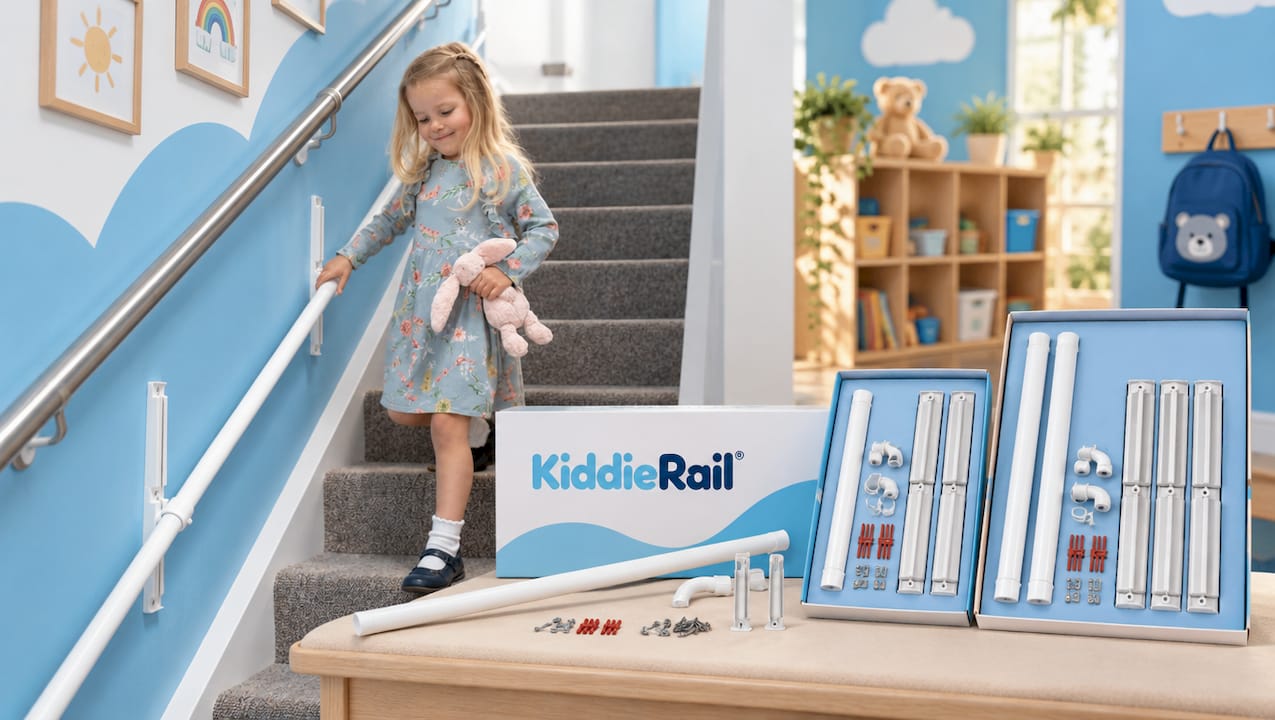
KiddieRail fits below a standard handrail, is fully adjustable, and has passed durability and safety testing. It is not a substitute for supervision, and we would never tell you it is. It is the part of your stair routine that lets a child hold on while you are beside them.
— Paul
What it costs
To put a child rail in context, look at the alternatives. As of May 2026, a UK guide to staircase costs puts a replacement spindle set at £600 to £1,500, and handrail supply at £15 to £35 per linear metre before fitting. A new straight softwood staircase is £1,200 to £2,450 installed.
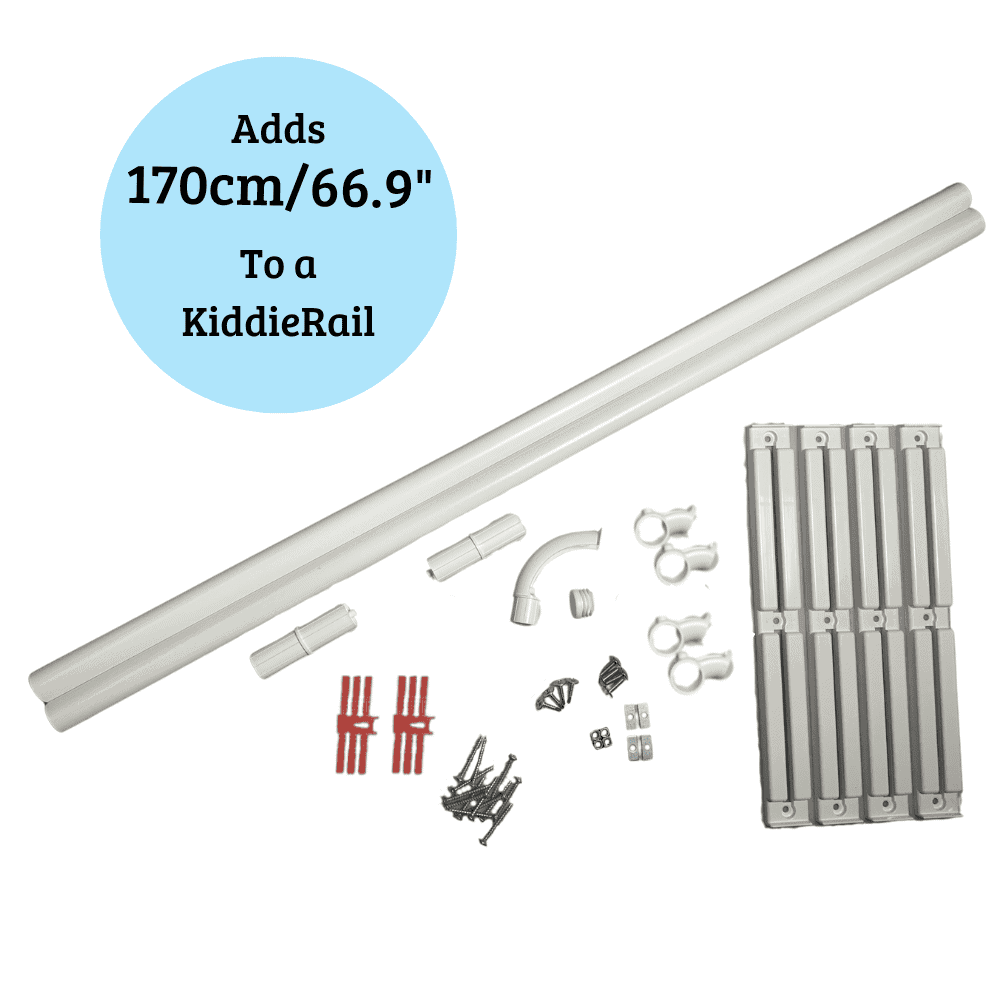
You do not need any of that to add a child-height grip. KiddieRail extension packs, which add length for longer or cornering stairs, cost £24.99 to £36.99 as a one-off payment. Check the shop for the main handrail.
Add a KiddieRail to your stairs
If you want a lower rail that adjusts as the children in your care grow, the KiddieRail Adjustable Child Stair Handrail fits below your existing rail and suits most staircase layouts. For longer flights, pick up an 85cm or 170cm extension pack. Our page on wall mounted child handrails explains the fit for UK stairs.
Checklist before you fit
- Is your balustrade sound, with no gaps a 100mm sphere can pass through?
- Is the wall solid enough, or do you need a backing board?
- Is the rail going on the wall side only?
- Have you measured from the pitch line at the youngest child’s hand height?
- Is your gate plan written down, with a point at which it comes off?
- Is the rail check part of your daily or weekly routine?
If your stairs are unusual, such as spiral or winder steps, ask a qualified joiner or builder before fitting anything. If you rent, check with your landlord.
FAQ
Do childminders need a child-height handrail?
Nothing in the sources we used makes a lower rail a legal requirement for a home childminder. Design guidance for settings serving young children, however, recommends one, and it helps your risk assessment. Ask Ofsted or your childminder agency what they expect for your premises.
Can I use a stair gate instead of a lower rail?
Gates and rails do different jobs. A gate keeps children off the stairs when you are not there, while a rail supports them when you are. NHS guidance says gates can become a hazard once a child tries to climb them, so plan for the transition to supervised rail use.
Should the rail go on both sides of the stairs?
For child-height rails, guidance advises the wall side only. On an open side, a low rail can act as a foothold and let a child climb towards the drop. Keep the open side protected by a proper balustrade.
Is a metal rail suitable for young children?
It can be, but childcare design guidance warns that metal gets cold and uncomfortable to hold, and may give less grip than timber or plastic. Choose a finish that is comfortable and contrasts with the wall.
Sources
- Steps, Ramps, Landings and Handrails, Universal Design for Early Schools and Care Settings
- Staircase Installation Cost UK, squote
- Internal stairways in schools
- DGUV Information 202-093
- Stairways, Access Board
- Safety Gates, Just One Norfolk (NHS)
- OIP 003 Preventing Injury, Government of British Columbia
- Child-safe cleaning explained


