
Currently Empty: £0.00


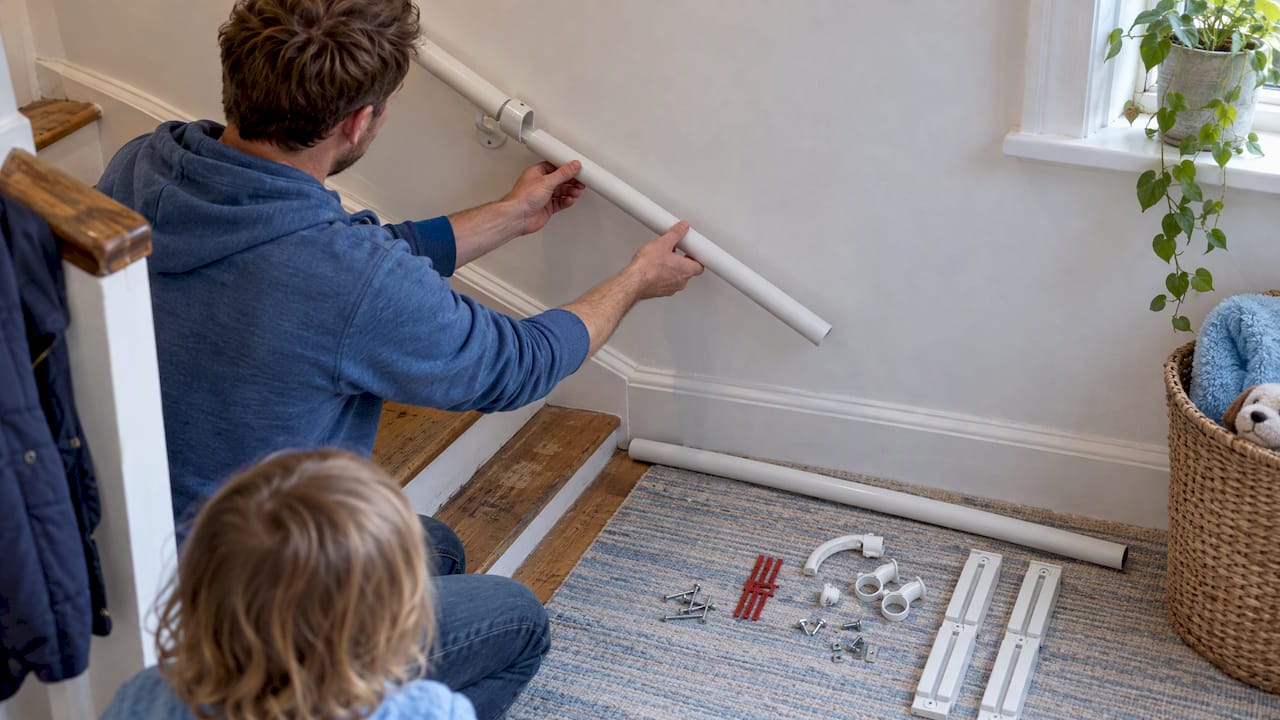
A child handrail extension adds extra length to a low-level children’s rail, so the rail follows your whole staircase rather than stopping part-way. Most UK stairs are longer than a single starter rail, or turn a corner, so working out how much extra length you need is the key step. This guide shows how to measure, what the packs cost, how to fit them and where an extension is not the right fix.
TL;DR
- An extension pack lengthens a KiddieRail so a child has something to hold from the bottom step to the top, including on longer or wider flights.
- Our extension packs come in two lengths, 85 cm and 170 cm, and cost from £24.99 to £36.99 one-off.
- Fit the rail below your adult handrail, within the 600 to 750 mm range that suits toddlers, and screw it to a solid fixing, not just plasterboard.
- A low rail helps a child steady themselves. It does not replace gates at the top and bottom for children under 24 months.
- Measure the stair length along the wall before you order, then add for any corner or landing.
Table of Contents
- What a child handrail extension actually does
- Do you need an extension, or is one rail enough?
- How to measure for the length you need
- Choosing between 85 cm and 170 cm extension packs
- Getting the height right
- Fitting an extension safely
- Our view: a rail that grows beats a gate that blocks
- Where the rail fits alongside gates and other measures
- Why not just use a piece of timber or a DIY rail?
- Ready to order?
- FAQ
- Sources
What a child handrail extension actually does
A standard UK handrail sits high. Approved Document K guidance puts the top of the rail between 900 mm and 1000 mm, which is roughly adult hip height. For a two-year-old, that is above their head. They end up grabbing the spindles, the wall, or nothing at all.
A child-height rail fixes that by giving small hands something to wrap around at the right level. An extension simply makes it longer. If your starter rail covers part of the flight, an extension continues it, so your child does not have to let go mid-staircase and look for the next hold.
There is good reason for lower rails in places where children are the main users. The US Access Board recommends a second, lower handrail for facilities mainly used by children, and the ADA advisory on handrail height suggests leaving at least 9 inches (230 mm) between the upper and lower rails to avoid entrapment. Those are American guidelines, but the principle carries over to the home: a child needs their own rail at their own height, with a safe gap above it.
Do you need an extension, or is one rail enough?
It depends on the staircase. Think of three situations.
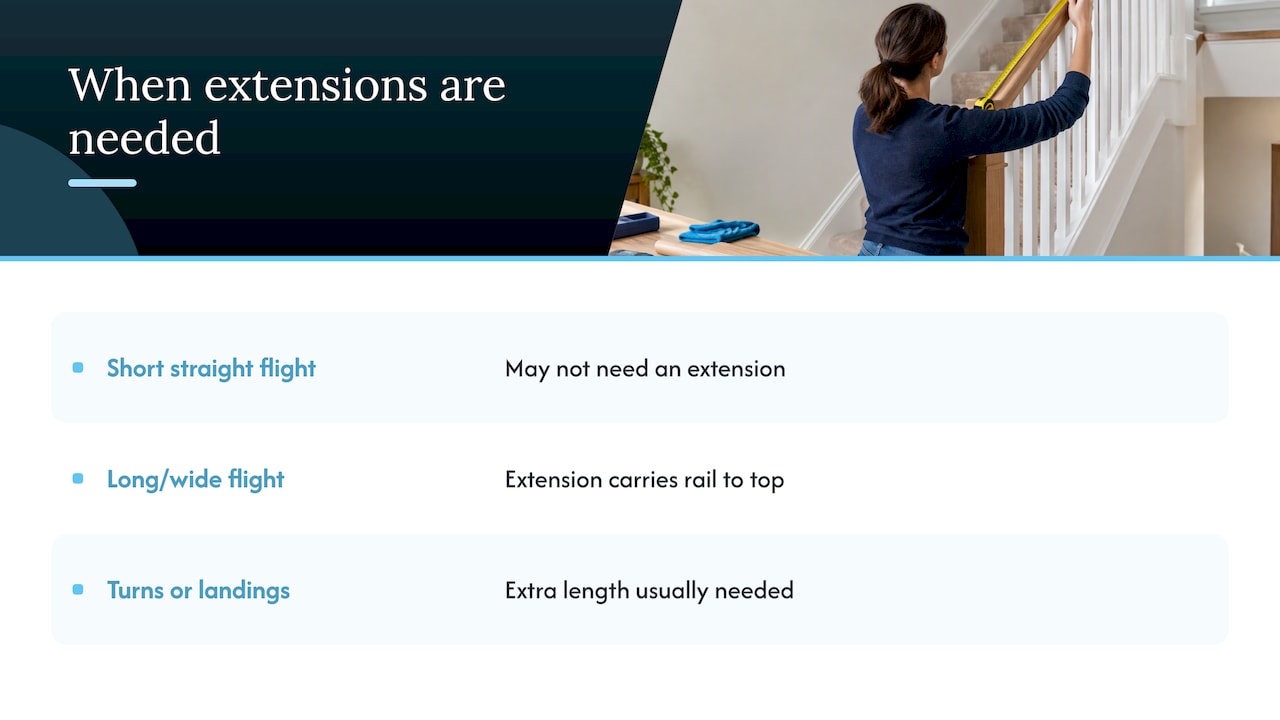
A short, straight flight. If the stairs run in one straight line and a single rail covers the full length, you may not need anything extra.
A longer or wider flight. Many UK staircases, especially in Victorian and Edwardian terraces, have more steps than a single starter rail covers. An extension carries the rail up to the top. Our guide to wide stair child handrails explains how to measure and what to do when a flight is over 2.3 m.
Turns, landings and dog-legs. A corner or half-landing breaks the line. The rail needs to continue past the turn, so an extra length is usually needed here.
If you are unsure, measure first. It takes five minutes and saves a second delivery.
How to measure for the length you need
- Pick the wall. Choose the wall side where your child naturally reaches. If the stairs have a wall on both sides, you can pick either, and many families start with the side the child favours.
- Measure along the slope. Run a tape measure along the stair nosings from the bottom step to the top step, following the angle of the stairs. Do not measure the floor distance, which is shorter.
- Add for landings and turns. Measure each straight section separately and add them together.
- Compare with the rail you have. Subtract the length of your starter rail from the total. The shortfall is what an extension needs to cover.
- Round to the available pack sizes. Our extension packs add 85 cm or 170 cm, so choose the combination that covers your shortfall. If you land between sizes, going up is better than leaving a gap.
Write the numbers down before you order. If you are working from a childminder’s or rental property’s stairs, the same method applies, and our childminder stairs guide walks through measuring and fitting step by step.
Choosing between 85 cm and 170 cm extension packs
| Situation | Likely choice |
|---|---|
| Short gap at the top or bottom of the flight | 85 cm pack |
| Corner or small landing to bridge | 85 cm pack |
| Longer staircase where the starter rail covers less than half | 170 cm pack |
| Very long flight, or two flights with a landing between | 170 cm pack, plus a second if needed |
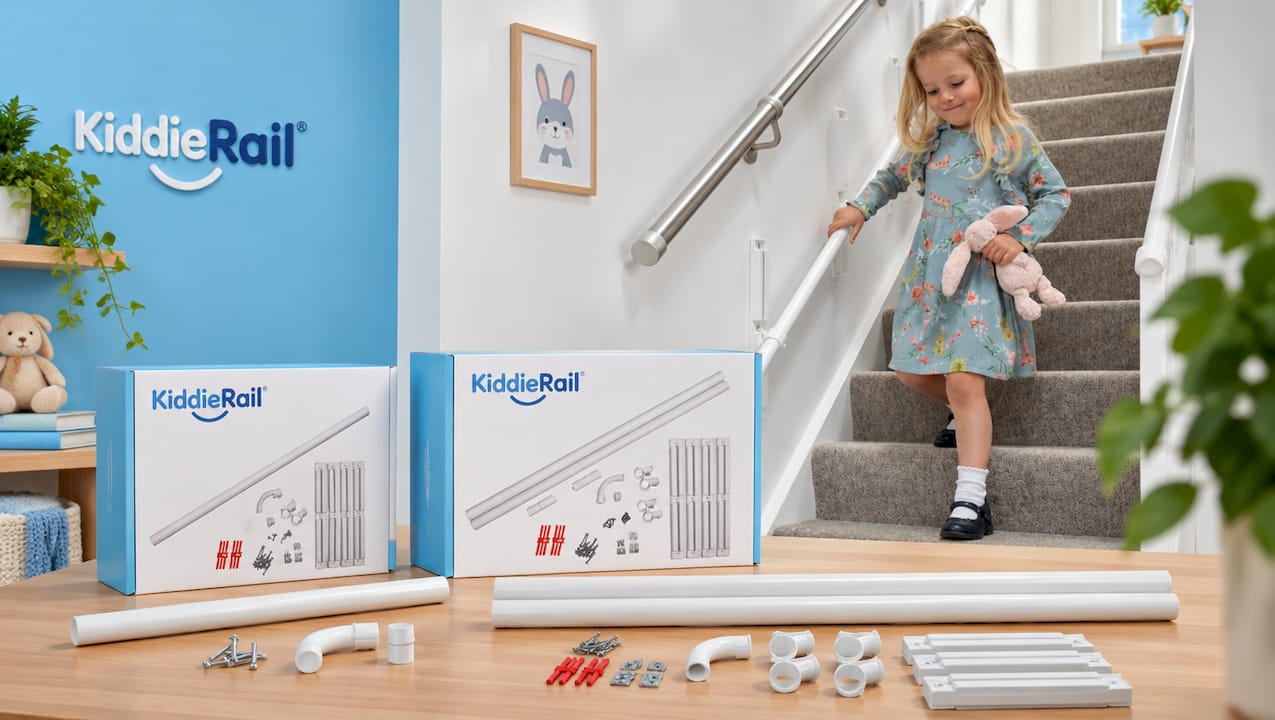
The packs are priced from £24.99 to £36.99, a one-off cost with no subscription. You can see both options on the 85 cm extension pack page and the 170 cm extension pack page. The full range is listed under extension packs and accessories.
Getting the height right
Height is the part parents most often get wrong, because a child grows and the numbers feel abstract. Here is what the guidance says.
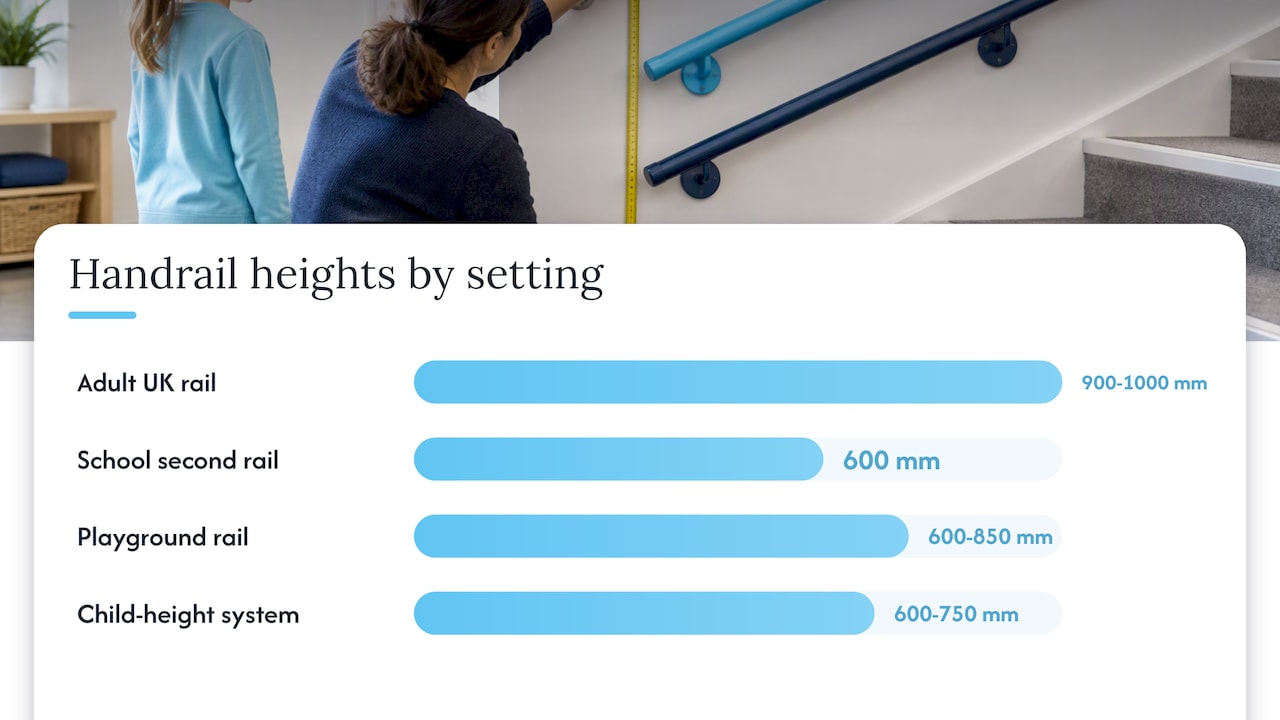
- Adult rails in the UK sit at 900 to 1000 mm, according to the Approved Document K summary, which also says second handrails in primary schools go at 600 mm.
- Playground guidance from Wicksteed says handrails, where needed, should sit between 600 mm and 850 mm above the foot position.
- For child-height rail systems the range often used is 600 to 750 mm, which suits toddlers’ reach.
Our adjustable rail is designed around that 600 to 750 mm zone, and the height can change as your child grows. That is the reason an adjustable rail makes more sense than a fixed one: you set it for a two-year-old now, and raise it later instead of replacing it. Our handrail placement guide shows exactly where to mark the height, and our page on wall-mounted child handrails covers the adjustable range for UK stairs.
A quick test: stand your child on a step and have them reach out naturally. Their hand should land on the rail with the elbow slightly bent, not stretched up or bent down. Mark the wall at that point on a few steps, because stairs slope and the rail should follow the pitch.
Fitting an extension safely
A rail only helps if it holds. A toddler will hang their full weight on it the first time they stumble, so the fixing matters more than the rail itself.
- Find solid fixings. Use a stud detector or tap the wall to find studs, brickwork or blockwork. Fixing only into plasterboard is the commonest reason a wall rail fails.
- Consider a backing board. If the wall is hard to fix to, or the studs do not line up with where the rail needs to go, a board screwed to the wall gives you a continuous solid surface. We cover this in our guide to installing a handrail backing board, including when to choose the 85 cm or 170 cm length.
- Mark the line, then check it. Hold a spirit level or a straight edge along your marks. The rail should run parallel to the stair nosings, not wander.
- Join the extension cleanly. Fit the extension so the joint is tight and the grip surface stays smooth. Run your hand along it. If you feel a lip or gap, adjust before tightening.
- Test with real weight. Pull down hard on the rail at several points, especially at the ends. If it moves, it is not ready.
If you hit a problem with a round or decorative banister, or have an awkward wall, an experienced installer can help you with adapters or an alternative fixing. Where a fixing is in doubt, ask a qualified tradesperson rather than trusting the rail to a weak wall.
Our view: a rail that grows beats a gate that blocks
We have spent a long time thinking about what makes children safer on stairs, and our view is simple. Gates keep a child off the stairs when no adult is watching. They do nothing when the child is actually on them, which is where most falls happen. A child who is about to climb will do it whether or not you approve, and what we want is for them to be able to hold on.
That is why we built a rail that sits at a child’s level and adjusts as they grow. It does not need replacing when they move from crawling to walking to running. And because the extension packs let the rail follow the shape of the home, we can cover real staircases, not tidy showroom ones: turns, long flights, wide stairs, rented flats.
We also say plainly that a rail is not a substitute for supervision or gates. Use both. Gate the top and bottom while your child is small, then let the rail teach them to use the stairs well. A child who has practised holding on from the age of two or three carries that habit with them.
— Paul
Where the rail fits alongside gates and other measures
Stairs are a genuine hazard for small children. A study from Nationwide Children’s Hospital found more than 93,000 children under five were treated in US emergency departments each year for stair-related injuries, about one every six minutes. That is American data from 1999 to 2008, but the pattern of toddlers falling on stairs is familiar to any parent.
UK advice points the same way. RoSPA recommends wall-mounted safety gates at the top and bottom of the stairs for children under 24 months, keeping stairs free of clutter, and checking that balustrades are strong and offer no footholds for climbing.
It also warns against the wrong sort of gate. Safety consultants note that pressure-fit gates can dislodge under a child’s weight, so the top of the stairs needs a hardware-mounted one. So a sensible set-up looks like this:
- a hardware-mounted gate at the top of the stairs
- a gate at the bottom while your child is under two
- a child-height rail with extensions so the whole flight is covered
- clear, well-lit, well-maintained steps
Our guide on pairing gates and teaching covers how to combine these in under an hour, and our prevention advice for UK parents goes into more detail. If you live in a flat, see our notes on apartment stairs and toddlers. Grandparents looking after children will find our advice for grandparents useful too.
Why not just use a piece of timber or a DIY rail?
It is a fair question, and a common one in forums. The problem is grip. A rail must be something a small hand can wrap around. A plain 2×4 does not qualify as a graspable handrail under US code guidance, because it lacks a profile a hand can wrap around firmly. Graspable rails in that guidance have a round cross-section of 1.25 to 2 inches (32 to 51 mm), or an equivalent non-circular profile. In the UK, the Approved Document K summary gives a similar 32 to 50 mm range for adult rails.
A toddler’s hand is much smaller than an adult’s, so a chunky profile is not necessarily better. A rail designed for children, and tested for durability, takes that guesswork away. It also removes the risk of a homemade fixing letting go at the worst moment.
Ready to order?
If you already have a KiddieRail, an extension pack is the simplest way to cover the rest of your stairs. If you are starting from scratch, the KiddieRail Adjustable Child Stair Handrail fits below your existing handrail and suits any home staircase layout. You can fit it yourself, and it is designed to adjust as your child grows. Extension packs run from £24.99 to £36.99. Browse the shop to see everything in one place, and measure your stairs first so you pick the right length.
FAQ
How much does a child handrail extension cost?
Our KiddieRail extension packs cost from £24.99 to £36.99, as a one-off payment. The price depends on the length you choose, 85 cm or 170 cm. Check the product pages for the current price of each.
Can I fit an extension to any staircase?
The rail is designed to suit any home staircase layout, including turns and wider flights. What matters is a solid fixing behind the rail. If your wall is hard to fix to, a backing board can give you a continuous surface to screw into.
What height should a child’s stair handrail be?
The range commonly used for child rails is 600 to 750 mm, set below a standard adult handrail. For comparison, adult rails in the UK sit between 900 and 1000 mm. Set the rail where your child’s hand lands naturally, and raise it as they grow.
Does a child handrail replace a stair gate?
No. A rail helps a child who is already on the stairs, while a gate stops access when you cannot watch them. RoSPA advises wall-mounted gates at the top and bottom for children under 24 months, so use the two together.
Sources
- Stair Safety, Nationwide Children’s Hospital
- Falls, RoSPA Keeping Kids Safe
- ADA Guidelines for Handrails, Florida Fence Products
- Chapter 5: Stairways, US Access Board
- Approved Document K, balustrade regulations
- Play standards guidance, Wicksteed
- Baby Gates on Stairs: Fit and Safety Guide
- Stairway guard and handrail requirements


