
Currently Empty: £0.00


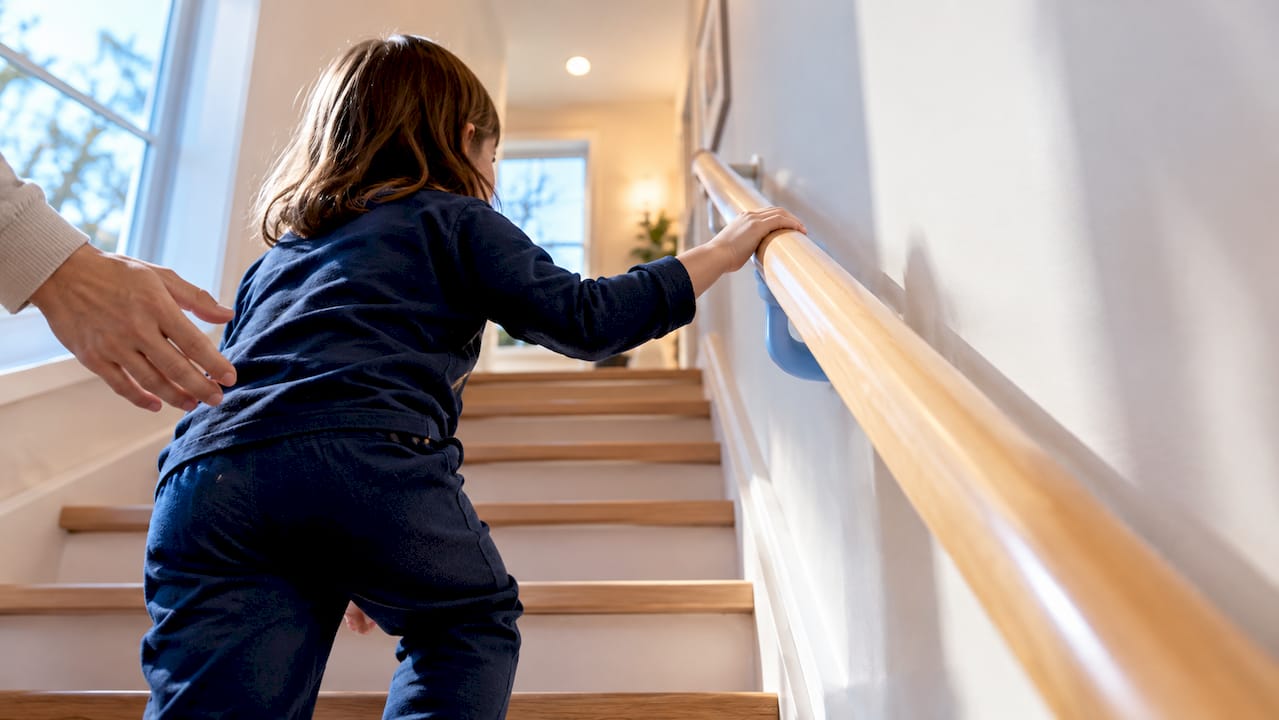
An adjustable child-height handrail is one of the most practical safety upgrades you can make to a staircase, giving young children something at their own reach to hold while they learn to climb and descend properly. The KiddieRail Adjustable Child Stair Handrail is built for exactly this job, fitting below a standard rail and adjusting in height as your child grows. It works alongside a stair gate rather than instead of it, and it teaches a skill gates cannot.
TL;DR:
- Properly positioned handrails between 600mm and 750mm above the pitch line improve a child’s trunk control and balance recovery during falls.
- A grip diameter of 25 to 38mm ensures children can fully grasp the rail, providing better support and grip during use.
- Using an adjustable, durable rail designed for children is more cost-effective long-term than repeatedly replacing fixed-height hardware.
- Fixing a rail into studs or masonry is essential for safety, as pressure-mounted options cannot withstand a child’s full weight or frequent pulling.
- Continuous coverage and accurate measurements are critical, especially on winding or spiral stairs where standard rails may not fit or provide proper support.
Table of Contents
- Why handrails for occupational therapists matter to parents at home
- What height, width and spacing actually work for children?
- How do you measure and fit a child handrail safely?
- How often should you check and maintain the rail?
- What proof is there that a tested rail makes a difference?
- What materials and durability testing should you look for?
- How do adjustable mechanisms actually work?
- What weight can a child handrail actually hold?
- What does an adjustable child handrail cost?
- Which brands suit occupational therapy-informed households?
- An occupational-therapy view on why height matters more than parents think
- Ready to fit a rail that’s actually built for your child?
- Sources
- FAQ
Why handrails for occupational therapists matter to parents at home
The phrase “handrails for occupational therapists” might sound like clinical equipment, but the underlying idea is one every parent already understands: a rail positioned at the right height teaches a child to use their hands and balance together, rather than relying on an adult’s grip alone. Occupational therapists have long recommended graded, hands-on support for developing motor skills, and a fixed handrail at child height does precisely that on the one surface where falls cause the most home injuries: the stairs.
A stair gate and a child rail solve different problems. A gate blocks access when nobody is watching. A rail, fitted correctly, actively teaches a child how to move on stairs when they are watching, and supervised. Consumer Reports advises fitting hardware-mounted gates at the top of stairs because pressure-mounted versions cannot hold against a child’s weight at the top of a flight. That’s sound advice, but it’s about restriction. A handrail is about skill.
The right time to introduce one is usually as soon as a child starts attempting stairs independently, typically somewhere between 18 months and three years old, always with supervision continuing until they’re confident. Guidance from Nationwide Children’s Hospital recommends actively teaching toddlers to hold a handrail and supervising stair use until they can manage it themselves.
Research backs up why the height matters so much:
- Correctly positioned handrails improve trunk control during a stumble, and studies on handrail height and balance recovery found that rails positioned for the user’s reach reduced how far the body tipped during a destabilising event.
- A rail that’s too high forces a child to reach up and outward, which weakens their grip and worsens balance rather than helping it.
- Gates and rails used together, per HSE guidance, cover both the moments a child is alone on the stairs and the moments they’re actively learning to use them.
What height, width and spacing actually work for children?
Precision matters more here than most parents expect. Guidance from universal design standards for early years and care settings recommends fitting a lower handrail between 600mm and 750mm above the pitch line, the imaginary line running along the tips of the stair nosings. Measure from that line, not from the floor at the base of each step, or you’ll end up with a rail that sits too low partway up a flight.
Diameter matters just as much as height. A rail with a small hand wrapped around 25 to 38mm of grip closes properly, giving real purchase during a stumble. Anything thicker and a toddler’s hand simply can’t close around it.
Standard to remember: universal design guidance sets the lower handrail at 600–750mm above the pitch line, with a grip diameter of 25–38mm and an extension of roughly 300mm past the top and bottom of the flight, according to Ireland’s Universal Design Guidelines for early learning and care settings.
A few other specifics to check before buying:
- Extension beyond the flight: rails should run about 300mm past the top and bottom step, giving a child something to hold before their foot even reaches the first tread.
- Contrast and visibility: a rail in a colour that stands out against the wall helps children (and adults) spot it quickly, particularly on darker staircases.
- Continuous coverage: gaps at half-landings or turns undermine the whole point, so check a product spans your actual layout before ordering.
- Winders and spiral stairs: tight winder treads or a spiral staircase often can’t take a continuous lower rail. In those cases, a floor-mounted guide rail, specialist fittings, or closer supervision paired with gates is the more realistic option.
How do you measure and fit a child handrail safely?
Getting the numbers right before you drill a single hole saves a return trip to the hardware shop. Work through this in order:
- Measure the pitch line. Run a straight edge along the nosing tips from top to bottom and mark 600 to 750mm perpendicular to that line at several points along the flight.
- Record the existing handrail height so you know how much clearance you have between the adult rail and your new child rail.
- Check clear width. Building regulations generally expect a minimum clear stair width even after a second rail goes in, so measure what’s left once the rail and its brackets are mounted.
- Locate solid fixing points. Studs, banister posts, or solid masonry behind plasterboard are what hold a rail through years of daily grabbing and pulling. Pressure mounting has no place on a stair rail; it’s designed for temporary gate barriers, not something a child will lean on with their full bodyweight.
- Space brackets according to the manufacturer’s instructions, typically no more than 900mm to 1,200mm apart, closer on longer flights.
- Test before you trust it. Apply a firm horizontal pull and push at child-rail height once fitted, then retighten every fixing and test again a week later once the wall has settled to the load.
Pro Tip: Get someone to press down and pull outward on the rail at several points along its length, not just one, since a rail can feel solid at the top bracket and still flex badly halfway along the run.
If your staircase has an awkward turn, an open-tread design, or you’re unsure what’s behind the wall, it’s worth arranging a home safety assessment with an occupational therapist before fitting anything permanent. KiddieRail’s guidance for occupational therapists covers exactly this kind of assessment.
How often should you check and maintain the rail?
A handrail only does its job if it stays as solid on day 500 as it was on day one. Build a simple routine around it:
- Weekly visual check: look for movement at brackets, loose screws, or any give when you push the rail sideways.
- Monthly pull test: apply the same firm pull and push you used at installation and note anything that’s shifted.
- Cleaning: use a mild soap solution rather than anything abrasive, since harsh cleaners can dull grip texture and fade contrast colouring over time.
- Watch for fading contrast: a rail that’s lost its visual pop against the wall may need a wipe with the right product or, eventually, replacement.
- Know when to raise or remove it: once your child can comfortably reach and use the main adult handrail unaided, that’s the signal to raise the child rail or retire it altogether.
What proof is there that a tested rail makes a difference?
Falls on stairs remain one of the leading causes of injury in the home, which is exactly the problem KiddieRail was built to address. An adjustable child stair handrail is designed specifically for young children, fitting below a standard rail and adjusting as they grow, so a family isn’t buying new hardware every year a child gets taller.
A tested product will have gone through durability testing aimed at confirming it holds up under the kind of repeated, forceful use a real toddler puts on a handrail: grabbing, swinging, and leaning their full weight into it dozens of times a day. That combination, a fixed measurable position plus a rail actually built to take a child’s weight, is what separates a proper handrail from a repurposed towel rail or an ill-fitting bracket kit. It’s also why the sizing standards covered above aren’t academic. A rail fitted outside the 600 to 750mm range, or with the wrong grip diameter, undoes the benefit even if the hardware itself is solid.
What materials and durability testing should you look for?
A child stair rail takes a different kind of punishment than a decorative handrail. It gets swung on, pulled diagonally, gripped with wet or sticky hands, and used as leverage by a child hauling themselves up two steps at once. Materials need to resist that without flexing, cracking, or loosening at the joints.
Look for rails built from rigid, powder-coated metal or dense reinforced polymer rather than lightweight plastic tubing, since thinner materials tend to develop stress fractures at bracket points after repeated lateral force. The finish matters too: a textured or slightly grippy surface holds up better under sweaty summer hands than a smooth gloss coating, which becomes genuinely slippery once damp.
Durability testing worth asking about includes repeated load cycling (simulating thousands of grab-and-release motions), fixed-point pull testing at various angles, and exposure to humidity and temperature changes if the staircase sits near an entryway or unheated hall. A quality child stair rail product should have been through durability testing of this kind before going to market, aimed at confirming the rail keeps its grip and structural integrity well beyond a single season of daily use. That matters more than most buyers realise: a rail that loosens after six months of use is arguably worse than no rail at all, since it teaches a false sense of security.

How do adjustable mechanisms actually work?
The whole appeal of a child-height rail over a fixed one is that a two-year-old and a five-year-old need the rail at genuinely different heights, and buying new hardware every year isn’t realistic for most households. An adjustable mechanism needs to do two things well: hold firmly at whatever height you set, and be simple enough that a parent can actually change it without specialist tools.
Most adjustable systems use a sliding bracket or telescoping mount that locks at set increments along a fixed vertical rail component, so you’re not eyeballing the height each time. The best versions let you shift the rail up in stages as your child grows, rather than forcing a full reinstall, which is the entire point of buying an adjustable product over a static one.
Ease of adjustment matters practically too. If raising the rail requires removing brackets from the wall and redrilling, most parents simply won’t bother, and the rail stays at toddler height long after a child has outgrown it. A mechanism that adjusts via a release catch or a visible height marker, without new holes in the wall, is what actually gets used correctly over years rather than months. When you’re comparing products, ask specifically how the height changes, not just whether it does.
What weight can a child handrail actually hold?
A rail rated only for gentle hand-holding will fail the first time a toddler decides to hang their full weight off it, which happens more often than most parents expect. Children don’t just rest a hand on a rail; they lean, swing, and occasionally dangle from one arm while looking back at a parent behind them.
A rail intended for genuine child use should be built to handle sustained lateral and downward force well beyond an average toddler’s bodyweight, accounting for sudden dynamic loads rather than just static weight. This is where the fixing method matters as much as the rail itself. Even a well-built rail will fail under repeated stress if it’s anchored into plasterboard rather than a stud, joist, or banister post, because the wall material gives way long before the rail does.
A simple way to sanity-check a fitted rail at home is the pull-and-push test described earlier: apply firm, deliberate force at the height and angle a child would realistically use, then check for any flex at the brackets rather than just the rail surface. Retest periodically, since repeated stress loosens fixings gradually rather than all at once, and a rail that felt solid at installation can develop play within a matter of months if bracket spacing was too wide for the wall type.
What does an adjustable child handrail cost?
Budget for a child-height rail depends heavily on staircase length, the number of turns or landings involved, and whether you need extension pieces for a wider or longer flight. As a general rule, a single straight flight needs less hardware than a staircase with a half-landing or winder section, which may require additional brackets or connector pieces to keep the rail continuous.
The KiddieRail Adjustable Child Stair Handrail is priced on request through the KiddieRail shop, where you can check current availability and options for your staircase type. For households with longer or more complex staircases, the KiddieRail Extension Pack runs from £24.99 to £36.99 as a one-off purchase, letting you extend coverage without buying an entirely new rail system.
Weighed against the alternative, replacing fixed-height hardware every couple of years as a child grows, an adjustable system tends to work out considerably cheaper over the years a family actually needs one. Factor in your own time too: an adjustable rail that a parent can reposition in minutes beats one that needs a fresh install and new wall holes every time a child hits a growth spurt.
Which brands suit occupational therapy-informed households?
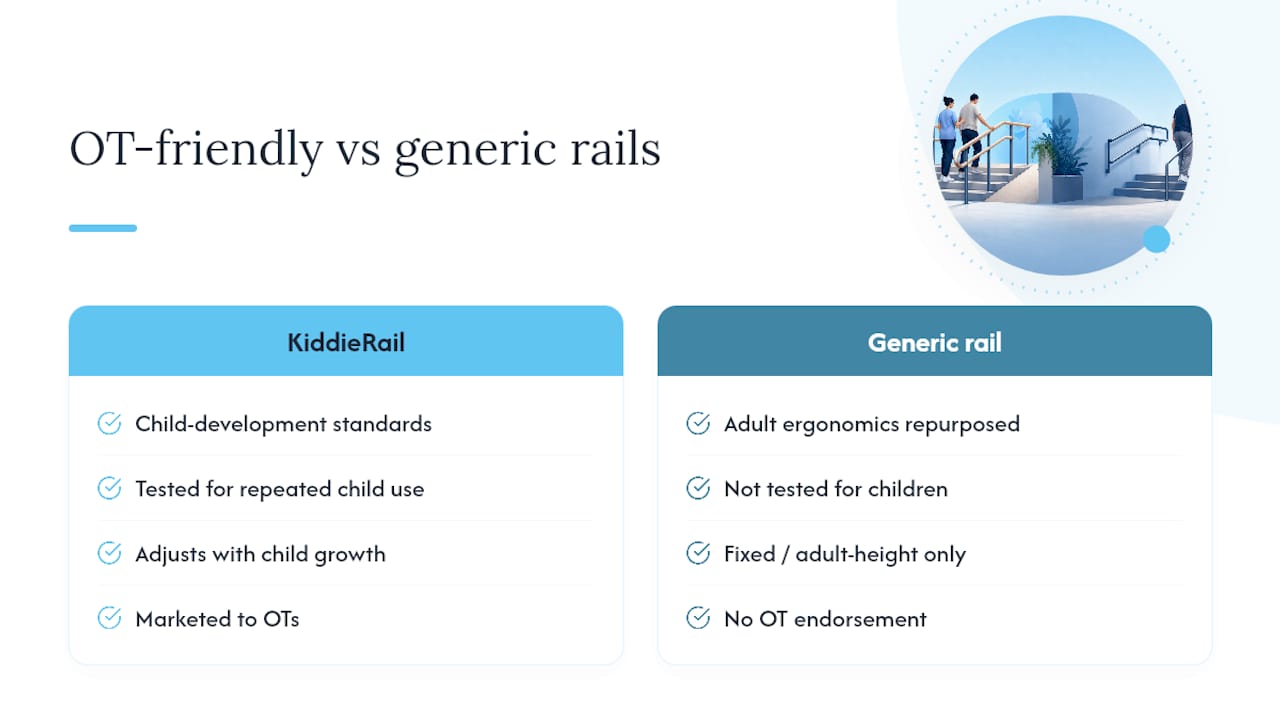
For a purchase this closely tied to child development and injury prevention, the product itself matters less than whether it was actually designed around the standards occupational therapists already use. That’s the gap a lot of generic stair hardware falls into: rails built for adult ergonomics, repurposed and marketed as “child-friendly” without ever being tested against a child’s actual grip strength, reach, or bodyweight distribution.
KiddieRail was designed specifically around this problem rather than adapted from adult stair hardware. The KiddieRail Adjustable Child Stair Handrail fits below a standard adult rail, adjusts in height as a child grows, and has been positioned from the outset as a product occupational therapists can reference when advising families on home stair safety. That’s a meaningfully different starting point to a generic bracket kit stocked as a stopgap.
If you’re choosing between options, ask any manufacturer directly whether their product has been tested for durability under repeated child use, what height range it adjusts across, and whether it was designed with input relevant to child development, rather than simply resized from adult specifications. A comparable focus on accessible, safety-led design shows up in other parts of the home too, from bathrooms to kitchens, wherever a family is thinking beyond a single fix toward a safer house overall.
An occupational-therapy view on why height matters more than parents think
Motor learning on stairs isn’t just about balance, it’s about a child building confidence in their own hands and feet working together, without an adult’s hand doing the job for them. A rail set at the wrong height undermines that every single time it’s used, because the child is either reaching up awkwardly or barely brushing a rail that’s too low to grip properly.
The single most useful thing a parent can do this week isn’t buying anything. It’s grabbing a tape measure, checking your pitch line, and comparing what you find against the 600 to 750mm range before deciding what to fit. A gate alone teaches nothing about stairs; a correctly measured rail teaches everything.
— Paul
Ready to fit a rail that’s actually built for your child?
Generic stair hardware forces a choice between a rail sized for adults or nothing at all, and neither option teaches a young child how to climb safely. KiddieRail closes that gap with a rail purpose-built for small hands, adjustable as your child grows, so you’re not replacing hardware every year and not gambling on a mismatched height in the meantime.

Start by browsing the KiddieRail Adjustable Child Stair Handrail to check fit for your staircase type, and if your flight is longer or includes a half-landing, look at the KiddieRail Extension Pack to keep the rail continuous. Use the height and grip guidance covered above before you order, and if you’re still unsure how it will sit on your particular staircase, get in touch with support before fitting anything permanently. Pair the rail with wider household safety habits from our stair safety advice for UK parents for a complete approach.
Sources
- Vertical circulation: stairs | Universal design for early schools and care settings
- Influence of handrail height and balance recovery reactions (Applied Ergonomics / PMC)
- Baby safety gate guide: types, safety, expert tips – Consumer Reports
- Home safety series: stairs and hallways – Nationwide Children’s Hospital
FAQ
What height should a child’s handrail be?
Universal design guidance recommends fitting a lower handrail between 600mm and 750mm above the pitch line, measured along the stair nosings rather than from the floor.
Does a handrail replace a stair gate?
No. A gate restricts access when a child is unsupervised, while a rail actively teaches balance and grip during supervised stair use, and most safety guidance recommends using both together.
What diameter handrail is best for small hands?
A grip diameter of 25 to 38mm suits most children’s hands, letting fingers close fully around the rail for real purchase during a stumble.
How much does the KiddieRail Adjustable Child Stair Handrail cost?
Pricing for the KiddieRail Adjustable Child Stair Handrail is available on the KiddieRail shop, while the Extension Pack runs from £24.99 to £36.99 as a one-off purchase.
Can I fit a child handrail on a spiral staircase?
Continuous lower rails are difficult to fit on winder or spiral staircases, so specialist fittings, a floor-mounted guide rail, or closer supervision alongside gates tend to work better in those layouts.


