
Currently Empty: £0.00


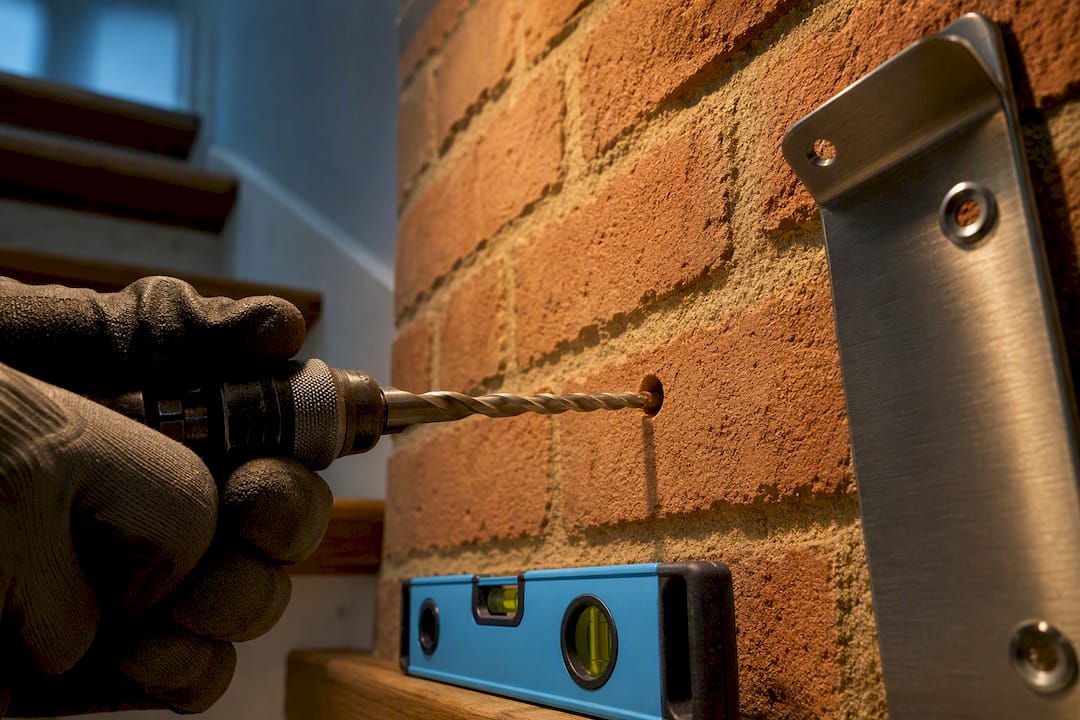
Anchor into the brick unit, never the mortar joint, using a hammer drill and a fastener sized to the load. For a light domestic rail, a masonry screw with at least 25 mm (1 in) of penetration into solid brick will hold. For anything heavier, a sleeve or resin anchor set to 50–75 mm (2–3 in) is the safer bet. Test every bracket by hand before you trust it, and call a professional if the brick crumbles as you drill or you find a cavity you didn’t expect.
TL;DR:
- Masonry screws require at least 25 mm of penetration into solid brick for light domestic handrails, while heavier loads benefit from sleeve or resin anchors set at 50 to 75 mm.
- Drilling must target the brick unit itself, never the mortar, with proper embedment depth and dust removal critical to ensuring long-lasting, secure fixings.
- Use a hammer drill or rotary hammer for faster, cleaner holes, especially on larger diameters over 10 mm, and always verify fitting strength with a pull test before use.
- Resin anchors are optimal for soft, hollow, or cracked masonry, but they take longer to cure, whereas masonry screws are convenient and easy to remove for repositioning.
- For child’s stair rails, fixings follow the same principles as adult handrails but should be tested carefully to ensure safety, with the product designed to grow with the child and reduce re-drilling.
Table of Contents
- What tools, PPE and fasteners do you need for masonry handrail fixes?
- How do you choose anchors and embedment depth for brick or concrete?
- Step-by-step: fitting a handrail bracket into brick or concrete
- Fitting a KiddieRail to a masonry wall
- When should you call a professional instead?
- Get a child-height rail that’s built for this kind of wall
- Sources
- FAQ
What tools, PPE and fasteners do you need for masonry handrail fixes?
A hammer drill handles most domestic jobs. If you’re drilling holes over roughly 10 mm across, a rotary hammer is worth hiring for that day rather than fighting a standard hammer drill through solid brick or block. Speed matters here: a rotary hammer chews through masonry faster and with less risk of the brick blowing out around the hole.
Get your bit size right before you start. As a rule of thumb, use a masonry bit around 1.6 mm (1/16 in) smaller than the fastener’s diameter, which keeps the fit tight enough for real holding power.
- Masonry screws (Tapcon-style): quick, removable, fine for light domestic handrails.
- Sleeve or wedge anchors: higher pull and shear strength, better for stair rails taking real weight.
- Resin (chemical) anchors: best where the brick is soft, hollow, or you’re not confident in the substrate.
- Plastic plugs: fine for shelving, not for a handrail someone will lean on.
- PPE and dust control: safety glasses, an N95 mask, and a vacuum or compressed air to clear the hole between drilling passes.
Keep a tube of exterior sealant and a set of cosmetic caps to hand too. They finish the job properly and stop water sitting around the fixing.
How do you choose anchors and embedment depth for brick or concrete?
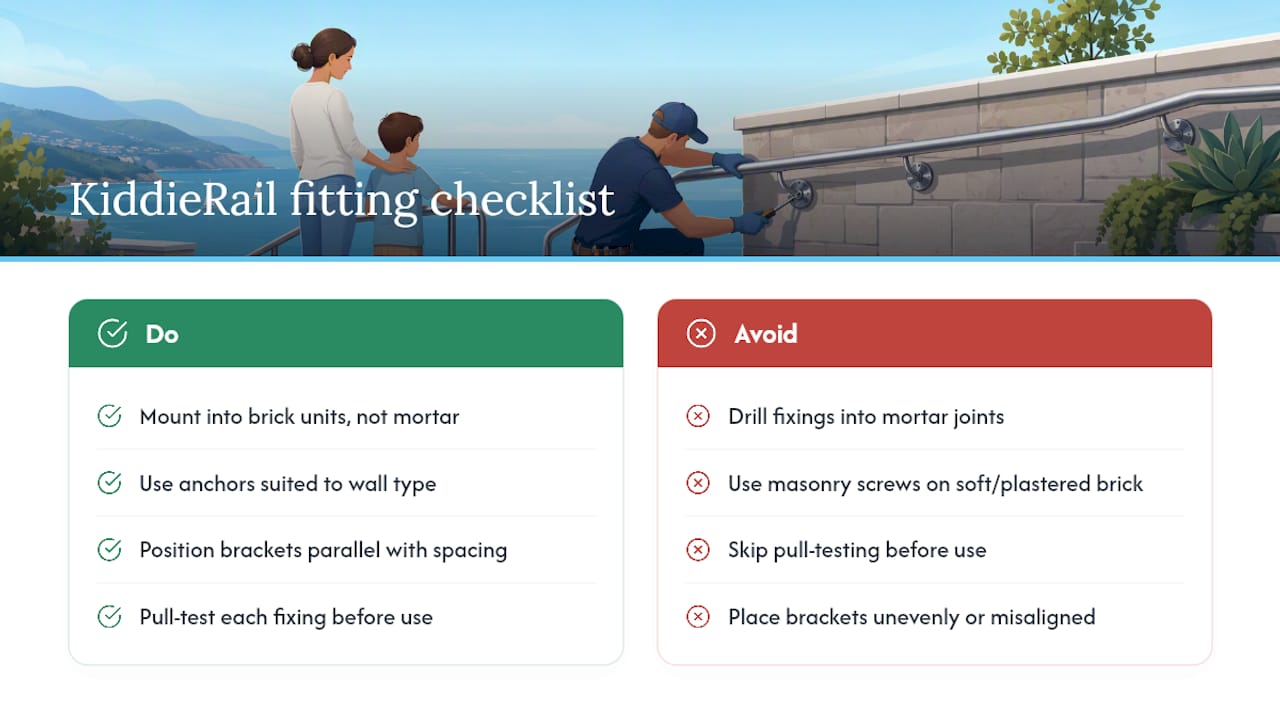
Drill into the brick unit itself, never the mortar between bricks. Mortar simply doesn’t hold a fastener the way fired brick does, so a screw or anchor sunk into a joint will work loose under repeated load, often within months rather than years.
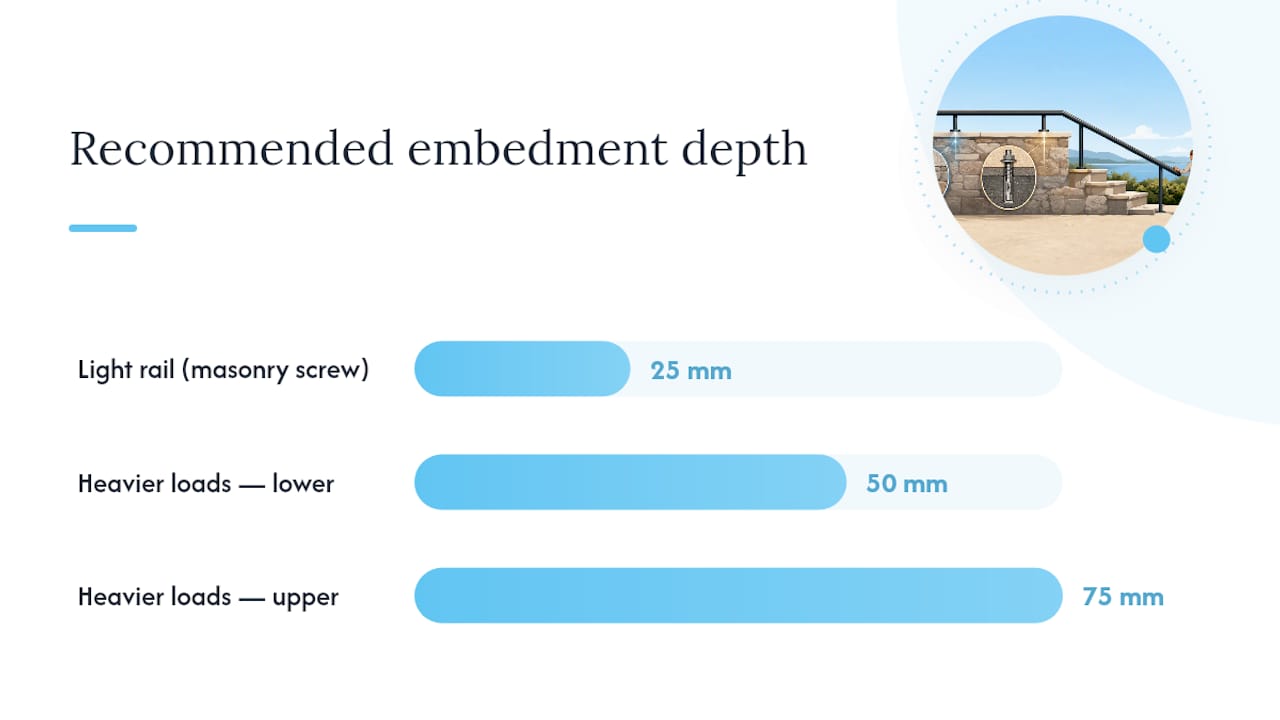
Embedment depth is where most DIY handrail fixes go wrong. Go too shallow and the bracket rocks; go in with the wrong anchor for a hollow or plastered wall and it never grips at all.
Pro Tip: If you’re not sure whether you’ve hit brick or mortar, back the bit out and look at the dust. Reddish, gritty dust means brick. Pale, powdery dust means mortar, so move the hole a few centimetres.
- Light domestic rail, masonry screw: at least 25 mm (1 in) into solid brick.
- Heavier loads or single-fix brackets: 50 to 75 mm (2 to 3 in) with a sleeve or resin anchor is the range most trade guides recommend.
- Plastered or rendered brick, or uncertain substrate: resin anchors or steel sleeve anchors increase both pullout and shear capacity.
Masonry screws win on convenience. They’re quick to fit and easy to remove if you need to reposition a bracket. Wedge and sleeve anchors cost a bit more effort but carry noticeably more shear strength, which matters on a stair rail people actually pull on. Resin anchors take the longest to install because of curing time, but they’re the right call on thin brick veneer, cracked masonry, or anywhere you’re fitting a heavier metal railing rather than a light indoor rail.
Step-by-step: fitting a handrail bracket into brick or concrete
- Measure and mark. Standard domestic handrail height runs 34 to 38 in (865 to 965 mm) from the tread nosing, and bracket spacing typically sits around 900 mm (36 in) apart. Use painter’s tape and a chalk line to keep every mark level and consistent, referencing the ergonomics of stair nosing if your treads are an unusual shape.
- Drill. Wrap a strip of tape around the bit at your target depth so you can see it at a glance. Hold the drill perpendicular to the wall, start slow to break through any render, then increase speed once you’re into solid brick. Clear the hole with a vacuum or compressed air every few centimetres. Discussion threads on brick veneer fixings consistently flag dust build-up as the main reason anchors under-perform, since packed dust stops the anchor or resin bonding properly.
- Set the anchor. Seat mechanical anchors flush with the wall face and tighten to the torque the manufacturer specifies, not by feel. For resin anchors, follow the mixing and curing times on the cartridge exactly; rushing this step is the single most common reason a chemical anchor fails a pull test.
- Mount bracket and rail. Fit the bracket and tighten the fixings in sequence rather than cranking one down fully before starting the next, which spreads the load evenly and avoids blowing out the brick around a single hole. Fit any decorative caps once you’re happy with alignment.
- Verify. Pull and push firmly on every bracket, not just the end ones. Check the rail sits level along its run, and if it’s an exterior fixing, run a bead of sealant around each fastener. Sealing the fixing point keeps water out, which matters because water sitting in a masonry hole through a freeze cycle is what eventually cracks the brick around an otherwise sound anchor.
If you’re planning the wider staircase alongside the rail, a UK loft staircase installation guide is a useful reference for getting rise, going, and headroom right before any fixings go in.
Fitting a KiddieRail to a masonry wall
A KiddieRail sits below your existing adult handrail, at a height a child can actually reach and grip, and it’s designed to mount using the same masonry principles as any other stair rail: brick unit, not mortar, with brackets sized to the wall. Because the rail adjusts as your child grows, you’re not redrilling new holes into brick every year or two, which matters when every extra hole is another point where the wall can be weakened.
The anchor classes covered above, masonry screws for lighter loads, sleeve or resin anchors on softer or plastered brick, apply directly to fitting a child rail. Position brackets so the rail runs parallel to the main handrail at consistent spacing, and always pull-test each fixing before letting a child use it unsupervised. For wider guidance on stair layout and positioning for younger children, see advice for UK parents on stair safety.
When should you call a professional instead?
Stop and get advice if the brick crumbles or turns soft as you drill, if you hit a cavity where you expected solid wall, or if there’s any sign of rising damp or a previous patch repair nearby. A quick pull test after fitting tells you a lot: if a bracket moves at all under firm hand pressure, don’t trust it. Beyond the safety risk, drilling into a wall you’re not confident about can also void a product’s fitting warranty, so when in doubt, bring in a tradesperson who can core-check the substrate properly.
— Paul
Get a child-height rail that’s built for this kind of wall
Once the anchor and depth are sorted, the actual rail matters just as much. The KiddieRail Adjustable Child Stair Handrail is built to fit beneath a standard handrail and grow with your child, so you’re not re-fitting a new rail, and re-drilling new holes into your brick or block wall, every couple of years.

- It’s designed around the same bracket logic covered above, so the masonry screws, sleeve anchors, or resin fixings you’ve just read about are exactly what you’ll use to fit it.
- Full mounting specifications and hardware recommendations sit on the product page, so you can check compatibility with your staircase before you drill a single hole.
If you’re fitting a rail for a young child on a masonry staircase, check the specifications and order the KiddieRail that matches your stairs.
Sources
For more detail on brick anchoring, see the handrail mounting guide on HomeSteady, the wrought iron railing installation guide, and general stair safety advice for households with young children. Always check local building regulations for load-bearing handrail requirements before starting exterior work.
- How to mount a handrail on brick | HomeSteady
- Installing wrought iron railing in brick: DIY guide
- Fixing method for handrail brackets into plaster covered brick walls | myBuilder
- Layout and mark handrail position — Install outdoor handrail | Oak Valley Designs
FAQ
How do I attach a handrail to a brick wall?
Drill into the brick itself, not the mortar joint, using a hammer drill and a masonry bit sized slightly smaller than your fastener, then set a masonry screw or sleeve anchor to the recommended embedment depth for the load.
How do I install a handrail into a concrete wall?
Concrete generally takes a deeper, higher-load anchor than brick, so a sleeve or wedge anchor at 50 to 75 mm (2 to 3 in) is the usual choice, drilled with a hammer drill or rotary hammer depending on hole size.
Can I screw directly into a brick wall?
Yes, provided you’re screwing into the solid brick unit rather than the mortar joint; a masonry screw with at least 25 mm (1 in) penetration works for light domestic handrails, but heavier rails need a sleeve or resin anchor instead.
How do I connect a handrail to a wall?
Mark the bracket positions at the correct height and spacing, drill into solid masonry avoiding mortar joints, fit an anchor suited to the wall and load, then pull-test every bracket before trusting the rail with weight.
Does a child stair rail need different fixings from an adult handrail?
No, a product like KiddieRail uses the same masonry anchor principles as any standard handrail; the difference is height and adjustability, not the fastening approach.


