
Currently Empty: £0.00


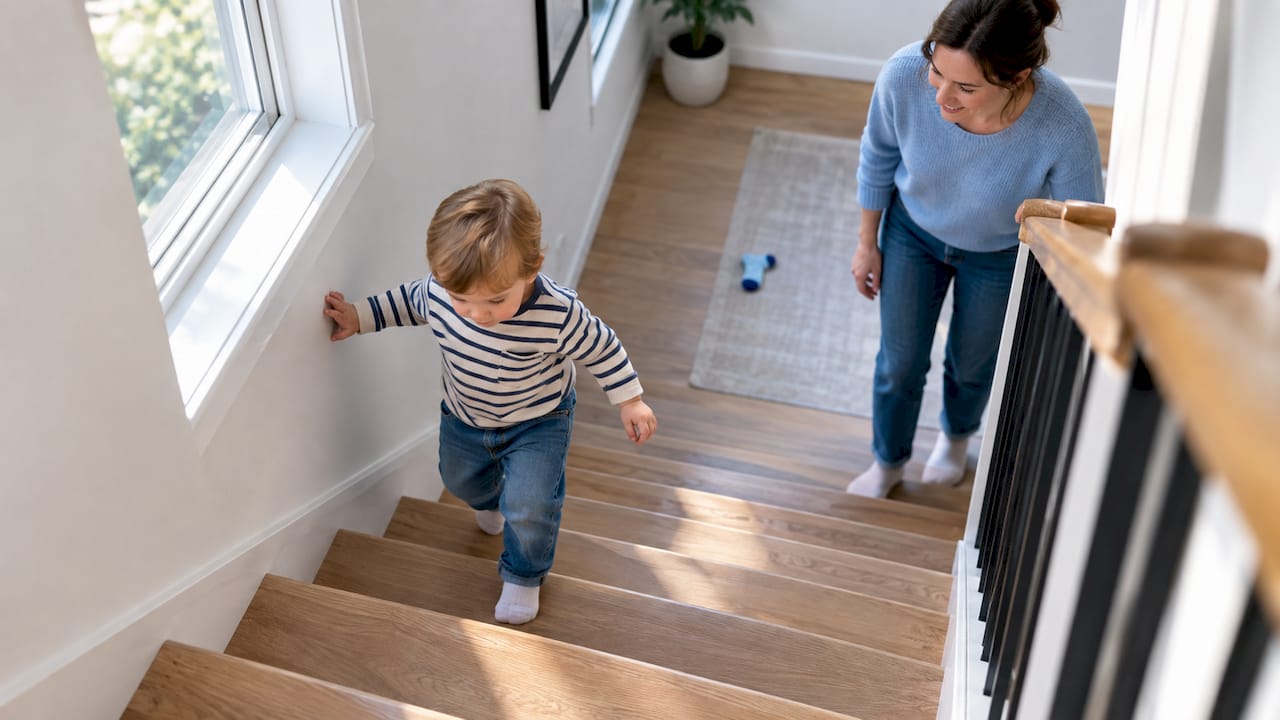
Most families remove a stair gate somewhere between 24 and 36 months, but the calendar matters far less than what your child can actually do. The real test is whether they can hold the handrail and alternate their feet going up and down, whether they’ve stopped trying to climb the gate itself, and whether they can’t work the latch. If any one of those conditions fails, the gate stays, or gets upgraded, regardless of what birthday is coming up.
TL;DR:
- Children should only have stair gates removed once they can hold the handrail, alternate feet, and cannot operate the latch, regardless of age.
- The optimal removal age varies widely, often between 24 and 36 months, depending on individual motor skills and impulse control.
- A staged approach, including supervised practice and reinforcement with a child handrail, improves safety and supports independence during transition.
- Ensuring the staircase is secure and free of hazards is essential before removing the gate, especially at the top of stairs where hardware-mounted gates are recommended.
- Consider partial or intermediate solutions, such as keeping the gate at night, adjusting its height, or replacing it with a supportive handrail like KiddieRail.
Table of Contents
- What the guidance says about the right age to remove a stair gate
- Signs your child is actually ready (not just old enough)
- Checking your home before you take the gate down
- A staged plan for teaching stairs and removing the gate
- How KiddieRail supports safer gate removal
- What happens if you remove the gate too early
- Alternatives if you’re not ready for full removal
- Balancing safety and independence
- A handrail worth considering once the gate comes down
- Sources
- FAQ
What the guidance says about the right age to remove a stair gate
Ask five parents when they took their stair gate down and you’ll get five different answers, and that’s not a contradiction, it’s the point. Development varies enormously between individual children, so official guidance leans on skill rather than age. NHS advice on baby and toddler safety recommends keeping gates up while children are infants and toddlers, then removing them once a child demonstrates they can manage stairs safely with support, rather than at a fixed age.
That said, patterns do emerge across sources. Consumer Reports and related paediatric guidance generally treat gates as tools for children roughly between 6 months and 2 years old. Many families find their child has outgrown the need by 24 to 36 months depending on how quickly motor skills and impulse control develop.
The variance exists for good reason. A child’s leg strength, balance, and understanding of cause and effect (grip the rail, one foot at a time, slow down) don’t arrive on a schedule. Some two year olds have it nailed. Some four year olds still rush stairs carelessly.
Falls on stairs remain one of the more common causes of childhood home injury, and Nationwide Children’s Hospital has documented gate-related incidents alongside general stair falls presenting to emergency departments. That’s not a reason to panic. It’s a reason to remove barriers based on evidence, not guesswork.
- Many sources cite 24 to 36 months as the common removal window
- Skill mastery, not age, is the deciding factor in nearly every credible guideline
- Hospital data confirms stairs remain a real injury risk during the toddler years
Signs your child is actually ready (not just old enough)
Forget the birthday. Watch for these instead, because they’re observable in your own hallway, not theoretical.
- They hold the handrail without prompting. A child who reaches for support automatically, rather than because you’ve just reminded them, has internalised the habit rather than performed it on demand.
- They alternate feet confidently. Early stair climbers often lead with one foot and bring the other up to meet it on the same step. Readiness looks like proper alternating steps, going both up and down.
- They pause at the top and bottom. A child who stops, checks their footing, and doesn’t launch straight into a run is showing the impulse control that matters just as much as the physical skill.
- They follow a simple instruction mid-stair. If you say “wait” or “slow down” and they actually do it, that’s a meaningful behavioural marker most checklists skip.
- They’ve stopped trying to climb the gate. This is a stop sign in reverse. A child actively climbing over a gate is more dangerous with the gate present than without it, because the fall height and posture are worse.
Watch, too, for whether they can work the latch themselves. Guidance from Ovia Health points to exactly this moment, latch mastery or gate climbing, as the practical cue that a gate has stopped protecting and started tempting.
Pro Tip: Run a supervised “test week” before you commit to full removal. Leave the gate open during the day while you’re nearby, and watch how your child handles the stairs without a barrier at all. It tells you far more than any age chart.
Checking your home before you take the gate down
A gate coming down shifts the entire safety burden onto the staircase itself, so check the staircase, not just the child.
Start with the adult handrail. Is it secure, is it actually graspable, and is it the right height for someone learning to use it? If the existing rail is too high or awkwardly angled for a young child’s grip, that’s worth addressing before the gate disappears, not after.
Then look at the surface and surroundings:
- Loose carpet, worn treads, or anything underfoot that could catch a small foot mid-step
- Open balustrades wide enough for a child’s head or body to pass through
- Furniture, toys, or rugs bunched near the top or bottom landing that create a trip hazard right where a fall would be worst
Gate type matters more than people realise. Hardware-mounted gates are the recommended choice at the top of stairs because pressure-mounted units can pop loose under weight, which is a serious risk above a drop. That distinction rarely applies at the bottom of the stairs, where a pressure-mounted gate is safer and easier to remove. Treat top-of-stairs removal and bottom-of-stairs removal as two separate decisions, not one.
A staged plan for teaching stairs and removing the gate
Removing a gate in one go, on one particular Tuesday, isn’t how this should work. A staged approach gives your child time to build the habit while you still have a safety net.
- Teach the technique first, gate still up. Practise holding the rail, one step at a time, with the gate open but you standing right there.
- Run supervised sessions daily. Several short practice runs beat one long one. Consistency builds the motor pattern faster than duration does.
- Introduce brief unsupervised stretches. Once you’ve seen several clean runs, let them try a short flight alone while you watch from a distance, not hovering.
- Remove during the day, keep it at night. Many parents keep the gate closed for naps and bedtime long after daytime removal, since a half asleep toddler doesn’t have the same coordination.
- Expect setbacks. A stumble doesn’t mean start over from scratch. It means go back to supervised practice for a few more days.
If your child is climbing before they’ve mastered the descent, or your existing gate is too short for their current height, an upgrade to a taller hardware-mounted gate is often the smarter move over outright removal.
Pro Tip: Teach descending before ascending gets all the attention. Most falls happen going down, so if your child can only do one confidently, make sure it’s that one.
How KiddieRail supports safer gate removal
A gate is a barrier. It stops access entirely. A handrail is different: it supports the activity itself, which is exactly what a child needs once you’ve decided a gate no longer fits their stage of development.
The KiddieRail Adjustable Child Stair Handrail fits below your existing adult handrail and adjusts as your child grows, giving them a graspable rail at a height they can actually reach and use, rather than one built for adult hands. Handrail design guidance around graspable profiles and reachable heights backs up the basic principle here: a rail a child can properly grip teaches better technique than relying on a barrier alone, because it supports the exact behaviour, holding on, stepping deliberately, that you’re trying to build during the transition.
- Designed to grow with a child, reducing the need for replacement as they get taller
- Intended to fit beneath a standard adult handrail on many home staircases
- Provides children something to hold during supervised practice sessions, reinforcing the habit before removing the gate
- Can function as a longer-term fixture, not just a temporary solution during transition periods
Our advice on protecting children on stairs covers the training side of this in more depth if you want a fuller walkthrough.
What happens if you remove the gate too early
Take the gate down before your child has genuinely mastered the handrail, alternating feet, and impulse control, and the risk doesn’t disappear, it just moves. A toddler who rushes stairs with a gate in place is contained. The same toddler without a gate has an open flight to fall down, and the injuries associated with stair falls, from bumps and bruises to more serious head injuries, scale with the height and speed of the fall.
There’s a subtler cost too: confidence outpacing ability. Children often believe they can manage stairs well before their coordination actually supports it, and an early gate removal can reward that overconfidence rather than correct it. You end up reinforcing exactly the behaviour, rushing, skipping steps, ignoring the rail, that leads to a fall later.
Reinstalling a gate after a scare is entirely reasonable and not a failure of judgement. If a child has a fall, or you notice they’re regressing into careless habits, putting the gate back up for a few more weeks of supervised practice costs you nothing except a little pride. The staircase isn’t going anywhere. There’s no deadline that makes it worth rushing the decision, and no research anywhere suggesting an early removal date produces a better outcome than a slightly later, better prepared one.
Alternatives if you’re not ready for full removal
Full removal isn’t the only option, and treating it as all or nothing is where a lot of families overcomplicate the decision.
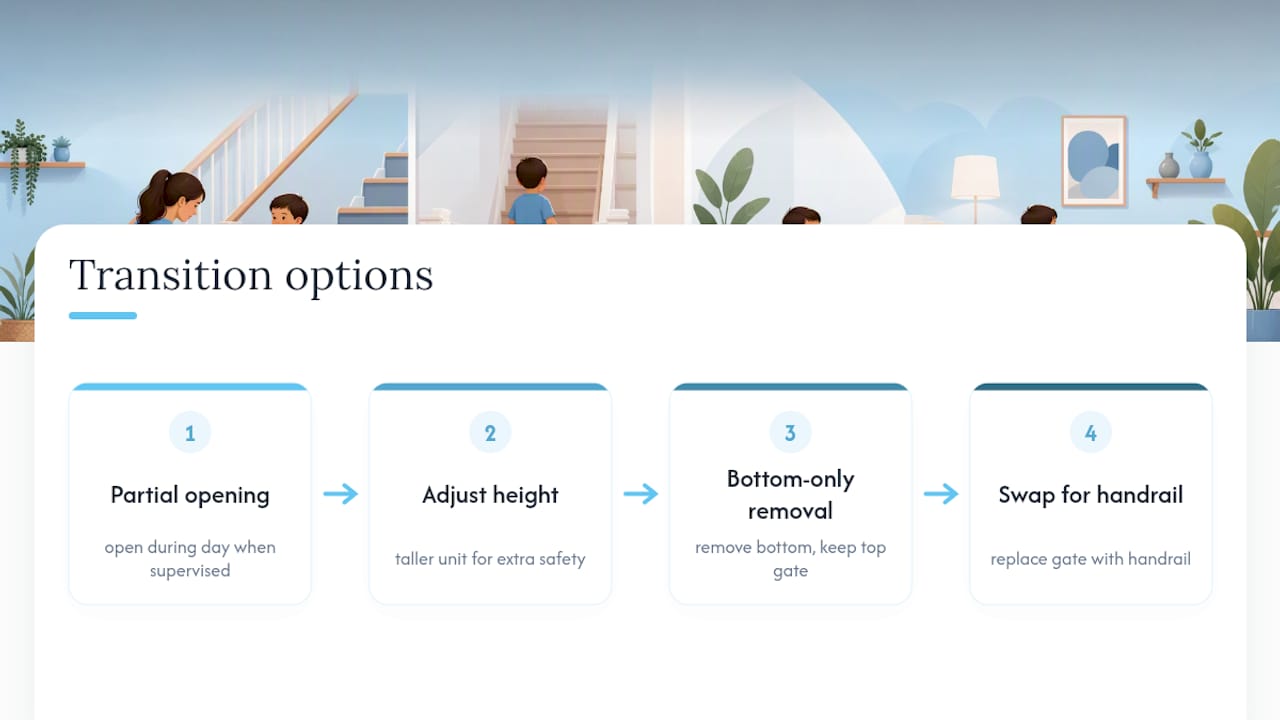
Partial opening works well for a transitional stretch. Leave the gate physically in place but open during the day when you’re around to supervise, and close it again at night or when you’re occupied elsewhere. This gives your child real unsupervised practice without removing the fallback entirely.
Adjusting gate height or position is worth considering before you assume removal is the only next step. If your current gate is a standard height and your toddler has entered the serious climbing phase, a taller unit can buy you months of extra safety without a single behaviour change required from your child.
Bottom-only removal is often the sensible middle ground. Because pressure-mounted gates are considered less critical at the base of a staircase than at the top, many parents remove the bottom gate first, watch how their child handles the lower flight, and leave the top gate in place considerably longer.
Swapping the gate for a handrail at the top of the stairs, once you’re confident your child has the coordination for it, moves you from a full barrier to active support without stripping away help entirely. It’s a genuinely different category of tool, not just a lighter-touch gate substitute, and it fits naturally into that gap between “still needs a barrier” and “ready for open stairs”.

If you’re tidying up the landing or hallway as part of this transition, organising the space around your stairs to clear trip hazards is worth doing at the same time.
Balancing safety and independence
Taking a gate down feels riskier than it is, mostly because you’re removing something visible and adding nothing in its place. That’s an illusion. Testing your child’s actual skills, rather than trusting a birthday, gives you real information instead of a guess dressed up as a rule.
The calmer approach isn’t the cautious one or the bold one. It’s the one where you’ve actually watched your child handle stairs before you decide anything. Do the home checklist tonight, while it’s fresh in your mind, rather than after something’s already gone wrong.
— Paul
A handrail worth considering once the gate comes down
Most guidance stops at “remove the gate when ready” and leaves you to figure out what comes next. Kiddierail exists for exactly that gap. Instead of a barrier that simply blocks access, the KiddieRail Adjustable Child Stair Handrail gives your child a rail they can actually reach and grip, fitted beneath your existing handrail and adjusted as they grow, so it supports the stairs rather than standing in the way of them.

It’s a natural fit once you’ve moved past supervised practice, particularly for the top-of-stairs gate that hardware-mounted advice recommends keeping longest. If your staircase has a longer run or an awkward layout, the KiddieRail Extension Pack (£24.99 to £36.99, one-off) extends coverage without needing a second product. Browse the full range in the shop and fit one before you take the gate down for good, not after.
Sources
- Baby and toddler safety
- Baby Gate for Stairs: Safety-First Installation Guide | Babysential
- Best Baby Gates for Stairs: 3 Strongest RN-Reviewed Picks
- Nationwide Children’s Hospital
FAQ
When should you get rid of a baby gate?
There’s no single correct age. Remove it once your child can hold a handrail, alternate their feet on stairs, and can’t operate the gate latch, which NHS guidance supports as the safer benchmark than a fixed birthday.
Does a 5 year old need a baby gate?
Most five year olds have the coordination and judgement to manage stairs without a gate, though children with developmental differences may still benefit from one. If a five year old still climbs the gate or ignores stair rules, the underlying behaviour, not the age, is what needs attention.
Can a 4 year old walk up and down stairs safely?
Yes, most four year olds can manage stairs independently, including alternating feet both ascending and descending. Some still need reminders about slowing down and using the handrail, which is a behavioural point worth reinforcing rather than a sign the stairs themselves are unsafe.
When did most parents stop using the stair gate?
Anecdotal ranges run widely, from as early as 18 months to as late as 4 years, depending on the child and the home. Guidance generally points to 24 to 36 months as the common window, but a handrail like KiddieRail can ease that transition regardless of when you decide the timing is right.


