
Currently Empty: £0.00


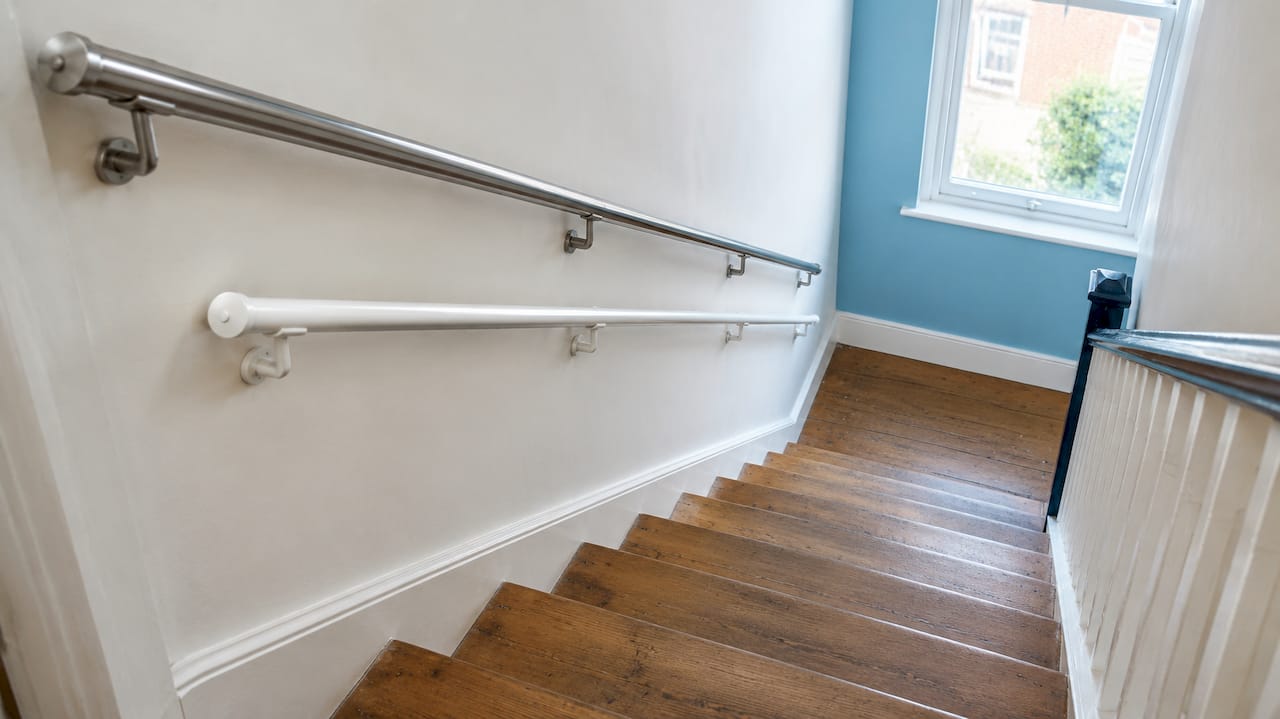
A standard UK stair handrail sits between 900 mm and 1000 mm above the stairs, which is roughly at a toddler’s head height or above. For a young child, a second, lower rail at about 600 mm to 750 mm above the stair nosings is what makes the stairs usable. It should run the full length of the flight and sit about 230 mm below the main rail. The rest of this guide explains where those numbers come from, how to measure your own staircase and what to do as your child grows.
TL;DR
- The main handrail on UK domestic stairs should be 900 mm to 1000 mm above the pitch line, which is far too high for a toddler to grip properly.
- A child-height rail is usually fitted in the 600 mm to 750 mm band, measured up from the stair nosings, and it should be adjustable so it keeps pace with growth.
- Keep about 230 mm (9 inches) of clear space between the adult rail and the child rail so a head or limb cannot get trapped.
- Run the child rail the full length of the flight, with a fixing into solid wall or a backing board, and add stair gates at the top and bottom for the youngest children.
- Measure the pitch line and the wall first. Wide stairs and curved flights need more length than a standard kit.
Table of Contents
- What the standard handrail height is, and why it fails small children
- What height should a child’s handrail be?
- The gap between the two rails matters as much as the height
- How long should a child’s handrail be?
- Fixing it: wall, bannister or backing board
- What about stair gates?
- Our view on child-height rails
- Where KiddieRail fits
- Other places where a lower rail helps
- Quick checklist before you fit
- FAQ
- Sources
What the standard handrail height is, and why it fails small children
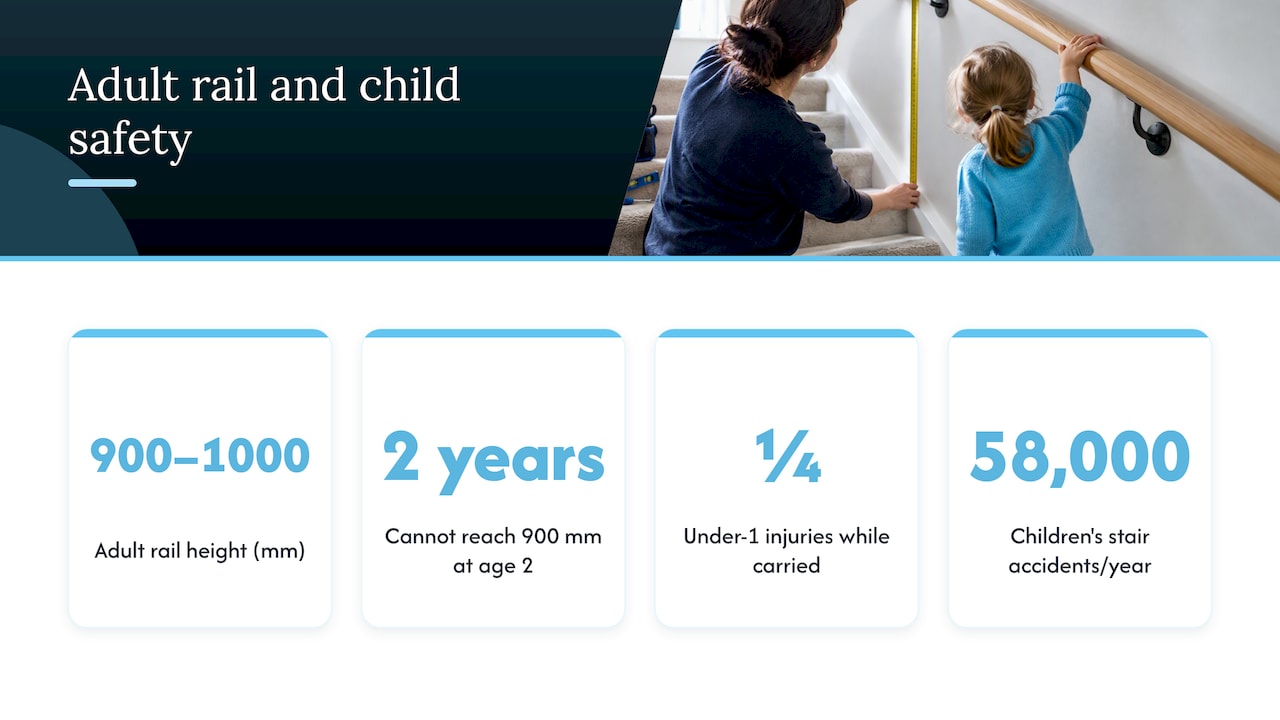
In England, the official guidance for new and altered stairs is Approved Document K. It says the top of a handrail on a stair should be 900 mm to 1000 mm from the pitch line, which is the sloping line joining the front edges of the stair nosings. On landings the same range is measured from the floor. Scotland and Wales have their own building standards, so check the local rules if you are building or altering a staircase there.
These figures were written with adults in mind. A two-year-old typically cannot reach a rail at 900 mm, and even when a child can touch it, the grip is at arm-stretch height, with the shoulder pulled up. That is not a position in which a child can steady a tumble. So many families end up carrying children on the stairs or holding a hand, which is where problems often start: in a US hospital study of stair injuries, one-fourth of injuries to children under 1 happened while they were being carried.
The scale of the issue in the UK is not small either. RoSPA reports that 58,000 children have accidents on the stairs every year.
Note that none of the above means your existing rail is wrong. A 900 mm rail is correct for the adults in the house. The point is that a child needs a second rail, in addition to it and not replacing it.
What height should a child’s handrail be?
The UK does not set a legal height for a second, child-height rail in a private home. Approved Document K covers the main rail, and a lower rail is an addition you choose. So the useful guides are the accessibility standards that do deal with children, and the practical experience of fitting rails on ordinary stairs.
The figures you will find are consistent:
| Source | Child-height rail |
|---|---|
| Australia’s National Construction Code (primary schools) | Second handrail between 665 mm and 750 mm |
| United Nations accessibility design manual | Additional rail at 0.60 m for children and short people |
| US ABA guidance on handrails | Maximum of 28 inches (710 mm) for a lower rail |
The US guidance also notes that the lower rail is lower than the adult range of 34 to 38 inches (865 mm to 965 mm). Put together, 600 mm to 750 mm is a sensible working band. That is the range our own rails are built around, and it is why we describe the adjustment as running from 600 mm to 750 mm on UK stairs.
How to pick the right height inside that band
Stand your child on a stair, arms relaxed at their sides, then bend their elbow to about 90 degrees. The top of the rail should fall roughly at that hand position, so the child can wrap their fingers over and around it without lifting the shoulder. Check this on the bottom, middle and top steps, because the measurement is always taken up from the nosing directly beneath the rail, not from the floor.
For a toddler who has just started climbing, you will usually land near the bottom of the band. For a six or seven year old you will be near the top. This is the practical argument for adjustability: a fixed rail set for a two-year-old is wasted by five, whereas one that moves up the bracket keeps doing its job. Our guide to child handrail placement between 665 mm and 750 mm goes through it step by step.
The gap between the two rails matters as much as the height
Adding a rail below an existing one creates a new space between the two. If that space is the wrong size, a child’s head or arm can become wedged. Two rules matter here.
Vertical clearance between rails. The US Access Board says to keep a vertical clearance of at least 9 inches (230 mm) between the upper adult rail and the lower child rail, to help prevent entrapment. Plan for roughly 230 mm as a minimum. If your adult rail is at 900 mm and the child rail at 665 mm, you have 235 mm between them: just inside the guidance. If the main rail is lower than 900 mm, the child rail needs to come down too, or you should leave it out until the adult rail can be raised.
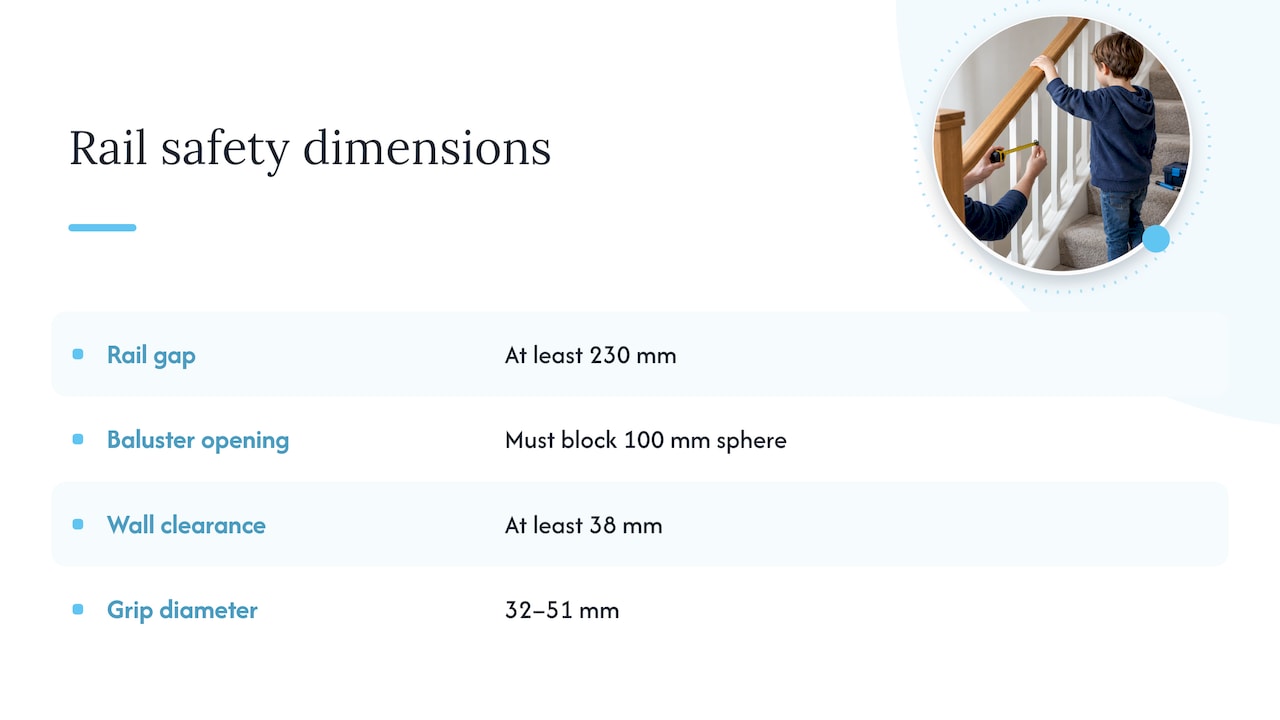
The 100 mm rule for balusters. UK building guidance requires openings in a stair guard to be small enough that a 100 mm sphere cannot pass through, a rule that exists because of infant head entrapment. A child rail sits on the wall side, so it does not change the baluster spacing, but it is a good moment to look at your open spindles and check none of them are wider apart than that.
We also recommend a clearance between the rail and the wall of at least 38 mm (1.5 inches), as US code guidance puts it, so that a small hand can close all the way around. A grippable profile of around 32 mm to 51 mm in diameter is the usual guide for adult rails, and a child’s hand often does better at the smaller end of that.
How long should a child’s handrail be?
A short rail that covers only half the flight leaves the child without support exactly where they would need it. The aim is a rail that begins before the first step, runs along the whole flight and finishes beyond the top step, so a child can take hold before setting off and keep hold until they are standing on flat floor.
One US code guide says handrails should be continuous for the full length of the stairs, with at least one extending 12 inches (about 300 mm) beyond the top and bottom risers. That is written for the main rail, but the principle carries over: continuous, with a little extra at each end.
Measuring the length you need
- Hold a tape along the wall at the angle of the stairs, from the nose of the bottom step to the nose of the top step. That is the sloping length, not the floor distance.
- Add a little at each end if there is room, so the child can take hold before stepping.
- Note any places where the wall changes: a turn, a half landing, a door frame or a radiator.
- Compare the total with the rail’s coverage. Our rail covers up to 348 cm, which suits most straight domestic flights.
If your staircase is longer or has a corner, extension packs add length. The 85 cm and 170 cm extension packs are priced from £24.99 to £36.99, one-off. For wider flights, see our advice on measuring wide stairs and splitting flights over 2.3 m.
Fixing it: wall, bannister or backing board
A child will put their full weight on a rail, sometimes suddenly, so the fixing is more important than the finish. There are three common routes.
- Wall mounting into masonry or a stud. The strongest and the neatest. Locate studs before you drill, and avoid fixing into plasterboard alone. Details are in our guide to wall-mounted child handrails.
- Backing board. Where the wall is thin, uneven or has no studs where you need them, a board fixed across several studs spreads the load and gives a solid base. We explain how to choose between boards of 85 cm or 170 cm.
- Bannister mounting. Possible on some staircases, but it needs a careful measure first. Our page on measuring a bannister before you buy covers the checks.
Whichever you choose, tug hard on the finished rail in several directions before the child uses it. Repeat the check every few months, since fixings can work loose with daily use.
What about stair gates?
A lower rail does not replace a gate. For babies and young toddlers who are not yet confident on stairs, researchers recommend gates at both the top and the bottom of the stairs, and a handrail if there is not one. RoSPA’s advice for under-fives likewise says to use safety gates at the top and the bottom of the stairs.
The two do different jobs. A gate stops access when nobody is watching. A child rail helps once the child is allowed on the stairs, and teaches the habit of holding on. A UK study found that fitting a stair gate was most likely when families were given education, low-cost or free equipment and fitting help, which tells you how often the fitting itself is the sticking point. If that is you, a rail that goes up in under an hour is a lot easier to get done. Our page on pairing gates with teaching shows how to put the two together.
Stairs are one part of keeping a home safe for a young child, alongside things like home safety rules for children at play, so it helps to treat them as a routine and not a single purchase.
Our view on child-height rails
Perspective
We built KiddieRail around a simple observation: a staircase is designed for the tallest person in the house, and the smallest person uses it most carefully and with the least help. A gate keeps a child off the stairs. It does not help a child who has to use them. The right fix is a rail at the child’s own height, and because children grow quickly, the rail has to move. That is why we make ours fully adjustable and tested for durability, so one purchase covers the years from early walking to older childhood.
We would also say plainly what a rail does not do. It does not make unsupervised stairs safe for a baby, and it works best alongside gates, tidy stairs, good lighting and the habit of holding on. Measure twice, fix into something solid, and check the fixings regularly.
— Paul
Where KiddieRail fits
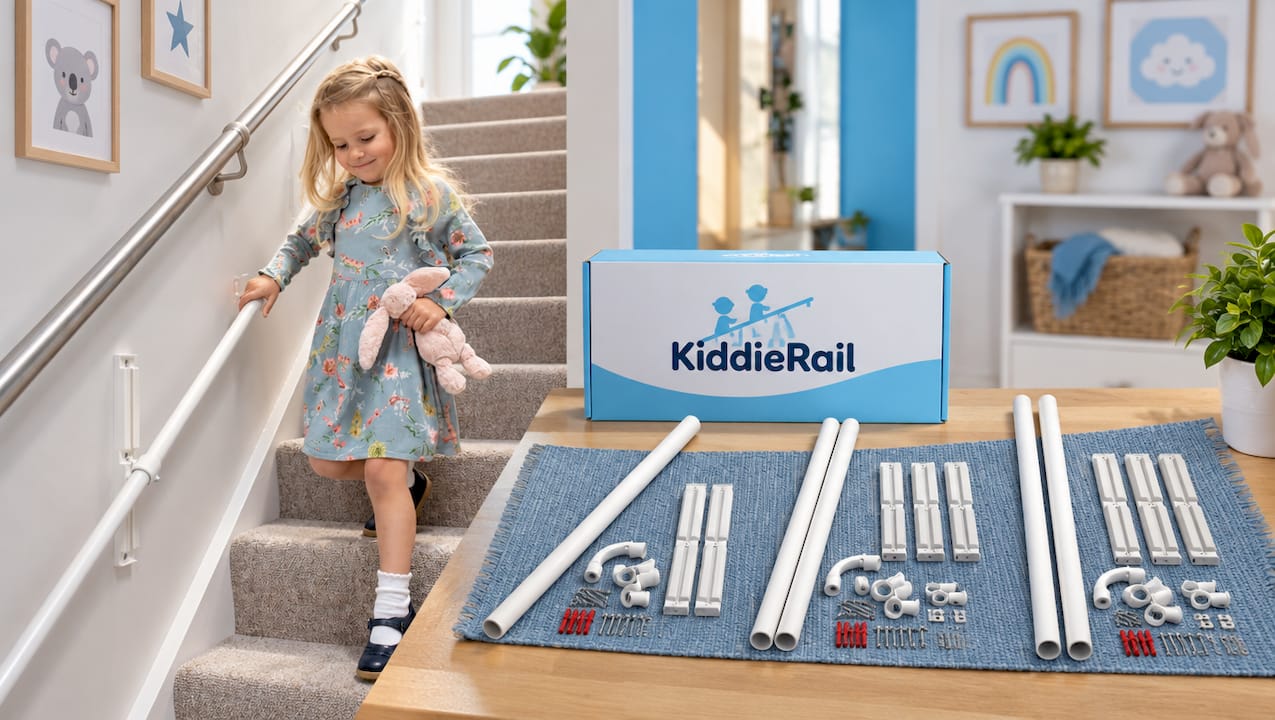
The KiddieRail Adjustable Child Stair Handrail sits below your standard handrail and adjusts as your child grows. It covers up to 348 cm, installs in under an hour and comes with a two-year warranty. It suits straight flights as well as other layouts, with extension packs for longer or wider runs. If you are a childminder, see how we approach stair handrails for childminders and daycare settings.
Other places where a lower rail helps
It is not only family homes. A short-let or holiday property has guests who do not know the stairs, and a permanent rail is a neater fix than a temporary one. See our notes on a 600–750 mm lower rail for rental stairs. Childminders registered to look after children in their own home have the same needs, covered in our guide to childminder stairs safety.
If you are comparing materials, look for a smooth, graspable profile with no sharp edges and no gaps a small head could enter. Our page on handrail materials for kids sets out what to look for. For wider prevention advice, see our child safety on stairs guide for UK parents.
Quick checklist before you fit
- Measure the pitch line and the wall length, and compare with the rail’s coverage.
- Set the rail inside 600 mm to 750 mm above the nosings, then fine-tune to your child’s elbow height.
- Keep about 230 mm between the adult rail and the child rail.
- Check the gap between rail and wall allows a full grip.
- Fix into studs, masonry or a backing board, and tug-test it.
- Keep gates at the top and bottom for babies and young toddlers.
- Re-check the height every few months while your child grows.
FAQ
What is the minimum handrail height in the UK?
For stairs in England, Approved Document K places the top of the handrail between 900 mm and 1000 mm above the pitch line. That applies to the main rail. A second, lower rail for children is an optional addition and has no set UK height in a private home.
How high should a handrail be for a toddler?
The commonly used range for a child’s rail is 600 mm to 750 mm above the stair nosings. Place it around the height of your child’s hand when their elbow is bent at 90 degrees, and raise it as they grow.
Can I fit a child’s rail below my existing handrail?
Yes, provided you leave at least about 230 mm of clear space between the two rails and fix the new one securely into a stud, masonry or a backing board. If your main rail is already low, you may not have room for a safe gap.
How long should a child’s handrail be?
It should run the full length of the flight, ideally starting before the first step and finishing past the top step. Measure along the slope of the stairs and, if your staircase is longer than the rail, add an extension pack.
Sources
- Approved Document K: Protection from falling, collision and impact (GOV.UK)
- RoSPA: accidents to children
- RoSPA: safe at home, under 5s
- ABCB: D3D22 Handrails
- UN Accessibility Design Manual
- 505 Handrails, ABA guidance
- U.S. Access Board: Chapter 5, Stairways
- Westfire Stair Parts: stair codes
- Nationwide Children’s Hospital: stair-related injuries study
- Injury Prevention: stair gate interventions
- Home safety rules for children


