
Currently Empty: £0.00


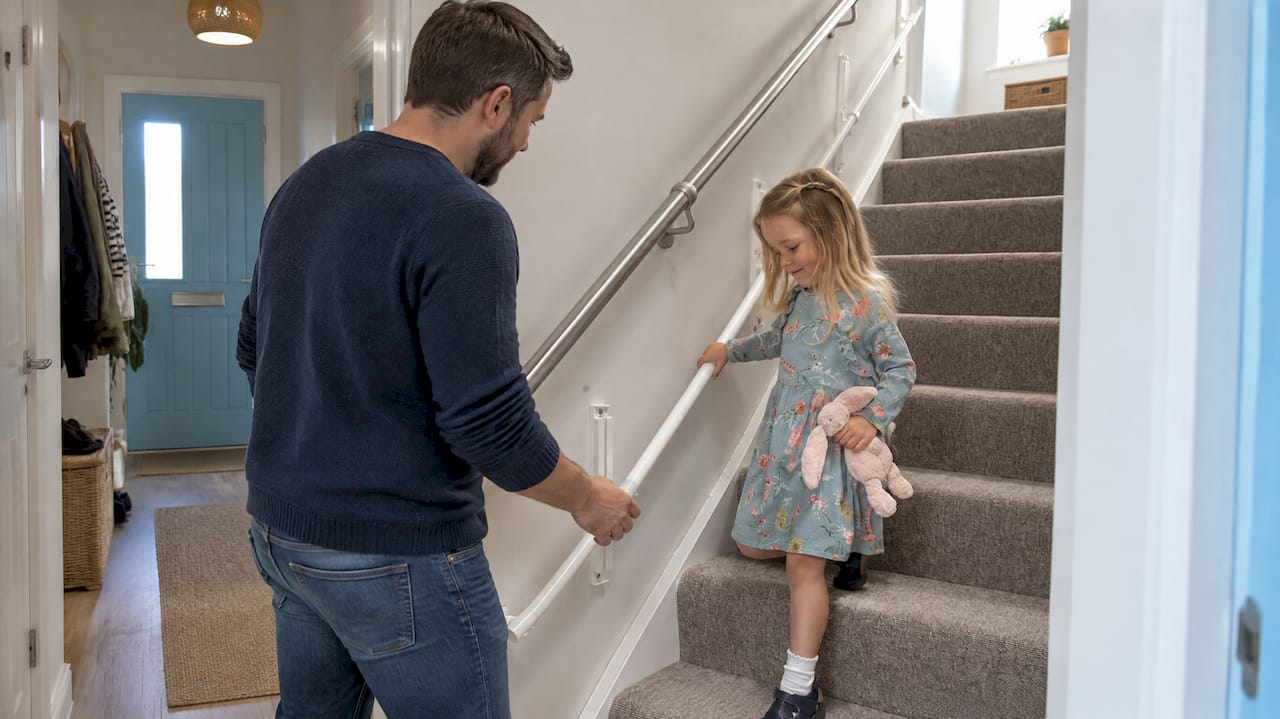
You cannot stop a toddler falling over: it is how walking is learned. What you can do is make the falls that matter less likely and less serious, and stairs are the place to start. The most effective routine combines gates while your child cannot yet manage steps, clear and well-lit stairs, and a handrail your child can actually reach, which is what the KiddieRail Adjustable Child Stair Handrail is designed to provide as it fits below your standard handrail and grows with your child.
TL;DR
- Everyday tumbles are normal development. Falls from height, especially down stairs, are the ones to design your home around.
- Use wall-mounted gates at the top and bottom of the stairs until your child is at least two, then switch to teaching safe climbing.
- Keep stairs clear and well lit, and avoid carrying your child on stairs where you can.
- A standard handrail sits far above a toddler’s reach. A child-height rail gives them something to hold while they learn.
- Windows, furniture and high surfaces need their own fixes: locks, wall anchors and a hand always on the child.
Table of Contents
- Why toddlers fall so often
- Stairs: a routine that works
- Stairs by stage
- The rest of the home
- When a fall needs medical advice
- Who this matters for
- Our view on stair safety
- A handrail that grows with your child
- FAQ
- Sources
Why toddlers fall so often
Toddlers are not clumsy by failure. NHS inform Scotland explains that trips and falls are a normal part of development between learning to walk and starting school, and that young children may fall around 17 times an hour on average. Flat feet, toe walking, knock knees and bow legs are common, normal reasons for falling more.
Body shape plays a part too. Ottawa Public Health notes that babies and toddlers have large heads relative to their bodies, which affects balance and makes falls more likely. Falls also teach: RHCG says they help children learn to get back up, solve problems and build core strength, and that they should reduce with independent walking practice.
So the aim is not a padded life. It is to separate the harmless tumble on the living room carpet from the fall that sends a child to hospital. Most of that second group happen in a handful of places.
Where the serious falls happen
Falls are the most common cause of injury in children taken to hospital, according to the HSE in Ireland, which lists stairs, changing tables, seats, baby walkers, furniture, bunk beds, ladders, windows and balconies as common hazards for ages one to five. The Northern Territory Government adds that for little children, falls are most likely on stairs and with baby furniture such as high chairs and prams.
Stairs deserve the most attention. A paper in AAP News, citing US hospital data, reports more than 900,000 children under five treated in emergency rooms for stair-related injuries between 1999 and 2008, roughly one every six minutes. Most were from falling down the stairs, mainly head and neck injuries and broken bones. These are US figures, but the mechanics of a small child on a steep flight are the same in any country.
In New Zealand, Starship’s Safe as Houses report found that on average 54 children a year were hospitalised for falls on steps and stairs at home between 2014 and 2018, with children aged 0 to 2 making up 44% of them.

Stairs: a routine that works
The guidance from health bodies is consistent. Put together, it makes a routine you can set up in an afternoon.
1. Gate the stairs while your child cannot manage them
NHS Healthier Together advises keeping safety gates at the top and bottom of the stairs until a child is at least two. RoSPA recommends wall-mounted gates for children under 24 months and says gates should comply with EN 1930:2011, the European safety standard for stair gates. Check the fittings regularly.
At the top of the stairs, use a screw-fixed gate. SickKids warns against pressure-mounted gates there, because a child may push them over. Ottawa Public Health suggests pressure-mounted gates are acceptable only at the bottom. Once your child starts trying to climb over, usually around two, the gate has done its job and should come off, as the HSE advises.
If you live in a flat or a house with an unusual layout, our guide to two-minute stair checks and top-gate fixes for apartments covers the awkward cases.
2. Keep the stairs clear and well lit
The AAP advises keeping stairs free of toys and clutter and well lit, and discouraging children from carrying toys up and down. A single shoe on a middle step is enough to cause a fall for an adult carrying a child. We explain what to clear from stairs and why in more detail.
Carpeted stairs reduce injuries, according to the Starship report, but they do not remove the risks: loose edges, worn treads and slippery socks still matter. See what still needs fixing on carpeted stairs.
3. Think twice about carrying your child
This one surprises people. In the AAP’s source data, 25% of stair injuries to children under one happened while the child was being carried down. The AAP advises avoiding carrying a child on stairs where possible and, when you must, carrying nothing else. NHS Healthier Together adds: keep a hand free.
4. Check the railings and banisters
NHS Healthier Together says to cover gaps in banisters or balcony railings wider than 6.5 cm (2.5 inches) with boards or safety netting. RoSPA says banisters should be secure and should not give footholds for climbing. Starship’s report recommends uprights no more than 80 mm apart. If your staircase is open-sided, our practical guide to open staircase child safety goes through the options.
5. Give your child a handrail they can use
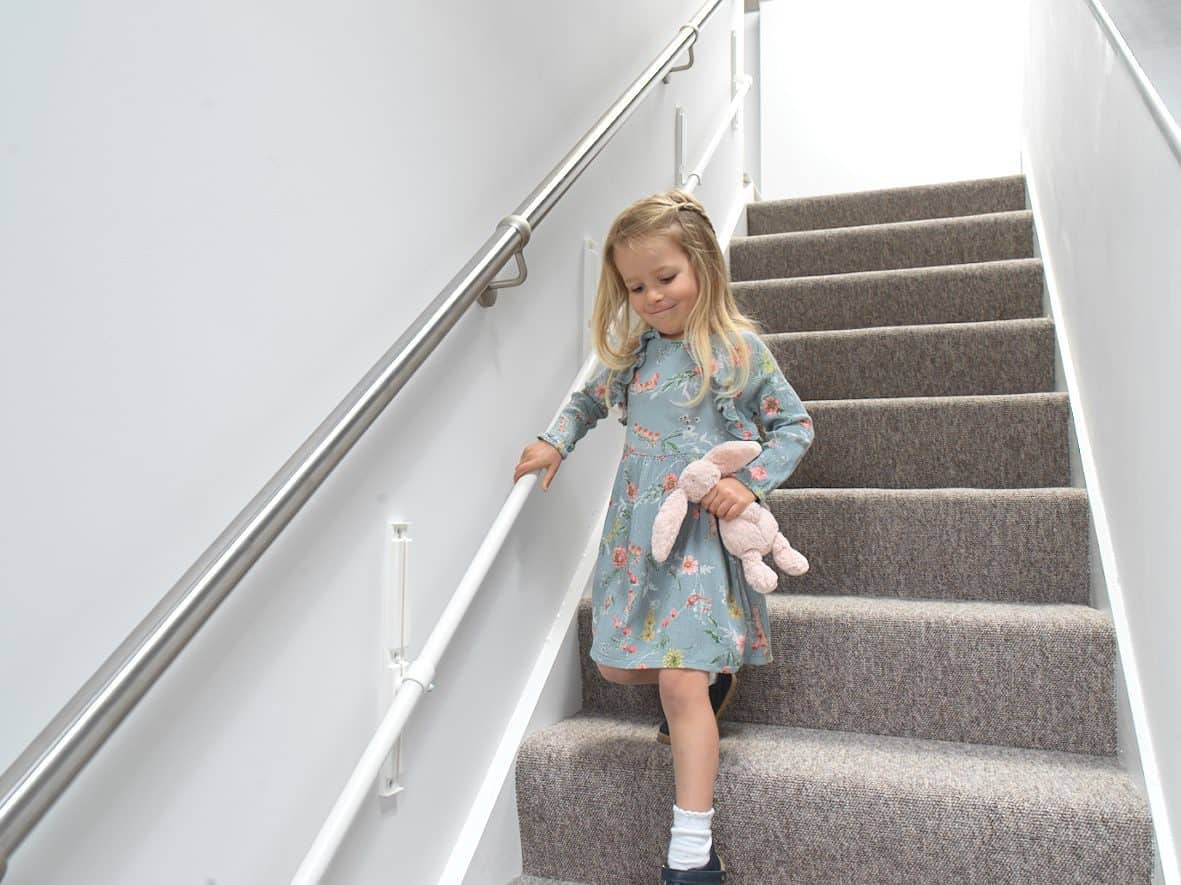
Gates keep a child off the stairs. They do nothing for the day your child is climbing for real. The AAP says to always use the handrail, and Ottawa Public Health advises securing handrails on all stairs and teaching children to use them.
There is a practical problem. A standard handrail in a UK home sits at adult height, well above a toddler’s reach. A child who cannot grip it is climbing unsupported, with nothing to catch at the moment their balance goes.
That is the gap a child-height rail fills. The KiddieRail handrail fits below your standard handrail and is fully adjustable, so the same rail grows with your child. It suits any home staircase layout, and it is designed for straightforward self-installation. For heights and fitting options, see our guide to toddler handrail ideas.
6. Teach, then supervise
Teach your child to go up and down slowly, holding the rail, and that stairs are not for play. Stay close while they are learning. Ottawa Public Health describes active supervision as keeping the child in view and close enough to reach. Our page on pairing gates with teaching shows how to do it in under an hour.
Stairs by stage
| Stage | Main risk | What to do |
|---|---|---|
| Pre-crawling to 6 months | Being carried on stairs, early crawling | Plan ahead: see babyproofing stairs before crawling starts. Keep a hand free when carrying |
| Crawling to first steps | Reaching the stairs unseen | Wall-mounted gates top and bottom, screw-fixed at the top |
| Walking and climbing, around 18 months to 2 years | Climbing the gate, climbing without support | Remove the gate once they try to climb over it. Fit a child-height handrail and teach the routine |
| Two to five | Hurrying, carrying toys, slippery socks | Keep stairs clear. Hold the rail. Supervise |
The rest of the home
Stairs are the priority, not the only place toddlers fall.
- High surfaces. New York State’s health department advises never leaving an infant or young child alone on a high surface, keeping one hand on them, and placing infant seats and bouncers on the floor. It also advises avoiding wheeled baby walkers.
- Windows. The same source recommends locks and window guards that limit openings to four inches on windows above the ground floor, because insect screens will not stop a fall. SickKids gives the limit as 10 cm. Keep furniture away from windows so there is nothing to climb on.
- Furniture and TVs. The HSE advises fixing free-standing furniture and TVs to the wall or floor with brackets or straps, and securing rugs with tape or rubber pads.
- Highchairs and prams. Use the harness every time. The Northern Territory Government recommends five-point harnesses.
- Cots. Lower the mattress and make sure the rails are high enough that a toddler cannot climb out.
If you want to check the whole house methodically, a room-by-room home safety check gives a useful framework for spotting fall hazards you have stopped noticing.
The World Health Organization’s falls guidance points the same way: give parents clear information on fall risks, and support them in reducing hazards at home. It rates home safety measures such as stair gates, window guards and handrail installation as promising, and notes that repeated visits change parents’ behaviour more than a single one. In practice that means revisiting your checks as your child grows, not doing them once.
When a fall needs medical advice
Most bumps are nothing. A child who is acting normally after a fall, with no cuts and little swelling, may not need treatment, says paediatric emergency physician Fahd Ahmad at St. Louis Children’s Hospital. Clinicians are more concerned by falls from a height, such as a changing table, high-speed impacts or impacts on sharp objects.
Seek medical help for a head bump if your child:
- Behaves differently from usual or is unusually sleepy
- Cries for more than 10 minutes
- Vomits
- Has difficulty breathing or passes out
In an emergency, call 999. For anything else you are unsure about, call NHS 111 or your GP.
Falling itself can also be a signal. NHS inform Scotland’s page says to seek advice if falls are new in a previously steady child, if they are one-sided, if they are not reducing as your child gets more practice walking, or if they are getting in the way of development. It also says to seek assessment if a child falls more than 10 times a day or has serious injuries from falls. Your health visitor or GP is the person to ask. Well-fitting footwear can also help, according to RHCG.
Who this matters for
Parents of toddlers and expecting parents. Stair safety is easier to do before the baby moves than after the first scare. Fit gates before crawling starts and plan the handrail for when walking begins.
New homeowners. Look at the staircase first: open sides, wide gaps, steep treads and no handrail on one side are the issues to fix. Our guide to child-friendly staircase design sets out what to get right.
Childminders and caregivers. You are responsible for children of different ages at once, so a rail that works for a two-year-old and a four-year-old matters. See our page on stair handrails for childminders and daycare settings.
Our view on stair safety
Most stair advice stops at the gate. A gate is right for the months when a child cannot yet manage steps, and we would never tell you to skip it. But every child eventually climbs, and when they do, the handrail in your house is at the wrong height for them.
That is why we built KiddieRail: an adjustable handrail designed for young children, which fits below a standard handrail and can grow with the child. A rail that is always at the right height means a small child has something to hold at the exact moment they need it, and the habit of holding on starts early.
The health guidance is clear that handrails matter and that children need to be taught to use them. Our job is to make that possible for a child who is 80 cm tall. Pair gates, a clear staircase and a rail at the right height, and you have covered the stairs properly.
Paul
A handrail that grows with your child
The KiddieRail Adjustable Child Stair Handrail is an award-winning, fully adjustable rail, tested for durability and designed to suit any type of home staircase. You can see the full range in the KiddieRail shop.
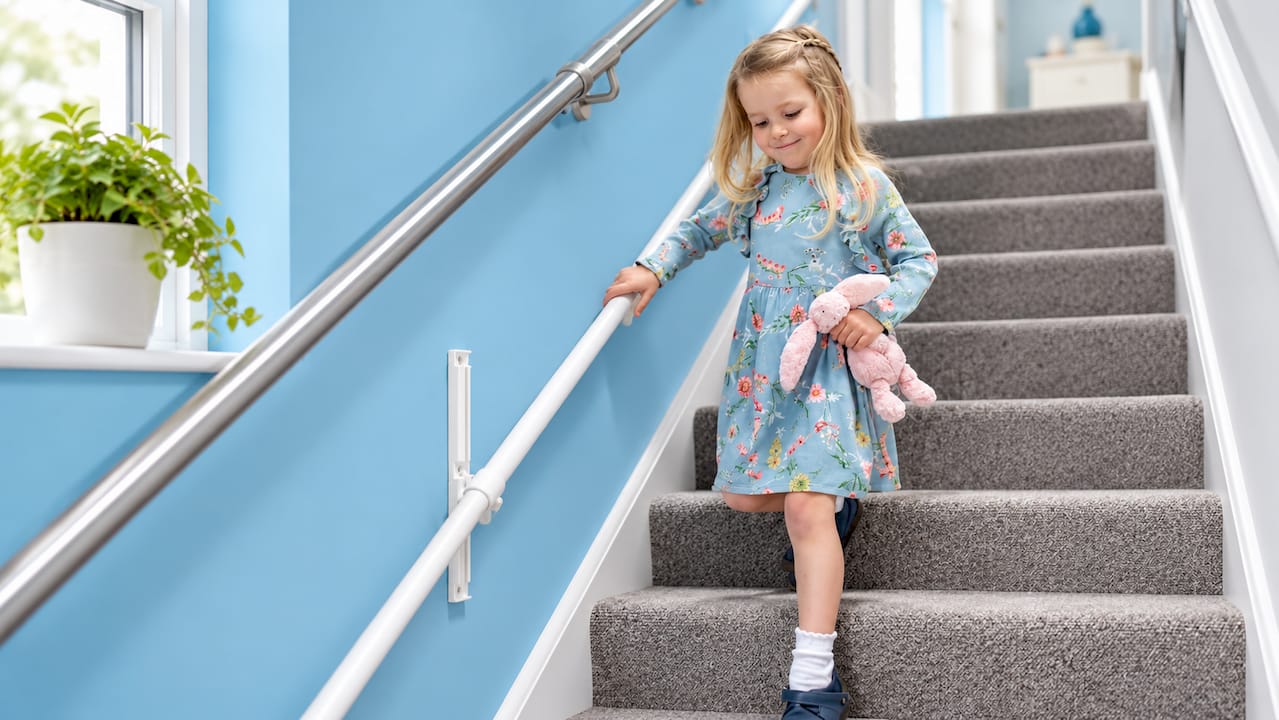
If your staircase is longer or turns, the KiddieRail Extension Pack is available at £24.99 to £36.99, one-off. For more on stair safety in general, read our guide to protecting children on stairs.
FAQ
Why is my toddler always falling over?
It is usually normal. Young children are still developing balance and walking patterns, and their large heads make them top-heavy. Falls should reduce as they get more practice walking. Speak to your health visitor or GP if the falls are new in a previously steady child, one-sided, increasing, or getting in the way of development.
When can I remove the stair gate?
NHS Healthier Together advises keeping gates at the top and bottom of the stairs until your child is at least two. Take a gate away once your child can climb over it, because a climbing child can fall from the top of a gate. From then on, teach safe stair use and make sure they can reach a handrail.
Is a gate enough to keep my toddler safe on stairs?
A gate stops access while your child cannot manage the stairs. When they begin to climb, they need to hold a rail at their own height, a clear staircase and an adult nearby. Combining all of these covers the whole period from crawling to confident walking.
What should I do first if I only have an afternoon?
Fit gates at the top and bottom of the stairs, clear everything off the steps, and check the light. Then look at the banister gaps and the handrail. Window locks and wall-anchoring of furniture can follow the same weekend.
Sources
- Trips and falls in young children, NHS inform
- Child Falls, Ottawa Public Health
- Motor Skill Development, RHCG
- Preventing falls in toddlers and children, HSE
- Children and falls at home, NT.GOV.AU
- Safety pitfalls: Stairs are a leading cause of injury, AAP News
- Safe as Houses, Starship
- Child Safety at Home, NHS Healthier Together
- Preventing Falls in Children, RoSPA
- Home safety: Fall prevention, SickKids
- Fall Prevention for Children, New York State Department of Health
- Strategies for preventing and managing falls, WHO
- Baby Bumps, St. Louis Children’s Hospital
- Elderly safety measures list: 2026 caregiver guide


