
Currently Empty: £0.00


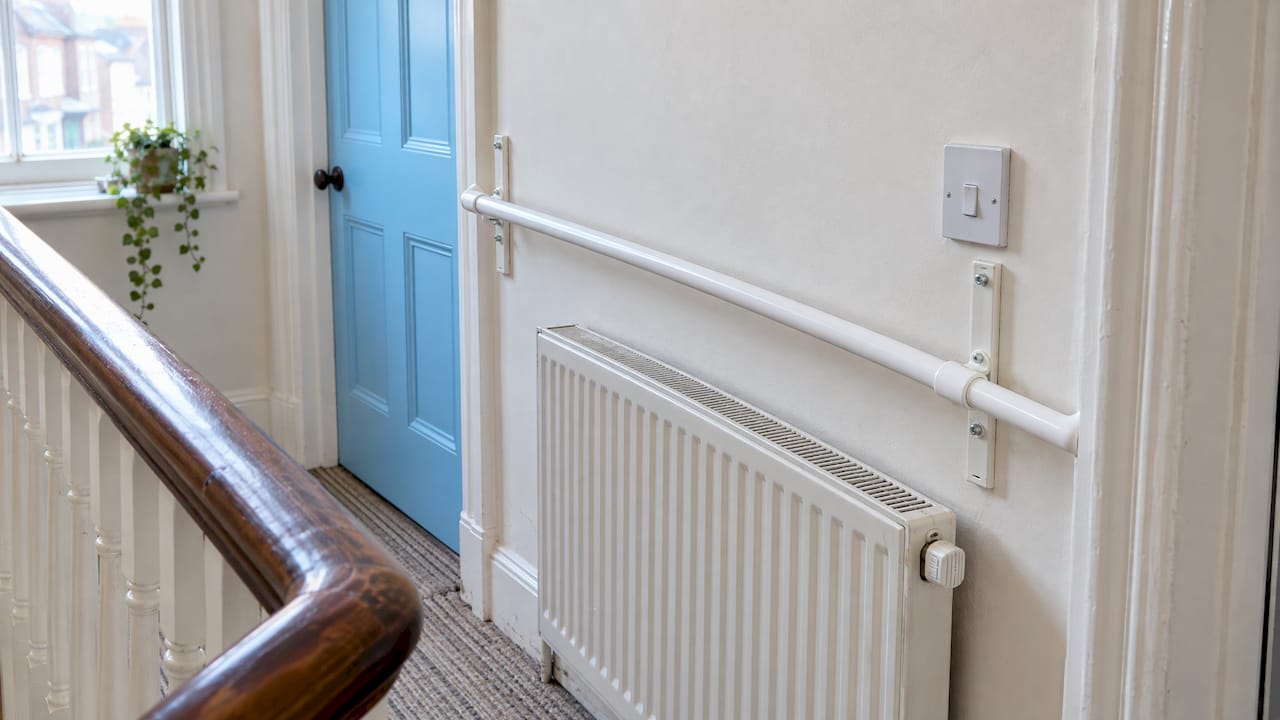
You can fit a child’s handrail past a radiator, pipework or a light switch, but the route needs planning. Keep the rail’s hand-line clear of anything hot, leave the switch reachable, and make the radiator itself safe to touch. This guide shows how to do all three on a typical UK staircase. It also covers when the hot surface, rather than the rail, is the thing to fix first.
TL;DR
- Map the rail’s route before you drill. Mark radiators, pipes, valves and switches on the wall first, then choose where each bracket goes.
- A child holding a rail steadies themselves, and a wobbling child can lean or fall onto what is beside them. Never let the rail’s path put a hand or an elbow against a hot surface.
- Most standard steel panel radiators can reach 75 °C, so guard or cover radiators and pipes within a toddler’s reach on the stairs and landings.
- Keep light switches clear and easy to reach. Run the rail past them rather than across them.
- Never box a radiator in with a sealed cover. Heat needs to circulate, and electric heaters often carry a “do not cover” instruction.
Table of Contents
- Why radiators and rails need to be planned together
- Planning the rail route past a radiator
- Light switches: run the rail past, not across
- Making the radiator itself safe to touch
- Special care in childminding and daycare settings
- Our view: plan the rail around the home, not the home around the rail
- Fit the rail that grows with your child
- More stair safety steps for the same visit
- FAQ
- Sources
Why radiators and rails need to be planned together
Stairs, landings and hallways are where a radiator, a handrail and a light switch all end up within a few feet of one another. A toddler on the stairs is holding on, reaching for the wall and sometimes tripping. Anything within arm’s length of that path will get touched.
The risk from hot surfaces is real and recent. The Children’s Burns Trust reports that 117 children were admitted to an NHS burns service in 2025 with burns from a central heating radiator. That figure excludes children treated in A&E. The same page says pipes, radiators and towel rails are common causes of burns and scalds.
Health and Safety Executive guidance says that where vulnerable people may have prolonged contact, hot surfaces should be designed or covered so they do not exceed 43 °C. It also notes that prolonged contact often happens when people fall or get trapped by furniture. That is exactly the situation on a staircase: a child who slips may not be able to pull away at once.
A child’s rail is there to prevent that fall in the first place. The sensible approach is to treat the rail, the radiator and the switch as one layout and plan them together.
Planning the rail route past a radiator
Start with a walk of the staircase at a child’s height. Crouch down and look at what a three-year-old would see and touch. Then work through these steps.
- Mark everything on the wall. Use masking tape for radiators, pipe runs, valves, thermostatic heads, switches and sockets. Mark where the adult handrail sits too, because a child rail fits below it.
- Choose the side with the least heat. If you have a choice of wall, fit the child rail on the side away from the radiator or pipework. Many staircases have only one wall that suits, in which case the next steps matter more.
- Keep the hand-line clear. A child holds a rail with the whole hand, thumb underneath. Leave enough space that fingers and knuckles do not brush the radiator or a pipe as they slide along.
- Place brackets where there is solid fixing, not where it is convenient for the pipe. Check behind the wall for pipes and cables before you drill. Our guide to how far apart to fix child rail brackets covers spacing so the rail stays firm along its length.
- Check the height for your child. The right height is the one that suits their hand, not the nearest convenient wall point. See handrail height for kids on UK stairs for what works in practice.
- Test the route with the radiator on. Run the heating, then walk the stairs. Feel the wall surface, pipework and valve with the back of your hand. Anything uncomfortably warm in the child’s reach needs a guard or insulation.
Where a radiator sits at the bottom or top of the stairs, the rail often needs to stop short of it or run level above it. If that leaves a gap in the support, an extension piece lets you continue the rail on a clear stretch of wall further along. We make extension packs for exactly that kind of staircase layout.
Pipes and radiator valves
Pipes and valves are often the part a child grabs first, because they are at hand height and easy to hold. They are also easy to forget. The CDC’s study of home radiator burns in Chicago found that 79% of units with more than one child burned had missing radiator covers or pipe insulation. It also notes that children’s skin is probably more susceptible to thermal injury than adults’ skin. That study is from the United States in the 1990s and concerned steam radiators, but the point about unprotected pipes and valves holds anywhere.
For valves and pipes beside a rail, you have two practical options:
- Lag or cover exposed pipework so the surface a child can touch is not hot.
- Move the rail route so that the child’s hand never passes within reach of the valve.
HSE guidance also lists covering exposed pipework and keeping controls in good order among the ways to reduce burn risk.
Light switches: run the rail past, not across
The keyword people type for this is often “handrail around light switches”, and the answer is simple: do not build the rail around the switch, and do not let the switch force the rail off course. Hall and landing switches are used by every member of the household, and a child can usually reach one at bedtime if it is clear.
Practical guidance:
- Run the rail below the switch plate. Where the switch sits above the rail’s line, nothing needs to change. Where it sits at the same height, shift the rail slightly or end it just before the switch and carry on with an extension piece afterwards.
- Keep a clear finger space. Leave enough room to press the switch without knocking knuckles on a bracket.
- Never fix a bracket through or too close to the switch box. Cables run to and from the box, usually vertically. Check with a detector, and if in doubt ask a qualified electrician before drilling near switches or sockets.
- Think about the child’s own reach. Lighting makers suggest a child’s bedroom switch should be within easy arm’s reach, so a child does not have to stretch or climb. For reference, advisory reach ranges in the 2019 California Standards for Accessible Design give a high reach of 36 inches (915 mm) for ages 3 and 4. That is a US standard, not UK regulation, but it shows how low a small child’s comfortable reach is.
If you are moving a switch box as part of wider work, a registered electrician should do it. A guide on how renovation increases home safety in older homes is a good starting point if you are planning bigger changes to an older house.
Making the radiator itself safe to touch
A rail guides a child’s hand to the right place, but a hot radiator within reach is still a hazard if they stumble. Fix both.
Guards and covers
A proper guard or cover places a barrier between the child and the hot metal and removes sharp edges. It should be securely fixed to the wall so it cannot be pulled over. It also must let heat out. Look for a slatted or meshed front and a gap at the base and top. A fully sealed solid box traps heat, so avoid it.
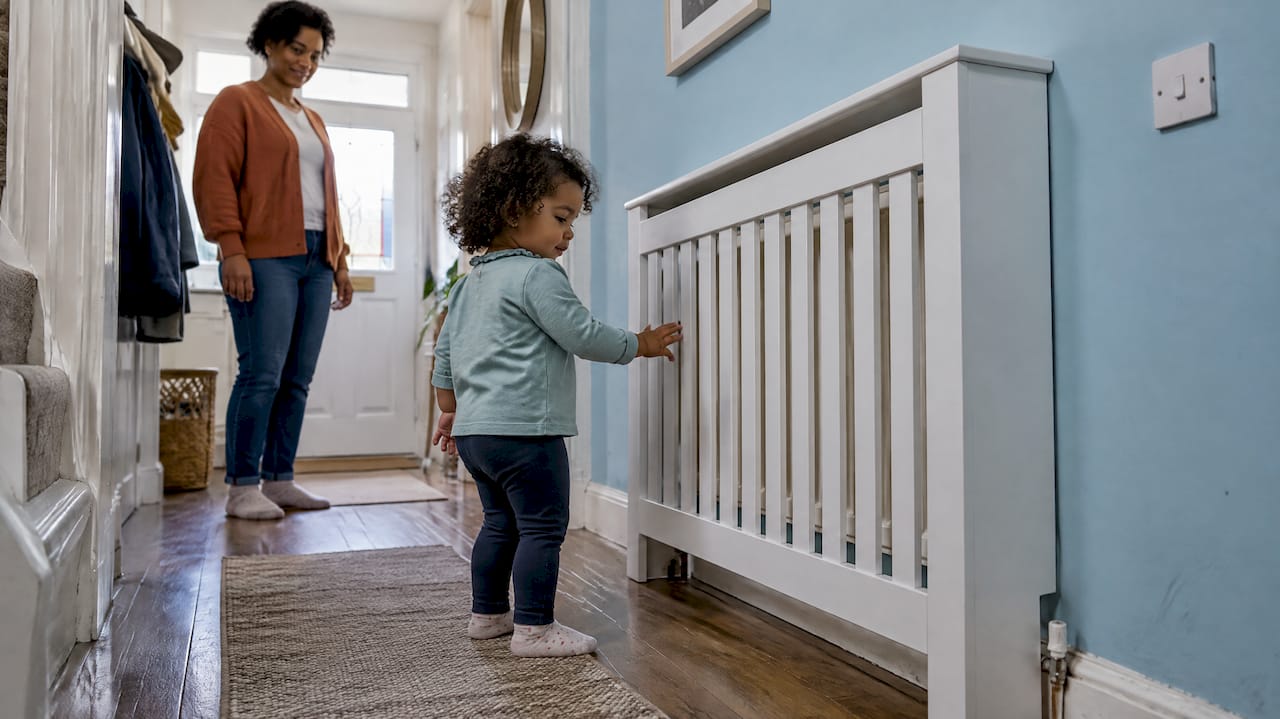
A guard reduces the chance of burns. It does not replace watching small children near heat. Keep an eye on them whenever they are near a radiator, guard or not.
Turn it down
NHS children’s health guidance for Devon recommends turning down the radiator thermostat and ventilating with small windows or window restrictors to reduce the risk of burns. Thermostatic radiator valves let you cap the temperature on the stairs and landing, which are often warmer than they need to be anyway. If you are comparing heating set-ups and what temperatures suit a home, this home heating temperature guide is written around California homes, but the principle of setting sensible temperature controls travels.
Low surface temperature radiators
Low surface temperature (LST) radiators are built so their surface does not go above 43 °C. Dimplex explains that LST panel heaters are made to meet that limit, a requirement of UK legislation for schools and care homes, and notes that standard electric panel heaters can reach 60 °C to 80 °C. If you are replacing a radiator on the stairs or in a child’s bedroom, an LST model is worth considering.
Electric radiators
Electric radiators are different. Many have thermal limiters, adjustable surface temperature settings and child locks, according to one UK supplier’s guidance. Because that comes from a retailer’s blog, check your own model’s manual. The most important rule is that many electric radiators and towel rails carry a clear instruction not to cover them, so never fit a cover or enclosure without reading the maker’s instructions first.
Special care in childminding and daycare settings
If you mind children in your home, the same layout thinking applies, with more children and more movement. Several children going up and down together raise the odds of someone leaning against the wall. Check the route at the busiest times of day, and make sure the guard on the radiator is fixed securely, not simply stood in place. Our pages on stair handrails for childminders and daycare settings and child rail measuring and fitting for childminder stairs go into detail.
Our view: plan the rail around the home, not the home around the rail
We designed KiddieRail so that a child gets a handrail at their own height, and so it can grow with them. That matters most in the real homes where stairs are awkward: a radiator at the bottom, a pipe run up the wall, a switch exactly where you want to fix a bracket.
Our advice is always the same. Walk the stairs first, mark what is in the way, and fit the rail so that the child’s hand has a clear, steady line. Where the wall is interrupted, our extension packs let you continue the rail on a clear section rather than compromising the route. The rail is fitted below a standard handrail and is built for straightforward self-installation, so you can adjust the plan as you go.
Then deal with the heat. A guard on the radiator, lagged pipes and a sensible thermostat setting do their part, and the rail does its: it gives a toddler something to hold so they are less likely to stumble in the first place. A rail that lets a child climb confidently is a better answer than a gate alone, because it supports them while they learn.
Paul
Fit the rail that grows with your child
If your stairs have a radiator, pipes or switches to work around, the KiddieRail Adjustable Child Stair Handrail is designed to fit below a standard handrail on any home staircase layout. For longer or more awkward runs, the extension packs are priced from £24.99 to £36.99, depending on length. Choose between the 85 cm extension and the 170 cm extension.

Browse the full range in our shop.
More stair safety steps for the same visit
While you have the tape measure out, it is worth checking the rest of the staircase. Our stair childproofing guide and babyproofing checklist cover gates, anchors and the order to do things in. For flats and shorter flights, the apartment stairs advice is a quick read, and our general stair safety advice for UK parents puts it all together.
FAQ
Can a child’s handrail run directly beside a radiator?
It can, as long as the child’s hand never touches the radiator or its pipes as it slides along the rail. Leave a clear gap, guard the radiator and check the route with the heating on. If you cannot get a safe gap, end the rail before the radiator and continue it beyond with an extension piece.
Do I need a radiator cover if I fit a child rail?
The two do different jobs. The rail supports the child on the stairs, while a guard or cover stops contact with hot metal if they stumble or reach. Most standard steel panel radiators can reach 75 °C, so a guard is sensible for any radiator within a toddler’s reach.
Is it safe to cover an electric radiator?
Not without checking the manual first. Many electric radiators and towel rails carry a “do not cover” instruction, and an enclosure can block airflow. Follow the maker’s safety instructions, or choose a low surface temperature model if you want one that stays cooler to the touch.
How do I avoid drilling into pipes or cables?
Use a pipe and cable detector, and avoid drilling directly above or below switches, sockets and radiator pipework, since cables and pipes often run vertically from them. If you are unsure, ask a qualified electrician or plumber before you fix anything near them.
How hot is too hot for a child to touch?
HSE guidance uses 43 °C as the maximum accessible surface temperature where vulnerable people may have prolonged contact. Many ordinary radiators exceed that, which is why guards, lagging and lower thermostat settings matter in rooms and hallways children use.
Sources
- Radiators, Children’s Burns Trust
- Managing the risk from hot water and surfaces, HSE
- Home Radiator Burns Among Inner-City Children, CDC
- Ways to make your home safer for your children, Children and Family Health Devon
- Child-safe radiator covers and airflow
- What is a low surface temperature radiator? Dimplex
- Do electric radiators need childproofing?
- How kids can use light switches safely, Legrand
- 2019 California Standards for Accessible Design, reach ranges
- Heating temperatures for California homes
- How renovation increases home safety in older homes


