
Currently Empty: £0.00


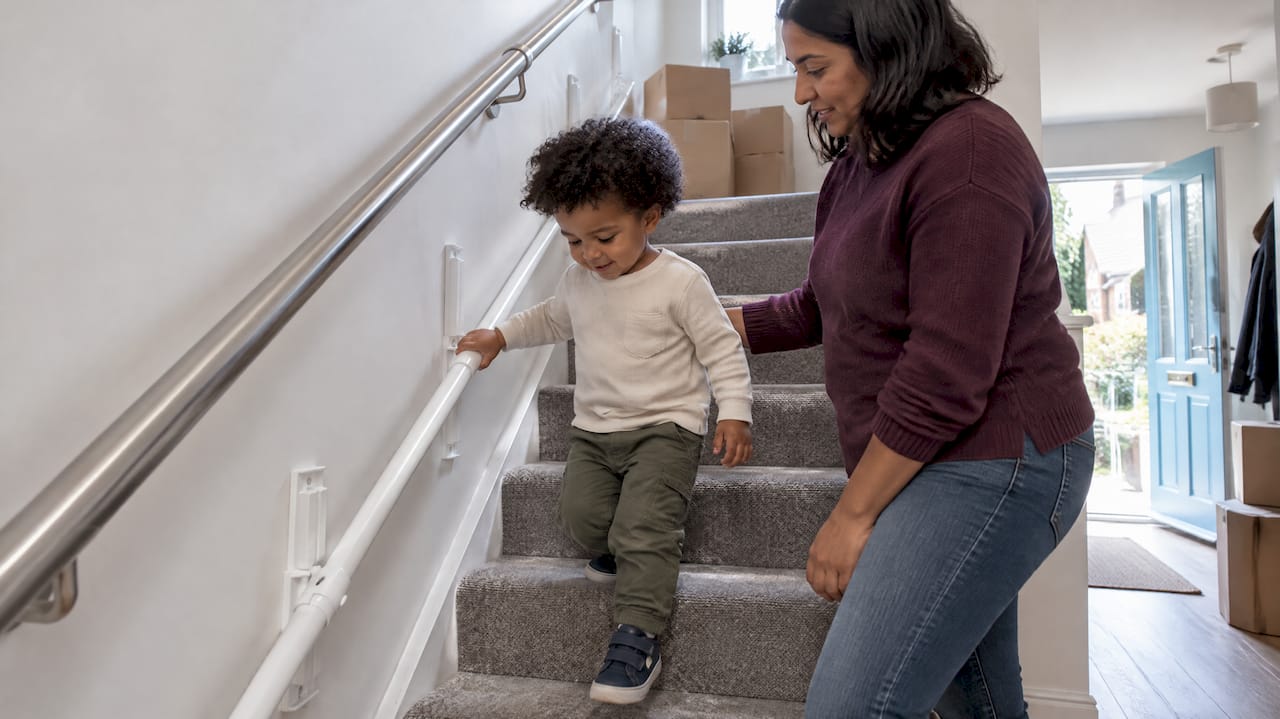
The stairs are the one part of a new home your toddler has never met, and the one part that can hurt them most. Before the removal van arrives, check the staircase for loose rails and worn treads, fit gates where your child is under two, and give them a handrail they can actually reach. A child-height rail such as KiddieRail sits below the standard handrail, so a small hand has something to hold from the first day.
This guide covers both halves of the move: keeping a toddler settled, and making the new staircase safe before they climb it.
TL;DR
- Inspect the new stairs before moving day: rails, treads, carpet, lighting and the gaps between spindles.
- For under-twos, RoSPA advises wall-mounted gates at the top and bottom of the stairs.
- A standard handrail is too high for a toddler. A child-height rail lets them practise holding on as they learn to climb.
- On moving day, keep your toddler with a trusted adult away from the busy house, and pack their things last and unpack them first.
- Keep routines and comfort objects steady for the first weeks. A settled toddler is easier to supervise on new stairs.
Table of Contents
- Why the stairs matter most in a new home
- Before moving day: inspect the staircase
- What your toddler can manage on stairs, and when
- Gates, rails and supervision: what each one does
- Fitting a child-height handrail in the new house
- Moving day: keeping your toddler safe and settled
- Helping your toddler settle in
- Your first week on the stairs: a simple routine
- A handrail your toddler can use from the first day
- Our view: fix the stairs before the sofa
- FAQ
- Sources
Why the stairs matter most in a new home
In your old house, your toddler knew the stairs. They knew which step was awkward and where the rail was. In a new home, none of that carries over, and you are distracted by boxes, keys and removal crews.
RoSPA says stairs are one of the most common places for serious falls, particularly for toddlers and young children, and that the risk rises when adults carry a child up or down. A move combines unfamiliar stairs, tired parents and a lot of clutter. That is why the stairs deserve attention before almost anything else.
The good news is that the job is small. You can do most of it in an evening, ideally before the family sleeps there for the first time.
Before moving day: inspect the staircase
If you can, visit the empty house once with a notebook. Empty rooms make defects easy to see. Walk the stairs slowly, then do it again at toddler height, as Ottawa Public Health suggests: get down to your child’s level to see hazards the way they do.
Use this checklist, drawn from KidsHealth’s household checklist and the CHKD hallway and stairwell checklist:
- Handrails and banisters: secure, not loose or splintery, and running the full length of the stairs.
- Treads: not cracked, uneven, worn or loose.
- Carpet and runners: firmly fixed down, with no loose edges. Our guide to carpeted stairs and toddler safety covers what still needs fixing even when the carpet looks sound.
- Gaps: the guidance in these checklists is spindle or slat gaps of less than 3 to 4 inches, so a child cannot slip through or get trapped. NACHI, a home inspectors’ body, lists balusters spaced more than 4 inches apart as a defect.
- Treads and risers: risers of uneven height, missing or worn nosing and sharp corners are all on the same inspectors’ list.
- Lighting: a well-lit stairwell, with a switch at both the top and bottom if possible.
- Doors: a door to a cellar or loft stairs that can be closed and kept shut.
UK homes vary a great deal. Older houses may have steep, narrow flights and open spindles, while newer builds follow current rules. If you want to understand what a standard staircase should measure, this explainer on UK staircase regulations and dimensions is a useful companion for the inspection.
If you are buying, note anything that needs repair and raise it early. A loose newel post or a wobbly rail is a job for a builder, not a quick fix on moving day.
Open staircases and wide flights
Two layouts need extra thought. Open-sided stairs and wide flights leave gaps a standard gate does not cover. Our guides to open staircase child safety in UK homes and fitting a gate to wide stairs with panels and a child rail walk through each situation. If you are moving into a flat, the two-minute stair sweep for apartments is the quick version.
What your toddler can manage on stairs, and when
Stair safety changes with age, so match what you fit to where your child is. Parents Canada’s developmental milestones give a typical pattern:
| Age | Typical stair skill |
|---|---|
| 13 months | Climbs stairs on all fours |
| 18 months | Walks upstairs with some help |
| 21 months | Walks downstairs if a hand is held |
| 24 months | Goes up and down holding the rail or wall |
| 30 to 36 months | Uses alternating feet |
Children develop at their own pace, so treat these as a guide, not a deadline. The point is that between roughly 18 and 36 months your toddler is learning to use stairs, and the thing they need to hold is the handrail. In most homes that rail sits at adult height, well above a toddler’s reach. Our page on toddler handrail ideas, heights and safe fitting goes into the options.
Gates, rails and supervision: what each one does
No single device does everything, and the official guidance is consistent about this.
Gates keep the youngest children off the stairs. For under-twos, RoSPA advises wall-mounted gates at both the top and bottom of the stairs, checked against EN1930:2011, fitted to the maker’s instructions and checked regularly to make sure the fittings stay secure. The same page says to fit gates before a baby becomes mobile. If your child is still small, our guide to babyproofing stairs before crawling starts covers the early stage.
A few practical points on gates from the health bodies:
- Use a gate that screws into the wall at the top of the stairs. Ottawa Public Health accepts a pressure-mounted one only at the bottom.
- Nationwide Children’s Hospital says to mount gates less than 3 inches from the floor so a child cannot crawl under, and to use extenders for odd-shaped openings.
- Avoid accordion-style gates that can trap a head, as Nemours KidsHealth warns.
- Always open a gate rather than stepping over it, Raising Children Network notes.
A handrail at the right height teaches safe climbing. A gate stops access. It does not help a child who has learned to climb and now needs to do it safely. This is where a child-height rail comes in. Ottawa Public Health advises securing handrails on all stairs and teaching the child to use them, and a toddler cannot use a rail they cannot reach.
Supervision ties it together. Nemours KidsHealth says never to leave a child alone around stairs even when gated, because babies can climb the gate and fall from a greater height. Stay close while your child is learning.
Fitting a child-height handrail in the new house
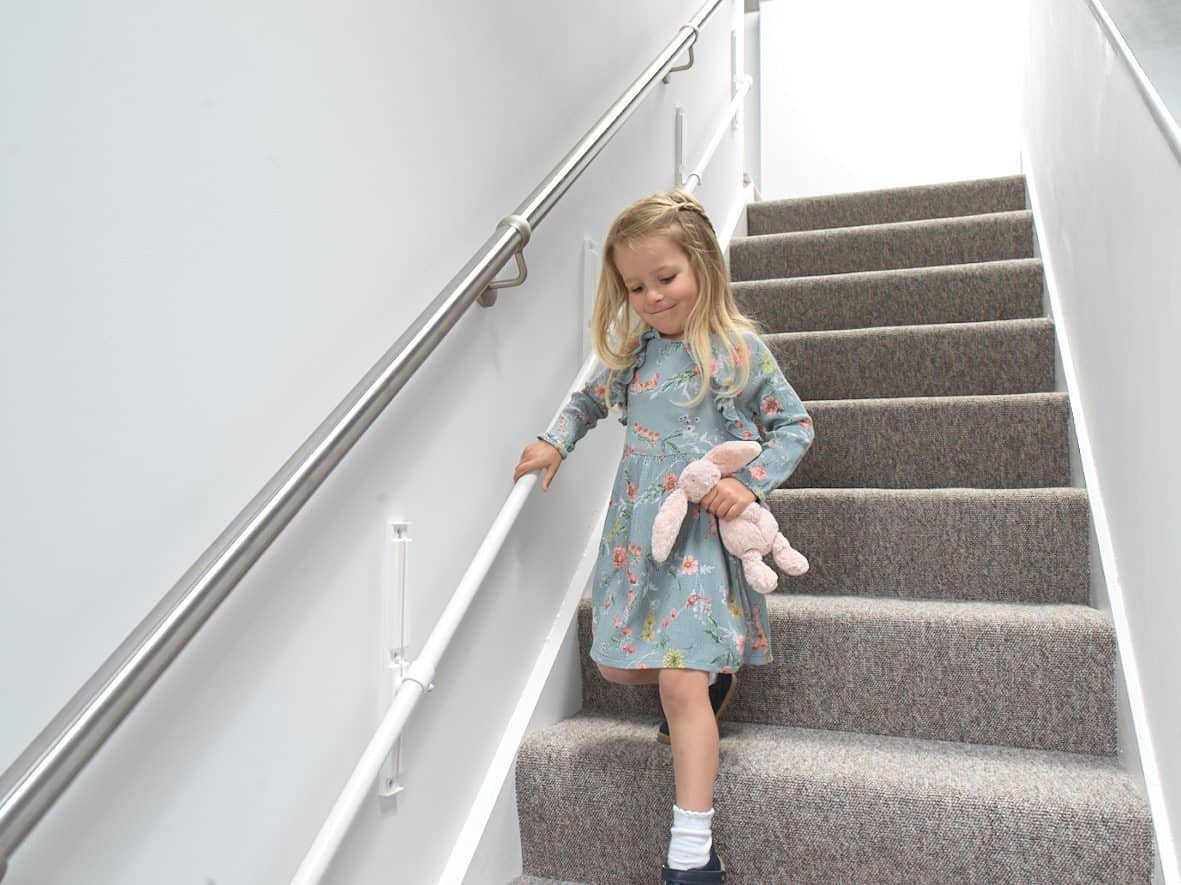
A new house is a good moment to fit a child rail, because you are already deciding where everything goes. The rail fits below the standard handrail, and our product is designed for any home staircase layout and for straightforward self-installation.
A sensible routine:
- Check the main handrail first. The rail you fit alongside it is only as good as what it sits beside, so deal with anything loose before fitting.
- Measure the flight. Note the length of the staircase and whether there are turns, landings or winders. Extension packs are available if your flight is longer or more complex.
- Fit it before the first night. Do it while the house is empty or half-empty, when stairs are clear and nobody is carrying furniture up them.
- Walk it with your toddler. Show them where the rail is and let them hold it while you stay close, on the way up and the way down.
- Re-check after the first week. Fittings can settle. RoSPA’s advice to check gate fittings regularly applies to anything fixed to a wall or banister.
The KiddieRail is adjustable, so it is designed to grow with your child instead of being replaced as they get taller. That suits a move well, since you are buying for the next few years in one house rather than the next few months.
Moving day: keeping your toddler safe and settled
Moving day is when stairs are at their worst. They are busy with strangers, full of boxes and crossed by people who are not looking down. Texas Health warns that moving day can be dangerous for an active toddler and suggests keeping them with a supervised caregiver or relative outside the home.
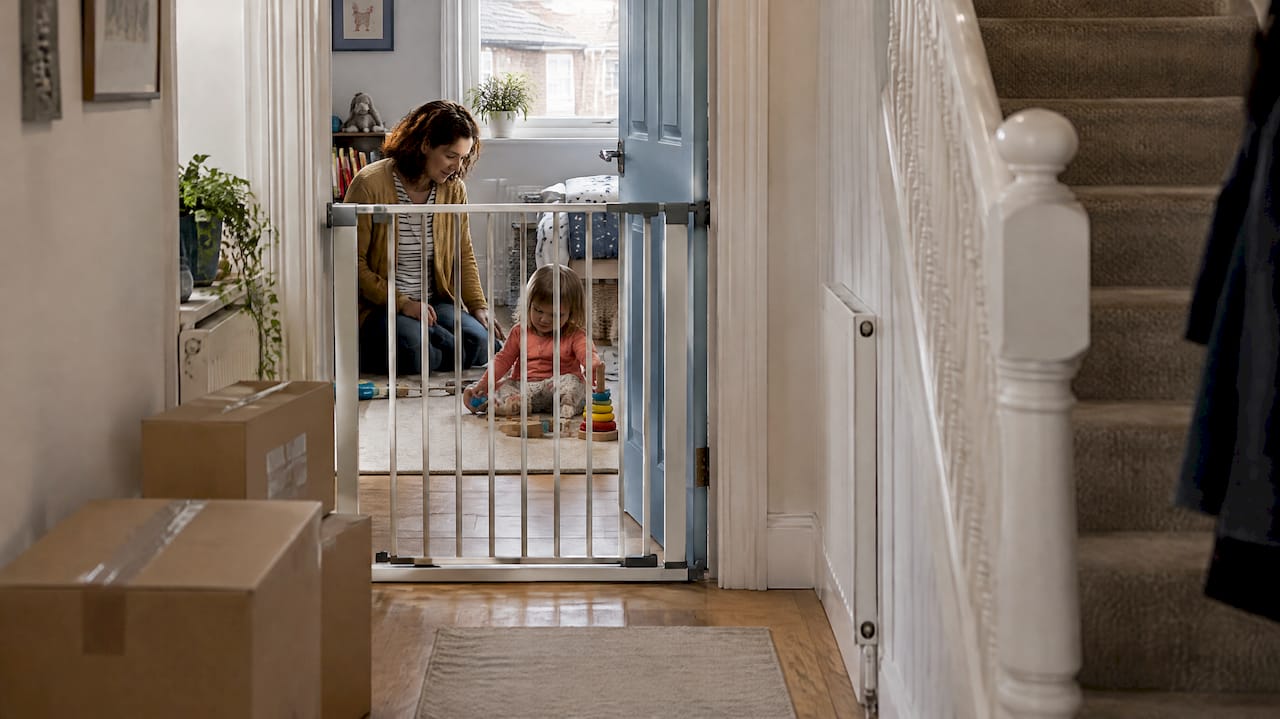
If that is not possible, set up one safe room in the new house, with a closed door and the gate on, and keep your child there with a familiar adult. Clear the stairs as you go. Boxes left on steps, even for a moment, are a trip hazard for you and for anyone climbing after your toddler. Our guide to stair clutter and toddler safety lists what to clear and why.
Also, mind how you carry them. RoSPA notes that risk increases when adults carry children on stairs, and advises using the handrail and keeping one hand free where possible. Raising Children Network suggests a baby carrier when carrying a child downstairs so a hand stays free for the banister. Avoid socks and slippers on the stairs, since they cause slips.
Helping your toddler settle in
A child who feels secure is easier to guide and less likely to bolt for the stairs out of curiosity or distress. The British Psychological Society (August 2026) describes preparation as one of the most effective ways to reduce moving anxiety. Its suggestions are practical:
- Talk about the move well in advance, in simple words, and encourage questions.
- Visit the new home and neighbourhood beforehand if you can.
- Keep mealtimes and bedtime rituals regular.
- Unpack the child’s bedroom first so they have a familiar space from the first night.
- Keep checking in afterwards, naming and accepting their feelings.
The BPS also explains that a favourite teddy, blanket or comforter matters more than usual during a move, because it stands for continuity when much else is unfamiliar. Keep it with you, not in a box on the lorry.
Give your toddler a job too. Zero to Three says helping to pack and unpack feels empowering for young children, and suggests a box of their own with safe, non-breakable things. It keeps small hands busy and away from the stairs.
Your first week on the stairs: a simple routine
Build the routine into the first few days, not the first few weeks.
- Day one: gates on, rail fitted, stairs clear, lights working.
- Every evening: a quick sweep for toys, shoes and loose items. Our page on pairing gates with teaching to make stairs safer in under an hour gives a short version.
- Every climb: your child holds the rail and you stay within reach.
- At the bedroom door: consider a gate here too, as Nemours KidsHealth recommends, so a toddler waking early cannot wander to the stairs.
- When your child outgrows the gate: remove it once they try to climb over it or reach the age the manufacturer sets, usually around two, as Ottawa Public Health notes. Keep the handrail, which carries on doing its job.
For a wider view of the whole staircase, our guide to child-friendly staircase design and the broader stair safety for toddlers page are good next reads.
A handrail your toddler can use from the first day
The KiddieRail Adjustable Child Stair Handrail fits below a standard handrail, so your toddler has something to hold at their own height, and it adjusts as they grow. It suits any home staircase layout and is designed for straightforward self-installation, which makes it a job you can finish before the first night in the new house. You can see it in the KiddieRail shop.
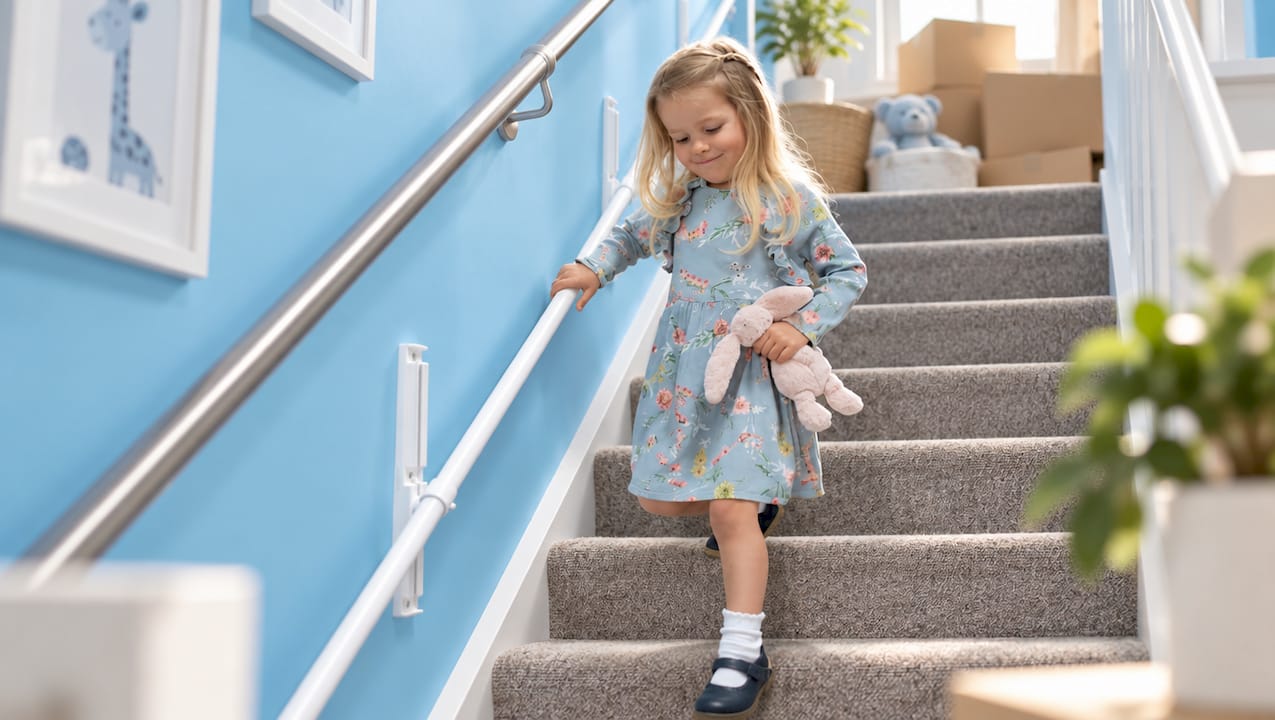
If your staircase is long or has several sections, the KiddieRail Extension Pack is priced from £24.99 to £36.99 as a one-off purchase. Unlike a gate, which blocks the stairs, the rail actively supports a child while they walk on them.
Our view: fix the stairs before the sofa
Most parents we speak to plan a move around the removal van, the school run and the broadband. The staircase comes last, if at all.
We would put it first. Stairs are where a toddler’s new independence meets a home they do not yet know, and a handrail that sits at adult height gives them nothing to hold. That is why we designed KiddieRail to sit below a standard handrail and adjust as your child grows. It is meant to be a long-term fix, not something you replace at every birthday.
Gates have their place for the youngest children, and we would never tell you otherwise. But a gate only blocks the stairs. Sooner or later your child has to learn to climb them, and we believe they should learn with a rail they can reach. Fit it in the first days, walk the stairs together, and the house starts to feel like theirs.
Paul
FAQ
How do I make a new house safe for a toddler before we move in?
Start with the stairs. Check the rails, treads, carpet, lighting and spindle gaps, then fit gates where your child is under two and add a rail at toddler height. Do it while the house is still empty, before the first night.
What age can toddlers go up and down stairs?
Typically, toddlers climb on all fours by about 13 months and walk upstairs with help by 18 months. By about 24 months many go up and down holding a rail or wall, according to Parents Canada. Every child differs, so keep supervising until your child manages confidently.
Should I unpack my toddler’s room first?
Yes. The British Psychological Society recommends unpacking the child’s bedroom first so they have a familiar space from the first night. Keep bedtime rituals and comfort objects the same too.
Do I need a gate if I fit a child handrail?
For children under 24 months, RoSPA advises wall-mounted gates at the top and bottom of the stairs. A child rail helps a toddler who is learning to climb, and the two do different jobs. Once your child can manage the stairs and tries to climb the gate, take the gate down and keep the rail.
Sources
- RoSPA: Preventing Falls in Children
- Ottawa Public Health: Child Falls
- KidsHealth: Household checklist, walls, floors and stairways
- CHKD: Hallway and Stairwell Safety Checklist
- NACHI: Stairway Inspection
- UK staircase regulations and dimensions
- Parents Canada: Toddler milestones
- Nationwide Children’s Hospital: Home Safety Series, Stairs and Hallways
- Nemours KidsHealth: Preventing Injuries From Falling, Climbing, and Grabbing
- Raising Children Network: Falls prevention
- Texas Health: Preparing Your Child for a Move
- British Psychological Society: The psychological impact on children when moving house
- Zero to Three: Help Your Child Deal With Relocation


