
Currently Empty: £0.00


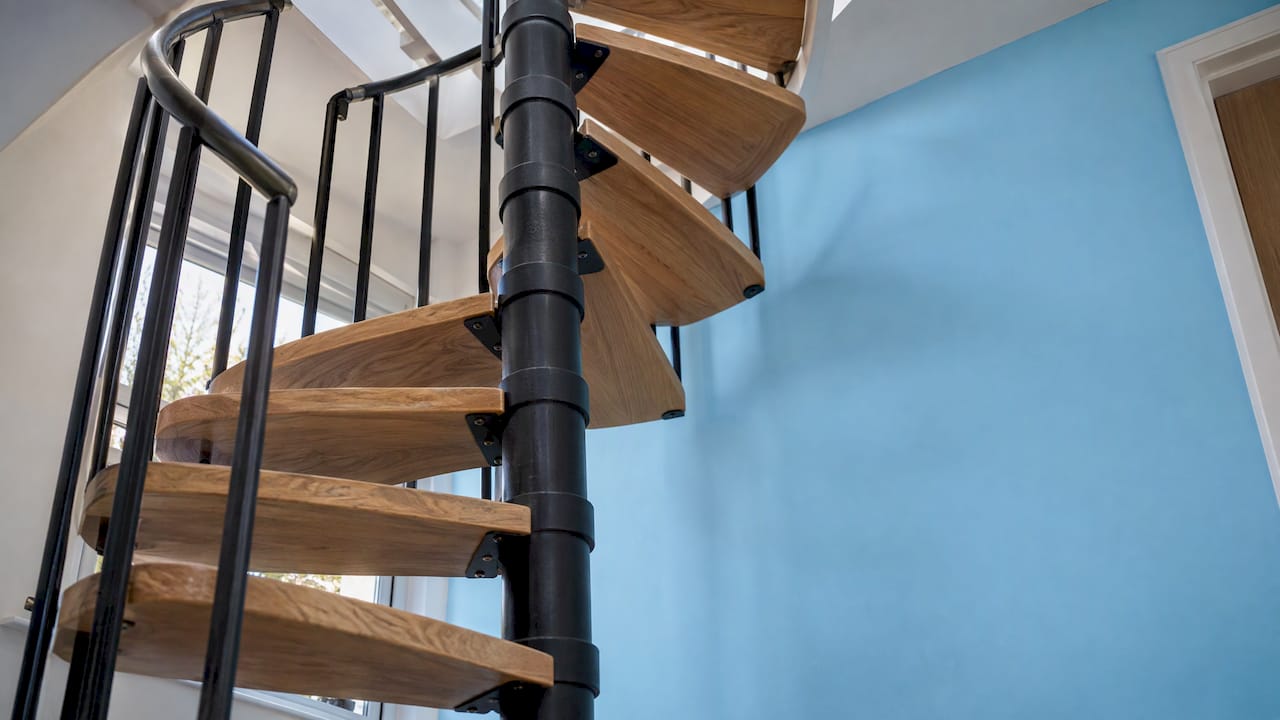
A spiral staircase is harder for a small child than a straight flight. The treads are narrow and wedge-shaped, the gaps are wide, and a toddler has nothing at their own height to hold. The safest set-up combines three things: a secure gate while the child is little, closed-off gaps and edges, and a handrail the child can actually reach. A child-height rail such as KiddieRail, which fits below a standard handrail and adjusts as your child grows, covers that last part.
TL;DR
- Spiral stairs combine narrow treads, open gaps and a handrail set for adults, so toddlers need more than a gate alone.
- Official UK guidance is to use gates at the top and bottom of stairs until a child is at least two, and to keep supervising after that.
- Check for gaps a child’s head, arm or leg could pass through, and make tread edges easy to see and grip.
- A handrail at the child’s own height gives them something to hold while they learn to use the stairs. KiddieRail is adjustable and designed to grow with your child.
- Gates, closed gaps, a child-height rail and supervision work together. None replaces the others.
Table of Contents
- Why spiral stairs are harder for small children
- Why a spiral can have gaps a straight stair would not
- When can children use stairs more safely?
- Gates on a spiral staircase: what to check
- Closing gaps and making edges easier to see
- The handrail problem: it is set for adults
- A simple spiral-stair routine for your home
- Our view: give a child something to hold
- Fit a child-height rail to your staircase
- FAQ
- Sources
Why spiral stairs are harder for small children
On a straight flight, every tread is the same depth from one side to the other. On a spiral, the tread is wide at the outer edge and shrinks to almost nothing at the centre post. A toddler who stays near the wall or rail has a safer footing than one who drifts inwards, and toddlers drift.
Three features cause most of the trouble:
- Narrow, tapering treads. Little feet have less room to land, and a missed step has nowhere to go but down.
- Open construction. Many spirals have minimal or no risers, so there is a gap between each tread. A foot, arm or head can pass through it.
- Wide spaces in the balustrade. Gaps between the uprights can be big enough for a child to slip through or become trapped.
The risk is also about how small children are built. Babies and toddlers have large heads in proportion to their bodies, which affects balance and makes falls more likely. Ottawa Public Health notes that children aged 0 to 4 are the most likely to fall at home.
Stairs are a serious place for it to happen. A study by the Center for Injury Research and Policy at Nationwide Children’s Hospital found that more than 93,000 children under five were treated in US emergency departments each year between 1999 and 2008 for stair-related injuries. That is roughly one child every six minutes. RoSPA also describes stairs as one of the most common places for serious falls among toddlers and young children in the UK.
Why a spiral can have gaps a straight stair would not
Building rules explain a lot about what you see in a spiral staircase. In the United States, the 2021 International Residential Code sets a minimum clear width of 26 inches (660 mm) for a spiral stairway, a tread depth of at least 6¾ inches (171 mm) at the walkline, and it exempts spiral stairways from the 4-inch sphere rule that limits openings between adjacent treads on other stairs.
That is a US code, and UK rules differ, but the point travels. A spiral can be perfectly legal for adults and still have openings a toddler can reach through. Rules for adult use are not a child-safety check, so you need to do your own.
If you are a new homeowner who has inherited a spiral staircase, or you are expecting a baby and the stairs are part of the house, this is the starting point. Look at the staircase the way a one-year-old would: from floor level, with a hand and a head to fit through gaps.
When can children use stairs more safely?
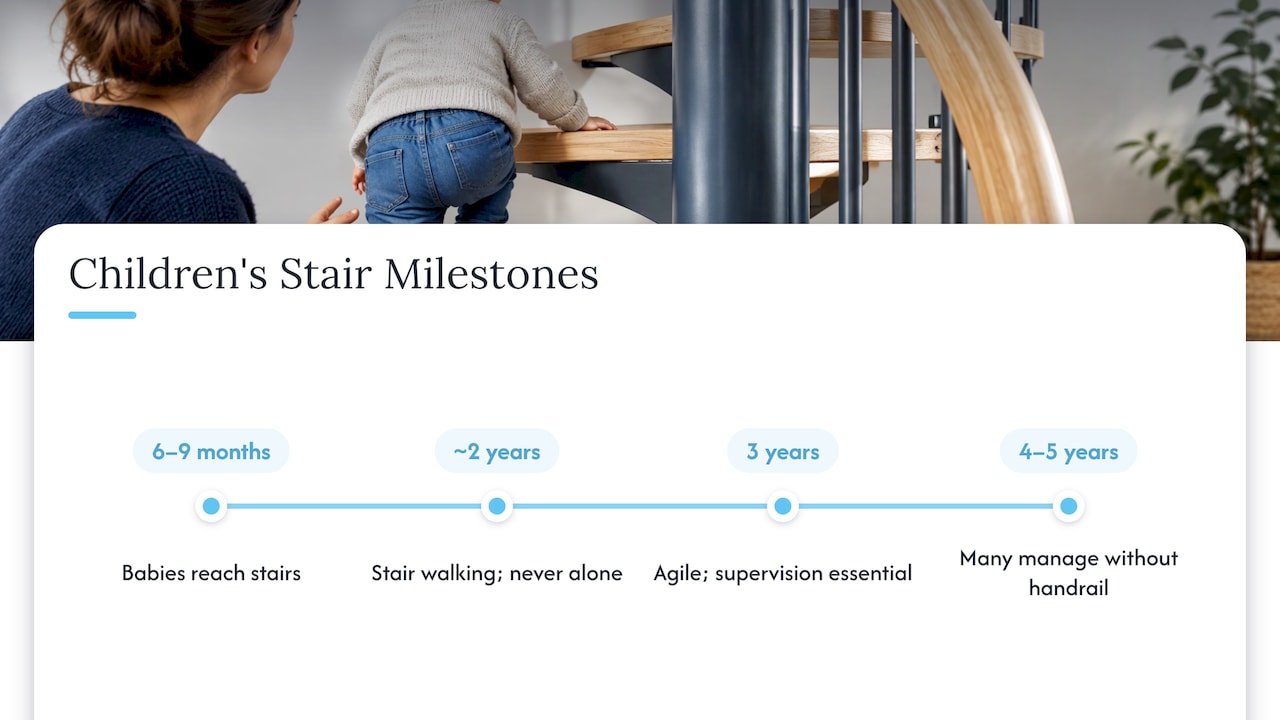
Most children start walking up and down stairs at around two years old, once their independent walking has settled, according to Children’s Hospital of Philadelphia. Before then, crawling babies try stairs as soon as they can reach them, usually from six to nine months, as Pathways.org explains.
The NHS advice for parents is clear. NHS Healthier Together says to fit safety gates before a baby starts crawling and to keep using them at the top and bottom of the stairs until the child is at least two. After that you can teach stair climbing, but children should never go up and down alone, and even four-year-olds may need some help.
By three, the American Academy of Pediatrics notes through HealthyChildren.org that a child moves with agility on stairs, but judgment, self-control and coordination are still developing, so adult supervision stays essential. By four or five, many children can manage stairs without holding the handrail.
So the stretch that matters most for a spiral staircase runs from roughly crawling age to four or five. During it, a child is learning, and learning needs something to hold on to at the right height.
For the early months, our guide on babyproofing stairs before crawling starts covers the first steps in order.
Gates on a spiral staircase: what to check
A gate is the first line of defence while your child cannot yet use the stairs safely. The checks are the same as on any staircase, but a spiral makes some of them harder:
- Fix it to the wall or a solid post. RoSPA recommends wall-mounted gates at the top and bottom of the stairs, fitted before a baby becomes mobile. The Nationwide Children’s team advises screw-in gates at the top because pressure-mounted gates can be knocked over.
- Check the standard. RoSPA says any gate for children under 24 months should comply with EN 1930:2011.
- Open the gate, never step over it. Raising Children Network advises this, and also suggests using a baby carrier when you carry a child down so that one hand stays free for the banister.
- Think about the top landing. On a spiral, the opening at the top is the place a child is most likely to reach first. Make sure the gate there closes the whole opening with no gap at the sides.
A gate stops access. It does not teach a child to use the stairs, and it does not help once a child is ready to climb. The Nationwide Children’s researchers stress that gates are important but are not a substitute for supervision. Their view is that parent education, gates and sound building design work best together.
The approach in our guide on pairing gates and teaching follows the same logic: protect at first, then teach.
Closing gaps and making edges easier to see
The next job is the staircase itself. Walk it slowly and check each of these:
- Baluster gaps. The Starship Safe as Houses guide from New Zealand recommends balustrade uprights no more than 80 mm apart to prevent entrapment or falling through. A child’s head is the usual problem, so measure.
- Climbable railings. The same guide says balustrade rungs should be vertical to stop climbing, and that heights of 1100 to 1200 mm are worth considering where extra protection is needed. RoSPA adds that banisters should be secure and should not give footholds.
- Open risers. The gap between treads is where legs and arms get caught. Our guides on open riser stairs and open staircases go through what to check at home.
- Grip and visibility. Narrow treads are far safer when the surface is not slippery and the edge stands out. Choosing non-slip flooring for stairs can improve grip and make tread edges easier to see, which helps children as much as it helps older people.
- Loose fixings. Give the balustrade and any existing handrail a firm shake. A handrail has to hold a falling person’s weight, so anything that moves needs fixing before a child leans on it.
The handrail point is worth a closer look, because it is where most spiral staircases fall short for children.
The handrail problem: it is set for adults
Stair handrails are positioned for grown-ups. As one US inspection checklist notes, handrail height is typically 34 to 38 inches (around 865 to 965 mm), and the rail should run continuously along the flight. A two-year-old’s shoulder is far below that. They can reach up and grab the rail awkwardly, or more often they do not reach it at all and steady themselves on the wall, the balusters or an adult.
On a spiral, that matters more. The tread you are standing on tapers, the direction keeps turning, and there is no straight run to recover your balance. A child who cannot hold a rail has to rely on balance alone.
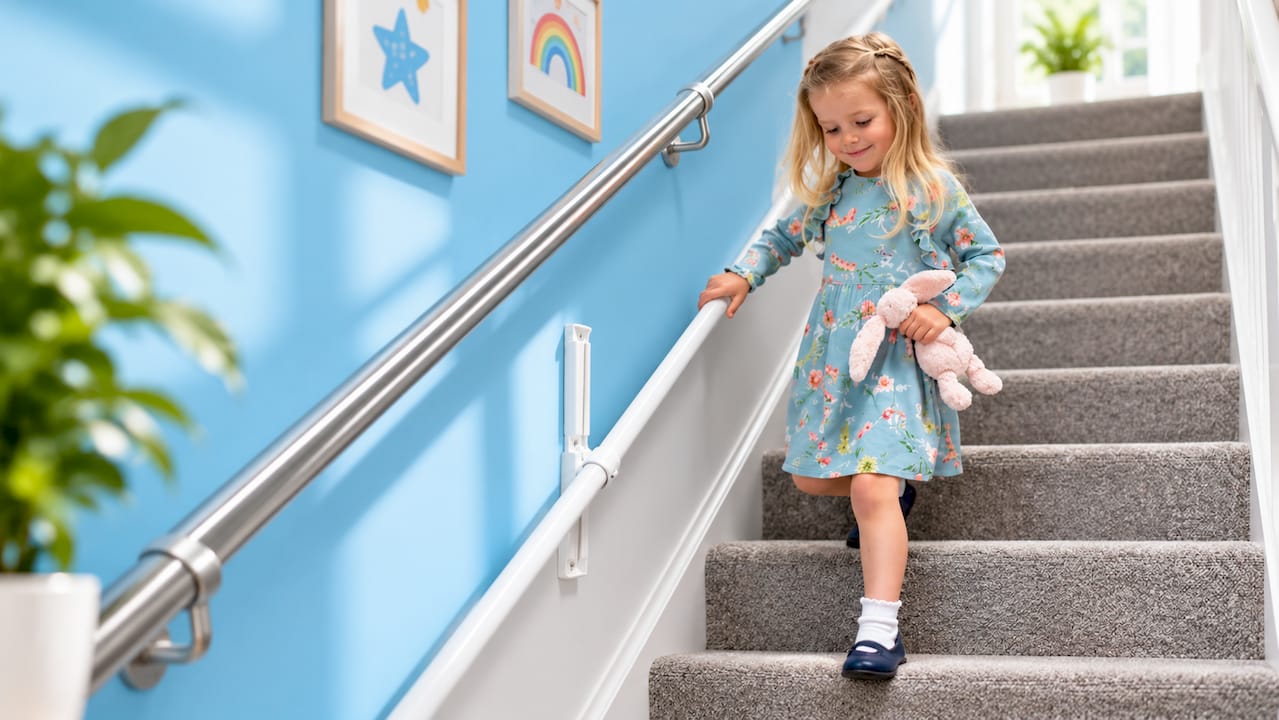
This is the gap that a child-height handrail fills. KiddieRail is an adjustable stair handrail designed for young children. It fits below a standard handrail, so the adult rail stays where it is and your child gets their own at a height that suits them. It adjusts, so it is designed to grow with your child rather than being outgrown in a year, and the client’s own description is that it suits any type of home staircase layout. It has been tested for durability and is designed for straightforward self-installation.
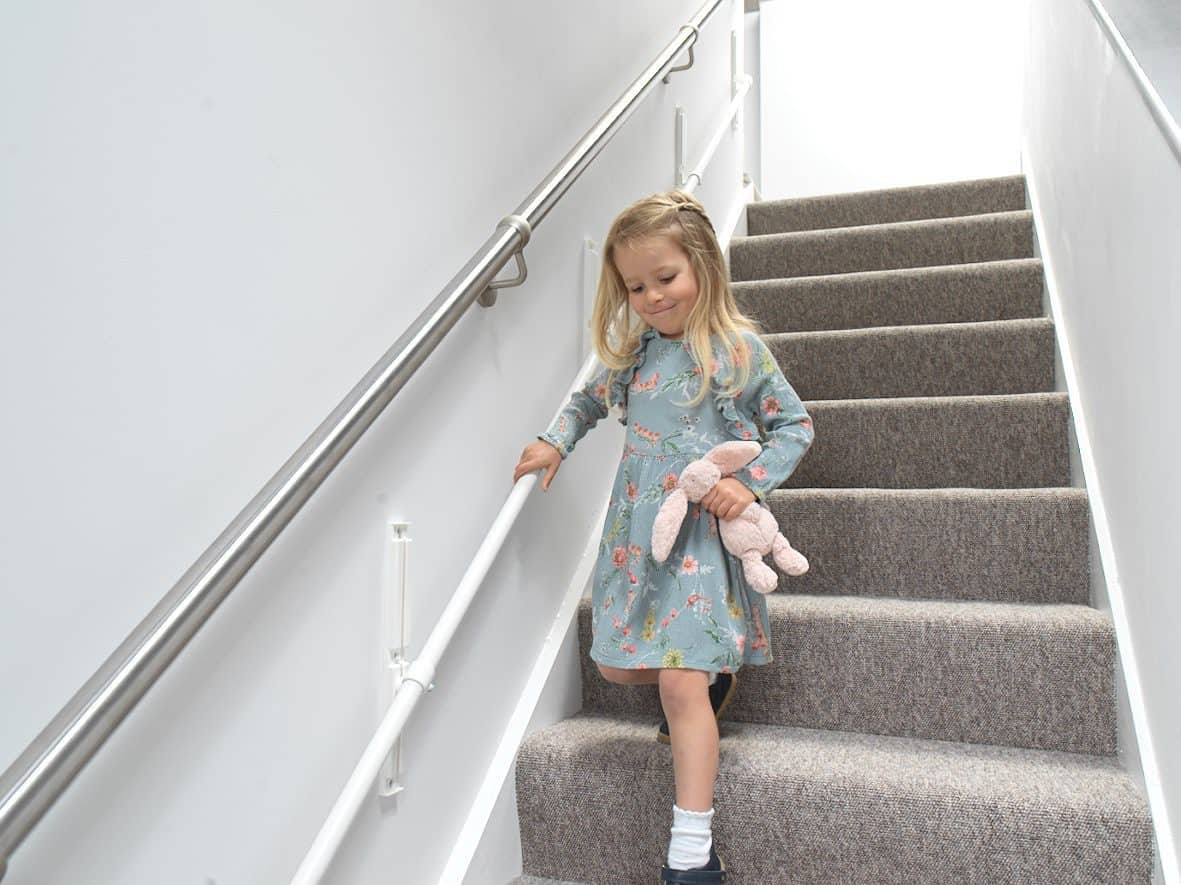
Where a gate holds the child back, a rail supports them while they walk. That is the difference we built the product around: it is made for the learning years, when children are moving between needing a gate and being confident on their own.
If the staircase is wide or has unusual proportions, fitting a secure gate and a child rail to wide stairs shows how the two work together. For design principles, see what to get right in a child-friendly staircase.
A simple spiral-stair routine for your home
Here is an order of work that takes an afternoon rather than a weekend:
- Crouch at your child’s height at the bottom and at the top. Note every gap a hand, foot or head could pass through.
- Secure the top and bottom with screw-in gates that meet EN 1930:2011, fixed to solid structure. Keep them closed.
- Deal with the gaps. Where uprights are too far apart, close them off before your child can crawl or climb. Check that nothing on the balustrade works as a ladder.
- Improve grip and visibility. Make sure treads are not slippery and that the front edge of each step is easy to see, with good lighting at both ends.
- Fit a child-height handrail below the adult one, set so your child can hold it comfortably with their arm slightly bent. Adjust as they grow.
- Teach in short sessions. Once your child is past two, practise going up and down together, with you below them on the way up. Keep a hand free, and let the gate stay closed when you are not there.
- Keep supervising. NHS guidance is not to let children use stairs alone, and even a confident four-year-old may need help on a staircase like this.
Childminders have extra considerations, including several children and several ages. Our pages on stair handrails for childminders and daycare and measuring and fitting a 600 to 750 mm child rail cover that setting. Flat dwellers can start with the two-minute stair sweep.
For a broader UK view, see our child safety on stairs prevention advice.
Our view: give a child something to hold
We hear the same worry again and again: a beautiful spiral staircase, a new baby, and no idea where to start.
Our answer is to think about the whole journey, not just the first year. A gate does a vital job while your child is small. But the day comes when they want to climb, and then they need something they can hold. A handrail at adult height does not do that for a two-year-old.
That is why KiddieRail exists. It is an adjustable handrail, fitted below the standard one, built to grow with your child and tested for durability. It is designed to suit any type of home staircase, so a curving staircase is not a reason to go without.
Stairs are a leading cause of injuries at home, and children learn best when they can practise safely, with support at the right height. Give them that, keep gates in place while they are little, and stay close. That combination gives you the confidence to let them learn.
Paul
Fit a child-height rail to your staircase
KiddieRail is our adjustable child stair handrail, designed to sit below your existing handrail and to grow with your child. You can see it on the KiddieRail Adjustable Child Stair Handrail page or browse the full shop. If your staircase needs more length, KiddieRail Extension Packs are priced from £24.99 to £36.99 as a one-off cost.
FAQ
Can you use a standard stair gate on a spiral staircase?
Only if it can be fixed securely, with no gap at the sides, and ideally screwed into solid structure at the top. RoSPA recommends wall-mounted gates at the top and bottom of stairs. Because spirals are curved and open, measure the opening carefully and make sure the gate closes the whole space.
At what age can a child safely use stairs?
Most children start walking up and down stairs at around two. NHS guidance is to keep gates at the top and bottom until at least that age, then to teach stair climbing with you present. Never let young children use stairs alone, and expect that even four-year-olds may need some help.
Are spiral stairs dangerous for toddlers?
They carry extra risks: narrow treads, open gaps and balustrade spaces a child can slip into or through. With gates, closed gaps, good grip and a handrail at the child’s height, you can reduce those risks. Supervision still matters throughout the toddler years.
How high should a child’s handrail be?
Adult handrails are typically around 865 to 965 mm, which is too high for a toddler to use. A child rail sits lower and should be set so your child can hold it comfortably. KiddieRail is adjustable, so you can change the height as your child grows.
Sources
- Child Safety at Home, NHS Healthier Together
- Preventing Falls in Children, RoSPA
- Stair Safety, Center for Injury Research and Policy, Nationwide Children’s Hospital
- Child Falls, Ottawa Public Health
- Safe as Houses, Starship
- Walking Up and Down the Stairs, Children’s Hospital of Philadelphia
- Movement Milestones in Preschoolers, HealthyChildren.org
- When Can Baby Climb Stairs, Pathways.org
- Falls prevention: babies and young children, Raising Children Network
- Handrail and stairway residential codes, International Residential Code
- General checklist for inspecting stairways, InterNACHI
- Non-slip flooring guide


