
Currently Empty: £0.00


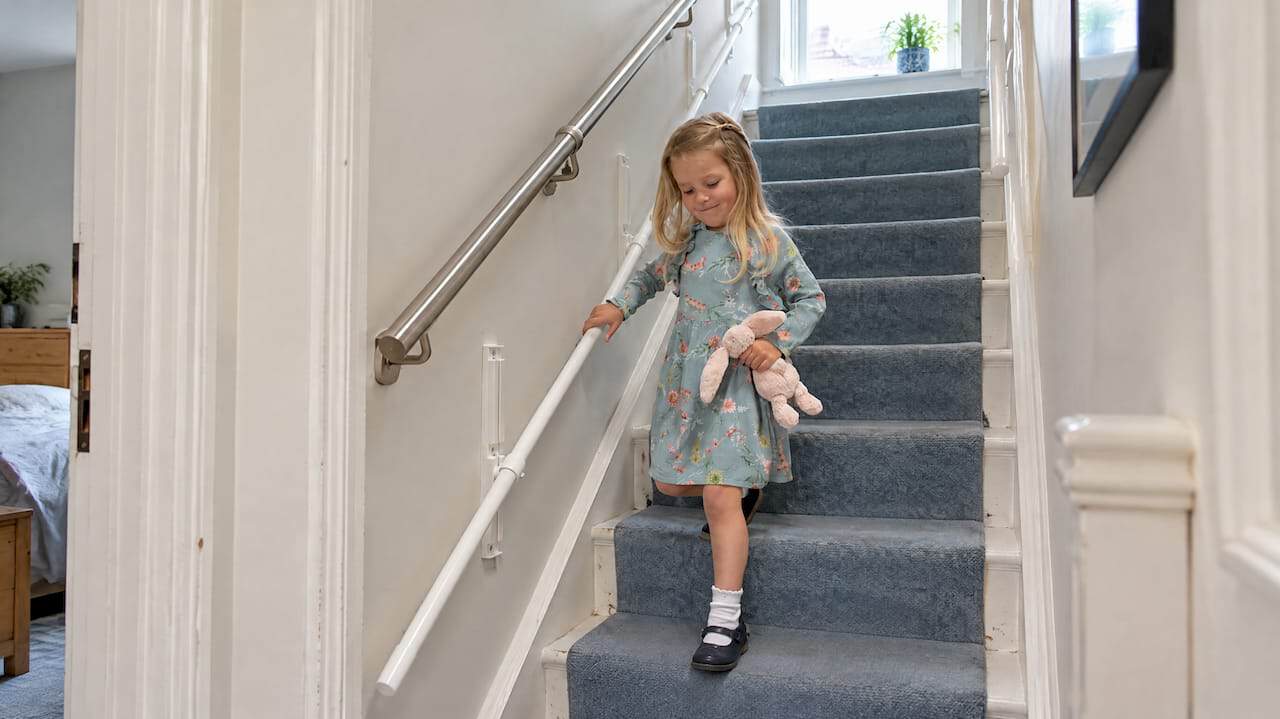
A child handrail works best mounted at roughly 665 to 750 millimetres above the pitch line, running the full length of the flight with at least 230 millimetres of vertical clearance below the adult rail. It should complement, never replace, a securely fitted adult handrail and a certified safety gate. Measure from the tread nosing, not the floor, and make sure the rail returns to the wall rather than ending in open air.
TL;DR:
- Child handrails should be mounted between 665 and 750 millimetres above the pitch line, with at least 230 millimetres of vertical clearance from the adult handrail.
- Use a continuous, rounded grip profile between 32 and 50 millimetres in diameter, avoiding makeshift solutions like ropes or low crossbars that can trap small hands or climbable footholds.
- Measure from the tread nosing along the pitch line rather than the floor to ensure consistent height and proper placement on both sides of wide stairs.
- Regularly inspect fixings, wear, and clearance, re-tightening or replacing the rail as needed, especially when a child grows or the rail shows signs of damage.
- An adjustable, tested child handrail can grow with your child, offer easier installation, and reduce entrapment or stability risks associated with DIY fixes.
Table of Contents
- Recommended heights and where to mount the rail on a flight of stairs
- What materials and designs to choose: safe options and those to avoid
- Quick installation and measuring checklist for parents and DIYers
- Safety checks, maintenance and when to replace or retrofit
- Why a tested, adjustable child handrail helps
- Adjustment recommendations for different child age groups and developmental stages
- Compliance with relevant safety standards and building codes specific to child handrails
- A straight answer on priorities
- Fitting a rail that matches your stairs and your child
- FAQ
- Sources
Recommended heights and where to mount the rail on a flight of stairs
Measuring from the right reference point matters more than most parents expect. The pitch line runs along the nosings, the front edge of each tread, and every handrail height should be measured as a vertical distance from that line rather than from the floor, which gives an inconsistent and often misleading figure on a sloped flight.
Adult handrails typically sit 900 to 1,000 millimetres above the pitch line, which is the figure most UK building guidance works from. A child rail sits lower, generally in the range of 665 to 750 millimetres, with some advisory guidance pointing to a figure of around 710 millimetres as a practical target for facilities used by children.
Three points to check once you have your target height:
- Vertical gap: leave at least 230 millimetres between the adult and child rails to stop a child’s head or limb becoming trapped between the two.
- Coverage: run the child rail the full length of the flight, including any landings, so a small hand never has to let go mid-climb.
- Sides: fit the child rail on the same side as the adult rail, and on both sides where the flight is wide enough to need two adult rails.
Our guide on stair safety for toddlers covers how this fits into a wider supervision routine.
What materials and designs to choose: safe options and those to avoid
A handrail only helps if a small hand can actually close around it. Most guidance on graspability points to a rounded profile with a diameter in the region of 32 to 50 millimetres, continuous along the whole run so a child’s grip never has to break and reset.
This is where improvised fixes cause real harm. The Consumer Product Safety Commission warns against makeshift solutions such as garden rope or a loosely clamped length of pipe, because these can sag, twist or create gaps that trap a small hand, arm or head. A rope rail also tends to pull away from its fixings under repeated tugging, exactly the kind of use a child rail gets every day.
Keep these design points in mind:
- Choose a tested product or a securely fixed timber or metal rail over rope, chain or anything with give in it.
- Avoid horizontal bars or low crossbars on the guarding below the rail, since these turn into footholds a toddler can climb.
- Make sure every end returns to the wall or a newel post rather than finishing in open space, where a sleeve or drawstring can snag.
Pro Tip: Check that any gap created by a new lower rail still passes the 100 millimetre sphere test, the same rule used for stair guarding, so nothing larger than a small ball can pass through.
Quick installation and measuring checklist for parents and DIYers
A methodical approach avoids most of the mistakes that turn a good idea into a hazard. Work through these steps in order:
- Mark the pitch line by running a straight edge or string along the tread nosings from top to bottom.
- Measure up from that line to your target child height, typically 665 to 750 millimetres, and mark it at several points along the flight.
- Check vertical clearance against the existing adult rail, aiming for at least 230 millimetres between the two.
- Identify your wall type, since solid masonry, dry lining and timber stud walls all need different fixings rated for a live, repeatedly loaded rail rather than a static shelf.
- Fix brackets into solid material wherever possible, using appropriate anchors in masonry or locating studs in a timber-framed wall; where neither is available, a tradesperson can fit a noggin or backing plate.
- Mount with continuous returns at both ends so there is no exposed cut edge.
- Test with a firm pull and push in several directions along the full length before letting a child use it unsupervised.
Standard tools cover most installations: a drill, a spirit level, a stud detector and the fixings specified for your wall type. If your walls are dot-and-dab plasterboard over masonry or anything you are unsure about, it is worth bringing in a tradesperson rather than guessing at a fixing; see our guide on modifying home for injury recovery for practical advice. Our piece on stair safety advice for UK parents runs through typical home layouts in more detail.
Safety checks, maintenance and when to replace or retrofit
A rail fitted correctly on day one can still fail quietly over months of use. Build a short routine around these checks:
- Fixings: look for any movement at the brackets, loose screws or a wall anchor beginning to pull through.
- Wobble: grip the rail firmly and push along its length; any flex suggests a fixing has failed.
- Wear and corrosion: check metal fittings for rust and timber for splitting, especially near high-traffic grip points.
- Clearance: confirm the gap to the adult rail above hasn’t closed up if either rail has been adjusted.
Re-tighten fixings every few months, and sooner if you notice any give. Adding an extension pack to lengthen a rail shifts the load onto new bracket points, so check those fixings on the same schedule as the originals. Once a rail shows persistent wobble or corrosion at the fixings rather than just surface wear, replace it rather than patching it, and remember that a child’s growth will eventually move the ideal height, which is where an adjustable rail earns its keep.
Why a tested, adjustable child handrail helps
We specialise in an adjustable stair handrail designed specifically for young children, built to sit at the right height without the guesswork of cutting and fixing a fresh timber rail by hand. Our rails have gone through rigorous testing to confirm their durability and effectiveness, which matters given how firmly a child rail gets pulled and leaned on every day.
The adjustable design means the rail grows with your child, so you are not re-measuring and re-drilling every year as height needs change. That also sidesteps the entrapment and stability risks that come with rope or loosely fixed DIY alternatives, since the fixing points and grip profile are built in rather than improvised. For families with a child who has additional support needs, our notes on SEN stair handrails explain where a dedicated child rail helps most.
Adjustment recommendations for different child age groups and developmental stages
A toddler who has just started cruising along furniture needs a very different handrail experience from a seven-year-old confidently running up and down. For early walkers, around one to two years old, keep the rail at the lower end of the range, close to 665 millimetres, and treat the handrail as a secondary support behind a closed, locked safety gate rather than the main line of defence.
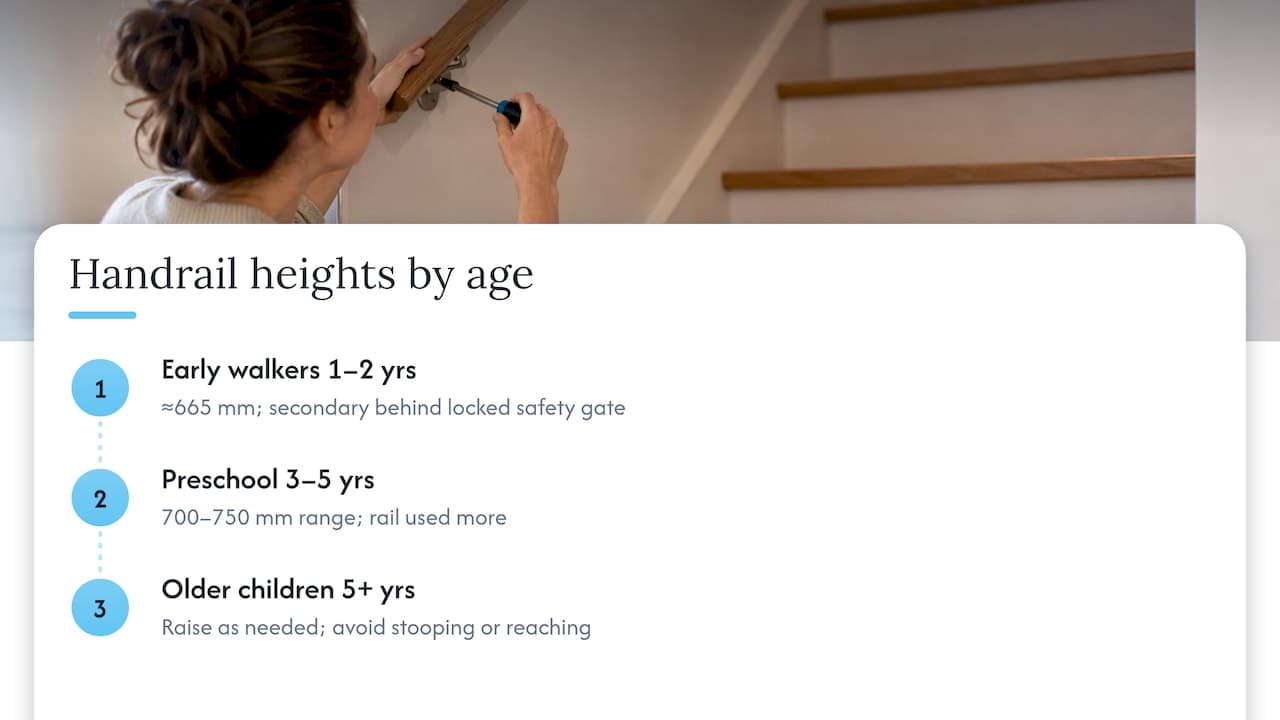
Between roughly three and five years old, children are learning to climb stairs one foot per step rather than two feet per step, and this is when a rail at the fuller 700 to 750 millimetre mark starts to get real use, since their reach and balance have both improved.
Once a child is past five or six and moving confidently, the rail becomes more of a habit and confidence tool, but it is still worth keeping it at a height that doesn’t force them to stoop or reach up awkwardly. An adjustable rail avoids the need to re-fit a new fixed rail at each of these stages, since the height can be raised as a child grows without starting the installation over from scratch.
Compliance with relevant safety standards and building codes specific to child handrails
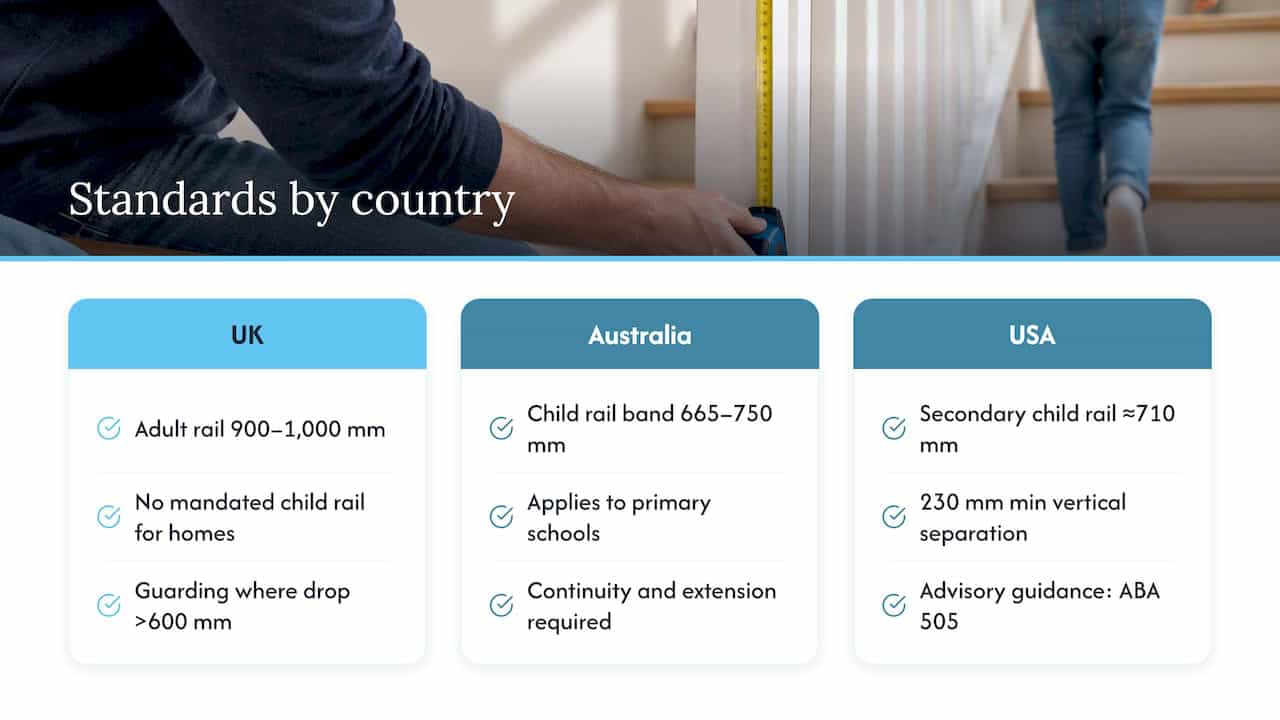
Child handrail height isn’t governed by a single universal number, and guidance varies by country and by setting. In the UK, Approved Document K sets the adult handrail height at 900 to 1,000 millimetres and requires guarding wherever a drop exceeds 600 millimetres, but it doesn’t mandate a specific child rail height for private homes. Australian guidance under D3D22 is more specific for primary school settings, citing a practical child handrail band of 665 to 750 millimetres along with continuity and extension requirements. US advisory guidance under ABA 505 recommends a secondary child rail height of around 710 millimetres with a minimum 230 millimetre vertical separation from the main rail.
For a private home, none of these figures are usually a legal requirement in the way they would be for a school or public building, but they give a sound, tested band to work within. If you are renovating to sell or let a property, it is worth checking which code applies in your area, since compliance requirements for rental and sold homes can differ from those for an owner-occupied house. Where in doubt, following the tighter of the applicable figures, rather than the loosest, keeps you on the safe side regardless of which code eventually applies.
A straight answer on priorities
Supervision and a correctly fitted, certified safety gate are the non-negotiable first move for any toddler just starting on stairs. No handrail, however well fitted, replaces a locked gate at the top and bottom of a flight during the early years.
Once your child is confidently cruising and climbing with supervision, a child handrail becomes worth the weekend. Treat it as a confidence and independence tool for three-year-olds and up, not a substitute for watching a one-year-old on the stairs.
— Paul
Fitting a rail that matches your stairs and your child
Once you know your target height and clearance, the practical question is finding a rail that actually fits your flight without a custom timber job. Our KiddieRail Adjustable Child Stair Handrail is built to adjust within the recommended child height band and grow with your child over several years, rather than needing replacement every time they shoot up.

For longer staircases or flights with a half-landing, our Extension Pack adding 85 centimetres or the Extension Pack adding 170 centimetres extend coverage so the rail runs the full flight rather than stopping short. Check measurements against your stairs on our shop page or browse the full accessories range to find the right fit before you order.
FAQ
What is the code for a hand railing?
Codes vary by country and setting: UK guidance under Approved Document K sets adult handrail height at 900 to 1,000 millimetres, while model code excerpts used elsewhere specify adult ranges and continuity rules too. There is no single global “handrail code”, so check the building regulations that apply in your area for formal compliance.
What height should a handrail be in the UK?
UK guidance places the adult handrail height at 900 to 1,000 millimetres measured from the pitch line, with guarding required wherever a drop exceeds 600 millimetres. A child rail sits lower than this, typically in the 665 to 750 millimetre band used in other building guidance, fitted below the adult rail rather than instead of it.
Can a 2×4 be used as a handrail?
A flat length of timber such as a 2×4 is wider than most grip guidance recommends and is harder for a small hand to close around securely compared with a rounded profile. It can also be difficult to return safely to the wall and to fix with the load rating a child rail needs, so a shaped rail or a tested product designed for grip is the safer choice.
Which side do you put a handrail on?
Fit the child rail on the same side as the main adult handrail so a child can use both at once without crossing the stairs. On wider flights with handrails on both sides, it is worth fitting the child rail on both sides too, especially while a child is still building confidence going up and down.
Sources
- 505 Handrails (ABA advisory)
- CPSC guidance on gates and enclosures
- D3D22 Handrails | ABCB
- Stair regulations and handrail heights (UK guidance summary)


