
Currently Empty: £0.00


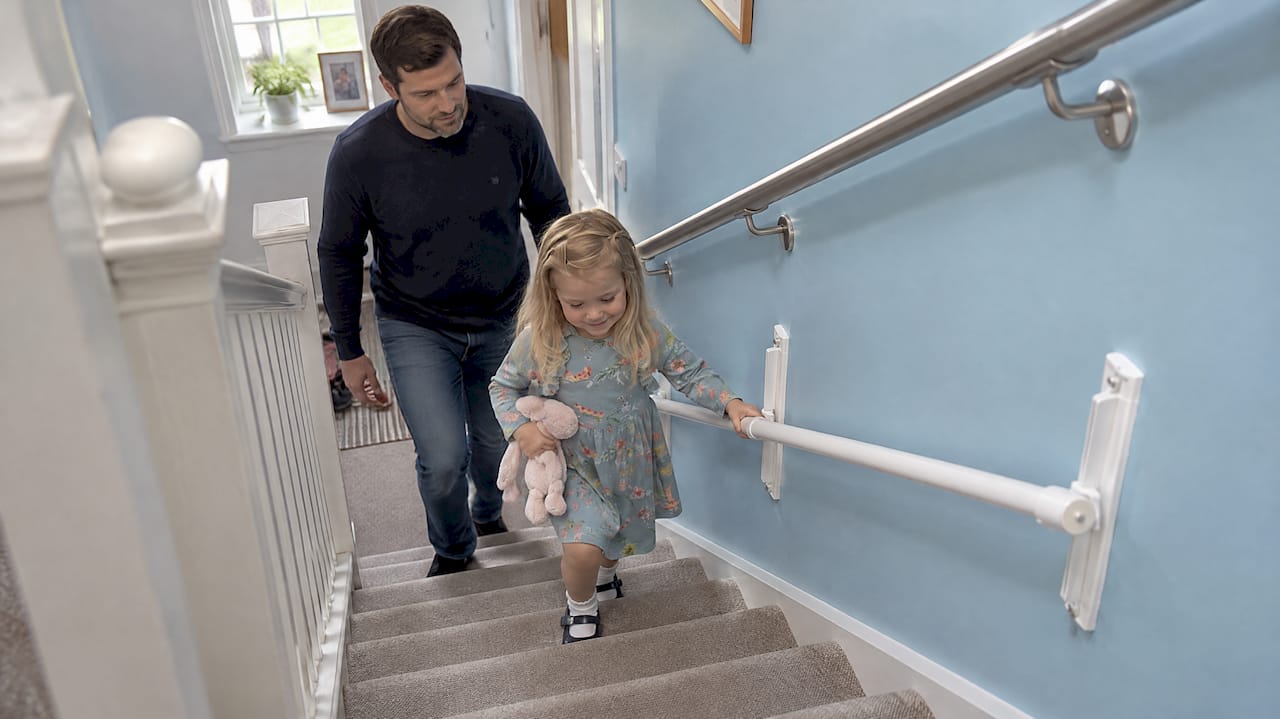
A handrail below the standard rail is a second, lower rail fitted on the same staircase so that a small child can grip something at their own height. A toddler cannot reach an adult rail, so on most staircases they have nothing to hold while they learn to climb. An adjustable child-height rail such as KiddieRail fits below your existing handrail and can be raised as the child grows, which is why it is a longer-term answer than a gate alone.
This guide explains what a lower rail is, what height and clearance the published guidance suggests, what to check before you fit one, and how it sits alongside gates and supervision.
TL;DR
- A lower handrail gives a toddler something they can actually grip. The standard rail is set for adults and is out of a small child’s reach.
- Published guidance for places that serve children suggests a second rail no higher than 28 inches (710 mm), with at least 9 inches (230 mm) of clear space to the adult rail.
- Before fitting, check the wall, the fixing points, the staircase layout and the gap between the two rails.
- A lower rail supports a child on the stairs. Gates at the top and bottom, and an adult close by, are still part of the plan.
- KiddieRail is an adjustable child stair handrail that fits below a standard handrail, is tested for durability and is designed for self-installation.
Table of Contents
- What a handrail below the standard rail actually is
- Why stairs matter so much for young children
- How high should the lower rail be?
- What to check before you fit a lower rail
- Fitting it: a short routine
- A lower rail and a gate do different jobs
- Who benefits most
- Our view
- Choosing your KiddieRail
- FAQ
- Sources
What a handrail below the standard rail actually is
A standard stair handrail is positioned for adult hands. A child-height rail is a second rail mounted lower on the same side of the staircase, so a toddler or young child can reach it, hold on and steady themselves.
The idea is not new in public buildings. The U.S. Access Board, which writes accessibility guidance, advises a second set of stairway handrails no higher than 28 inches above the stair nosings in facilities that mainly serve children. The nosing is the front edge of each tread. The same guidance says at least 9 inches of vertical clearance helps prevent entrapment, meaning a child’s head or body getting wedged between the two rails.
At home the logic is the same. Children learn stairs between roughly crawling and the age at which they are confident on two feet, and in that period their reach is far below an adult rail. The Stairbuilders and Manufacturers Association recommends considering a handrail at a lower height that small children can reach, and notes that handrails on both sides add an extra margin of safety beyond code requirements.
Why stairs matter so much for young children
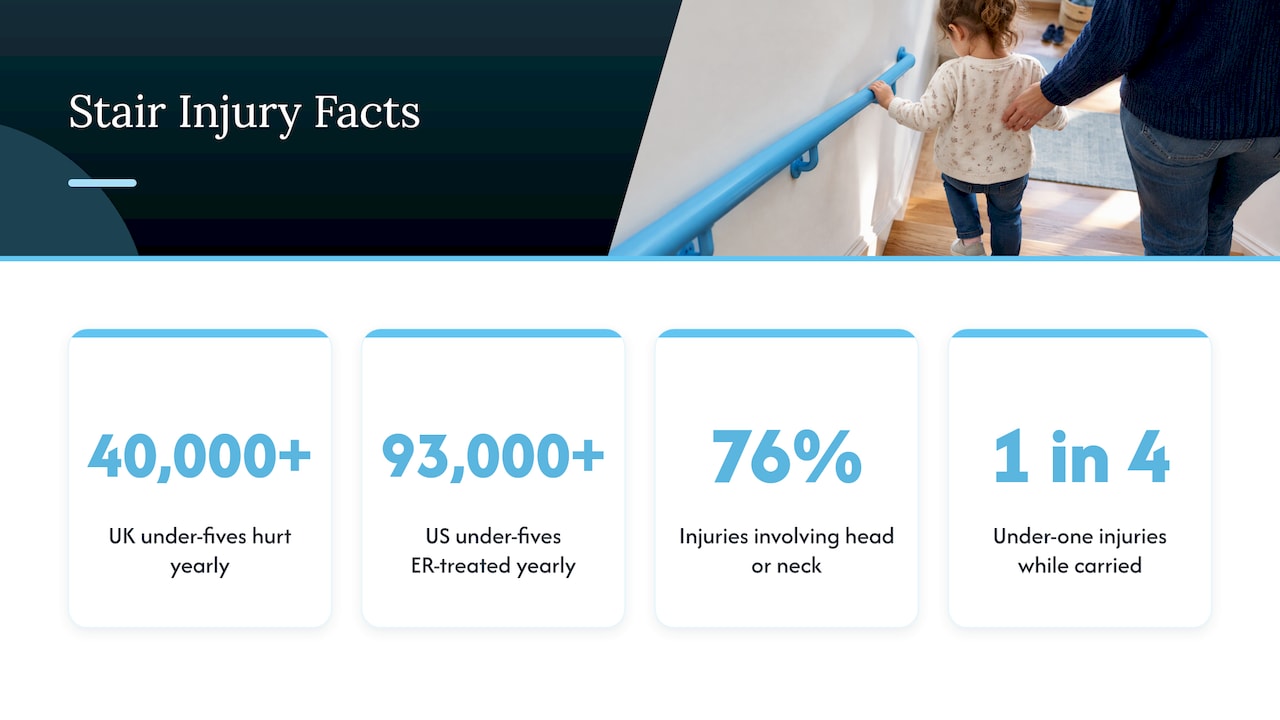
Stairs are one of the most common places for young children to be hurt at home. ROSPA, the UK’s Royal Society for the Prevention of Accidents, states in its home-safety material that over 40,000 children under five are hurt each year in the UK as a result of a fall down stairs. It also attributes most non-fatal home accidents in the 0 to 4 age group to falls.
US research gives a sense of the pattern. Nationwide Children’s Hospital reported that from 1999 to 2008, more than 93,000 children under five were treated in emergency departments each year for stair-related injuries, and that head and neck injuries accounted for 76 per cent. The same release found that a quarter of the injuries to children under one happened while the child was being carried on the stairs. The hospital’s injury research team also suggests installing a handrail where there isn’t one and teaching children to keep a free hand on it.
That last point is the practical heart of a lower rail. You cannot teach a child to hold on if there is nothing they can hold.
How high should the lower rail be?
There is no single UK rule for a child’s rail in a private home. Building regulations set the height of the adult handrail, and a second child-height rail is an addition you choose. The published guidance from other countries gives a useful range.
| Source | Suggested height of lower rail | Clearance to adult rail |
|---|---|---|
| U.S. Access Board, Chapter 5 Stairways | No higher than 28 in (710 mm) above the nosings, in facilities serving children | At least 9 in (230 mm) |
| 2025 California accessibility guide, advisory 11B-505.4 | Maximum 28 in (710 mm), measured to the top of the gripping surface from the nosing | At least 9 in (230 mm) |
| Australian Building Codes Board, D3D22 | Between 665 mm and 750 mm, a second handrail in primary schools to aid shorter children | Not stated in the guide extract |
Three things follow from these figures.
- Measure to the top of the grip, vertically from the nosing. The nosing line is the sloping line joining the front edge of each step. Measure up from it, not from the floor or the skirting.
- Treat 28 inches (710 mm) as a ceiling, not a target. A toddler’s comfortable grip is lower than that, which is why an adjustable rail makes sense: you set it for the child you have now.
- Keep the gap. The 230 mm clearance between the two rails is there so a child cannot get trapped between them. ArchDaily’s guide to handrails gives the same figure and adds that rails should extend at least 305 mm (12 inches) beyond the stair run.
For a closer look at placement on UK stairs, see our guides to handrail height for kids and child handrail placement.
What to check before you fit a lower rail
This is where most plans stand or fall. A rail that a child leans their weight on has to be fixed properly, and it has to suit your staircase. Go through these checks before you buy.
1. Which side and how long
Stand at the bottom and look at the staircase. Your existing handrail is on one side or both. The lower rail should run alongside it, following the same slope, for the full flight where the child will climb. If your stairs turn or have a landing, count each flight separately. KiddieRail is designed to suit any home staircase layout, and its extension packs add length for longer flights and corners.
2. The wall behind it
A rail is only as strong as what it is fixed to. Check whether the wall is solid masonry or plasterboard on a timber frame. The Stairbuilders and Manufacturers Association advises screwing safety gates into wall studs, the timber uprights behind plasterboard, and the same principle applies to anything a child will pull on. A stud finder will show you where they are.
If the studs are not where you need them, a backing board spreads the fixing across a wider area. Our guide to a handrail backing board explains how to choose a length.
3. The gap between the rails
Mark where the lower rail will sit, then check the vertical distance to the adult rail. It should be at least 230 mm, as the published guidance says. If your adult rail is low or the stairs are steep, that limits how high the child rail can go, so measure before you commit.
4. Balusters and open spaces
Nidirect, the Northern Ireland government’s public information service, advises keeping gaps between vertical stair rods to no more than 100 mm so children cannot climb through, and repairing loose balustrades promptly. A child-height rail does not replace a sound balustrade. Check that the existing one is firm before you add anything to it.
5. The surface you are fixing into
Hardwood, painted plaster and tiled walls all behave differently when you drill. Our page on child handrails for hardwood stairs covers fit and fixing on timber, and the wall mounted child handrail guide covers the wall side.
6. Lighting and clutter
ROSPA’s guidance frames stair safety as a combination of measures: well-lit stairs, free of trip hazards, with strong balustrades and no footholds for climbing. Clear the steps of shoes, laundry and toys before a child starts using the new rail.
Fitting it: a short routine
KiddieRail is designed for straightforward self-installation, so most households can fit it without a tradesperson. A sensible order is:
- Decide the side and note any turns, landings or doors that interrupt the flight.
- Measure the staircase length along the slope, then choose whether you need an extension pack.
- Find the fixing points in the wall and mark them in line with the pitch of the stairs.
- Set the rail at a height your child can grip comfortably, staying under the 28 in (710 mm) ceiling and keeping at least 230 mm to the adult rail.
- Fix it firmly, then pull and push along its length to check there is no movement before the child uses it.
- Walk the stairs with your child, show them where to put their hand, and adjust the height as they grow.
The second step is where a one-size rail usually lets people down: stairs vary in length, and a rail that stops short of the top or bottom leaves the child without support at the most awkward moment. That is why KiddieRail offers extension packs. For a fuller walk-through, see our second stair handrail guide.
A lower rail and a gate do different jobs
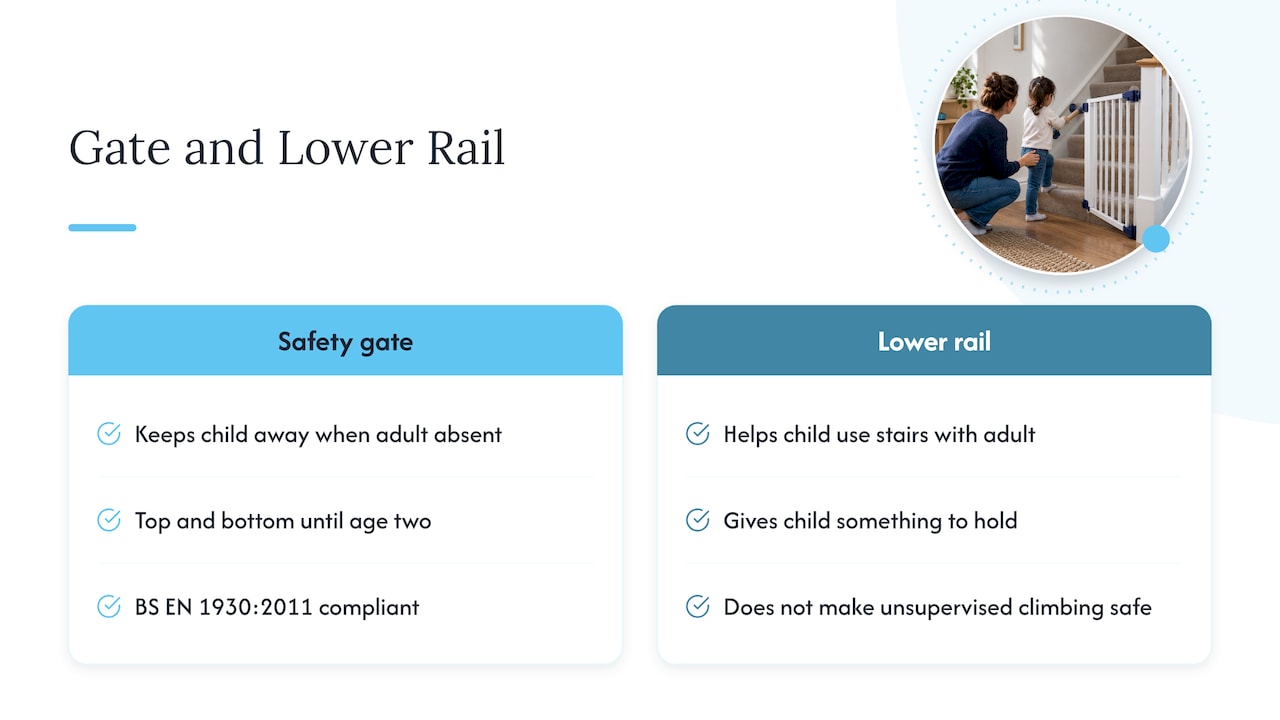
A gate keeps a child away from the stairs when you are not there. A lower rail helps a child use the stairs when you are. They are complementary.
Nidirect advises fitting BS EN 1930:2011-compliant safety gates at the top and bottom of the stairs from when a baby starts to move until 24 months. The NHS-backed Healthier Together service gives the same timing: keep gates at the top and bottom until a child is at least two, teach children how to climb stairs, and never let them go up or down alone. If you are choosing a gate for the top of the stairs, a flat step safety gate is one option that suits a staircase without a lip to fix to.
The Nationwide Children’s Hospital study authors say gates are important and effective but not a substitute for adult supervision. The same goes for a lower rail. It gives a child something to hold. It does not make an unsupervised climb safe.
When you carry a baby, keep a hand free for the adult rail. Healthier Together gives this advice, and it matters because the carried child is often the one who is injured.
Who benefits most
Parents of toddlers. The point where a child first wants to climb alone is the point where a rail within reach makes the biggest difference. Adjusting the height as they grow means one fitting carries you through the early years.
Expecting parents and new homeowners. Fitting a rail before the baby is mobile means the stairs are sorted well before the first climb. It is a one-off job rather than a repeated one.
Childminders and caregivers. If several children of different heights use the stairs, an adjustable rail lets you set it for the smaller ones. Our pages on childminder stair safety and daycare stair handrails cover the particulars of working settings.
Our view
We built KiddieRail around a simple observation: the stairs in most homes are made for adults, and a child is expected to cope with them anyway. A gate keeps a child out, which is right when you are not there. But it does nothing for the moment the child is on the stairs and needs something to hold.
That is why we make a rail that fits below a standard handrail and adjusts as the child grows. It supports children while they walk on stairs, it is tested for durability, and it suits any home staircase layout. You fit it yourself, and when the child is taller you move it up rather than replacing it.
Our advice is to treat the stairs as a system: a gate where the child should not go unsupervised, a clear and well-lit staircase, an adult nearby, and a rail they can use at their own height. The rail is the part that teaches them to use stairs safely.
Paul
Choosing your KiddieRail
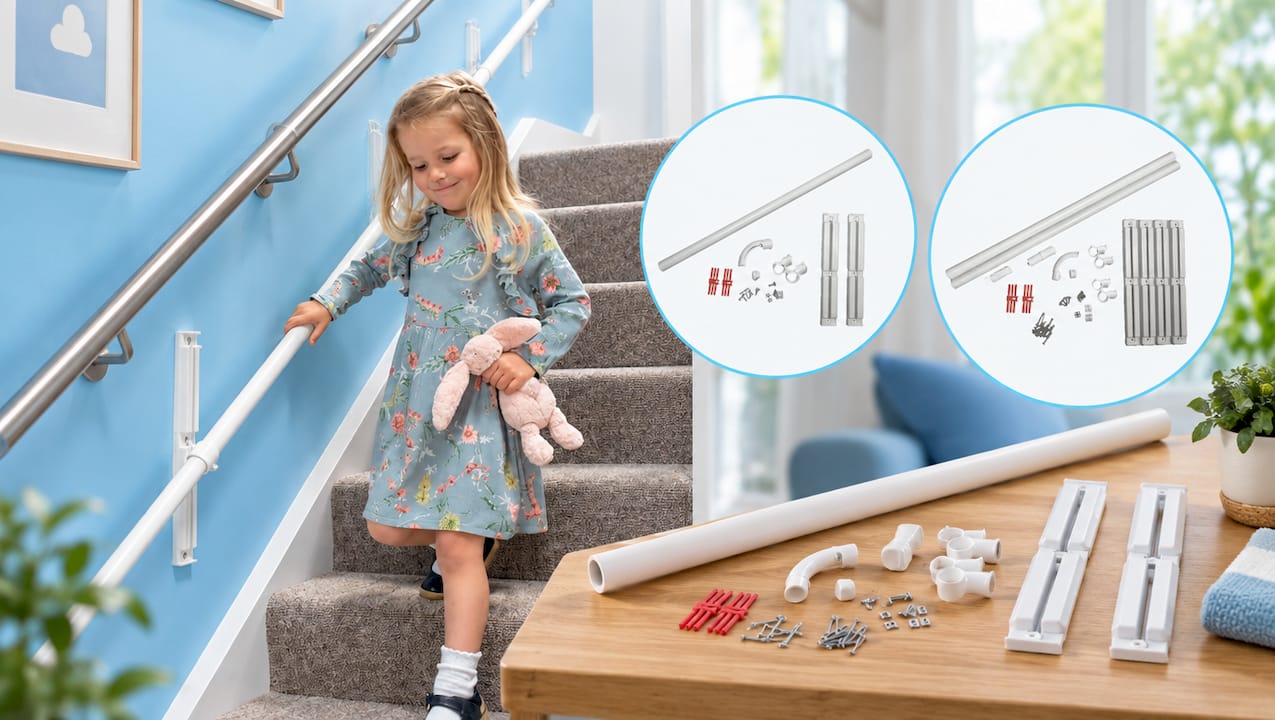
The KiddieRail Adjustable Child Stair Handrail is the main rail. It fits below a standard handrail, adjusts as your child grows and is designed for self-installation. You can see it on the KiddieRail shop page.
For longer flights or turns, the extension packs add length. They are available in an additional 85 cm length and an additional 170 cm length, priced from £24.99 to £36.99 as a one-off purchase. All options are listed in the extension pack category.
If you are ready to order, the KiddieRail Adjustable Child Stair Handrail is where to start.
FAQ
Is a second handrail for children a legal requirement in a UK home?
No. Building regulations set the requirements for the adult handrail, and a child-height rail is something you add by choice. The U.S. Access Board describes the lower rail as advised for facilities that mainly serve children, not as a mandate. Many families fit one because it makes the stairs usable for a small child.
How far below the adult rail should a child’s rail sit?
Leave at least 9 inches (230 mm) of vertical space between the two, and keep the child rail no higher than 28 inches (710 mm) above the nosings, as California’s accessibility guide recommends. Within that limit, set it at a height your child can grip comfortably, and raise it as they grow.
Do I still need a stair gate if I fit a lower rail?
Yes, while your child is small. Healthier Together advises gates at the top and bottom of the stairs until a child is at least two. The gate covers the times you are not beside them. The lower rail helps when you are there to supervise.
Can I fit a child’s handrail myself?
KiddieRail is designed for straightforward self-installation. The key is a secure fixing: find solid fixing points in the wall, fit the rail in line with the slope of the stairs and check it does not move before your child uses it. Our second stair handrail guide goes through the process.
What if my staircase is long or has a turn?
Measure each flight along the slope and add an extension pack where the rail would otherwise stop short. KiddieRail is designed to suit any home staircase layout, and extension packs add 85 cm or 170 cm of length.
Sources
- Stairways, U.S. Access Board
- Chapter 5: Stairways, U.S. Access Board
- 11B-505.4 Height, 2025 California Standards for Accessible Design Guide
- D3D22 Handrails, Australian Building Codes Board
- Handrails and Accessibility 101, ArchDaily
- Stair Safety, Stairbuilders and Manufacturers Association
- Keep Me Safe at Home flipchart, ROSPA
- New study examines stair-related injuries among children, Nationwide Children’s Hospital
- Stair Safety, Nationwide Children’s Hospital
- Guarding children against trips and falls, nidirect
- Child Safety at Home, Healthier Together


