
Currently Empty: £0.00


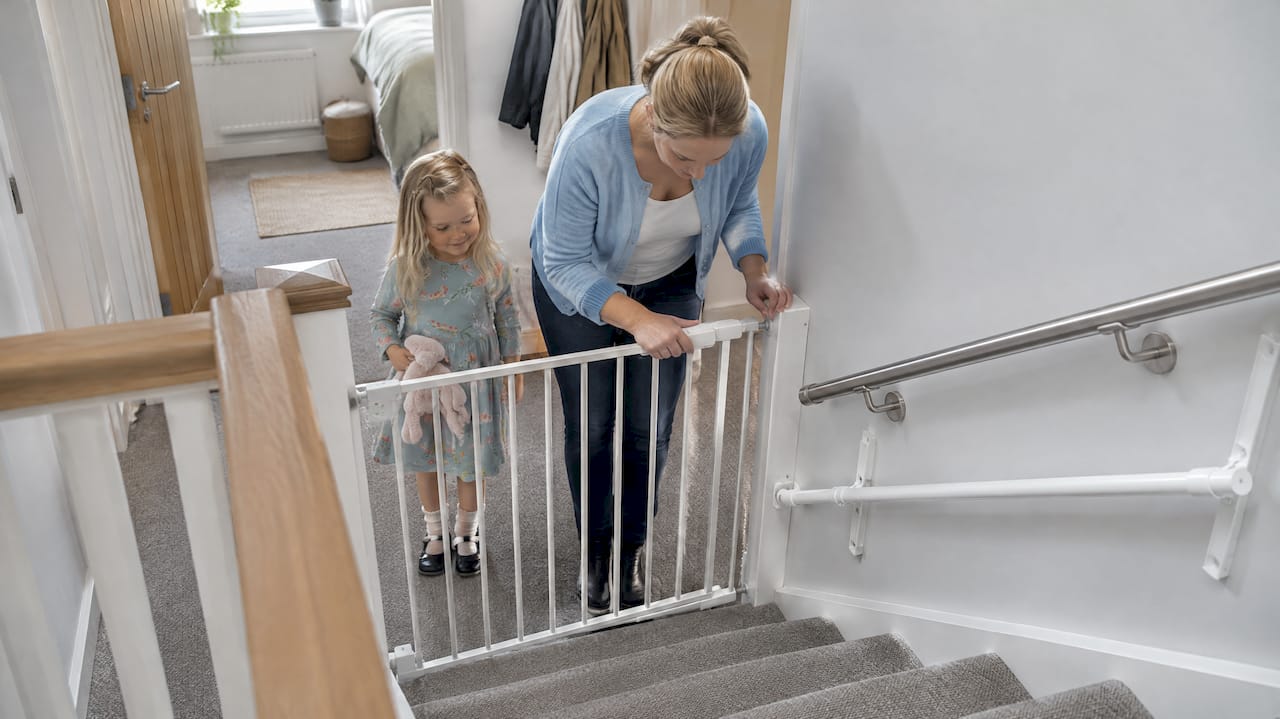
Install secure barriers at the top and bottom of your stairs before your baby becomes mobile. The NHS recommends safety gates at both ends of every staircase, and the AAP points out that babies move faster than adults can react. Fit a hardware-mounted gate at the top, pair it with supervision and simple stair teaching, and consider an adjustable child handrail from KiddieRail as a complementary fix once your toddler starts using the stairs properly.
TL;DR:
- Begin measuring and installing barriers around 4 to 6 months, with fittings ready by 6 months, because mobility can appear without warning.
- A gate held by tension is suitable only at the bottom; choose one with wall cups or a visual indicator confirming secure installation.
- Cover banister openings wider than 6.5 centimeters, and add nonslip treads where hard flooring or worn carpet could cause a slip.
- Keep gates in place until your child is at least 2 years old, and inspect every fitting monthly and after each new mobility milestone.
- During supervised practice, teach your baby to descend backward, feet first, and keep baby walkers away from stairs because they are linked to serious falls.
Table of Contents
- When should you start babyproofing stairs?
- Why stairs are risky and what safety standards cover
- How to babyproof stairs properly
- A quick checklist for babyproofing your stairs today
- Teaching your baby to use stairs safely
- Common mistakes parents make with stair safety
- How a child-height handrail complements your stair gates
- What actually matters most when babyproofing stairs
- Give your toddler a handrail built for their height
- FAQ
- Sources
When should you start babyproofing stairs?
Preparation works best when it happens before your baby needs it. Most guidance points to starting around 4 to 6 months, with gates and barriers fully installed by about 6 months, since that is when rolling, scooting and early crawling can appear with little warning, according to BabyCenter.
Between 7 and 12 months, development moves quickly. A baby who was only rolling at 7 months can be pulling up on furniture and cruising along the sofa by 9 months, and stair climbing often follows soon after. Mobility tends to outpace judgement at this stage, which is exactly why stairs catch so many families off guard.
The reasoning behind early preparation is straightforward:
- Babies gain mobility skills faster than they gain the judgement to use them safely.
- Waiting until your baby is already crawling leaves no buffer for fitting gates or testing fixes properly.
- Stairs remain a leading cause of injury for small children, according to the AAP.
- Preparing early means fittings get tested and adjusted before they matter most.
Treat the months before crawling as your setup window, not a countdown you can push back.
Why stairs are risky and what safety standards cover
A baby’s speed is the core problem. Children can cover more than three feet in a second once they are mobile, a pace that makes adult reaction time an unreliable safeguard, according to the AAP.
Stairs are consistently flagged as a leading cause of injury in young children, which is why gate standards exist at all rather than being left to individual preference, per the AAP.
In the United States, gates and enclosures are governed by ASTM and CPSC requirements that cover several practical points:
- Push-out force limits, so a gate cannot be forced open by a leaning or pushing child.
- Entrapment prevention, including gap sizes a head or limb could pass through.
- Labelling and installation warnings, particularly for pressure-mounted designs.
- Visual indicators or wall-cup requirements that show when a pressure-fit gate is not properly seated.
These points come from the official CPSC safety standard for gates and enclosures, which revised push-out and installation feedback rules after documented failure cases with pressure-mounted gates. That is also why hardware-mounted gates, screwed into the wall or banister, are the standard recommendation for the top of any staircase. A pressure-mounted gate relies on tension alone, and a determined push from a toddler at the top of the stairs is a genuinely dangerous place for a fitting to fail.
How to babyproof stairs properly
Start by measuring the opening. Standard gates fit typical openings of moderate width, and anything wider needs an extension panel or a custom-fit barrier rather than a stretched, less secure fit.
- Measure the full width of the stair opening, including any uneven wall surfaces or banister posts.
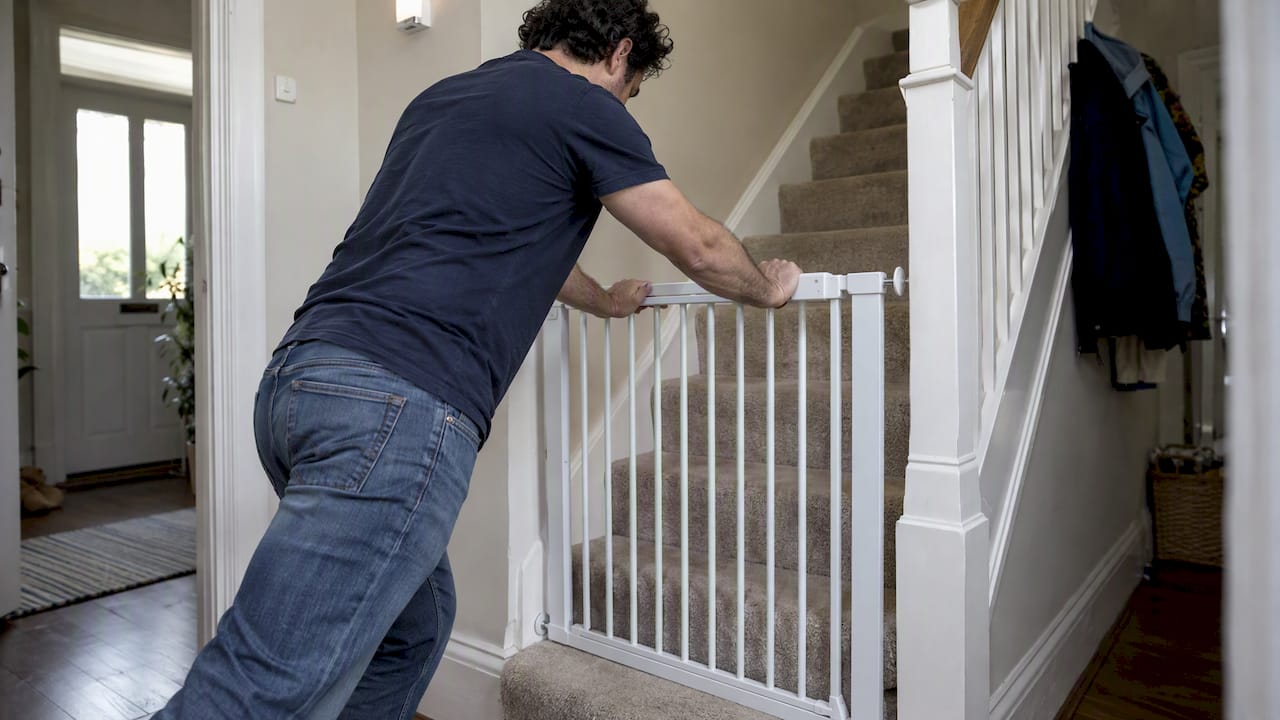
- Choose a hardware-mounted gate for the top of the stairs. This is not optional: a fixed, screwed-in gate removes the push-out risk that pressure fittings carry.
- A pressure-mounted gate is acceptable at the bottom of the stairs, where a fall has nowhere to go, but check it includes the wall-cup or visual indicator features required for proper installation feedback.
- For wide or oddly shaped openings, use extension panels or a custom mesh fit rather than squeezing a standard gate into a gap it was not designed for, as recommended by Wren.
- Check banister and baluster gaps. The NHS advises covering any gap wider than 6.5 centimetres with mesh, boards or specialist netting, since that is wide enough for a small head to pass through.
- Add non-slip runners or nosing strips to each step, particularly on hard flooring or carpeted stairs with worn patches.
- Improve lighting at both ends of the staircase and clear loose items, shoes or toys that create trip hazards.
- If you rent, look for tension-free, no-drill mounting kits designed for rental properties, but keep hardware-mounted fittings for the top of the stairs regardless of tenancy status.
If you have a particularly wide or irregular staircase, our guide to fitting gates on wide stairs walks through panel combinations in more detail, and our apartment stair safety guide covers rental-friendly fixes for flats and shared buildings. While you are checking the staircase, it is worth glancing at window coverings and blind cords nearby, since loose cords near a stairwell landing are another common hazard; a window safety consultation can address that at the same time.
Pro Tip: Test any gate by leaning your own body weight against it before trusting it with your baby, hardware-mounted fittings included.
A quick checklist for babyproofing your stairs today
A fast, structured sweep gets the basics covered in one sitting rather than spread across several half-finished weekends.
- Spend two minutes walking the staircase top to bottom, clearing shoes, toys, loose rugs and anything that could become a trip hazard, a routine recommended by Consumer Reports.
- Check every banister gap against the 6.5 centimetre rule and cover any that fail.
- Measure the top and bottom openings precisely before buying a gate.
- Fit a hardware-mounted gate at the top of the stairs and a hardware-mounted or properly fitted pressure gate at the bottom.
- Add non-slip treads or runners if the stairs are bare wood, tile or worn carpet.
- Fit banister guards or mesh if gaps or low rails are a concern.
- Re-check every fitting monthly, and again at each new mobility milestone, pulling and pushing to confirm nothing has loosened.
Our broader babyproofing checklist for 2026 covers the rest of the home if you want to tackle stairs alongside other rooms in one pass.
Teaching your baby to use stairs safely
Gates buy time, not skill. Once your baby is reliably crawling, supervised practice helps them learn how stairs actually work, which matters for the years after the gates eventually come down.
- Teach backwards descent first: guide your baby to turn around and climb down on their stomach, feet first, rather than facing forward.
- Practise hand-hold climbing on a few steps at a time, always within arm’s reach.
- Never leave a gated staircase unsupervised, even briefly, while a gate is open for practice.
- Keep practice sessions short and end them before your baby gets tired or frustrated.
- Avoid baby walkers near stairs entirely; they are linked to serious stair falls, per Healthychildren.
Keep gates in place well beyond early toddlerhood. The NHS recommends continuing to use stair gates until your child is at least two years old, even once they can climb competently, since judgement about speed and safe footing takes longer to develop than the physical skill itself.
Common mistakes parents make with stair safety
The most frequent error is fitting a pressure-mounted gate at the top of the stairs, where a push-out failure has the worst possible consequences.
- Never use a pressure-mounted gate at the top of a staircase. Use hardware mounted securely into wall studs instead.
- Avoid propping gates open “just for a minute”; a gate that is not latched offers no protection at all.
- Do not let children learn to climb over a closed gate. Always open it properly so that climbing a barrier never becomes a learned habit, a point echoed in BabyCenter’s guidance.
- Treat rental-friendly, no-drill gates as a short-term fix, and move to a hardware-mounted fitting as soon as your tenancy or circumstances allow.
Pro Tip: If a gate ever feels loose when you lean on it, stop using it until it is refitted, even if that means a day without a top gate while you sort it.
How a child-height handrail complements your stair gates
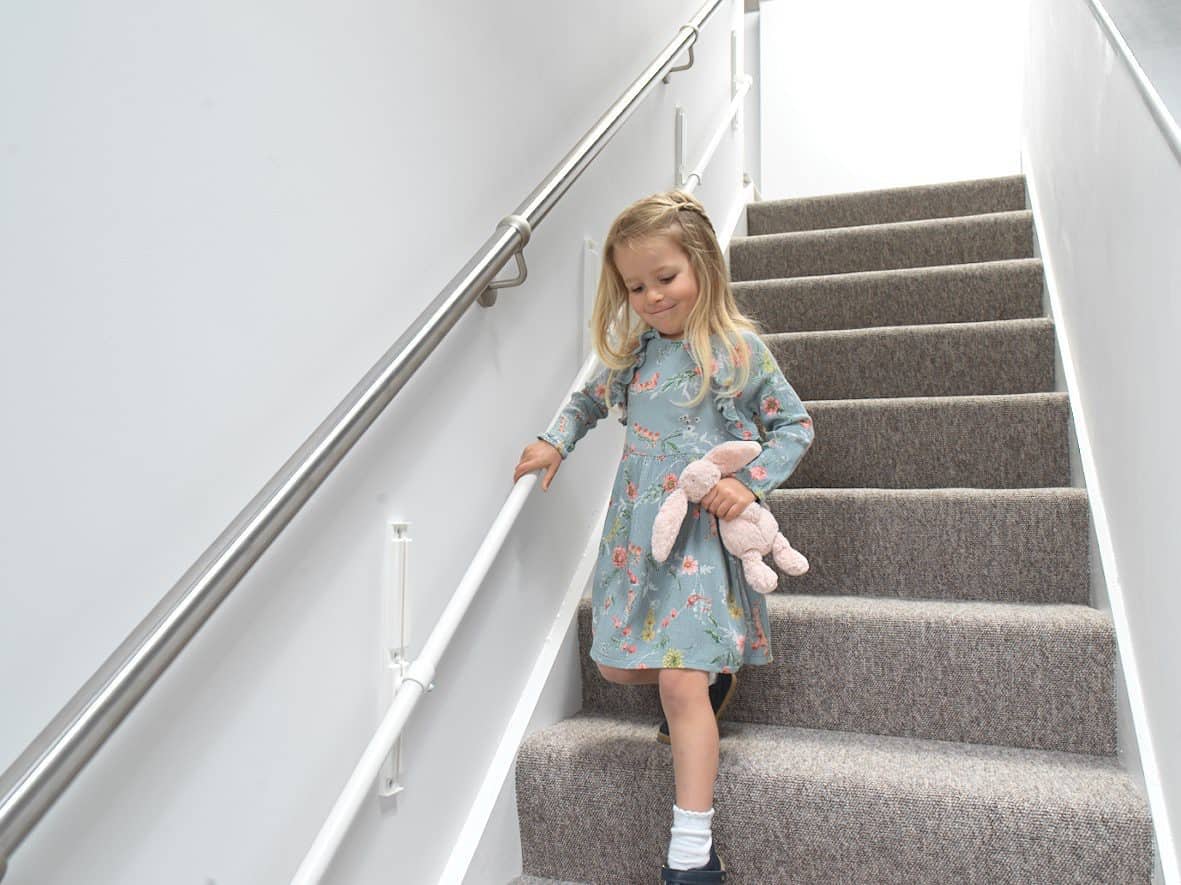
Gates handle the years before your child can manage stairs independently. A child-height handrail picks up where gates leave off, once your toddler is using the stairs under supervision but still needs something their own height to hold.
A standard handrail is fitted for adult height, which means most toddlers cannot reach it at all. The KiddieRail Adjustable Child Stair Handrail fits below the existing rail and adjusts as your child grows, so it stays useful for years rather than being outgrown in months. We built it to be tested for durability, so it holds up to daily use on a busy family staircase.
- It fits beneath a standard handrail on most staircase layouts without altering the existing rail.
- It adjusts in height, so the same rail supports a child from early walking through to confident climbing.
- It gives a toddler something to actively hold onto while walking stairs, rather than only acting as a barrier.
- It works alongside hardware-mounted gates rather than replacing them, supporting the stage after gates come down.
During supervised practice sessions, a rail at the right height lets a toddler steady themselves with their own hand rather than gripping an adult’s fingers or the vertical balusters.
What actually matters most when babyproofing stairs
Most stair safety advice focuses heavily on gate selection, and for good reason, but it often skips the part that matters just as much: timing. Parents frequently start shopping for gates only after their baby has already started pulling up on furniture, which leaves little room to measure properly, test fittings, or fix a wonky banister gap before it becomes urgent.
The conventional advice also tends to treat gates as the whole solution. They are not. A gate that stays shut is a barrier, not a teacher, and a child who spends a year behind one without ever practising a step under supervision is not actually safer once the gate comes down, just safer for longer. The families who handle this well do two things at once from the start: they fit hardware-mounted gates early, and they treat supervised stair practice as a regular, unremarkable part of the week rather than a milestone to dread.
If you take one thing from this: prepare the stairs before your baby needs it, not after.
— Paul
Give your toddler a handrail built for their height
Gates protect your baby before they can climb. The KiddieRail Adjustable Child Stair Handrail picks up afterwards, giving your toddler a rail they can actually reach and grip as they learn to manage stairs under your supervision. It fits below your existing handrail and adjusts as your child grows, so one purchase covers several years of use.
- Browse the full KiddieRail shop for the adjustable handrail and accessories.
- Add an Extension Pack, priced between £24.99 and £36.99, if your staircase needs extra length.
- Check our guide to childproofing stairs properly for fitting advice before you buy.
FAQ
When should a baby start crawling up stairs?
There is no fixed age, since crawling and early climbing attempts can begin anywhere from around 7 months depending on the child. That is why preparation should happen earlier, around 4 to 6 months, so barriers are already in place before any attempt happens, per BabyCenter.
How do I baby proof for a crawling baby?
Fit a hardware-mounted gate at the top of the stairs and a secure gate at the bottom, check banister gaps against the 6.5 centimetre guideline, and clear loose rugs or trip hazards from every step, as recommended by the NHS. Add non-slip treads and improve lighting at both ends of the staircase while you are at it.
How can I babyproof my stairs?
Measure the stair opening, choose a hardware-mounted gate for the top, and use a pressure-mounted gate only at the bottom if it meets the wall-cup and labelling requirements set out by the CPSC. Cover wide banister gaps, add non-slip runners, and keep the gates in place until your child is at least two years old.
Is it a problem if a baby doesn’t crawl before walking?
Not every baby crawls before walking, and skipping crawling is not generally a safety concern on its own. What matters for stair safety is readiness, not the exact sequence of movement milestones, so gates and barriers should be in place by around 6 months regardless of whether your baby crawled first.
Sources
- Baby and toddler safety | NHS
- When should I put up safety gates to protect my baby? | BabyCenter
- Safety pitfalls: Stairs are a leading cause of … | AAP News
- Final rule: Safety standard for gates and enclosures | CPSC
- Babyproofing checklist | Consumer Reports


