
Currently Empty: £0.00


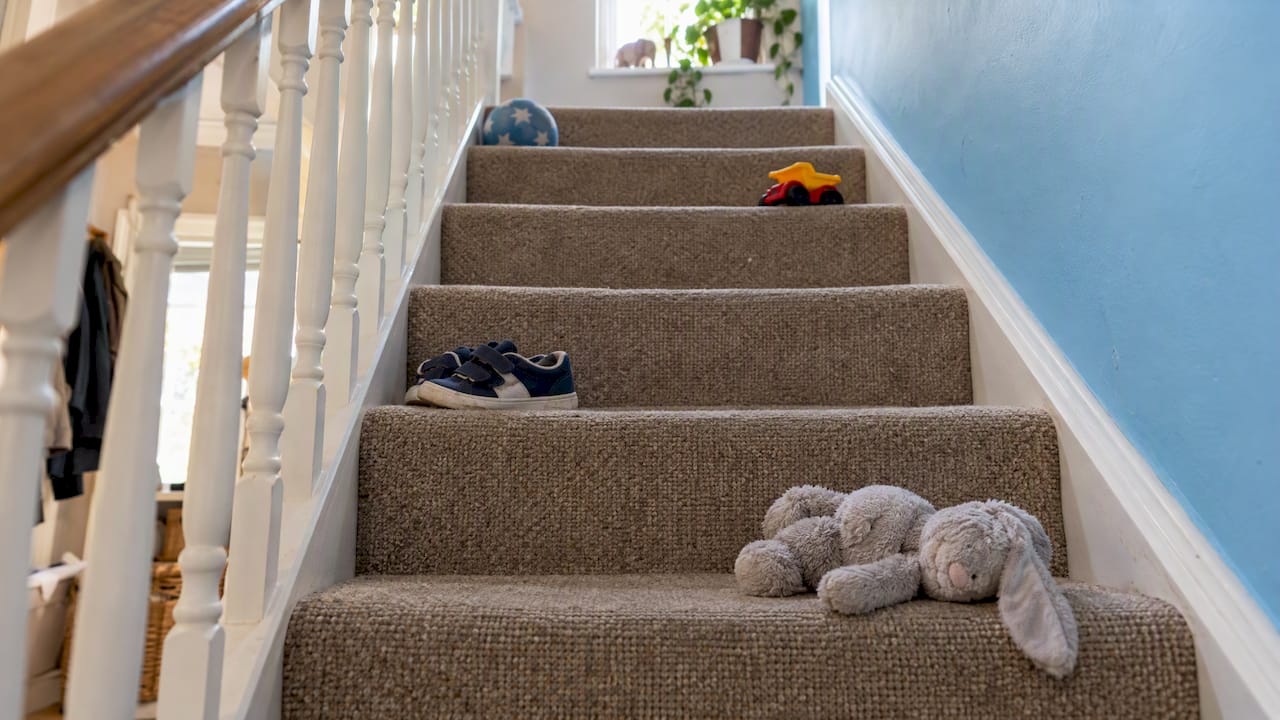
Keep every step and landing completely clear, every day, and keep it that way as a household habit. Toys, shoes, laundry piles and “I’ll carry it up later” items are the usual culprits, and a toddler has little ability to see them, judge them or recover when a foot lands on one. This guide covers what to take off the stairs, how to handle seasonal garlands, what else makes a staircase safer, and what to do if a fall happens anyway.
TL;DR
- Stairs are a common place for serious falls in toddlers, and UK safety guidance lists toys, shoes and other clutter as things to remove. (RoSPA)
- Clear the steps, the landings and the floor at the top and bottom, and set up a “stair basket” so nothing is left on a step overnight.
- Do not wrap garlands or light strands around a banister in a home with a young child. Hang decorations where small hands cannot pull them down.
- Clutter control works alongside gates at the top and bottom, good lighting, sound carpet and a handrail the child can actually reach.
- After a fall, check the child carefully and get medical help if you are worried or see warning signs (listed below).
Table of Contents
- Why clutter on stairs matters so much for toddlers
- What to keep off stairs and landings
- A five-minute stair routine that actually sticks
- Stair garlands and seasonal decorations
- What else makes a staircase safer
- Perspective: why we think the handrail matters as much as the tidy-up
- Teaching your toddler to use stairs safely
- Alternatives when a gate is not an option
- Our child stair handrail
- If your toddler falls down the stairs
- Where to go next
- FAQ
- Sources
Why clutter on stairs matters so much for toddlers
An adult walking downstairs with a pair of shoes on the third step simply steps around them. A toddler is shorter, has a higher centre of gravity for their size, is still learning to place each foot and is usually looking at something other than their feet. A small object on a tread can mean a trip, a slip, or a grab at the nearest thing for balance, which may be a loose item rather than something fixed.
The official advice is consistent across countries. Ireland’s Health Service Executive says stairs are one of the most common causes of falls in children and recommends keeping steps and staircases clear. In the UK, RoSPA says stairs are a common location for serious falls in toddlers and young children and recommends removing toys, shoes and other clutter, repairing worn coverings, securing handrails and keeping stairs well lit. Ottawa Public Health gives much the same list: well lit, free of clutter and tripping hazards, no play on stairs, secure handrails, and an adult close by while children are learning.
None of this is complicated. The difficulty is that stairs are the natural resting place for things that belong upstairs or downstairs, and a busy household drifts into using them that way.
What to keep off stairs and landings
Walk your staircase as if you were 90 cm tall. Look at every tread, the landing, and the first and last metre of floor at each end. Then clear the following.
Toys and children’s belongings
This is the obvious one. Nationwide Children’s Hospital’s stair safety guidance says stairs should be kept free of clutter and in good repair and tells children to keep toys off the stairs, not to play or jump on them, and to ask an adult for help carrying things up or down. A two-year-old will not grasp that yet, so the adult has to run the system: toys go back to a box in the room where they live.
Shoes, bags and “going up” piles
Shoes are a classic hazard because they are hard, uneven and often left in pairs on the step nearest the door. Bags with trailing straps are worse. Give shoes a shelf or rack at the bottom, and hang bags on hooks.
Laundry, post and parcels
A basket left on the landing is a trip hazard and a temptation to climb. Take laundry up in a single trip when your hands are free, and open deliveries at the door, not halfway up.
Loose rugs and runners
New York State Health advises keeping stairs clutter-free and securing area rugs to the floor with double-sided tape to reduce tripping. The same logic applies to the landing mat at the top of the stairs: if it can slide, fix it or remove it.
Worn or loose coverings
A frayed carpet edge or a loose stair rod behaves like clutter, because it catches a toes or slides under a foot. RoSPA specifically lists repairing worn coverings.
Anything at the very top and bottom
A gate is only as safe as the floor around it. Do not leave a toy box, pushchair or laundry bag right at the gate, as it gives a toddler something to climb on or trips an adult who is carrying a child.
A five-minute stair routine that actually sticks
The trick is to make clearing the stairs part of a habit you already have.
- Use a stair basket. Keep one at the bottom for items going up and one at the top for items going down. Anything found on a step goes into the basket, not onto the next step.
- Do a sweep at bedtime. Take the last two minutes of tidying to walk up and down once, with the light on, looking at each tread.
- Carry less, more often. One trip with free hands beats a tower of laundry that blocks your view. RoSPA’s advice is to use the handrail and keep one hand free when carrying a child, and the same goes for you with a load.
- Give everyone a job. Older children can be the “basket monitors”. It turns a rule into a game.
- Brief visitors. Grandparents, friends and babysitters are the people most likely to leave a bag on the bottom step. A quick word at the door helps. Our advice for grandparents looking after children on stairs is a handy page to share.
If you live in a flat, the same sweep applies to communal stairs and your own hallway. Our guide to a two-minute stair sweep and top gate fixes for apartments covers the specifics.
Stair garlands and seasonal decorations
Garlands are the clutter that looks like a feature. Evergreen swags, ribbon and fairy lights wound around a banister are a seasonal tradition in many British homes, and they turn the one part of the stairs a toddler is supposed to hold into something to pull, chew or tangle in.
The cautious approach for a home with a child aged three or younger is to avoid wrapping boughs, garlands or light strands around the stair railing or banister. If you want something on the stairs, individual durable bows tied securely on the side facing away from the steps are a safer alternative than a continuous strand.
A few practical points:
- Keep the handrail free. A child learning stairs needs to be able to grip the rail along its full length. Anything wound around it defeats the purpose.
- Keep lights out of reach. The American Academy of Pediatrics advises keeping lights, sharp and breakable decorations and small-part items out of young children’s reach and securing battery compartments. A trailing cable on a staircase is both a trip hazard and a pulling hazard.
- Move the display, not the safety. A mantelpiece, a high shelf or the wall above the stairs works better than the banister. If you like a handmade look, child-friendly Christmas tree decorations with dull points and food-safe finishes are a gentler choice for the lower branches, away from the staircase.
- Take it down on time. Dry greenery sheds needles that make treads slippery, so sweep daily while it is up.
What else makes a staircase safer
Clutter control is the cheapest layer of protection, but it is only one layer. The other layers are well documented.
Gates at the top and bottom
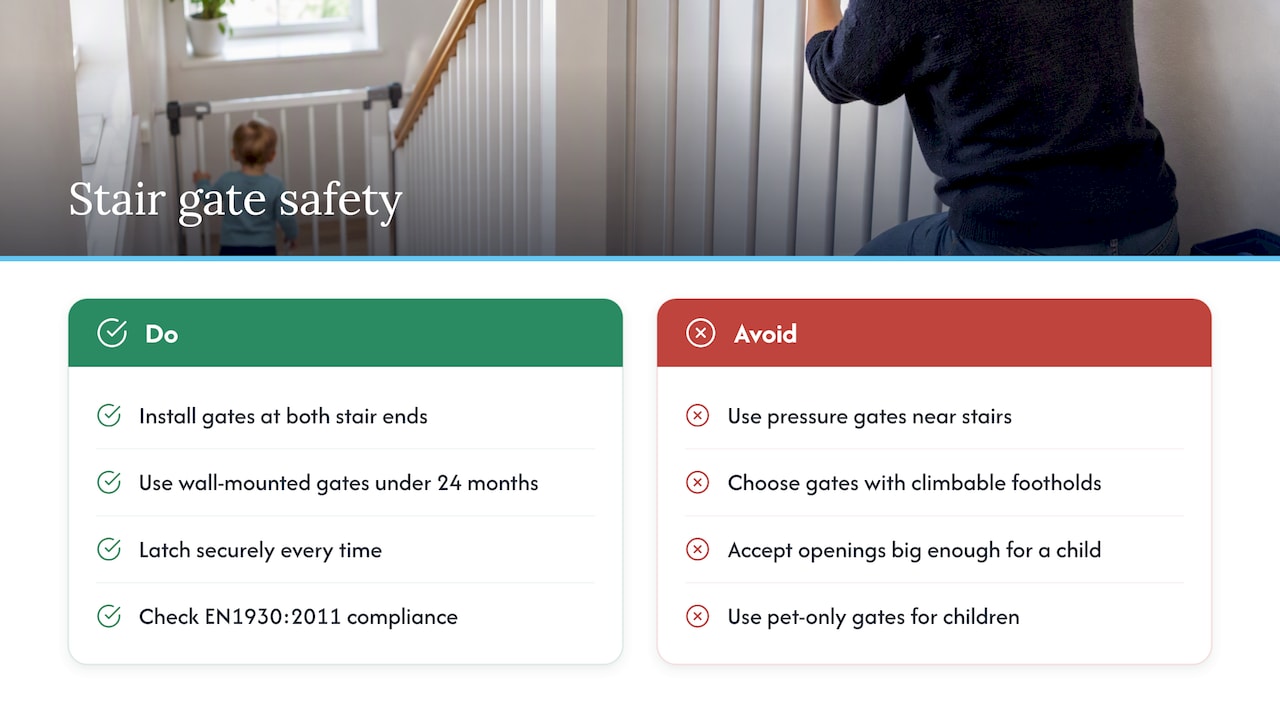
RoSPA recommends installing safety gates at both the top and bottom of the stairs before a baby becomes mobile. For children under 24 months it recommends wall-mounted gates and checking that a gate complies with EN1930:2011. Nemours KidsHealth gives similar advice: hardware-mounted gates at the top and bottom of every stairway.
Health Canada adds some useful cautions. It says gates are intended for children from 6 through 24 months, that some pressure-mounted gates are not designed for use near stairs, and that caregivers must follow the manufacturer’s instructions and latch the gate securely every time. It also warns against gates with climbable footholds or openings big enough for a child’s head or body, and says pet-only gates should not be used as child gates. If your staircase is wide or awkwardly shaped, see our guide to fitting a secure gate to wide stairs with panels and a child rail.
Light
Poorly lit stairs hide the very clutter you are trying to remove. Ottawa Public Health and RoSPA both recommend keeping stairs well lit. A night light on the landing, or lighting that comes on automatically, helps during night-time trips. If you are planning an upgrade, these stair lighting ideas that avoid rewiring show what is possible without a big job.
Sound treads and coverings
Slippery treads, worn carpet and loose edges are all hazards. Make sure carpet is tight, rods are secure and any polished or painted wood has a grip strip or runner that is firmly fixed.
A handrail at the right height
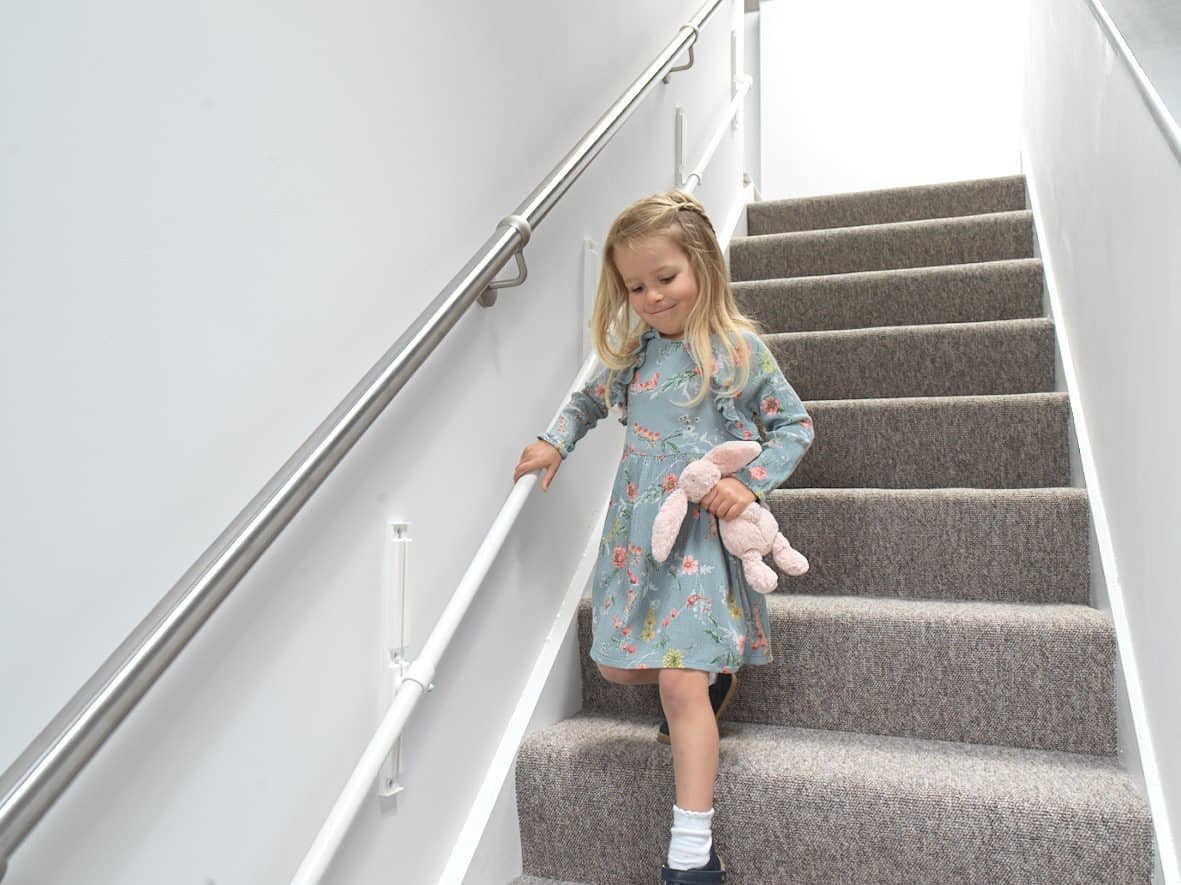
This is the one most families overlook. A standard handrail sits at adult height, well above a toddler’s shoulder. The Rhode Island health department tells parents to teach children to hold the handrail, but a child cannot hold something they cannot reach. This is the gap that a lower child-height rail fills.
Perspective: why we think the handrail matters as much as the tidy-up
We make a child-height stair handrail, so you would expect us to say this, but it comes from watching how families use their stairs. Tidying is vital, and we would never suggest a rail replaces it. But even in the tidiest house a toddler will sometimes be on the stairs, and the question is what they can hold when they are.
Gates keep a child off the stairs. They do not help the child who is ready to practise climbing, and they do not help the three-year-old who has outgrown the gate but still cannot reach the adult rail. A rail set at the child’s own height gives them something to grip at the moment they need it, and because ours adjusts, it moves up as they grow instead of being replaced.
Our honest advice is to layer: clear stairs, good light, gates while the child is small, a reachable handrail while they learn, and an adult close by. Take away any one of them and the others have to work harder.
— Paul
Teaching your toddler to use stairs safely
A clear staircase is the stage; teaching is the performance. Nationwide Children’s Hospital treats teaching as part of prevention: children need explicit rules about handrails, carrying things, toys, jumping and asking for help. Keep these rules short and repeat them every time.
- Free hand for the rail. Teach children to keep one hand free for the handrail. That means they do not carry toys while climbing.
- Ask for help to carry. “Shall we ask Mummy to carry it?” becomes habit if you always ask the same way.
- Walk, do not run or jump. Rhode Island’s guidance says children should not run or play on stairs.
- Go backwards on the way down at first. The same department says children learning to crawl or walk should be taught to descend backwards, with an adult holding their hand and showing them how to use the rail.
- Slow and steady. HSE says that when a child is old enough, you should show them how to climb stairs slowly and safely.
Practise with you right beside them, in daylight, on a clear staircase, and with the gate open only while you are there. Our guide to pairing gates and teaching to make stairs safer in under an hour walks through a simple plan, and the page on signs your child is ready to remove a stair gate helps you judge when to take the next step.
Alternatives when a gate is not an option
Some staircases, especially in older houses or with unusual layouts, do not take a standard gate. Ottawa Public Health suggests locking doors that lead to stairs or using a doorknob cover, and recommends a wall-screwed gate at the top of the stairs while staying close to the child. A closed door at the foot of the stairs is a legitimate answer in a house where the stairs rise from a hallway, provided every adult remembers to shut it.
Whatever you choose, none of these replaces watching a child who is near the stairs.
Our child stair handrail
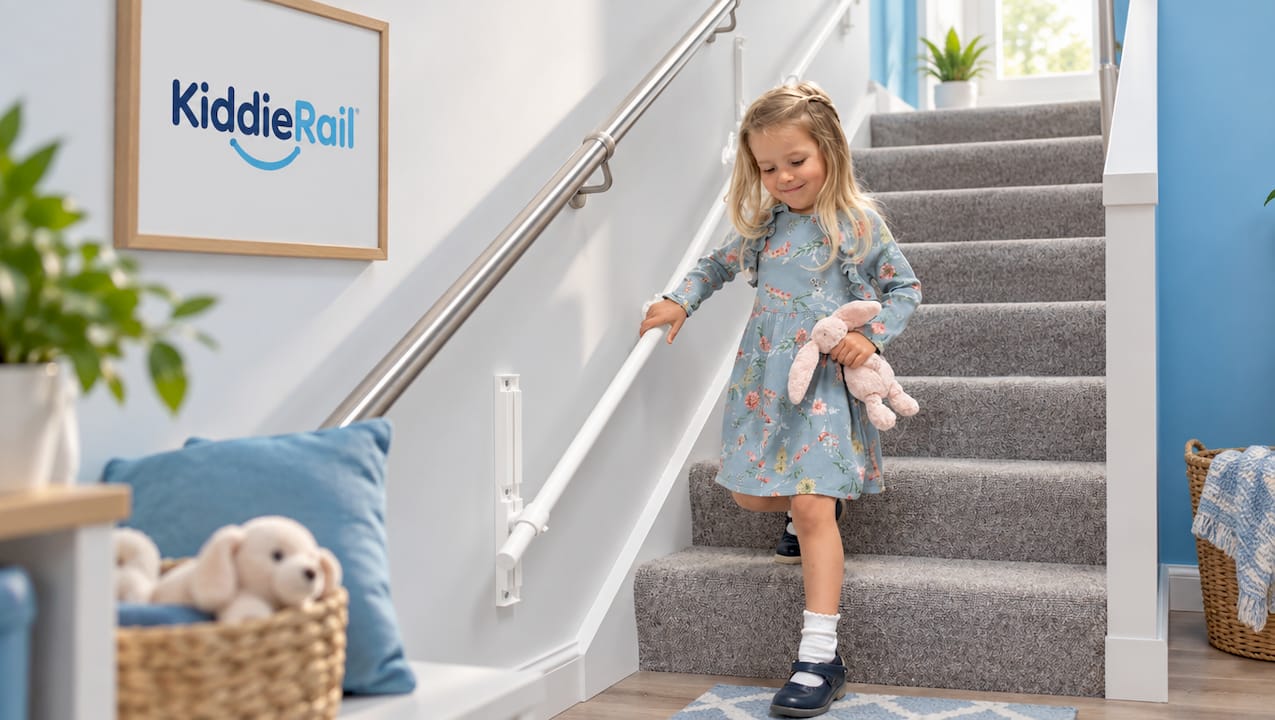
Once the stairs are clear, the rail is the next gap to close. The KiddieRail Adjustable Child Stair Handrail fits below a standard handrail, adjusts as your child grows, suits any home staircase layout and is designed for straightforward self-installation. It has been tested for durability. If your staircase is longer or has turns, the KiddieRail Extension Pack is priced from £24.99 to £36.99, one-off. You can see the full range in the shop. Childminders can read how it works in a group setting on our stair handrails for childminders and daycare page.
If your toddler falls down the stairs
First, stay calm and check your child. HSE advises checking for injuries after a fall and taking the child to a GP or injury unit if you are concerned. Signs of a possible fracture include pain and swelling, not using the limb, or an unusual position of the limb. Keep a suspected injured limb still and supported, as Starship Children’s Hospital’s SafeKids guidance advises.
Call emergency services (999 in the UK) straight away after a serious fall if the child:
- was unconscious or cannot be woken
- is vomiting or unusually sleepy
- has trouble breathing
- has bleeding that will not stop, or bleeding from an ear
These are the signs Starship lists as needing immediate emergency help. After a bump to the head, the American Academy of Pediatrics also lists repeated vomiting, unequal pupils, seizures, unusual behaviour or loss of consciousness as reasons for emergency care. If you are unsure, call NHS 111 or your GP for advice rather than waiting.
Where to go next
If you are setting up from scratch, start with the pre-crawling stair checklist and our overview of stair safety for toddlers. For the wider picture, see our advice on child safety on stairs for UK parents and essential child stair safety advice.
FAQ
What is the number one cause of stair accidents with toddlers?
There is rarely a single cause, but the common ones are trips on objects left on steps, slips on worn or slippery treads, poor lighting, and children being on the stairs unsupervised. Clear stairs, secure coverings, good light and a close adult address most of these. RoSPA lists clutter, worn coverings, loose handrails and poor lighting together in its advice.
Can I decorate the banister at Christmas with a toddler in the house?
It is safest not to wrap garlands or lights around the banister or handrail. A toddler needs the rail clear to hold, and strands can be pulled or chewed. Hang decorations on a wall or a high shelf instead, or tie a few sturdy bows on the side facing away from the steps.
What can I use instead of a stair gate?
A door that stays closed or locked, or a doorknob cover, can keep a toddler away from the stairs. Ottawa Public Health also suggests a wall-screwed gate at the top and staying close to the child. Whichever you choose, your own supervision matters more than any one product.
How do I stop my toddler playing on the stairs?
Make the rule simple and consistent: stairs are for going up and down, not for playing. Keep toys off the steps so there is no reason to stop there, and practise climbing together with an adult beside the child. Gates at the top and bottom help while the child is still learning.
Sources
- RoSPA: Preventing Falls in Children
- HSE: Preventing falls in toddlers and children (1 to 5 years old)
- Ottawa Public Health: Child Falls
- New York State Health: Fall Prevention for Children
- Rhode Island Department of Health: Childhood Falls Prevention, Information for Parents
- Nationwide Children’s Hospital: Stair Safety
- Nemours KidsHealth: Preventing Injuries From Falling, Climbing, and Grabbing
- Health Canada: Safety gates
- American Academy of Pediatrics: Holiday Decoration Safety
- Simply Smart Living: Safe Holiday Home Decorating Ideas
- Starship Children’s Hospital: Falls, 1 to 2 years
- American Academy of Pediatrics: Concussions in Babies


